July 10, 2026
The Reserve Asset Dilemma in a Fractured World Order
The architecture of global monetary trust does not collapse overnight. It erodes gradually, through accumulating decisions, shifting incentives, and the slow recognition among sovereign actors that the rules of the system are no longer applied equally. That erosion is precisely what is driving one of the most significant structural shifts in global finance today: the migration of central bank reserves away from U.S. Treasuries and toward physical gold as the world's preferred neutral reserve asset amid U.S. sanctions.
Understanding why this shift is happening requires looking beyond gold's commodity characteristics and examining it instead through a geopolitical and monetary systems lens. Furthermore, the role of gold in the monetary system has evolved dramatically, making this an essential framework for any serious investor or policymaker.
When big ASX news breaks, our subscribers know first
How U.S. Treasuries Became the World's Default Reserve Asset
After the collapse of Bretton Woods in 1971 and the closing of the gold window, the U.S. dollar assumed an extraordinary role: it became the world's primary store of value for international trade settlement. U.S. Treasuries, backed by the deepest and most liquid sovereign debt market ever created, offered foreign central banks a reliable, high-capacity place to park reserves accumulated through trade surpluses.
However, this arrangement carried an embedded cost. For the world to accumulate dollar-denominated reserves, the United States had to run persistent current account deficits, essentially exporting financial claims on itself in exchange for goods and services produced elsewhere. This is the structural bargain that underpinned post-war globalisation, and it is also the mechanism that gradually hollowed out American industrial capacity.
The Implicit Contract and Its Fracturing
The system functioned as long as three conditions held: the dollar remained genuinely neutral as a settlement medium, the U.S. maintained fiscal credibility, and geopolitical trust between major trading blocs remained intact. All three conditions are now under significant strain.
Fiscal dominance — the tendency for monetary policy to be subordinated to sovereign debt management — has become a structural feature of the U.S. economy rather than a cyclical aberration. Meanwhile, the deployment of dollar-denominated financial infrastructure as a coercive geopolitical tool has fundamentally altered how foreign sovereigns assess the risk of holding U.S. assets.
What Happens When a Reserve Asset Becomes a Weapon
The concept of financial weaponisation is more precise than it might appear. A sanction is not simply a foreign policy gesture. At its core, it is a mechanism that increases the friction associated with using the dollar or U.S. Treasuries as neutral reserve assets. By deciding which entities are permitted to hold, transfer, or settle in U.S. financial instruments, sanctions effectively function as a structural tax on the dollar's core value proposition.
Every new designation on the U.S. Treasury's OFAC sanctions list narrows the universe of permissible counterparties in the dollar system. From the perspective of a sovereign wealth manager in a non-aligned nation, this creates a measurable and growing risk premium attached to dollar-denominated assets that simply does not exist for physical gold.
The 2014 Inflection Point
The phase shift in central bank reserve strategy can be traced to 2014, when large-scale financial sanctions were first deployed against Russia following the annexation of Crimea. This marked the moment when reserve diversification away from dollars became strategic policy rather than theoretical portfolio management. Consequently, the global monetary shift that followed has reshaped how sovereign wealth managers approach risk.
The subsequent timeline charts an accelerating trajectory:
- 2014: Initial Russia sanctions trigger the earliest wave of deliberate central bank gold accumulation among non-Western sovereigns.
- 2022: The freezing of more than $300 billion in Russian sovereign foreign reserves following the Ukraine conflict represents an unprecedented use of dollar infrastructure as a coercive instrument. Central bank gold purchases surged to multi-decade highs in the aftermath.
- 2023–2025: China's holdings of U.S. Treasuries declined to their lowest levels since 2008, while BRICS+ member states accelerated reserve rebalancing toward gold at scale.
Once the sanctions mechanism is activated at sovereign scale, it is structurally difficult to reverse. Like deficit spending enabled by a printing press, each new use of the tool makes the next application more likely and the credibility cost of withdrawal higher.
Gold's Structural Ascent: The 2025 Crossover
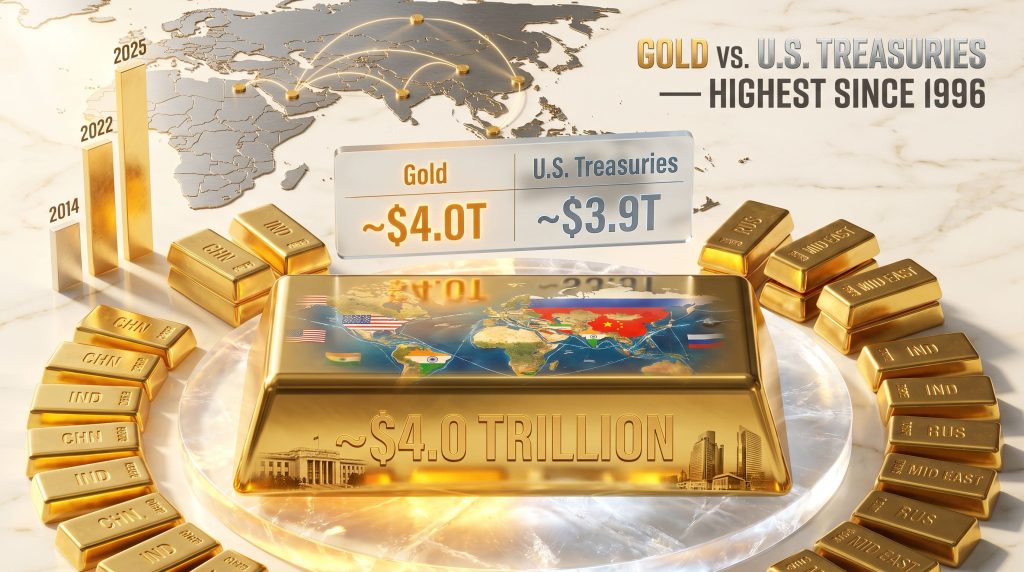
By 2025, global central bank gold reserves are estimated to have crossed approximately $4.0 trillion, surpassing foreign-held U.S. Treasuries at roughly $3.9 trillion. This represents the first time since 1996 that gold has led in share of official global reserves, now accounting for approximately 19% of total holdings — the highest proportion in the modern records era.
| Metric | Gold | U.S. Treasuries |
|---|---|---|
| Estimated Central Bank Holdings (2025) | ~$4.0 trillion | ~$3.9 trillion |
| Share of Official Global Reserves | ~19% (highest in modern era) | Declining from post-GFC peak |
| Last Time Gold Led | 1996 | N/A |
| Primary Buyers (2023–2025) | China, Russia, India, Middle East | Declining foreign demand |
| Seizure or Freeze Risk | Zero (physical) | High (U.S. custodial systems) |
The structural explanation for this shift is straightforward. Physical gold held in sovereign vaults requires no custodian within U.S. financial infrastructure. It carries no counterparty risk, no permission dependency, and no exposure to executive order. It cannot be frozen by any external sovereign authority. These properties, long considered secondary to gold's commodity characteristics, have become its primary investment thesis in the current environment.
Why Plotting Sanctions Volume Against Gold Prices Matters
There is a compelling analytical framework worth constructing: mapping the cumulative volume of U.S. Treasury OFAC sanctions designations over time against the long-run gold price appreciation curve. The intuition is that each new sanction represents an incremental degradation of dollar neutrality, and that degradation is capitalised into gold's price as displaced reserve demand. According to Sprott's analysis, this dynamic is now a defining feature of global reserve strategy.
Once sovereign actors observe that dollar-denominated assets can be frozen by executive order, as occurred with Russian foreign reserves in 2022, the risk premium on holding Treasuries rises permanently. Gold, which requires no custodian within U.S. financial infrastructure, absorbs that displaced demand.
The China-specific dimension is particularly significant. When the U.S. sanctioned a senior Chinese official, Beijing responded by enacting its own sanctions-blocking legislation — a watershed moment signalling that China was willing to institutionally confront U.S. financial coercion rather than absorb it quietly.
Gold as a Neutral Trade Settlement Bridge
Beyond reserve management, gold is increasingly discussed in the context of bilateral trade settlement between nations that have no desire to accumulate each other's currencies. Consider the structural problem: two emerging-market economies, one exporting energy and one exporting manufactured goods, complete a transaction. Neither party wants to hold a growing position in the other's currency.
Gold, settled via allocated accounts or held in a neutral third-country vault, provides a politically weightless unit of final account. This is not a novel concept historically, but its practical relevance is being rediscovered as the costs of dollar dependence become more visible to sovereign decision-makers.
| Settlement Mechanism | Sanctions Risk | Counterparty Risk | Liquidity | Geopolitical Neutrality |
|---|---|---|---|---|
| U.S. Dollar / Treasuries | High | Low | Very High | Low (post-2022) |
| Yuan / RMB | Low-Medium | Medium | Growing | Moderate |
| Stablecoins (USD-pegged) | Medium-High | Medium | High | Low |
| Physical Gold | Very Low | None | Moderate | Very High |
| Gold-Backed Settlement Instruments | Low | Low | Emerging | High |
Nobody objects when gold appreciates against all other currencies simultaneously. Its appreciation redistributes gains without creating the zero-sum political tensions that accompany currency movements. In addition, this property makes it uniquely suited to multilateral trade settlement in a world where trust in any single nation's financial infrastructure is degrading.
The Stablecoin Paradox and Dollar Hegemony's Double Edge
The emergence of dollar-pegged stablecoins presents a genuine strategic ambiguity. On one side, widespread adoption of USD stablecoins by global users extends the dollar's transactional reach far beyond what traditional correspondent banking could achieve. On the other, stablecoins inherit the same foundational neutrality problem as Treasuries if they remain subject to unilateral confiscation by U.S. authorities.
The public disclosure that crypto wallets had been confiscated through Treasury enforcement actions sent a clear signal: any asset whose custody can be revoked by sovereign decree carries the same political risk premium as a frozen Treasury account. For a small business owner in Brazil or a trader in Nigeria, the practical question is not ideological — it is operational: where can value be stored that cannot be arbitrarily seized?
Regional Reserve Behaviour: Who Is Actually Diversifying?
- Russia and Iran: Effectively excluded from SWIFT and U.S. Treasury markets, both nations rely on gold for bilateral trade anchoring and reserve accumulation.
- China: Pursuing systematic reduction of Treasury exposure while accelerating domestic gold reserve accumulation and developing alternative payment infrastructure through CIPS.
- India and Brazil: Hedging dollar exposure through gold purchases while maintaining partial integration with the dollar system.
- Middle Eastern Sovereign Wealth Funds: Diversifying into gold as petrodollar recycling volumes decline and energy revenues are redeployed across a broader asset class spectrum.
- Broader Global South: Evaluating Chinese payment rails, including Alipay and CIPS, as functional alternatives, particularly for populations with limited access to formal dollar banking.
The next major ASX story will hit our subscribers first
The U.S. Manufacturing Paradox and the Cost of Reserve Currency Status
There is a profound structural irony embedded in the dollar's reserve role. The very mechanism that gave the U.S. financial dominance required running persistent trade deficits, which over decades transferred industrial capacity to surplus nations. For U.S. Treasuries to serve as the world's neutral settlement asset, there had to be a large and growing supply of them — and that required the U.S. to consistently spend more than it produced.
The industrial and military manufacturing complex that emerged dominant after World War II has been gradually eroded since the gold window closed in 1971. This is not a partisan observation; it is a structural outcome of the bargain the U.S. made to maintain reserve currency status. The central bank influence on gold pricing reflects precisely this long-term structural tension.
A weaker dollar and higher gold prices are not coincidental outcomes of a reindustrialisation strategy — they are mathematically necessary preconditions for it. The capital planning cycle for every major industrial sector is measured in years and decades, far longer than the U.S. political cycle, which makes sustained execution of any reindustrialisation programme structurally difficult.
Long-Term Gold Demand Scenarios Based on Sanctions Trajectory
| Scenario | Sanctions Trajectory | Estimated Central Bank Gold Demand | Gold Price Implication |
|---|---|---|---|
| Base Case | Gradual escalation, limited reversal | 800–1,000 tonnes/year | Structurally supported above current levels |
| Escalation Case | Broad BRICS+ decoupling accelerates | 1,200–1,500 tonnes/year | Significant upside pressure |
| De-escalation Case | Diplomatic reset, sanctions rollback | 400–600 tonnes/year | Demand moderation, floor remains elevated |
Gold's stock-to-flow ratio — the relationship between total above-ground supply and annual new mine production — provides a complementary valuation framework. Unlike most commodities, gold's stock-to-flow ratio is extraordinarily high, meaning annual mine supply represents a small fraction of total existing inventory. This structural scarcity dynamic amplifies the price impact of incremental demand shifts, particularly when that demand originates from large sovereign buyers accumulating at scale.
An Important Caveat: When Gold Trade Itself Becomes a Sanctions Target
Physical gold held in sovereign reserves cannot be frozen by U.S. executive order. However, Executive Order 14068 established specific prohibitions on the importation of gold originating from Russia. This creates an important two-tier dynamic within gold markets: reserve gold, held in sovereign vaults and effectively immune to external seizure, versus trade gold, which is subject to origin-based restrictions when sourced from sanctioned jurisdictions.
This distinction matters for market participants tracking global gold flows. Russian-origin gold has effectively been bifurcated from Western trading infrastructure, redirected instead through non-Western intermediaries and refiners. The attempt to close the gold-based sanctions evasion loophole has not eliminated demand for that gold but has rerouted it, creating pricing and provenance divergences across different market segments. Furthermore, as the IMF's research on reserve assets confirms, these divergences have lasting structural consequences for global liquidity.
The Deglobalisation Inflection and What Comes Next
The broader question of whether peak globalisation has passed is no longer purely theoretical. Supply chain fragmentation, escalating tariff regimes, and the strategic autonomy drives of major powers all point toward a world in which efficiency-maximising trade logic is increasingly subordinated to security and resilience objectives.
In a multipolar reserve system, no single nation's currency can serve as a truly neutral settlement anchor. The U.S. dollar's neutrality has been compromised by its weaponisation. The yuan carries its own geopolitical and capital control risks. In this environment, an asset with no issuer, no counterparty, and a multi-thousand-year store-of-value history occupies a structural niche that no engineered instrument can easily replicate.
Gold's role as a neutral reserve asset amid U.S. sanctions is not a prediction. It is an observation of a process already well underway, visible in central bank purchase data, Treasury holding trends, and the institutional behaviour of sovereign wealth managers across four continents. For those monitoring gold safe-haven demand in particular, the data consistently reinforces this structural shift.
This article is intended for informational and educational purposes only and does not constitute financial advice. All forecasts, scenarios, and price projections referenced are speculative in nature and subject to significant uncertainty. Readers should conduct independent research and consult qualified financial professionals before making investment decisions.
Frequently Asked Questions
Why is gold considered a neutral reserve asset?
Gold carries no counterparty risk, requires no custodian within any single nation's financial infrastructure, and cannot be frozen or seized by external sovereign authority. These properties make it politically neutral in a way that no fiat-denominated instrument can replicate once that instrument's issuer begins using it as a coercive tool.
How do U.S. sanctions increase demand for gold among central banks?
Each sanction designation narrows the universe of entities permitted to hold or settle in U.S. dollar instruments. This functions as an incremental tax on the dollar's neutrality, raising the risk premium for non-aligned sovereigns and redirecting reserve demand toward assets that carry no such political exposure.
Has gold actually surpassed U.S. Treasuries in global central bank reserves?
By 2025 estimates, central bank gold holdings reached approximately $4.0 trillion, marginally exceeding foreign-held U.S. Treasuries at roughly $3.9 trillion. This is the first time gold has led in share of official reserves since 1996.
Can the U.S. sanction gold directly?
The U.S. cannot freeze physical gold held in foreign sovereign vaults. However, it has enacted origin-based restrictions — notably on Russian-origin gold under Executive Order 14068 — creating a two-tier market between reserve gold and trade gold from sanctioned jurisdictions.
What is the relationship between BRICS+ expansion and gold reserve accumulation?
BRICS+ expansion increases the collective economic weight of nations that have strategic incentives to reduce dollar dependency. As membership grows and intra-bloc trade volumes increase, the structural demand for a neutral settlement anchor — currently best served by gold — grows proportionally.
Are stablecoins a viable alternative to gold for non-dollar settlement?
Dollar-pegged stablecoins extend dollar transactional reach but inherit its fundamental neutrality problem. If stablecoin wallets remain subject to confiscation by U.S. authorities, as enforcement actions have demonstrated, they offer no structural improvement over Treasuries for sovereign actors seeking genuine political neutrality.
What would cause the gold-as-neutral-reserve thesis to break down?
A credible and sustained reversal of sanctions policy, combined with a restoration of dollar neutrality and a reduction in U.S. fiscal dominance, could moderate the structural demand thesis. However, the self-reinforcing nature of the sanctions mechanism makes this scenario difficult to execute politically, even if desired by policymakers.
Want to Track the ASX Discoveries Driving the Next Wave of Resource Wealth?
Discovery Alert's proprietary Discovery IQ model delivers real-time alerts on significant ASX mineral discoveries — transforming complex resource data into actionable investment insights the moment they hit the market. Explore historic discoveries and their extraordinary returns, then begin your 14-day free trial at Discovery Alert to position yourself ahead of the broader market.