June 29, 2026
When Commodity Wealth Meets Sovereignty: Understanding Burkina Faso's Development Gamble
Across the Sahel, the relationship between natural resource wealth and sustainable development has historically followed a familiar and disappointing pattern. Commodity revenues flow upward into state budgets, external creditors collect debt service, and poverty persists at the household level. What makes the current moment in Burkina Faso's policy history structurally different is not simply the scale of ambition embedded in its planning documents, but the financing logic underpinning them. For the first time in its modern economic history, the Burkina Faso economic roadmap attempts to build a multi-year development framework that deliberately reduces dependence on external concessional financing and places domestic capital mobilisation at the centre of its growth strategy.
This is not a minor administrative adjustment. It represents a fundamental reorientation of how a low-income, landlocked, conflict-affected economy intends to finance its own transformation over the next five years.
When big ASX news breaks, our subscribers know first
The Architecture of the Burkina Faso Economic Roadmap
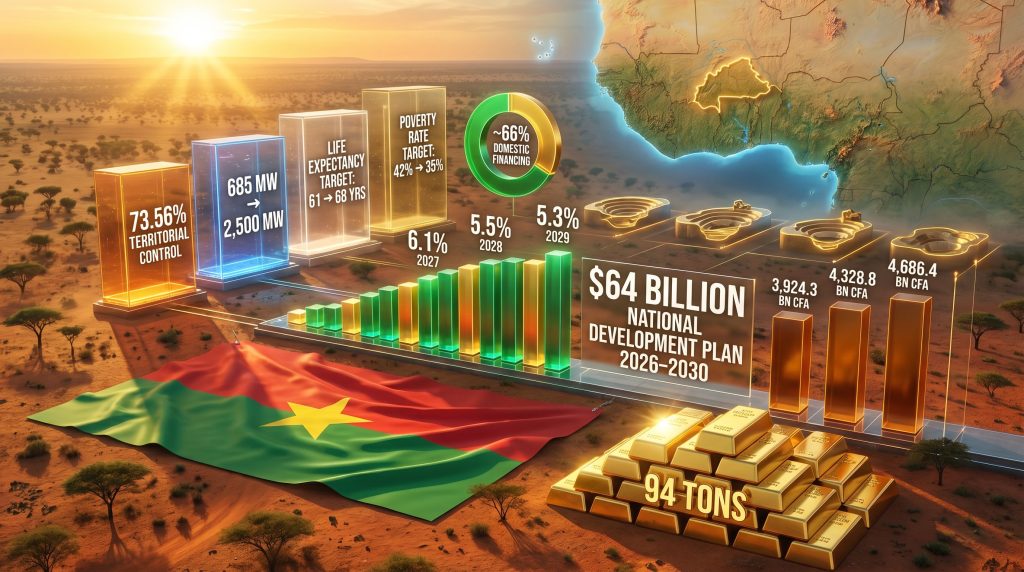
Two documents released together in late April 2026 form the structural backbone of the Burkina Faso economic roadmap. The first is the DPBEP 2027-2029, the country's multi-year budget and economic programming document, approved by the Council of Ministers on 24 April 2026. The second is the National Development Plan covering the 2026-2030 period, estimated at approximately $64 billion in total investment requirements. Read together, these frameworks create an unusually layered policy architecture for a Sahelian economy.
The DPBEP is not simply a budget projection document. Under Burkina Faso's public finance law, it serves as a binding fiscal anchor, establishing revenue, expenditure, and deficit ceilings that ministries must operate within. This transition toward programme-based budgeting — a system in which spending is organised around measurable outcomes rather than line-item allocations — represents one of the more technically significant governance reforms embedded within the broader "Relance" national development programme. According to reporting by Ecofin Agency, the DPBEP was approved by Burkina Faso's Council of Ministers on 24 April 2026.
What Programme-Based Budgeting Actually Changes
For most observers, budget documents are bureaucratic formalities. In the context of Burkina Faso's governance reform agenda, the shift to programme-based budgeting carries direct implications for how public money is tracked, evaluated, and held to account. Under a traditional input-based system, ministries receive allocations and report on spending. Under programme-based budgeting, allocations are tied to specific deliverables and outcome indicators. This creates a feedback mechanism that, when properly implemented, reduces leakage and improves the credibility of multi-year fiscal commitments.
Digitised tax administration operates in parallel as a domestic revenue mobilisation lever. Rather than raising headline tax rates — which would risk suppressing private sector activity in an already constrained credit environment — the government is pursuing a broader tax base through improved compliance, reduced evasion, and formalisation of previously untaxed economic activity.
The Four Pillars Holding the Plan Together
The National Development Plan is organised around four interlocking strategic areas. Each pillar is dependent on the others functioning simultaneously, which is both the plan's structural strength and its most significant vulnerability.
Pillar One: Security as an Economic Precondition
Territorial control is treated within this framework not as a separate defence policy objective but as a foundational economic variable. The logic is straightforward: investment cannot flow into territories where state authority is contested, agricultural activity cannot be sustained in displacement-affected zones, and infrastructure cannot be built where security cannot be guaranteed.
Progress on this dimension has been measurable. Territorial control expanded from approximately 69% in 2023 to 73.56% by late 2025, according to available tracking data. The remaining gap, however, carries disproportionate economic significance. The areas outside state control tend to concentrate in agricultural corridors and mining peripheries — precisely the zones most critical to the revenue and food security assumptions embedded in the plan.
The presence of more than two million internally displaced persons across the country represents a compounding drag on the plan's assumptions. IDPs reduce agricultural labour supply, increase humanitarian expenditure demands on an already stretched public budget, and concentrate poverty in ways that are difficult to address through standard investment-led growth strategies.
Pillar Two: Fiscal Governance and State Reform
The plan's fiscal governance pillar addresses a structural weakness that has historically undermined public investment effectiveness across Sahelian economies: the gap between budgeted expenditure and actual delivered outcomes. Reforms targeting digitised revenue collection, improved treasury management, and programme-based expenditure accountability are designed to close this gap incrementally across the planning horizon. Furthermore, this resource export dependence challenge is not unique to Burkina Faso, with many commodity-driven economies facing similar structural vulnerabilities.
Pillar Three: Human Capital Investment
Burkina Faso's Human Development Index ranking reflects a long-accumulated deficit in education, healthcare, and workforce productivity. The plan sets a specific five-year target: raising average life expectancy from 61 years to 68 years. Achieving a seven-year gain in life expectancy within a single planning cycle requires substantial and sustained investment in primary healthcare infrastructure, maternal and child health services, and disease prevention capacity.
Vocational training and skills development are positioned as the mechanism for industrial diversification, specifically as a pathway out of dependence on raw commodity exports. This is a long-cycle investment: workforce productivity gains from improved education and training typically take a decade or more to fully materialise in productivity statistics.
Pillar Four: Infrastructure and Economic Transformation
The infrastructure pillar carries the most quantitatively ambitious targets in the plan. Electricity generation capacity is targeted to expand from 685 MW to over 2,500 MW, representing a more than threefold increase over five years. This target is foundational to the plan's industrialisation aspirations: without reliable and affordable electricity, domestic manufacturing, processing, and value-added production cannot scale.
Transport connectivity and digital infrastructure development are positioned as enabling conditions for agricultural value chain development, connecting producing regions to processing facilities and export corridors.
Fiscal Projections: Reading the Three-Year Numbers
The DPBEP 2027-2029 establishes a clearly defined fiscal corridor. The numbers tell a story of deliberate consolidation combined with scaled-up investment — a balancing act that depends heavily on revenue growth tracking projections.
Revenue and Expenditure Trajectory
| Fiscal Year | Budget Revenue (CFA Francs) | USD Equivalent (Approx.) | Total Expenditure (CFA Francs) |
|---|---|---|---|
| 2027 | 3,924.3 billion | ~$7.0 billion | 4,543.3 billion |
| 2028 | 4,328.8 billion | ~$7.7 billion | 4,992.2 billion |
| 2029 | 4,686.4 billion | ~$8.4 billion | 5,403.6 billion |
Deficit and Growth Projections
| Fiscal Year | Deficit (% of GDP) | Government Growth Target | IMF Medium-Term Range |
|---|---|---|---|
| 2027 | 2.8% | 6.1% | 4.5-5.0% |
| 2028 | 2.8% | 5.5% | 4.5-5.0% |
| 2029 | 2.9% | 5.3% | 4.5-5.0% |
Fiscal context: The government projects a budget deficit of 2.8% of GDP in both 2027 and 2028, widening marginally to 2.9% in 2029. These figures reflect a deliberate fiscal consolidation path that attempts to maintain macroeconomic discipline while simultaneously scaling up public investment across all four strategic pillars.
The revenue growth trajectory assumes an average annual increase of roughly 9-10% across the three-year period. This rate is achievable if gold export earnings remain elevated and domestic tax administration reforms deliver measurable improvements in collection efficiency. If either assumption underperforms, however, the expenditure growth path creates a widening structural deficit problem.
Per Capita Income: The Gap That Contextualises Everything
Growth rates and fiscal ratios are important. But for understanding what this plan actually means for the lives of ordinary Burkinabe, the per capita income trajectory is the most grounding set of numbers in the framework.
| Year | Nominal GDP per Capita (USD) |
|---|---|
| 2024 | $982 |
| 2025 | $1,127 |
| 2026 | $1,250 |
| 2029 (IMF Projection) | $1,427 |
Even at the IMF's projected $1,427 per capita by 2029, Burkina Faso would remain well below the Sub-Saharan Africa average. This is not a critique of the plan's ambition; it is a reminder of the structural depth of the development challenge being addressed. The IMF's medium-term projections assume sustained gold prices and a meaningful improvement in the security environment, both of which carry non-trivial uncertainty.
The World Bank's poverty reduction projection offers a more granular welfare lens. Poverty is expected to decline by approximately 1.5 percentage points per year, which could lift close to one million Burkinabe out of extreme poverty by 2028. The plan's five-year target is to reduce the overall poverty rate from approximately 42% to 35% — a seven percentage point reduction that demands consistent annual progress across multiple sectors simultaneously.
Gold: The Engine, the Risk, and the Strategic Question
No honest analysis of the Burkina Faso economic roadmap can avoid confronting the centrality of gold. The metal is simultaneously the country's primary export earner, its main fiscal revenue driver, the catalyst for its most significant recent financing decision, and the source of its greatest structural vulnerability. In this respect, understanding gold as a strategic asset provides important context for evaluating whether the plan's financing assumptions are realistic over a five-year horizon.
Gold production surged 47% to 94 tons in 2025, a transformative shift in the country's revenue base. Elevated global gold prices have amplified this effect, boosting not only mining activity but also export earnings, government receipts, and the fiscal space available for social investment. The gold price outlook remains a critical variable: the IMF has noted that rising gold prices represent one of the key positive drivers supporting its improved forecast for Burkina Faso across 2026-2028.
The plan's infrastructure pillar specifically targets domestic gold processing capacity as a mechanism for capturing greater value-added within the national economy. Currently, Burkina Faso exports primarily raw gold concentrates, meaning that refining margins, value-added manufacturing linkages, and downstream employment are captured in other jurisdictions. Building domestic processing infrastructure would shift this dynamic, but requires sustained capital investment and skilled workforce development to deliver at scale.
The Concentration Risk Problem
A financing model where approximately two-thirds of the $64 billion plan is sourced domestically, and where gold is the primary driver of both export revenues and government receipts, creates a structural concentration risk that the plan does not fully resolve. Furthermore, the relationship between gold and mining equities illustrates how price volatility can rapidly alter the investment landscape for resource-dependent economies. Gold prices are determined by global financial market dynamics, geopolitical risk sentiment, and central bank reserve decisions — none of which Ouagadougou controls.
A meaningful correction in gold prices would simultaneously compress export revenues, reduce government receipts, and diminish the capacity of state-owned enterprises to contribute to domestic financing targets. Scenario modelling around this risk is essential for evaluating the plan's robustness, yet it remains the most underexamined dimension of the financing architecture.
Investor note: This article contains analysis of forward-looking government projections and multilateral forecasts. Macroeconomic projections involve inherent uncertainty. Readers should independently verify data and consult qualified financial or policy advisers before drawing investment or policy conclusions from this analysis.
The next major ASX story will hit our subscribers first
Three Scenarios for Growth: Optimistic, Base Case, and Downside
The gap between the government's central growth scenario and the IMF's more conservative medium-term range is not merely a technical forecasting disagreement. It reflects genuinely different assumptions about how quickly security conditions improve, how effectively domestic financing can be mobilised, and how reliably gold revenues will track current elevated price levels.
Scenario A (Optimistic, 6.1-7.2% range): Requires sustained gold prices, measurable security improvement, successful citizen shareholding programme uptake, and accelerated infrastructure delivery. This outcome is achievable but depends on multiple favourable variables aligning simultaneously across a five-year horizon.
Scenario B (Base Case, 4.5-5.0% range): The IMF's more conservative projection reflects realistic assumptions about security stabilisation timelines and private sector credit recovery. Even at this range, the trajectory represents meaningful improvement if structural reforms begin delivering efficiency gains.
Scenario C (Downside, sub-4.0%): Triggered by a combination of gold price correction, renewed security deterioration, domestic financing shortfalls, or inflation acceleration beyond the 1.5% government target. The World Bank has flagged the risk of inflation reaching 2.3% in 2026, driven by higher global oil prices linked to Middle East conflict dynamics, which would erode household purchasing power and complicate the social stability assumptions embedded in the plan.
The Domestic Financing Model: Innovation Under Constraint
The plan's most structurally novel dimension is its financing architecture. Approximately two-thirds of the $64 billion total is intended to be financed through domestic channels, including state-owned enterprise revenues and citizen shareholding programmes. This represents a significant departure from the external concessional financing models that have historically dominated development planning across the Sahel.
The nationalisation of five foreign-owned gold mining assets in June 2025 provided the initial capital injection for this strategy, generating over $2 billion in immediate revenue. This capital was deployed to reduce domestic debt by approximately 25%, creating fiscal headroom for increased investment spending without requiring equivalent external borrowing. The commodity price sensitivity inherent in this model, however, means that sustained execution depends heavily on gold markets remaining supportive.
The citizen shareholding component raises legitimate questions about implementation in a country where nominal GDP per capita is estimated at $1,250 in 2026. Meaningful participation in shareholding programmes by households at this income level requires accessible structures, financial literacy support, and transparent governance mechanisms. The plan's credibility on this dimension will be tested in execution rather than in the document itself.
Risk Matrix: What Could Derail the Roadmap
| Risk Category | Severity | Nature |
|---|---|---|
| Security deterioration | High | Insurgency expansion limits investment viability |
| Gold price correction | High | Revenue and financing model exposure |
| Private sector credit decline | Medium-High | Reduced business investment and employment |
| Inflation overshoot | Medium | Household purchasing power erosion |
| Domestic financing shortfall | Medium-High | Citizen programme underperformance |
| External commodity shocks | Medium | Oil price spikes compressing household welfare |
Frequently Asked Questions: Burkina Faso's Economic Roadmap
What is the DPBEP 2027-2029?
The DPBEP (Document de Programmation Budgétaire et Économique Pluriannuelle) is Burkina Faso's multi-year budget and economic programming framework, approved by the Council of Ministers on 24 April 2026. It establishes fiscal and macroeconomic guidelines for 2027 through 2029, setting revenue, expenditure, and deficit targets consistent with the country's public finance law and the broader Relance national development programme.
What GDP growth rate is Burkina Faso targeting?
The government's central scenario projects GDP growth of 6.1% in 2027, 5.5% in 2028, and 5.3% in 2029. The IMF's medium-term projection sits in the more conservative 4.5-5.0% range, reflecting uncertainty around security conditions and private sector financing trends.
How is the $64 billion National Development Plan being funded?
Approximately two-thirds of the plan's financing is expected to come from domestic sources, including state-owned enterprises and citizen shareholding programmes. As outlined by Africa Business Insider, the nationalisation of five foreign-owned gold mining assets in June 2025 generated over $2 billion in revenue, a portion of which was used to reduce domestic debt by approximately 25%.
What are the main poverty reduction targets?
The National Development Plan targets a reduction in the poverty rate from approximately 42% to 35% over the 2026-2030 period. The World Bank projects poverty declining by around 1.5 percentage points annually, which could lift close to one million Burkinabe out of extreme poverty by 2028.
What is Burkina Faso's projected budget deficit?
The DPBEP projects a budget deficit of 2.8% of GDP in both 2027 and 2028, widening marginally to 2.9% in 2029 — a deliberately conservative fiscal path designed to maintain macroeconomic discipline while scaling up public investment.
Can the Roadmap Deliver Structural Transformation?
The Burkina Faso economic roadmap presents a coherent internal logic: security progress enables investment conditions, investment drives gold sector and agricultural expansion, commodity revenues finance the broader plan, and governance reforms improve the efficiency of every franc spent. The challenge, however, is that this logic only holds if all three interdependencies function simultaneously and at sufficient scale.
What success looks like by 2030 is reasonably well-defined within the plan: territorial control approaching full national coverage, poverty below 35%, electricity generation exceeding 2,500 MW, and GDP per capita approaching $1,500. A domestic financing architecture that has measurably reduced structural dependence on external concessional lending would represent a genuine structural achievement for a Sahelian economy.
What failure would look like is also identifiable: a gold price correction coinciding with continued security deterioration would simultaneously compress revenues, expose financing model weaknesses, and erode the social stability assumptions that underpin poverty reduction targets. The regional implications of such an outcome would extend well beyond Burkina Faso's borders, given the country's position within the broader Sahel stability corridor.
Whether the sovereignty-first, domestically-financed development model being piloted here represents a replicable template for other Sahelian economies — or a high-risk experiment contingent on unusually favourable gold sector conditions — will only be answerable in retrospect. What is clear now is that the ambition of the framework is structurally serious, the financing logic is internally consistent, and the execution risks are both substantial and well understood by the plan's architects.
Readers seeking ongoing economic coverage of Burkina Faso and West African fiscal developments may find value in following Ecofin Agency (ecofinagency.com), which provides sector-focused economic reporting across West and Central Africa.
Want to Identify the Next Major Mineral Discovery Before the Market Does?
Discovery Alert's proprietary Discovery IQ model delivers real-time alerts on significant ASX mineral discoveries, transforming complex mineral data into actionable investment insights for both short-term traders and long-term investors — explore historic discoveries and their substantial market returns to understand the opportunity, then begin your 14-day free trial at Discovery Alert to position yourself ahead of the market.