Cadoux Ltd
Cadoux Drills First Holes at WMS and Advances Darwin Processing Strategy in Rare Earths Push
Cadoux Limited (ASX: CCM) has completed its maiden drilling programme at the Wimmera Mineral Sands (WMS) Project in Victoria, with 101 aircore holes for 2,864 metres and 1,066 samples collected for analysis. In the ASX update, the company paired this field progress with downstream engineering work tied to its proposed Darwin Mineral Separation Plant, giving investors fresh detail on how exploration at WMS may connect to a broader rare earth and mineral sands processing strategy.
The update matters because it links an early-stage exploration programme with parallel metallurgical and engineering studies. Assay results from the May to June 2026 campaign are expected in September 2026, whilst Cadoux is also preparing a Danube bulk sample to support testwork and expanded plant design studies for finer-grained WIM-style feed.
When big ASX news breaks, our subscribers know first
Maiden Drilling Completed at WMS
According to the ASX announcement dated 14 July 2026, the drilling programme was Cadoux's first systematic campaign since entering its joint venture earn-in with Rovatec Resources Pty Ltd and Century Minerals Pty Ltd. Under that agreement, the company is earning up to a 70% interest in the WMS Project.
The maiden programme focused on the Danube deposit and other WIM-style and strandline mineral sands targets across the broader tenement package. Cadoux reported that the average hole depth was less than 30 metres, reflecting the shallow nature of the targeted deposits.
The main drilling metrics reported were:
| Drilling metric | Result |
|---|---|
| Total aircore holes drilled | 101 |
| Total metres drilled | 2,864m |
| Average hole depth | <30m |
| Samples collected | 1,066 |
| Assay timing | September 2026 |
| Next phase drilling target | Q4 2026 |
Drilling was halted by adverse rain and wet ground conditions, with remaining targets to be included in the next phase. In practical terms, that means the current campaign has established an initial dataset, whilst further follow-up work is already being scoped for later in the year.
For investors, the next important step is the assay programme. Cadoux said samples will be analysed using XRF and ICP-MS, which are laboratory methods used to measure the chemical make-up of the material. Historic drill residues will also be re-assayed to help refine the geological model, whilst heavy liquid separation (HLS) and modal analysis will be used to confirm mineralogy.
What Did the Managing Director Say?
"Cadoux is pleased to have this maiden drilling programme completed and supporting downstream processing options studies underway following the signing of the joint venture agreement," said Roland Hill, Managing Director.
"This drilling programme is Cadoux's first step in unlocking the significant rare earth and mineral sands potential across the WMS Project. The programme is designed to test the scale and continuity of rare earth enriched mineralisation, targeting monazite and xenotime-rich zones that host high-value rare earth elements including NdPr, terbium and dysprosium."
Why Is the WMS Location Attracting Attention?
The WMS Project covers a large 1,400km² land position in the southern Wimmera district of Victoria. In the announcement, Cadoux described the area as an established rare earth-rich mineral sands province.
The project is also located next to two known deposits:
- WIM 100, owned by Iluka Resources Ltd
- WIM 150, owned by LB Group Co Ltd
This proximity is relevant because neighbouring deposits can help support the geological rationale for exploration, although they do not guarantee similar outcomes on Cadoux's ground. The company's current work is aimed at testing whether WIM-style mineralisation extends across its tenure and whether the Danube deposit and other targets may support future development studies.
Furthermore, Cadoux described Danube as a fine-grained WIM-style mineral sands deposit with metallurgical characteristics comparable to other Victorian southern Murray Basin projects, including Iluka's WIM 100, Astron's Donald project, and VHM's Goschen deposit.
For investors assessing exploration risk, this regional context can be useful. It suggests the company is exploring within a known geological setting rather than in a frontier district, but the commercial potential still depends on assay results, mineralogy, metallurgical performance, engineering studies and future approvals.
What Is WIM-Style Mineralisation and Why Does It Matter?
WIM-style mineralisation is a type of fine-grained mineral sands deposit first identified in Victoria's Wimmera region. It differs from more conventional, coarser mineral sands systems because the valuable mineral grains are much finer and can require different processing methods.
Key Characteristics of WIM-Style Deposits
In simple terms, WIM-style deposits are often characterised by:
- Very fine grain size, which can make recovery more complex
- Heavy minerals such as zircon, ilmenite, rutile, monazite and xenotime
- Rare earth element content, especially in monazite and xenotime
- Shallow, flat-lying geometry, which may suit open-cut mining if later studies support development
This matters because fine grain size has historically been one of the key technical challenges for WIM-style deposits. Standard gravity processing alone may not be sufficient to separate the minerals efficiently, so additional methods such as flotation are often assessed.
Flotation is a processing method that uses reagents and air bubbles to separate fine particles based on their surface properties. In the context of WIM-style mineral sands, it may help recover rare earth-bearing minerals such as xenotime and monazite from heavy mineral concentrate.
Key Terms Explained
A few key terms from the Cadoux update are worth understanding:
| Term | Plain-English meaning |
|---|---|
| Heavy Mineral Concentrate (HMC) | A concentrated product made after initial separation of heavy minerals from ore |
| Xenotime | A rare earth mineral that can contain heavy rare earths such as dysprosium and terbium |
| Monazite | A rare earth mineral that can contain light rare earths such as neodymium and praseodymium |
| HREC | Heavy rare earth-rich carbonate, an intermediate rare earth product |
| Flotation circuit | Plant equipment used to separate very fine mineral particles |
| HLS | A lab test used to identify and measure heavy minerals in a sample |
From an investor perspective, xenotime is a notable part of the story because it can host dysprosium and terbium, both of which are used in permanent magnets for electric vehicles and wind turbines. Monazite is also relevant because it can host NdPr — shorthand for neodymium and praseodymium — which are widely used in magnet applications.
Danube Bulk Sample Links Exploration to Processing Studies
Whilst the market is waiting for September assays, Cadoux is already advancing metallurgical work using available drill residues from the previously reported Danube drilling programme. In the announcement, the company said a representative composite bulk sample is being prepared to support testwork.
The Planned Testwork Pathway
The planned testwork pathway includes several stages:
- Gravity separation to produce heavy mineral concentrate
- Rare earth flotation to separate rare earth-bearing minerals from that concentrate
- Dry processing, including magnetic and electrostatic methods, to produce rare earth, zircon and titanium products
- Further rare earth testwork to produce a xenotime stream
This approach is relevant because metallurgical testwork often determines whether a deposit can be processed economically, particularly in fine-grained mineral sands systems. Geological results may indicate mineral presence, however metallurgy helps test whether those minerals can be separated into saleable products.
Cadoux said the xenotime-rich material from this work is expected to support pre-feasibility study level work for the Minhub4000 concept. That concept aims to assess processing of up to 4,000 tonnes per annum of xenotime in the Northern Territory to produce HREC. At this stage, these remain development concepts rather than approved projects.
Darwin Plant Study Expands to Include WIM-Style Feed
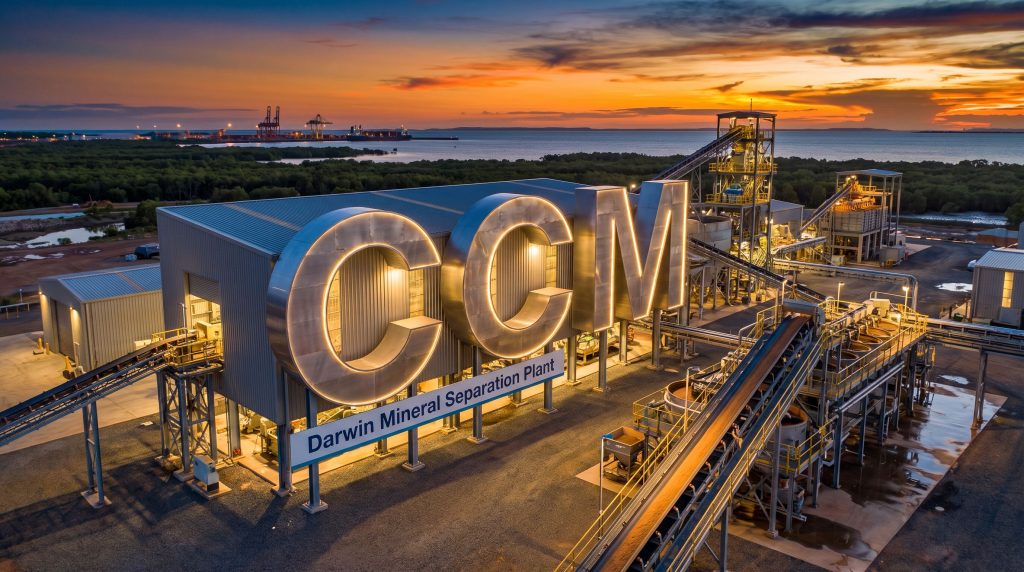
A major part of the announcement was the downstream update tied to Cadoux's interest in Minhub Operations Pty Ltd. Cadoux owns 50%, with the right to increase to 100%, in the Minhub vehicle that is advancing the proposed Darwin Mineral Separation Plant (DMP).
According to the update, the DMP is proposed for the East Arm Port precinct in Darwin and is being studied as a plant capable of processing an initial 500,000 tonnes per annum of heavy mineral concentrate feed.
Planned Product Suite from the Darwin Plant
The planned product suite includes:
| Product | Market exposure |
|---|---|
| Xenotime product | Heavy rare earths including dysprosium and terbium |
| Monazite product | NdPr-rich rare earth feed |
| Premium zircon | Ceramics, refractories, specialty applications |
| Titanium minerals | Pigment and industrial end uses |
The feasibility study had initially focused on coarser-grained heavy mineral concentrate from Gippsland Basin material. The latest update broadens that scope considerably. Cadoux said the Danube metallurgical programme and supporting engineering studies will now inform the inclusion of a 250,000tpa flotation circuit suitable for finer-grained WIM-style feed.
That is an important technical and commercial point. If supported by study outcomes, an added flotation circuit could allow the Darwin plant to process not only coarser feed but also finer-grained WIM-style material from southern Murray Basin projects.
Cadoux also stated that Minhub is engaged with multiple project proponents regarding collaborative processing of similar third-party feedstock. For investors, shared infrastructure can be relevant because utilisation rates are often central to plant economics. A broader feed base may improve optionality, although no operating outcome is assured at this stage.
The Integrated Model Investors Are Watching
The announcement sets out a multi-step rare earth and mineral sands strategy rather than a standalone exploration story. In broad terms, the company is seeking to connect upstream mineral sands exploration in Victoria with downstream processing concepts in Darwin and the Northern Territory.
The current development path outlined in the ASX release can be summarised as follows:
- WMS Project: exploration of WIM-style and strandline targets, including Danube
- Danube metallurgy: bulk sample and testwork to assess processing behaviour and product streams
- Darwin Mineral Separation Plant: feasibility work for a plant processing heavy mineral concentrate into rare earth and mineral sands products
- Minhub4000: concept-stage xenotime processing to produce heavy rare earth-rich carbonate
This structure may interest investors because it attempts to address more than one part of the value chain. Instead of relying solely on a future mine development outcome, Cadoux is also studying mid-stream processing capacity for rare earth-rich mineral sands concentrate. However, the current status remains staged, with each part of the model conditional on technical results and future decisions.
The next major ASX story will hit our subscribers first
Upcoming Catalysts from the July 2026 Update
The next milestones identified in the ASX announcement provide a clear calendar for investors following Cadoux's rare earths strategy.
| Milestone | Expected timing |
|---|---|
| Assay results from 1,066 WMS samples | September 2026 |
| Re-assay of historic drill samples | September 2026 |
| Next phase drilling at WMS | Q4 2026 |
| Danube bulk sample preparation and testwork | Ongoing |
| Engineering studies for 250,000tpa flotation circuit | Ongoing |
| Minhub4000 concept advancement | Subject to studies and review |
The most immediate catalyst is the September assay release. Those results are expected to help define the scale and continuity of mineralisation and guide the next drilling phase. Metallurgical results from Danube will also be relevant because they may influence both project assessment at WMS and the design assumptions for the Darwin processing route.
For investors focused on ASX rare earth stocks and mineral sands developers, Cadoux's update points to a company attempting to progress exploration and processing studies in parallel. The near-term question is whether upcoming assay and metallurgical data support the technical case outlined in the company's July 2026 announcement.
Want to Be First When the Next Major Mineral Sands Discovery Hits the ASX?
Discovery Alert's proprietary Discovery IQ model delivers real-time alerts on significant ASX mineral discoveries — including rare earth and mineral sands opportunities like those emerging across Victoria's Wimmera district — turning complex geological data into actionable insights for investors at every level. Explore historic examples of exceptional discovery returns and begin your 14-day free trial today to position yourself ahead of the broader market.