
August 8, 2026
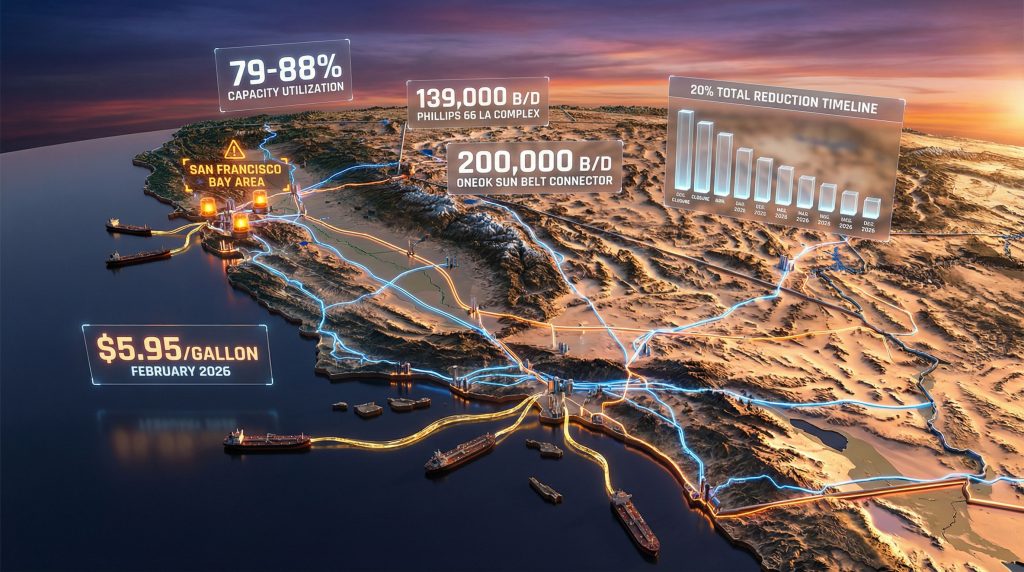
California's geographic isolation from domestic energy resources has created a complex web of vulnerabilities that threaten regional energy security. While the United States produces over 13.5 million barrels per day, making it the world's largest crude oil producer, pipeline gaps and refinery shifts expose California's energy vulnerability through structural constraints that fundamentally separate the state from national energy abundance.
The geographic reality creates what energy analysts describe as functional isolation, where California's 39 million residents depend on a fundamentally different supply model than the rest of the United States. Furthermore, this isolation affects oil price movements throughout the region, creating unique market dynamics compared to pipeline-connected states.
How Do Infrastructure Bottlenecks Create California's Energy Island Effect?
The Geographic Isolation Framework
California operates within a structurally separated energy ecosystem that lacks the pipeline connectivity linking major domestic production regions to West Coast refineries. This creates unique vulnerabilities when global supply chains face disruption, fundamentally different from other regions that benefit from extensive pipeline networks.
The isolation stems from a critical infrastructure gap: no crude oil pipelines connect the Permian Basin or midcontinent production areas to California's refineries. Every barrel processed in the state must originate through three limited pathways:
- Local in-state production (declining rapidly)
- Alaskan crude shipments via tanker
- Marine imports from international sources
This contrasts sharply with Gulf Coast operations, where dense pipeline networks efficiently transport oil from the Permian Basin and Canadian sources to Texas and Louisiana refining complexes. From these facilities, refined products flow into national distribution systems with multiple redundant pathways.
Pipeline Capacity Constraints and System Vulnerabilities
California's refining infrastructure operates with minimal buffer capacity for demand spikes or supply interruptions. The absence of redundant pathways means any single point of failure can cascade through the entire regional system, creating what infrastructure analysts recognise as systematic vulnerability.
Current refining capacity faces meaningful contraction due to facility closures, according to pipeline gaps and refinery monitoring data from industry sources. The Energy Information Administration has formally warned that refinery retirements on the West Coast increase the risk of higher gasoline prices in PADD 5 (Petroleum Administration for Defense District 5).
| Infrastructure Metric | California | Gulf Coast | Impact |
|---|---|---|---|
| Pipeline Connections | None to major basins | Dense network | Supply flexibility |
| Import Dependence | Majority waterborne | Pipeline supplemented | Weather/geopolitical risk |
| Refinery Configuration | Heavy crude optimised | Diverse feedstock capable | Operational flexibility |
Strategic Chokepoint Dependencies
The United States imports approximately 700,000 barrels per day from Saudi Arabia and Iraq combined, with over half transiting the Strait of Hormuz. While this volume appears modest in a 20-million-barrel-per-day national market, distribution patterns create concentrated regional exposure for California.
Because Gulf Coast refiners access domestic crude through pipelines, Persian Gulf imports concentrate disproportionately in California's PADD 5 district. When Hormuz shipments face disruption, the shortfall impacts Long Beach and Bay Area terminals first, where import dependence is highest and substitution options remain limited.
The missing barrels show up where import dependence is highest and alternatives are most constrained, creating immediate price and availability pressures.
Houston refiners maintain pipeline alternatives to domestic Texas crude, while Midwest facilities can access Canadian and Bakken production. However, California's refineries cannot easily substitute these sources due to both infrastructure and technical constraints.
When big ASX news breaks, our subscribers know first
What Makes California's Refinery System Uniquely Vulnerable to Supply Shocks?
Capacity Reduction Timeline
California's refining base has experienced significant contraction over recent years, removing substantial processing capacity during a period of increasing import dependence. These developments contribute to the broader oil price rally concerns affecting regional markets.
| Facility | Closure Date | Daily Capacity Lost | Cumulative Impact |
|---|---|---|---|
| Phillips 66 LA Complex | Late 2025 | 139,000 b/d | 8% state capacity reduction |
| Valero Benicia | 2026 | 150,000 b/d | Additional 9% capacity loss |
| Chevron Richmond | Operational | 220,000 b/d | Continued strategic capacity |
These facility closures remove approximately 289,000 barrels per day of processing capacity over an 18-month window. The timing coincides with declining in-state crude production, creating a double constraint on California's energy independence.
The California Energy Commission reports that the majority of crude processed in the state now arrives via marine imports, representing a fundamental shift from historical production patterns when California ranked among leading domestic oil producers.
Crude Configuration Constraints
California refineries invested decades optimising processing equipment for heavier, higher-sulfur imported crude grades from Middle Eastern and Latin American sources. This specialised configuration creates economic barriers to processing domestic light crude, even when theoretically available.
Technical Processing Constraints:
- API Gravity Optimisation: Heavy crude (20-30° API) versus light sweet crude (35-45° API)
- Sulfur Content Handling: Equipment designed for high-sulfur "sour" crude processing
- Conversion Unit Configuration: Cokers and hydrotreaters scaled for heavy feedstock residue
- Yield Economics: Light crude processing reduces gasoline output in heavy-crude-optimised facilities
Light, sweet shale oil from the Permian Basin cannot achieve optimal economics when processed through hardware designed for heavier feedstocks. Large-scale substitution increases costs and reduces gasoline and diesel yields precisely when capacity constraints are tightest.
This creates a paradox where domestic abundance cannot easily substitute for import disruptions due to decades of infrastructure investment in specific crude processing configurations.
Import Dependency Escalation
California has responded to declining domestic production and refinery capacity constraints by increasing imports of finished gasoline and blending components from overseas markets, including facilities in the Bahamas and Asian refineries.
Supply Chain Transformation:
- Traditional Model: Import crude, refine locally, distribute regionally
- Emerging Model: Import finished products and blending components directly
- Hybrid Approach: Combine reduced local refining with increased product imports
While importing finished products can stabilise supply in the short term, it does not address the underlying structural exposure. Each additional supply chain link adds transportation costs, weather vulnerability, and geopolitical complexity to California's energy supply.
The shift represents a defensive adaptation rather than a solution to infrastructure constraints that limit California's ability to access domestic energy abundance.
How Do Regulatory Pressures Amplify Energy Security Risks?
CARB Policy Impact Assessment
The California Air Resources Board (CARB) implements emissions and fuel specifications exceeding federal standards, creating additional compliance costs and operational constraints that accelerate refinery closures while limiting new infrastructure development.
CARB regulations require:
- Low Carbon Fuel Standards: Progressive reduction in fuel carbon intensity
- Cap-and-Trade Compliance: Greenhouse gas emission allowances
- Cleaner Gasoline Requirements: Reformulated gasoline specifications
- Refinery Emission Standards: Local air quality compliance measures
These requirements impose operational modifications and ongoing compliance expenses that affect facility economics, particularly for older refineries processing heavier crude grades that generate higher emissions per barrel processed.
Cap-and-Invest Programme Effects
California's Cap-and-Invest framework creates additional cost pressures on existing refining facilities through greenhouse gas emission limits and carbon credit requirements. Companies evaluate these costs against facility modernisation investments and alternative business strategies.
The programme affects refinery economics through:
- Carbon Credit Purchases: Direct compliance costs for emissions
- Operational Modifications: Process changes to reduce carbon intensity
- Capital Investment Requirements: Equipment upgrades for emissions reduction
- Competitive Disadvantage: Higher operating costs versus out-of-state facilities
Industry analysts note that regulatory compliance costs contribute to refinery closure decisions, removing local processing capacity during periods when pipeline alternatives remain unavailable. This situation compounds the OPEC price stagnation effects on regional energy security.
Permitting Bottlenecks for Infrastructure
Environmental review processes create extended timelines for critical pipeline and refinery infrastructure projects, generating mismatches between policy objectives and infrastructure development needs.
Permitting Timeline Challenges:
- Environmental Impact Reports: Multi-year assessment processes
- Public Comment Periods: Extended stakeholder review requirements
- Legal Challenge Provisions: Court review and appeal processes
- Agency Coordination: Multiple regulatory authority approvals
These procedural requirements, while designed to ensure environmental protection, can delay infrastructure projects that could enhance regional energy security and reduce import dependence.
What Are the Economic Consequences of California's Energy Vulnerability?
Price Volatility Patterns
California's supply constraints translate directly into consumer price impacts, with regional fuel costs consistently exceeding national averages. Bay Area gasoline prices demonstrate how infrastructure limitations create persistent premium pricing compared to regions with pipeline access to domestic production.
Regional Price Differential Factors:
- Transportation Costs: Marine shipping versus pipeline transport
- Supply Chain Complexity: Multiple intermediary handling points
- Inventory Constraints: Limited strategic storage capacity
- Regulatory Compliance: California-specific fuel formulation requirements
The price differential reflects both structural supply constraints and the cost of maintaining adequate inventory levels through more expensive supply chains.
Market Risk Premiums
Energy commodity traders incorporate volatility premiums into California fuel markets, recognising the state's exposure to supply disruptions and limited substitution options. Risk assessment models factor in:
- Geopolitical Supply Risk: Middle East disruption exposure
- Weather-Related Delays: Marine transport vulnerability
- Infrastructure Constraints: Limited pipeline alternatives
- Regulatory Complexity: Compliance cost uncertainty
These risk premiums represent the financial market's assessment of California's structural energy vulnerability compared to regions with more diversified supply options.
Regional Economic Impact
Higher energy costs affect transportation, manufacturing, and logistics sectors throughout California, creating broader economic effects beyond direct fuel expenses. Industries evaluate location decisions based on energy security considerations and total cost structures.
Sector-Specific Impacts:
- Transportation Industry: Fleet operating cost increases
- Manufacturing: Energy-intensive production cost pressures
- Logistics Operations: Distribution and warehousing expense increases
- Agriculture: Fuel costs for equipment and transportation
The economic effects extend beyond direct energy users to affect competitiveness in sectors where energy represents a significant input cost component.
Which Infrastructure Solutions Could Reduce California's Energy Isolation?
Proposed Pipeline Developments
Several pipeline projects could potentially address California's infrastructure constraints, though regulatory and environmental approval processes continue to impact development timelines. These developments could influence US‑China trade impact considerations for energy supply chains.
ONEOK Sun Belt Connector:
- Capacity: 200,000 barrels per day by 2029
- Route: Texas production regions to West Coast markets
- Status: Regulatory review and permitting processes ongoing
HF Sinclair Expansion Projects:
- Capacity: Up to 150,000 barrels per day additional by 2028
- Function: Alternative supply route development
- Scope: Regional pipeline network extensions
Combined, these projects could potentially deliver 550,000+ barrels per day of additional pipeline capacity, significantly reducing California's import dependence if regulatory approvals proceed according to projected timelines.
Alternative Supply Route Analysis
New pipeline connections would create supply redundancy in California's energy system, reducing vulnerability to marine transport disruptions and geopolitical supply shocks affecting traditional import sources.
Redundancy Benefits:
- Domestic Source Access: Connection to Permian Basin production
- Weather Risk Reduction: Pipeline versus marine transport reliability
- Geopolitical Diversification: Reduced Middle East import dependence
- Cost Structure Improvement: Pipeline transport economics versus shipping
Alternative supply routes would provide operational flexibility during disruptions, enabling California refineries to maintain operations using domestic crude sources.
Infrastructure Investment Requirements
The California Energy Commission has allocated funding for pipeline infrastructure upgrades, though regulatory review processes continue to affect project development schedules and investment commitments.
Investment Categories:
- Pipeline Construction: New transmission capacity development
- Terminal Facilities: Crude receiving and distribution infrastructure
- Storage Systems: Strategic inventory capacity expansion
- Distribution Networks: Regional pipeline connectivity improvements
Investment requirements reflect both new capacity needs and modernisation of existing infrastructure to accommodate changing supply patterns and regulatory requirements.
How Do Geopolitical Risks Compound California's Energy Challenges?
Middle East Supply Dependencies
California's pipeline isolation concentrates Middle Eastern crude imports in West Coast refineries disproportionately compared to other U.S. regions. This creates heightened exposure to Persian Gulf political instability and shipping disruptions affecting Strait of Hormuz transit routes.
Concentration Risk Factors:
- Saudi Arabian Imports: Direct crude supply relationships
- Iraqi Oil Flows: State-controlled export dependencies
- Iranian Sanctions Impact: Regional supply balance effects
- Shipping Route Vulnerabilities: Hormuz transit concentration
Geopolitical events affecting Middle Eastern production or export capabilities impact California's energy supply more directly than regions with domestic pipeline alternatives.
Strategic Petroleum Reserve Implications
California's isolation from national pipeline networks limits the effectiveness of Strategic Petroleum Reserve releases during regional supply disruptions, since reserve crude cannot easily reach West Coast refineries through existing infrastructure.
The Strategic Petroleum Reserve system was designed primarily to serve Gulf Coast and Midwest refining regions connected to the national pipeline network. California's benefits from reserve releases depend on:
- Export Terminal Capacity: Gulf Coast crude export to California
- Marine Transport Availability: Tanker shipping during disruptions
- West Coast Reserve Sites: Limited regional storage facilities
- Distribution Timeline: Extended transport periods versus pipeline delivery
This infrastructure limitation reduces California's participation in national energy security mechanisms designed to address supply disruptions.
National Security Considerations
Military installations and defence contractors in California face potential fuel supply constraints during extended disruptions, affecting operational readiness and strategic capabilities.
Defence Sector Vulnerabilities:
- Naval Operations: Fuel supply for Pacific Fleet facilities
- Air Force Bases: Jet fuel availability for operations
- Defence Manufacturing: Energy requirements for production facilities
- Emergency Response: Fuel access during national security events
Pipeline gaps and refinery shifts expose California's energy vulnerability creates potential national security implications extending beyond civilian economic impacts.
The next major ASX story will hit our subscribers first
What Role Does Electricity Grid Vulnerability Play in Overall Energy Security?
Import Dependency in Power Generation
California relies substantially on electricity imports from neighbouring states during peak demand periods, creating additional vulnerability when regional energy systems face coordinated stress from supply disruptions affecting multiple energy sectors simultaneously.
Grid Import Dependencies:
- Arizona Generation: Desert Southwest power plant electricity
- Pacific Northwest: Hydroelectric capacity during summer peaks
- Nevada Sources: Regional grid integration and supply sharing
- Natural Gas Dependencies: Gas-fired generation fuel supply coordination
Electricity import dependence compounds transportation fuel vulnerabilities when regional energy disruptions affect multiple supply systems concurrently.
Renewable Integration Challenges
California's renewable energy expansion creates intermittency management challenges requiring dispatchable backup generation capability, typically provided by natural gas facilities that share some of the same import vulnerability characteristics as petroleum refineries.
Grid Reliability Requirements:
- Peak Demand Management: Natural gas peaker plant operations
- Renewable Intermittency: Solar and wind output variation compensation
- Grid Stability Services: Frequency and voltage regulation requirements
- Emergency Reserve Capacity: System reliability during outages
Renewable energy systems require backup generation capabilities that may share supply chain vulnerabilities with transportation fuel systems during comprehensive regional disruptions.
Grid Hardening Investments
California utilities invest in wildfire-resistant infrastructure and grid modernisation, but ageing transmission systems remain vulnerable to natural disasters that could compound energy security challenges during supply disruptions affecting multiple energy sectors.
Infrastructure Resilience Measures:
- Transmission Line Hardening: Wildfire resistance and weather protection
- Distributed Generation: Local renewable energy and storage systems
- Microgrids: Community-level energy independence capabilities
- Emergency Response: Rapid restoration and alternative supply protocols
Grid modernisation efforts aim to reduce vulnerability cascades where electricity disruptions compound transportation fuel shortages and economic impacts.
How Could Energy Security Scenarios Unfold Under Different Policy Frameworks?
Scenario A: Accelerated Infrastructure Development
Streamlined permitting processes enable rapid pipeline construction, potentially reducing California's import dependence by 40% within five years while maintaining environmental protection standards through focused regulatory efficiency improvements.
Policy Framework Elements:
- Fast-Track Permitting: Priority review for energy security projects
- Environmental Compliance: Streamlined but rigorous assessment processes
- Stakeholder Coordination: Integrated review with multiple agencies
- Investment Incentives: Tax and regulatory benefits for infrastructure development
This scenario assumes regulatory efficiency improvements without compromising environmental protection, focusing on process optimisation rather than standard reduction.
Scenario B: Continued Regulatory Constraints
Extended environmental reviews delay critical infrastructure projects, forcing California to increase reliance on higher-cost imported fuels and finished products while energy security vulnerabilities persist and potentially intensify.
Constraint Impact Projections:
- Project Timeline Extensions: Multi-year delays for pipeline approvals
- Cost Escalation: Higher energy prices from import dependency
- Security Risk Persistence: Continued vulnerability to supply disruptions
- Economic Competitiveness: Regional disadvantage from higher energy costs
This scenario reflects continuation of current regulatory approaches without modification for energy security considerations.
Scenario C: Emergency Response Protocols
Supply disruptions trigger temporary regulatory waivers enabling rapid deployment of alternative fuel sources and emergency infrastructure connections, balancing environmental protection with energy security necessities.
Emergency Response Mechanisms:
- Temporary Permitting: Expedited approval for emergency infrastructure
- Alternative Fuel Authorisation: Regulatory flexibility for substitute sources
- Interstate Coordination: Regional cooperation for supply sharing
- Reserve Activation: Strategic inventory deployment and distribution
Emergency protocols would provide flexibility during acute disruptions while maintaining long-term environmental protection frameworks.
What Investment Implications Emerge from California's Energy Vulnerability?
Infrastructure Investment Opportunities
Pipeline companies with West Coast expansion capabilities represent potential beneficiaries of California's supply gap challenges, though regulatory approval risks affect investment timeline certainty and project economics. These opportunities extend beyond traditional energy sectors to include battery metals investments supporting renewable energy storage solutions.
Investment Considerations:
- Regulatory Approval Risk: Permitting timeline uncertainty
- Capital Requirements: Large infrastructure investment needs
- Long-term Contracts: Supply agreement and revenue security
- Competitive Positioning: First-mover advantages in constrained markets
Infrastructure investment opportunities exist but require careful assessment of regulatory and political risk factors affecting project development.
Energy Storage and Alternative Technologies
Battery storage and renewable energy projects gain strategic value as California seeks to reduce fossil fuel dependencies while maintaining energy security and grid reliability requirements.
Technology Investment Areas:
- Grid-Scale Storage: Large battery installations for renewable integration
- Distributed Energy: Community-level generation and storage systems
- Hydrogen Production: Alternative fuel development for transportation
- Advanced Biofuels: Domestic renewable fuel production capabilities
Alternative technology investments benefit from both environmental policy support and energy security considerations driving diversification strategies.
Risk Assessment for Energy-Intensive Industries
Manufacturing and logistics companies must factor energy security risks into California location decisions and supply chain planning, evaluating total cost structures including energy price volatility and availability risks.
Industry Risk Evaluation:
- Operating Cost Volatility: Energy price fluctuation impacts
- Supply Chain Reliability: Fuel availability for operations
- Competitive Positioning: Energy costs versus other regions
- Emergency Preparedness: Business continuity during disruptions
Energy-intensive industries increasingly incorporate energy security assessments into strategic planning and facility location decisions.
How Do California's Challenges Compare to Other Regional Energy Markets?
Gulf Coast Resilience Model
Texas and Louisiana benefit from multiple crude sources, extensive pipeline networks, and integrated refining complexes providing supply flexibility and operational redundancy that California's isolated system cannot match.
Gulf Coast Advantages:
- Pipeline Connectivity: Dense network accessing multiple production basins
- Refinery Diversity: Facilities configured for various crude types
- Storage Capacity: Large strategic and commercial inventory systems
- Export Infrastructure: Global market access for product distribution
The Gulf Coast model demonstrates how infrastructure diversity creates energy security resilience through multiple supply options and operational flexibility.
Northeast Heating Oil Lessons
New England's winter heating oil vulnerabilities provide case studies in regional isolation management, demonstrating how supply constraints create acute vulnerability during seasonal demand peaks and supply disruptions.
Northeast Parallel Challenges:
- Pipeline Constraints: Limited capacity for domestic supply access
- Import Dependencies: Marine transport for heating oil supplies
- Seasonal Demand: Peak consumption during winter months
- Price Volatility: Supply constraints creating cost fluctuations
New England's experience with heating oil shortages illustrates how regional infrastructure limitations create vulnerability patterns similar to California's transportation fuel challenges.
International Energy Island Examples
Hawaii and Puerto Rico provide case studies in energy isolation management, offering insights for California's strategic planning through their experience with import dependence and supply chain vulnerability mitigation.
Island Energy Security Strategies:
- Diversified Import Sources: Multiple supplier relationships
- Strategic Inventory: Enhanced storage capacity for supply security
- Alternative Energy Development: Renewable sources for energy independence
- Emergency Protocols: Rapid response systems for supply disruptions
Island energy systems demonstrate both the challenges and potential solutions for geographically isolated energy markets facing import dependence.
What Long-Term Strategies Could Enhance California's Energy Resilience?
Diversified Supply Portfolio Development
Balancing domestic pipeline connections with strategic reserve capacity and renewable energy expansion creates multiple resilience layers, reducing dependence on any single supply source or transportation method.
Portfolio Diversification Elements:
- Pipeline Infrastructure: Domestic crude access capabilities
- Strategic Reserves: Regional inventory capacity expansion
- Renewable Integration: Transportation electrification and alternative fuels
- Import Source Diversity: Multiple international supply relationships
Portfolio approaches provide redundancy and flexibility during various disruption scenarios affecting different supply chain elements.
Regional Coordination Frameworks
Interstate compacts for emergency fuel sharing and coordinated infrastructure development could reduce individual state vulnerabilities while maintaining regulatory autonomy for environmental protection and energy policy objectives. Such coordination mechanisms could benefit from monitoring supply chain vulnerabilities across regional energy networks.
Coordination Mechanisms:
- Emergency Sharing Agreements: Fuel allocation during disruptions
- Infrastructure Planning: Regional pipeline and storage coordination
- Regulatory Harmonisation: Compatible standards for interstate energy flows
- Information Sharing: Coordinated monitoring and early warning systems
Regional coordination enables collective energy security benefits while preserving state-level policy autonomy for local priorities.
Technology-Enabled Supply Chain Monitoring
Advanced analytics and real-time supply tracking systems enable proactive response to emerging disruptions before they cascade into shortages, improving emergency response effectiveness and supply chain resilience.
Technology Integration Applications:
- Supply Chain Visibility: Real-time inventory and flow monitoring
- Predictive Analytics: Early warning systems for potential disruptions
- Emergency Response: Rapid deployment of alternative supply sources
- Market Intelligence: Price and availability forecasting capabilities
Technology solutions enhance decision-making capabilities during supply chain stress and enable more effective emergency response coordination.
California's energy vulnerability demonstrates how pipeline gaps and refinery shifts create regional isolation despite national energy abundance. The state's infrastructure constraints, regulatory environment, and import dependencies combine to create unique supply chain risks that cannot be easily addressed through market mechanisms alone. Strategic infrastructure investment, regulatory efficiency improvements, and regional coordination frameworks could enhance California's energy resilience while maintaining environmental protection objectives. Understanding these complex interactions provides valuable insights for energy security planning in other isolated regional markets facing similar supply chain vulnerabilities and infrastructure constraints.
Disclaimer: This analysis is for educational and informational purposes only and should not be considered as investment advice. Energy market investments carry significant risks, including regulatory, technological, and market volatility factors. Readers should conduct their own research and consult qualified professionals before making investment decisions. Forward-looking statements regarding infrastructure development, policy changes, and market conditions are subject to uncertainty and may not materialise as projected.
Ready to Invest in the Next Major Mineral Discovery?
Discovery Alert instantly alerts investors to significant ASX mineral discoveries using its proprietary Discovery IQ model, turning complex mineral data into actionable insights. Begin your 14-day free trial today to position yourself ahead of the market and gain a market-leading advantage in identifying investment opportunities.