June 7, 2026
The Canadian mining landscape continues to witness unprecedented capital deployment as companies position themselves for long-term value creation in volatile commodity markets. Modern mining enterprises face complex decisions regarding the timing, scale, and financing of major expansions, particularly when balancing operational continuity with growth ambitions. The phase 2 of Blackwater mine expansion represents a compelling case study in strategic capital allocation within Canada's gold mining sector.
When examining large-scale mining investments, several critical factors emerge that distinguish successful projects from those that struggle with execution challenges. These include technical engineering specifications, operational scaling economics, workforce development requirements, and the intricate balance between debt financing and self-funded growth models. Understanding these dynamics provides valuable insights into how mid-tier producers can achieve operational leverage while maintaining financial flexibility through comprehensive junior mining strategies.
Capital Deployment Strategy in Canada's Gold Mining Sector
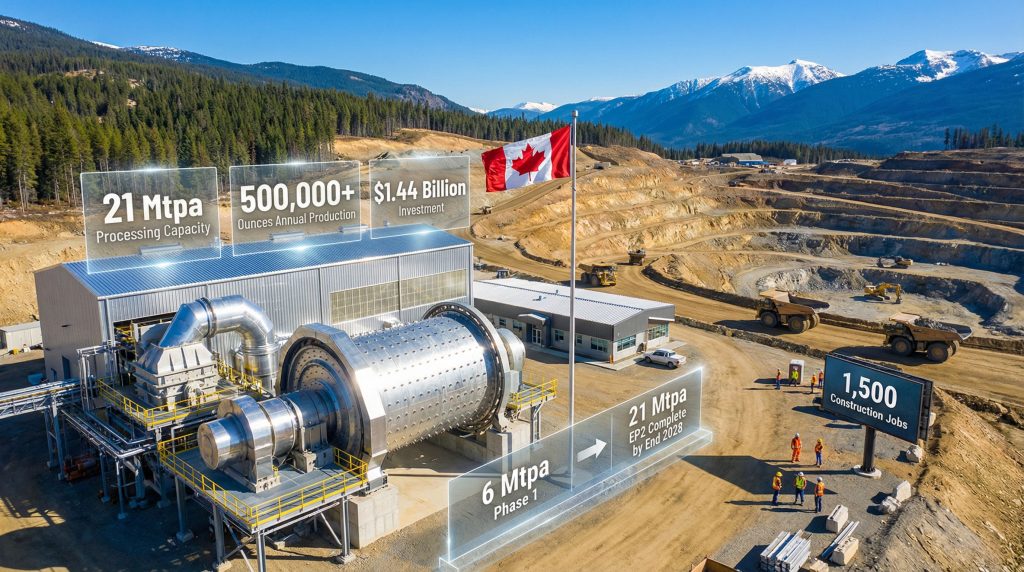
The $1.44 billion EP2 investment signals a fundamental shift in how Canadian gold producers approach capacity expansion during favourable commodity price cycles. This level of capital commitment represents approximately 21% of Canada's total annual precious metals mining investment, positioning the project among the most significant greenfield processing developments in recent years.
Furthermore, this massive investment aligns with current gold market performance trends that have provided the necessary market conditions for such ambitious expansion plans.
Capital Intensity Benchmarking and Operational Leverage
The EP2 expansion demonstrates capital efficiency metrics of approximately $68.6 million per million tonnes of annual processing capacity, reflecting the complex infrastructure requirements for remote mining operations in central British Columbia. This capital intensity falls within the mid-range for modern gold processing facilities, considering the geological complexity and infrastructure challenges inherent in developing a 21 million tonne per annum processing operation.
Key Investment Metrics:
- Total EP2 capital commitment: $1.44 billion CAD
- Phase 1A concurrent investment: $110 million CAD
- Combined processing capacity target: 21 Mtpa by end 2028
- Capital per tonne efficiency: $68.6 million/Mtpa installed capacity
The strategic timing of this approval reflects management's assessment that operational leverage increases proportionally with processing throughput, particularly when commodity prices support aggressive capital deployment. By accelerating EP2 development rather than awaiting Phase 1 completion, Artemis Gold aims to capture cost efficiencies from larger-scale operations while gold prices remain elevated.
Self-Funding Models and Cash Flow Dependencies
The commitment to finance EP2 primarily through operating cash flow represents a disciplined approach to capital allocation that reduces external financing dependencies. This strategy requires sustained production from existing operations to generate sufficient cash flow for construction funding, creating a direct link between operational performance and expansion capabilities.
Financial Structure Analysis:
- Primary funding source: Operating cash flow from Phase 1 and Phase 1A operations
- Production target supporting cash generation: 500,000-525,000 ounces annually
- All-in sustaining cost envelope: US$800-US$1,100 per ounce
- Timeline dependency: Phase 1A completion (late 2026) must align with EP2 major construction (Q3 2026)
This self-funding approach demonstrates confidence in the underlying asset's ability to generate substantial free cash flow, while also indicating management's preference for maintaining financial flexibility rather than accessing debt or equity markets during the construction phase.
When big ASX news breaks, our subscribers know first
Processing Capacity Transformation and Operational Economics
The evolution from 6 Mtpa to 21 Mtpa processing capacity represents a 250% increase in throughput that fundamentally alters the operational economics of the Blackwater mine. This scaling provides significant opportunities for fixed cost absorption improvements while introducing new operational complexities related to integrating multiple processing facilities.
According to Artemis Gold's official announcement, this expansion will significantly enhance the company's production profile and operational efficiency.
Throughput Scaling Economics and Cost Structure Optimisation
Capacity Evolution Timeline:
| Phase | Capacity (Mtpa) | Timeline | Capital Investment | Status |
|---|---|---|---|---|
| Phase 1 | 6 | Operational | Initial Development | Commercial production May 2025 |
| Phase 1A | 8 | Late 2026 | $110 million | Under construction |
| EP2 Complete | 21 | End 2028 | $1.44 billion | FID approved December 2025 |
The phased approach allows for incremental capacity additions while maintaining operational continuity. Phase 1A represents modular expansion of existing infrastructure at $55 million per additional Mtpa, while EP2 introduces a greenfield facility at $111 million per Mtpa, reflecting the full infrastructure requirements for a standalone processing plant.
Production Economics and Reserve Utilisation
With proven and probable reserves of 334 million tonnes grading 0.75 grams of gold per tonne, the Blackwater deposit contains approximately 8 million ounces of gold. At the targeted production rate of 500,000-525,000 ounces annually, the reserve base supports 15-16 years of full-scale operation, with mine life extending to 2043 through stockpile processing in the final years.
Reserve Economics Analysis:
- Total contained gold: 8 million ounces at 0.75 g/t grade
- Annual production target: 500,000-525,000 ounces (first 10 years)
- Reserve life at full production: 15-16 years
- Extended operations through stockpile processing: 2043 target
The grade consistency at 0.75 g/t provides predictable metallurgical performance across the mine life, supporting reliable production forecasting and cost estimation. This grade level positions Blackwater within the range typical for large-scale, low-grade gold deposits that rely on high-volume processing to achieve economic viability.
Integration Challenges and Operational Continuity
The decision to construct EP2 as a separate, standalone facility adjacent to the existing Phase 1 plant addresses the critical challenge of maintaining production during major construction activities. This segregation approach minimises operational disruption while introducing new complexities related to shared infrastructure, including tailings management, water treatment, and power distribution.
Critical Integration Points:
- Tailings storage facility expansion to accommodate 21 Mtpa discharge
- Water balance management across integrated processing circuits
- Power distribution requiring BC Hydro confirmation of hydroelectric capacity
- Workforce allocation between operations and construction activities
The success of this integration strategy depends heavily on careful sequencing of Phase 1A completion and EP2 construction mobilisation, as delays in Phase 1A could impact the cash flow generation required to fund EP2 development.
Technical Engineering Specifications and Processing Circuit Design
The EP2 processing facility incorporates proven technologies scaled for high-throughput gold processing, with particular emphasis on crushing circuit redundancy and grinding power to handle the geological characteristics of the Blackwater deposit. This technical approach reflects broader trends in mining industry evolution towards larger-scale, more efficient operations.
Primary and Secondary Crushing Infrastructure
The crushing circuit design prioritises reliability and maintainability through redundant secondary crushing capacity. The configuration includes:
- Primary crushing: Gyratory crusher for initial size reduction
- Secondary crushing: Twin secondary cone crushers providing redundancy
- Stockpile management: Covered stockpile design to mitigate weather exposure
This dual secondary crusher configuration ensures operational continuity if one unit requires maintenance, preventing crushing circuit bottlenecks that could constrain overall processing throughput.
Semi-Autogenous Grinding Mill Specifications
The grinding circuit represents the highest power consumption component of the processing facility, with combined power requirements of 36 MW:
Grinding Circuit Configuration:
- Semi-Autogenous (SAG) Mill: 18 MW specification
- Ball Mill: 18 MW specification
- Combined grinding power: 36 MW total installed capacity
- Design philosophy: SAG/Ball mill configuration for optimal particle size distribution
The 18 MW specification for each mill reflects the energy requirements for achieving optimal gold liberation from the Blackwater ore. This power level enables processing of harder ore types while maintaining consistent particle size distribution essential for downstream gravity concentration and cyanide leaching effectiveness.
Gravity Concentration and Cyanide Processing Circuits
The processing circuit incorporates both gravity concentration and cyanide leach/adsorption technologies to maximise gold recovery across varying ore characteristics:
Recovery Circuit Design:
- Gravity concentration: Initial recovery of coarse gold particles
- Cyanide leach circuits: Dissolution of fine gold particles
- Adsorption systems: Gold recovery from pregnant leach solutions
- Integration approach: Sequential processing to optimise overall recovery rates
This dual-recovery approach addresses the metallurgical complexity of the Blackwater deposit, where gold occurs in various forms requiring different extraction methodologies to achieve optimal recovery rates.
Production Positioning Within Canadian Gold Mining Rankings
The targeted annual production of 500,000-525,000 ounces positions the expanded Blackwater operation among Canada's largest gold producers, representing a significant addition to national gold output and establishing Artemis Gold as a major industry participant.
Industry experts who provide CEO insights on gold mining have highlighted how projects of this scale fundamentally reshape competitive dynamics within the Canadian mining sector.
Comparative Scale Analysis Against Tier-1 Producers
With full EP2 implementation, Blackwater's production profile places it within the top tier of Canadian gold operations:
Production Scale Comparison:
- Blackwater EP2 target: 500,000-525,000 ounces annually
- Canadian gold mining context: Represents approximately 12-15% of total national gold production
- Operational scale: 21 Mtpa processing capacity among largest in Canada
- Regional significance: Largest gold operation in central British Columbia
This production level establishes Blackwater as a significant contributor to Canada's gold output while providing Artemis Gold with the operational scale necessary to achieve cost competitiveness within the North American gold mining sector.
Reserve Base Sustainability and Resource Optimisation
The 8 million ounce gold resource provides substantial operational life while offering potential for further resource expansion through exploration activities:
Resource Sustainability Factors:
- Current reserves: 334 million tonnes @ 0.75 g/t gold (8 million ounces)
- Production timeline: 15-16 years at 500,000+ ounces annually
- Stockpile processing: Additional 5 years extending operations to 2043
- Exploration potential: Opportunity for resource expansion beyond current reserves
The planned resource and reserve update scheduled for 2025 may provide additional clarity on the long-term sustainability of the expanded operation and potential for further capacity increases beyond the current EP2 specifications.
Regional Economic Development and Workforce Implications
The phase 2 of Blackwater mine expansion creates significant economic opportunities for central British Columbia, generating substantial direct and indirect employment while contributing to regional skills development in mining and processing technologies.
Employment Generation and Skills Development
The construction and operation phases provide distinct employment profiles with different skill requirements:
Employment Projections:
- Peak construction workforce: 1,500 direct construction jobs
- Permanent operational positions: 1,200 direct employees and contractors
- Regional hiring target: 75-80% of workforce from British Columbia
- Skills development: Training programmes for mining and processing technologies
This employment scale represents a significant economic driver for the Prince George region, providing high-paying technical positions while supporting local service industries and community development.
Supply Chain Integration and Regional Development
The Blackwater expansion strengthens the Prince George industrial corridor through increased demand for:
- Construction materials: Concrete, steel, and specialised equipment
- Transportation services: Heavy haul trucking and logistics coordination
- Technical services: Engineering, maintenance, and specialised consulting
- Accommodation and catering: Support services for construction workforce
The project's location approximately 160 kilometres southwest of Prince George provides access to established transportation infrastructure while supporting economic diversification in the region's resource-based economy.
Funding Strategy and Financial Risk Management
The self-funding approach for EP2 development reflects a conservative financial strategy that prioritises debt capacity preservation while creating dependencies on operational performance and commodity price stability.
Operating Cash Flow Dependency Analysis
The success of the self-funding model depends on sustained production and favourable gold prices, particularly given current gold price forecast expectations:
Cash Flow Generation Requirements:
- Phase 1 production: Current 6 Mtpa operation generating base cash flow
- Phase 1A contribution: Additional 2 Mtpa capacity by late 2026
- Gold price sensitivity: Cash flow sustainability across price cycles
- Cost control importance: AISC management within US$800-1,100 range
This funding approach requires careful cash flow management during the construction period, with potential risks if production targets are not achieved or gold prices decline significantly during the 2026-2028 construction timeline.
Capital Allocation Timeline and Milestone Dependencies
The phased capital deployment aligns with construction milestones and production ramp-up:
Critical Funding Gates:
- Early works (January 2026): Initial capital deployment for site preparation
- Major construction (Q3 2026): Significant capital acceleration phase
- Equipment procurement: Long-lead items requiring advance funding
- Construction completion (Q3 2028): Final capital deployment before production
The timeline requires sustained cash flow generation throughout the construction period, creating interdependencies between Phase 1/1A operational performance and EP2 development progress.
Hydroelectric Power Confirmation Requirements
The conditional Final Investment Decision pending BC Hydro confirmation represents a critical regulatory gate that could impact project timing:
Power Infrastructure Dependencies:
- Formal confirmation required: BC Hydro capacity assessment expected early 2026
- Power demand: 21 Mtpa processing requires substantial hydroelectric capacity
- Grid integration: Connection to provincial electrical system
- Timeline risk: Delay in confirmation could impact construction schedule
This regulatory dependency reflects British Columbia's strategic control over industrial power allocation and the province's commitment to ensuring adequate grid capacity for major mining developments.
The next major ASX story will hit our subscribers first
Risk Assessment and Implementation Challenges
The EP2 expansion faces multiple execution risks that could impact timeline, budget, or operational performance, requiring comprehensive risk management strategies throughout the development process.
Construction Timeline Dependencies and Weather Considerations
Central British Columbia's climate presents seasonal construction challenges that could affect project scheduling, as detailed in recent mining industry reports:
Timeline Risk Factors:
- Weather windows: Limited construction seasons due to winter conditions
- Equipment delivery: Remote location challenges for heavy equipment transport
- Site preparation: Ground conditions and seasonal access limitations
- Construction sequence: Weather-dependent activities requiring careful scheduling
The two-year construction timeline from Q3 2026 to Q3 2028 spans multiple winter seasons, requiring robust weather contingency planning and potentially accelerated construction during optimal weather periods.
Skilled Labour Availability and Remote Location Challenges
The remote location and specialised nature of mining construction create workforce recruitment and retention challenges:
Labour Market Considerations:
- Skilled trades shortage: Limited availability of specialised mining construction workers
- Remote work conditions: Fly-in/fly-out arrangements for non-local workers
- Wage inflation: Competition for skilled workers in resource sector
- Training requirements: Specialised equipment operation and safety certification
The peak requirement for 1,500 construction workers represents a significant portion of available skilled trades in the region, potentially requiring recruitment from other Canadian provinces or international sources.
Regulatory Approval Pathways and Environmental Compliance
While the project has received major approvals, ongoing regulatory compliance requirements present execution risks:
Regulatory Risk Management:
- Environmental monitoring: Continuous compliance with operating permits
- Water management: Discharge quality and quantity regulations
- Air quality standards: Processing facility emissions compliance
- Community relations: Ongoing stakeholder engagement requirements
The expansion of processing capacity to 21 Mtpa may trigger additional regulatory review requirements, particularly related to environmental impact assessments and community consultation processes.
Market Fundamentals and Long-Term Strategic Positioning
The phase 2 of Blackwater mine expansion aligns with structural trends in global gold markets while positioning Artemis Gold for sustained competitiveness across commodity price cycles.
Mine Life Extension Strategy Through Operational Optimisation
The expansion extends productive mine life through 2043 while creating opportunities for further optimisation:
Strategic Timeline Considerations:
- Peak production years: 2029-2039 at 500,000+ ounces annually
- Stockpile processing phase: 2039-2043 extending operational life
- Resource expansion potential: Exploration opportunities beyond current reserves
- Technology advancement: Processing efficiency improvements over mine life
This extended timeline provides operational stability while allowing for technological improvements and potential resource additions that could further extend mine life beyond the current 2043 target.
Future Expansion Potential and Resource Development
The infrastructure established through EP2 creates a platform for potential further expansion:
Growth Optionality:
- Processing capacity: Potential for additional capacity beyond 21 Mtpa
- Resource additions: Exploration targets within the property boundaries
- Technology upgrades: Processing circuit optimisation opportunities
- Satellite deposits: Potential for additional ore sources within trucking distance
The substantial infrastructure investment creates economies of scale that could support processing of additional ore sources, either through resource expansion or third-party ore processing arrangements.
Strategic Lessons for Mid-Tier Gold Producers
The Blackwater expansion provides valuable insights for other mid-tier producers considering major capacity additions and strategic positioning within the Canadian mining sector.
Phased Development Approach Benefits
The sequential expansion strategy demonstrates several advantages over single large-scale development:
Strategic Development Benefits:
- Risk mitigation: Smaller initial capital commitments with proven concepts
- Cash flow generation: Earlier production supporting subsequent phases
- Technical optimisation: Learning from initial phases informing later development
- Market timing: Flexibility to accelerate or defer based on commodity cycles
This approach allows companies to validate technical approaches and market conditions before committing to larger capital investments, reducing overall project risk.
Cash Flow Self-Funding Model Effectiveness
The commitment to self-funding demonstrates both financial discipline and confidence in underlying asset quality:
Self-Funding Strategy Implications:
- Debt capacity preservation: Maintaining financial flexibility for future opportunities
- Shareholder value protection: Avoiding dilutive equity financing during expansion
- Performance accountability: Direct link between operational success and expansion capability
- Market confidence: Demonstration of asset quality and management confidence
This funding approach requires strong operational performance but provides significant advantages in maintaining financial flexibility and avoiding external financing dependencies.
Operational Continuity During Major Expansions
The segregated facility design addresses a critical challenge in mining expansions:
"The standalone EP2 processing facility design allows segregation of Phase 1 operations from Phase 2 construction, minimising operational disruption during the two-year build period while maintaining revenue generation essential for project funding."
This engineering approach demonstrates the importance of maintaining cash flow during construction periods, particularly for self-funded expansion projects where operational performance directly impacts development capability.
The phase 2 of Blackwater mine expansion represents a comprehensive approach to scaling mining operations while managing financial and operational risks. Through careful timing, technical design, and funding strategy, the project positions Artemis Gold among Canada's largest gold producers while providing a template for sustainable growth in the mining sector. The success of this expansion will likely influence similar development approaches across the Canadian mining industry, demonstrating the viability of self-funded growth models in favourable commodity environments.
Disclaimer: This analysis is based on publicly available information and company disclosures. Mining projects involve substantial risks including commodity price volatility, construction delays, regulatory changes, and operational challenges that could materially impact project outcomes. Readers should conduct independent research and consult qualified professionals before making investment decisions.
Looking to Identify the Next Major Mining Opportunity?
Discovery Alert's proprietary Discovery IQ model delivers instant notifications of significant ASX mineral discoveries, helping investors capture opportunities in early-stage mining developments before broader market recognition. With proven historic examples of substantial returns from major discoveries and real-time analysis of over 30 commodities, begin your 30-day free trial today to position yourself ahead of the market in identifying the next transformative mining investment.