

May 11, 2026
When Trade Policy Becomes Industrial Triage: Understanding Canada's Metals Tariff Crisis
There is a particular kind of economic stress that supply chain participants know well: the moment when a pricing assumption that has been stable for decades is repriced overnight. Cross-border manufacturing networks are built on the expectation of policy continuity. When that continuity breaks, the damage is not merely financial but structural, disrupting the logic of entire production systems that took years to integrate. That is precisely the environment Canadian metals manufacturers found themselves navigating following the April 2026 expansion of U.S. Section 232 tariff enforcement. The Canada metals tariff support package announced on May 4, 2026 is the government's direct response to that disruption, and understanding both its architecture and its limitations is essential for anyone with exposure to North American industrial supply chains.
When big ASX news breaks, our subscribers know first
The Regulatory Trigger: How the April 2026 Tariff Shift Changed Everything
The mechanics of the change deserve careful attention because the policy shift was not simply a rate increase. On April 2, 2026, a U.S. presidential proclamation altered how Section 232 tariffs are calculated for derivative products — those articles substantially made of steel, aluminium, or copper. Previously, a 50% tariff applied only to the identified metals component within an imported product.
A manufacturer could therefore limit their tariff exposure by managing input ratios, structuring bills of materials, or shifting to lower-metals-content product designs. The U.S.-Canada trade war has consequently reshaped these long-established production strategies in fundamental ways.
The new regime eliminated that optimisation pathway entirely. Under the revised methodology, a flat 25% duty now applies to the full declared value of any derivative article substantially made of steel, aluminium, or copper. This means the tariff base now includes fabrication labour, engineering, logistics coordination, quality assurance, profit margins, and all other value-added components embedded in the final product. The effective tariff burden for many Canadian exporters did not merely increase; it was recalculated on an entirely different conceptual basis.
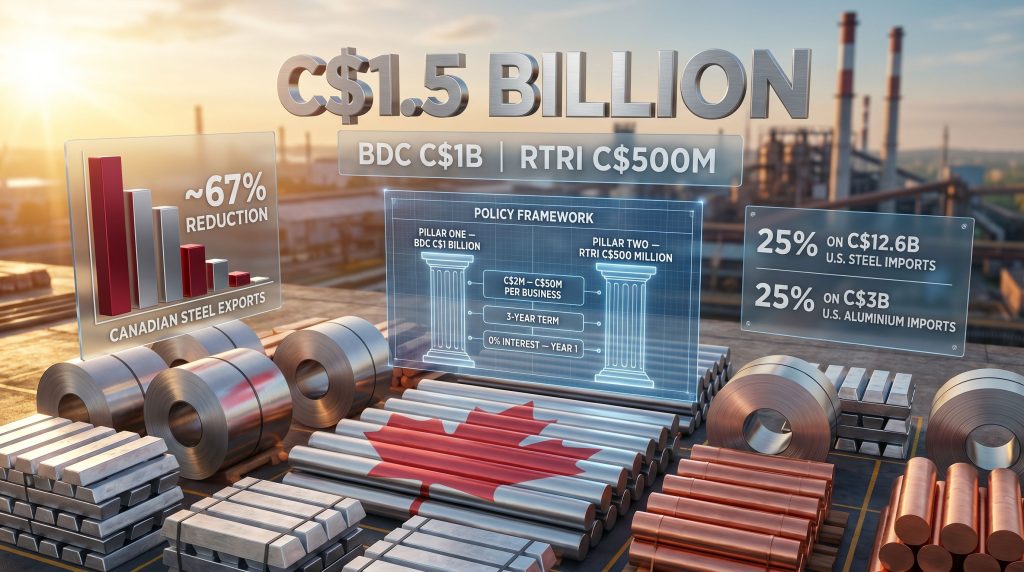
The April 6, 2026 effective date produced an immediate market response. Canadian steel exports fell to approximately one-third of pre-tariff levels, a roughly 67% decline that reflected both direct cost impacts and the broader behavioural response of buyers reconsidering supply chain configurations. Sectors carrying the heaviest exposure included manufacturers of wind towers, prefabricated buildings, fasteners, wire products, and steel coil derivatives. These are industries where metals constitute the dominant structural input but are embedded within higher-value assembled products, making them particularly sensitive to full-value tariff assessments.
The April 2026 tariff recalculation was not an incremental policy adjustment. It represented a fundamental repricing of cross-border supply chain economics that had been integrated across decades of bilateral trade under CUSMA/USMCA frameworks.
This context matters because it explains why the Canadian government's response was framed with considerable urgency. The Canadian government formally characterised the tariffs as unfair and unjustified and publicly committed to working with urgency to help strategic industries adapt, compete, and succeed within the altered global trade environment. That framing signals that policymakers understood the change as structural rather than temporary, requiring more than bridge financing.
How Canada's C$1.5 Billion Support Package Is Structured
The Canada metals tariff support package operates through two financing pillars, each targeting different segments of the affected industrial base. Understanding the distinction between these instruments is important for assessing which businesses are likely to benefit and in what timeframe.
Pillar One: The C$1 Billion BDC Financing Program
The Business Development Bank of Canada program represents the larger and more immediately deployable component of the package. With C$1 billion in committed financing, it targets Canadian companies that use steel, aluminium, or copper in a significant way in their production and that have experienced documented disruption from the April 2026 tariff changes.
The loan parameters are specific and deliberately structured to address the temporal dynamics of a trade crisis:
- Loan range: C$2 million to C$50 million per eligible business
- Term: Three years
- Year One: Zero interest with no repayment obligations
- Years Two and Three: Standard repayment schedule applies
- Eligible uses: Working capital stabilisation, market diversification, productivity upgrades, and supply chain reconfiguration
The Year One structure is the defining feature. It creates a 12-month liquidity window that allows viable businesses to maintain payroll, service existing supplier relationships, and reconfigure cost structures without simultaneously managing new debt service obligations. For a mid-sized fastener manufacturer or structural steel fabricator operating on thin margins, that breathing room can be the difference between survival and forced rationalisation.
Applications opened immediately upon the May 4, 2026 announcement, reflecting the government's stated priority of rapid liquidity deployment to businesses under acute pressure.
Pillar Two: The C$500 Million Regional Tariff Response Initiative
The Regional Tariff Response Initiative (RTRI) expansion operates through a fundamentally different delivery architecture. Rather than a single national programme, the RTRI channels funding through Canada's regional development agencies, allowing geographically tailored deployment to industrial clusters where metals employment is concentrated.
Key structural elements of the RTRI expansion include:
- Total allocation: C$500 million in additional funding
- Primary beneficiaries: Small and medium enterprises (SMEs)
- Focus areas: Competitive capability enhancement, new market access development, and operational adaptation
- Steel-specific carve-out: C$150 million ring-fenced exclusively for steel producers
The regional delivery model carries meaningful advantages over a centralised programme when industrial activity is geographically concentrated. Steel production in Southern Ontario, aluminium processing in Quebec and British Columbia, and copper manufacturing clusters each face distinct labour market conditions, transportation cost structures, and competitive dynamics. Regional agencies are better positioned to calibrate support toward these specific contexts than a uniform national programme.
| Instrument | Total Value | Primary Beneficiary | Delivery Channel | Key Feature |
|---|---|---|---|---|
| BDC Financing Program | C$1 billion | Mid-to-large manufacturers | Business Development Bank of Canada | 0% interest, Year 1; no repayments |
| RTRI Expansion | C$500 million | SMEs and steel producers | Regional development agencies | C$150M steel-specific carve-out |
| Total Package | C$1.5 billion | Steel, aluminium and copper industries | Federal and Regional | Rapid liquidity deployment |
The Broader Trade Defence Architecture Canada Has Assembled
The C$1.5 billion announcement represents one layer within a substantially larger cumulative policy framework. Since the initial imposition of 50% Section 232 tariffs in June 2025, Canada has assembled a multi-vector trade defence strategy combining retaliatory tariffs, import volume controls, domestic demand stimulation, workforce programmes, and strategic financing reserves. Furthermore, the U.S. tariffs on Canadian industries have accelerated the pace at which this architecture has been constructed.
Retaliatory Tariff Measures
Canada's retaliatory posture is anchored by mirror tariffs applied to U.S. metals exports:
- 25% counter-tariffs on U.S. steel imports, covering a trade value of C$12.6 billion
- 25% counter-tariffs on U.S. aluminium imports, covering a trade value of C$3 billion
- 25% tariffs on certain Chinese steel and aluminium imports, specifically targeting products containing metals melted or cast in China regardless of the country of final manufacture
The China-origin clause is a less-discussed but strategically significant element. It closes a potential circumvention pathway that would otherwise allow Chinese producers to route materials through third-country processors before entering Canada duty-free, a supply chain arbitrage pattern observed in multiple global trade frameworks.
Tariff Rate Quotas: Preventing Market Flooding
Canada also implemented a tariff rate quota (TRQ) system designed to prevent third-country steel from displacing domestic production as global trade flows redirect in response to U.S. tariffs. The structure creates differentiated treatment based on trade agreement status:
- Non-FTA countries: TRQs set at 20% of 2024 import levels, with a 50% over-quota tariff
- FTA partner countries (excluding the U.S. and Mexico): TRQs set at 75% of 2024 import levels, with the same 50% penalty above quota
This architecture reflects an understanding of how trade disruption creates secondary market effects. When the U.S. restricts imports from Canada and other traditional partners, those displaced volumes do not disappear; they seek alternative destinations. Without import controls, Canadian domestic prices could face downward pressure from redirected global supply at precisely the moment Canadian producers most need stable pricing to recover margins. Indeed, the global commodity tariff impacts of U.S. trade policy have made such redirection of supply flows a near-universal challenge for exporting nations.
Domestic Demand Stimulation: The Buy Canadian Policy
Effective demand-side industrial policy requires both protecting supply capacity and ensuring a viable domestic market for that capacity to serve. The Buy Canadian procurement policy addresses the demand dimension by mandating that all publicly funded contracts valued at over C$25 million must prioritise Canadian-made steel and aluminium.
This creates a structurally stable domestic demand floor that operates independently of U.S. market access conditions, reducing the degree to which Canadian producers' commercial viability depends on bilateral trade relationships.
Workforce Transition and Labour Market Stabilisation
A critical but often underweighted dimension of industrial trade responses is the labour market effect. The Canadian metals sector employs approximately 100,000 workers, and any significant capacity rationalisation carries concentrated regional employment consequences.
Canada's workforce response framework includes:
- A reskilling programme targeting up to 50,000 workers in tariff-affected sectors
- Enhanced employment insurance flexibility and extended benefit periods
- A new digital jobs and training platform to accelerate worker redeployment into adjacent industries
- More than C$100 million over two years committed to work-sharing agreements, protecting up to 26,000 workers in sectors including steel
The work-sharing component is particularly notable from a structural perspective. Rather than funding layoffs and subsequent retraining, work-sharing programmes allow employers to reduce hours across the workforce while government supplements worker income. This maintains workforce cohesion and institutional knowledge within firms while preserving employment levels during a period of market disruption — a more efficient mechanism than workforce dispersal followed by costly rehiring.
The Strategic Response Fund
Sitting above all sector-specific programmes is the C$5 billion Strategic Response Fund, a flexible capital reserve designed for longer-term adaptation, diversification, and growth initiatives across all tariff-affected sectors. Unlike the BDC programme, which targets immediate liquidity, the SRF is positioned as a medium-to-long-term transformation instrument.
| Policy Instrument | Value | Purpose |
|---|---|---|
| BDC Financing Program | C$1 billion | Immediate liquidity, bridge financing |
| RTRI Expansion | C$500 million | SME support, regional delivery |
| Strategic Response Fund | C$5 billion | Long-term adaptation and diversification |
| Counter-tariffs on U.S. steel | C$12.6 billion trade coverage | Retaliatory leverage |
| Counter-tariffs on U.S. aluminium | C$3 billion trade coverage | Retaliatory leverage |
| Workforce support | C$100+ million | Labour market stabilisation |
| Cumulative response | C$20+ billion | Multi-vector trade defence |
The C$1.5 billion announced on May 4, 2026 functions as a tactical liquidity layer within a much larger cumulative policy framework that Canada has assembled since initial 50% Section 232 tariffs were imposed in June 2025.
Industry Reaction: Cautious Optimism Meets Structural Scepticism
The Canadian metals industry's response to the announcement ranged from cautious acknowledgment to pointed criticism, reflecting a divide between those who welcome immediate liquidity relief and those who question whether government-directed capital can substitute for systemic competitiveness reform.
One market participant noted that while the announcement was visible, the absence of clarity around the application process meant that practical utility remained uncertain, with industry participants typically needing several weeks to understand how new programme mechanics translate into business operations.
More pointed criticism came from another industry voice, who argued that the government's emphasis on expecting financial institutions to co-participate amounts to relying on institutional pressure rather than structural reform. This source characterised the package as a continuation of top-down capital allocation rather than a genuine transformation of Canada's investment environment.
The core critique articulated was that Canada had failed to address the underlying conditions making the country less attractive as a destination for industrial investment: no meaningful tax reform, no changes to the banking system to encourage more productive competition, no regulatory liberalisation in concentrated sectors, and no substantive improvement to the investment climate.
The concern expressed by multiple industry voices is not merely about this particular programme. It reflects a longer-standing structural argument: that Canada's highly concentrated banking sector systematically underserves the risk appetite required for mid-market industrial lending.
The government's counter-position is that private financial institutions are expected to operate alongside the BDC programme rather than be displaced by it. The BDC acts as a complementary instrument, filling the gap between what commercial banks are willing to lend and what viable businesses actually require during periods of acute trade disruption. Whether this co-participation model materialises in practice at the required scale remains an open implementation question.
The Banking System Dimension: OSFI's Simultaneous Policy Signal
One of the most strategically significant developments of May 4, 2026 received comparatively little attention in the initial policy coverage. On the same day the Canadian government announced the Canada metals tariff support package, Peter Routledge, the superintendent of financial institutions at Canada's Office of the Superintendent of Financial Institutions (OSFI), indicated in a media interview that OSFI was exploring ways to streamline banking processes with the objective of better balancing financial system stability and competitive lending conditions.
The timing was not coincidental. OSFI's signal represents what might be characterised as a second-order policy response. Rather than simply deploying more government capital to fill the gap left by risk-averse commercial lenders, the regulator is beginning to examine whether the structural conditions governing banking competition are themselves a constraint on effective industrial policy.
This distinction matters considerably for long-term policy effectiveness:
- First-order response (BDC and RTRI): Deploy government capital directly to tariff-affected businesses
- Second-order response (OSFI review): Examine whether banking sector structure and regulatory settings limit private capital's willingness to serve industrial borrowers
- Third-order response (CUSMA renegotiation): Resolve the bilateral trade conditions that make direct intervention necessary in the first place
Critics of the current approach argue that without meaningful progress on the second and third order responses, the first-order instruments risk becoming permanent structural features of Canadian industrial finance rather than temporary bridge mechanisms. When government capital perpetually fills gaps that private markets should serve, it can suppress the competitive pressure that would otherwise drive banking sector evolution and productivity improvement.
The next major ASX story will hit our subscribers first
Comparing Canada's Response to Global Peers
Canada's multi-vector approach is notable for its breadth when viewed against comparable national responses to U.S. Section 232 pressure. Few economies have simultaneously deployed direct liquidity programmes, retaliatory tariffs, import volume controls, domestic procurement mandates, and workforce transition packages at the scale Canada has assembled. However, the steel and aluminium tariffs imposed by the U.S. have compelled a wide range of trading partners to develop their own defensive policy frameworks.
| Country/Bloc | Primary Response Mechanism | Scale of Fiscal Support | Retaliatory Tariffs | Domestic Procurement Policy |
|---|---|---|---|---|
| Canada | BDC loans, RTRI grants, SRF | C$6.5B+ cumulative (direct programmes) | 25% on C$15.6B in U.S. goods | Buy Canadian threshold: C$25M+ contracts |
| European Union | EU Steel Safeguard Measures | Multi-billion EUR across member states | Counter-tariffs on targeted U.S. goods | EU content preferences in procurement |
| China | State-directed financing | Extensive, state bank channelled | Existing tariff escalation framework | Domestic preference embedded in policy |
| Mexico | CUSMA negotiation leverage | Limited direct fiscal support | Selective retaliatory measures | Emerging domestic procurement frameworks |
The C$5 billion Strategic Response Fund in particular positions Canada's response closer to EU-style active industrial policy than to the market-led approach traditionally associated with Anglo-American economic frameworks. Whether this represents a durable shift in Canadian economic philosophy or a crisis-period exception will depend heavily on how CUSMA renegotiations develop under Prime Minister Mark Carney's administration.
Long-Term Scenarios: What Happens Next for Canadian Metals
The following section presents scenario analysis for informational purposes only and does not constitute investment advice. Outcomes are inherently uncertain and dependent on bilateral trade negotiations, macroeconomic conditions, and policy decisions that cannot be predicted with precision.
Three credible forward trajectories exist for the Canadian metals sector, each with distinct implications for how the C$1.5 billion package performs against its stated objectives. In addition, the risk of tariff-driven supply chain disruption further complicates forward planning for manufacturers across all three scenarios.
Scenario One: Successful Market Diversification
Canadian metals producers leverage BDC financing to develop durable export relationships in European and Southeast Asian markets. The Buy Canadian procurement policy establishes a stable domestic demand base reducing U.S. dependency. By 2028, the sector emerges structurally more resilient, and government financing programmes wind down as market conditions normalise.
Scenario Two: Prolonged Trade Tension Without Resolution
If CUSMA renegotiations fail to restore a stable bilateral trade framework, Canadian manufacturers face sustained margin compression across a multi-year horizon. Government financing programmes risk becoming structural features rather than transitional instruments, raising questions about long-term fiscal sustainability and potential capacity rationalisation in regions with concentrated metals employment.
Scenario Three: Bilateral Negotiated Settlement
A renegotiated CUSMA framework restores preferential access for Canadian steel, aluminium, and copper derivative products. The BDC and RTRI programmes serve their intended function as bridge financing during negotiation, then wind down as market access normalises. This represents the optimal policy outcome from a fiscal efficiency perspective.
Prime Minister Mark Carney has explicitly framed the C$1.5 billion package as support designed to sustain industry viability during ongoing CUSMA renegotiation discussions with the Trump administration, signalling that the financing programme is conceived as a transitional instrument rather than a permanent industrial policy mechanism. The package's ultimate effectiveness therefore depends on whether bilateral negotiations deliver the trade framework restoration that domestic financing cannot substitute for.
FAQ: Canada Metals Tariff Support Package
What is the Canada metals tariff support package?
The Canada metals tariff support package is a C$1.5 billion (approximately USD $1.1 billion) financing programme announced on May 4, 2026, designed to help Canadian manufacturers and exporters in the steel, aluminium, and copper industries manage the financial consequences of expanded U.S. Section 232 tariffs. It consists of a C$1 billion BDC loan programme and C$500 million in additional RTRI funding delivered through regional development agencies. Further details on the programme structure are available via the official government announcement.
Who qualifies for BDC tariff support loans?
Eligibility targets Canadian companies that use steel, aluminium, or copper significantly in their production and that export products affected by the revised U.S. Section 232 derivative product tariff rules effective April 6, 2026. Loans range from C$2 million to C$50 million per business, with a three-year term and zero interest in Year One.
What specific U.S. tariff change triggered Canada's response?
The April 2, 2026 U.S. presidential proclamation changed Section 232 tariff calculations on derivative products from a 50% rate applied only to the metals content to a flat 25% duty applied to the full declared value of any derivative article substantially made of steel, aluminium, or copper, effective April 6, 2026.
How much has Canada committed in total to counter U.S. metals tariffs?
Canada's cumulative policy response exceeds C$20 billion, including C$5 billion through the Strategic Response Fund, C$12.6 billion in retaliatory coverage on U.S. steel imports, C$3 billion on U.S. aluminium, C$1.5 billion in the new BDC and RTRI package, and over C$100 million in workforce support programmes. Industry analysts at Fast Markets have noted this represents one of the most comprehensive national responses to U.S. Section 232 enforcement seen to date.
Has the Canadian metals industry welcomed the support package?
Reactions have been mixed. While some industry leaders acknowledged the rapid liquidity deployment, several participants expressed scepticism, arguing the package addresses short-term cash flow without resolving deeper structural issues including banking sector concentration, investment climate barriers, and the absence of meaningful regulatory reform.
How does the RTRI work within the broader package?
The RTRI channels funding through Canada's regional development agencies to support SMEs facing tariff-related pressures. The May 2026 expansion added C$500 million to the initiative, with C$150 million specifically reserved for steel producers. Funding supports competitiveness improvements, market diversification, and operational adaptation.
Key Statistics Summary
| Metric | Value |
|---|---|
| Total new support package (May 4, 2026) | C$1.5 billion (approx. USD $1.1 billion) |
| BDC programme allocation | C$1 billion |
| RTRI expansion allocation | C$500 million |
| Steel-specific RTRI carve-out | C$150 million |
| BDC loan range per business | C$2 million to C$50 million |
| BDC loan term | 3 years |
| Year 1 interest rate | 0% |
| U.S. flat tariff on derivative products | 25% of full product value |
| Prior U.S. tariff method | 50% on metals component only |
| Canadian steel exports decline post-tariff | Approximately 67% (to roughly one-third of prior levels) |
| Canadian retaliatory tariffs on U.S. steel | 25% on C$12.6 billion in imports |
| Canadian retaliatory tariffs on U.S. aluminium | 25% on C$3 billion in imports |
| Strategic Response Fund (cumulative) | C$5 billion |
| Workers covered by reskilling programme | Up to 50,000 |
| Workers protected by work-sharing support | Up to 26,000 |
| Buy Canadian procurement threshold | Contracts over C$25 million |
| Approximate jobs in Canadian metals sector | Approximately 100,000 |
Is This a Structural Solution or a Tactical Bridge?
The Canada metals tariff support package demonstrates genuine speed and fiscal commitment. The zero-interest, no-repayment Year One structure provides measurable breathing room for viable businesses. The regional delivery architecture allows geographically targeted deployment. The steel-specific carve-out within the RTRI reflects informed prioritisation of the most exposed subsector.
However, the package's critics raise a legitimate challenge that liquidity support alone cannot answer. A government financing programme fills a gap, but it does not change the structural conditions that create the gap. The simultaneous OSFI banking review suggests that Canadian policymakers are beginning to recognise this distinction and are exploring whether the regulatory architecture governing financial sector competition is itself a constraint on effective industrial policy.
The ultimate measure of this package's effectiveness will not be loan disbursement velocity, though that matters. It will be whether Canadian metals manufacturers emerge from this period with structurally diversified market exposure, improved competitive cost positions, and access to private capital on commercial terms — or whether the C$1.5 billion becomes the first instalment in an ongoing programme of government-directed industrial finance.
For market participants and investors monitoring Canadian industrial exposure, the key variables to track are BDC loan take-up rates and disbursement velocity, RTRI allocation patterns across regions and sectors, steel export volume recovery data relative to pre-April 2026 baselines, and most critically, the trajectory and outcome of CUSMA renegotiation discussions. Those discussions will determine whether this package is remembered as effective bridge financing or as the beginning of a structural dependency on public capital in an industry that once competed on commercial terms.
Want to Track the Next Major Mineral Discovery Before the Broader Market Does?
While Canada's metals sector navigates tariff-driven disruption and supply chain reconfiguration, Discovery Alert's proprietary Discovery IQ model delivers real-time alerts on significant ASX mineral discoveries — instantly translating complex data across 30+ commodities into actionable insights for both traders and long-term investors. Explore Discovery Alert's dedicated discoveries page to understand how historic finds have generated substantial market returns, and begin your 14-day free trial to position yourself ahead of the next major discovery.

