August 12, 2026
The Geology Is the Easy Part: Why Canada's Mining Competitiveness Problem Is Entirely Self-Made
Few industries illustrate the gap between potential and performance as vividly as mining. A nation can sit atop extraordinary geological wealth and still fail to convert that endowment into economic output, employment, or strategic influence. The critical variable is never the ore body. It is the operating environment surrounding it. Permitting timelines, infrastructure quality, processing capacity, and fiscal design collectively determine whether world-class deposits become producing mines or remain permanent pipeline items on investors' watch lists. Canada mining sector competitiveness, consequently, hinges less on what lies underground and more on the systems built around it.
Canada finds itself at precisely this inflection point. The country's mineral endowment is genuinely exceptional. Its regulatory, infrastructure, and processing gaps are equally real. The question is not whether Canada has the resources to compete in the global critical minerals race. It plainly does. The question is whether the systems surrounding those resources are capable of converting geological advantage into bankable, producing projects before competing jurisdictions claim the investment capital and market position that Canada is currently leaving on the table.
When big ASX news breaks, our subscribers know first
Canada's Mining Sector by the Numbers: A Portrait of Strength and Stagnation
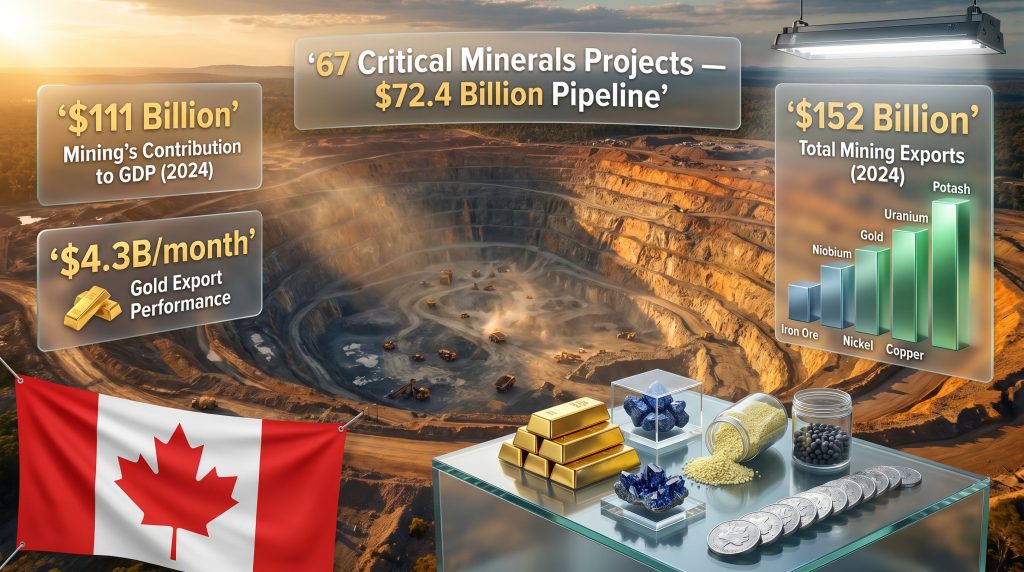
The raw economic data tells a story of considerable scale. According to the Mining Association of Canada's 2026 Facts & Figures report, the sector contributed $111 billion to Canada's GDP in 2024, representing 3.6% of the entire national economy. Direct employment across the sector stands at 438,000 workers, with a further 272,000 indirect roles supported across supply chains, services, and regional economies, producing a total economic footprint of approximately 710,000 jobs nationwide.
The sector's compensation profile is particularly striking. The average annual mining wage sits at $146,213, compared with a national average of $78,098. That 87% wage premium reflects the technical sophistication of modern mining operations and positions the sector as one of Canada's highest-productivity employers.
On the trade side, total mining exports reached $152 billion in 2024, with gold emerging as a standout performer. Gold exports averaged $4.3 billion per month during the first ten months of 2025, underscoring Canada's emergence as the world's fourth-largest gold producer, a ranking that represents a significant rise from historical positioning.
| Metric | Value |
|---|---|
| Mining contribution to GDP (2024) | $111 billion (3.6% of economy) |
| Direct employment | 438,000 jobs |
| Indirect employment supported | 272,000 jobs |
| Total economic footprint | ~710,000 roles |
| Average annual mining wage | $146,213 |
| National average wage | $78,098 |
| Total mining exports (2024) | $152 billion |
| Gold export monthly average (Jan–Oct 2025) | $4.3 billion/month |
| Share of global non-ferrous exploration budgets | ~20% |
| Canadian-HQ firms' share of global exploration | 38% of worldwide budgets |
| Public mining companies on Toronto exchanges | 43% of global listed miners |
Canada also commands a dominant position in global exploration finance. Approximately 20% of all non-ferrous exploration budgets worldwide are directed toward Canadian projects, while Canadian-headquartered companies control 38% of worldwide exploration budgets in aggregate. Toronto's exchanges host 43% of the world's publicly listed mining companies, cementing Canada's status as the global capital market hub for mining investment.
Where Canada Leads and Where It Is Losing Ground
Canada's commodity leadership is concentrated in sectors where it has operated at scale for decades. The country is the world's largest potash producer, ranks among the top three uranium producers globally, and is a major supplier of niobium, palladium, and cadmium. Gold production growth has been particularly strong in recent years.
Against these strengths sits a troubling trend across several base metals. Production of copper, nickel, and iron ore has all declined over the past decade, according to the MAC's 2026 report. For copper and nickel specifically, this contraction carries strategic implications beyond domestic economics. Both metals are foundational to electric vehicle manufacturing, grid-scale energy storage, and defence applications. A Canada that cannot grow copper and nickel output struggles to serve the allied supply chain diversification agenda that Western governments are actively pursuing.
The Four Structural Frictions Eroding Canada's Competitiveness
Understanding why production growth has stalled across key commodities requires looking past commodity prices and geological factors to the structural environment surrounding project development. Four interconnected frictions are collectively constraining Canada mining sector competitiveness.
1. Regulatory Layering and Approval Uncertainty
Canada's project approval framework requires proponents to navigate simultaneous federal and provincial regulatory processes, each with distinct mandates, timelines, and consultation requirements. Unlike jurisdictions that have moved toward single-window approvals, Canada's system creates layered duplication that extends pre-construction timelines and inflates costs before a single tonne of ore is mined.
The MAC's 2026 report is direct on this point. Mining projects in Canada must traverse multiple layers of approvals before construction can begin, and while some reform initiatives have been launched, meaningful duplication persists. The association calls specifically for:
- Eliminating duplicated approval requirements between federal and provincial regulators
- Establishing binding timelines for permitting decisions
- Improving intergovernmental coordination without compromising environmental standards or Indigenous rights
- Extending the Canadian Exploration Expense (CEE) to cover feasibility and development-stage studies
- Making brownfield mine expansion development costs fully eligible for applicable tax credits
For international capital allocators comparing jurisdictions, regulatory uncertainty is a direct cost. Every additional month in the permitting queue is a month of carrying costs, a month of opportunity for competing projects in faster-moving jurisdictions to lock up offtake agreements, and a month during which commodity price cycles can shift the economics of a project from viable to marginal.
2. Infrastructure Gaps in the North
Canada's most significant undeveloped mineral deposits are disproportionately located in northern and remote regions where road, rail, power, and port infrastructure ranges from inadequate to nonexistent. This creates what might be called a structural stranding problem, where deposits that are geologically excellent and economically viable in principle cannot be developed in practice because the cost of building enabling infrastructure exceeds project-level economics.
The MAC identifies investment in trade-enabling infrastructure as a core competitiveness requirement, noting that northern corridor development and port capacity represent long-standing priorities that have received insufficient capital commitment. Energy access for remote operations remains a significant operating cost burden, though on-site renewable generation and electrification projects are beginning to address this challenge at the individual project level.
Canada's northern mineral deposits represent some of the world's most significant undeveloped resources. The absence of connecting infrastructure does not diminish their geological value. It simply ensures that value accrues to whichever jurisdiction addresses its infrastructure deficit first.
3. The Processing Capacity Deficit
Perhaps the most strategically consequential gap in Canada's mining competitiveness profile is its declining domestic processing capacity. Over the past two decades, Canada has progressively shifted toward exporting raw or minimally processed minerals, capturing only the earliest and least profitable portion of the value chain.
This matters for two distinct reasons. First, it is an economic efficiency problem. Value-added processing of copper concentrate into refined copper, or lithium spodumene into battery-grade lithium carbonate, multiplies the revenue per tonne of ore extracted. A jurisdiction that exports raw materials and reimports processed products is effectively transferring economic activity, employment, and industrial capability to its trading partners.
Second, and more critically in the current geopolitical climate, it is a supply chain vulnerability. Much of the world's mineral refining and processing capacity is controlled by Chinese state-linked enterprises. A Canada that extracts critical minerals and sends them offshore for processing is not a reliable strategic supplier. This dynamic directly undermines the broader agenda of critical minerals and energy security that Western allies are urgently pursuing.
4. Labour Market Tightness and Skills Constraints
Sector unemployment below 3.5% signals a labour market operating near full capacity, with limited ability to absorb rapid growth in project activity. Demand for skilled mining workers has risen approximately 40% since 2022, driven by a combination of new project development activity and the structural uplift in demand created by the global energy transition.
Indigenous workforce participation represents both an ethical imperative and a practical solution to this constraint. More than 12,000 Indigenous Canadians are currently employed across the sector, supported by over 500 active partnership agreements between mining companies and Indigenous communities. Expanding this participation addresses labour supply constraints while simultaneously strengthening the social licence that underpins project viability.
Canada vs. the World: How the Competitive Landscape Compares
Canada's primary competitor for critical minerals investment capital is Australia. Both countries occupy top-tier positions in global exploration investment rankings, maintain strong ESG credentials, and benefit from geopolitical alignment with the United States and other Western allies. Furthermore, Australia's critical minerals push has gained considerable momentum, creating a perception advantage among international project developers that Canada has not yet fully countered.
Chile commands the global lithium market and maintains strong copper production, though its processing capacity remains limited relative to extraction volumes. The United States is accelerating its own critical minerals development agenda through a series of fiscal incentive structures, though permitting challenges remain a constraint at the federal level. Scandinavian jurisdictions, particularly Finland and Sweden, are increasingly competitive for rare earth and battery metal investment, leveraging advanced processing capabilities and streamlined approval frameworks.
| Competitiveness Dimension | Canada | Australia | Chile | United States |
|---|---|---|---|---|
| Regulatory Approval Speed | Moderate to slow | Moderate | Moderate | Variable |
| Processing Capacity | Declining | Moderate | Limited | Growing |
| Infrastructure Quality | Gaps in the north | Strong | Moderate | Strong |
| ESG and Environmental Standards | World-leading | High | Moderate | Variable |
| Geopolitical Alignment with Allies | Strong | Strong | Neutral | Strong |
| Exploration Investment Attraction | Top global destination | Second globally | Regional leader | Growing |
The China dimension complicates the competitive calculus for all Western mining jurisdictions. Chinese state-backed enterprises have maintained dominant positions in mineral processing for lithium, cobalt, rare earths, and nickel, effectively controlling the refining chokepoint for most battery supply chains. State-subsidised overproduction in key battery metals has periodically depressed spot prices to levels that make higher-cost Canadian project economics difficult to justify on standalone commercial terms. Canada's strategic response must therefore centre on allied market commitments and offtake agreements with US and European industrial partners rather than competing on unit cost with subsidised producers.
The $72.4 Billion Pipeline: Canada's Critical Minerals Opportunity
Canada has identified 67 critical minerals projects valued at approximately $72.4 billion, targeted for development through to 2034. These projects span lithium, cobalt, nickel, graphite, rare earths, and copper. Collectively, they represent Canada's most concrete opportunity to establish itself as a preferred allied supplier of the materials underpinning the global energy transition and advanced manufacturing base.
Global demand for critical minerals is projected to rise by 71% by 2030, creating a defined but narrowing window during which Canada can establish production and processing capacity before supply chains consolidate around other jurisdictions. The window is narrow because infrastructure and processing facilities take years to build, and because offtake relationships between producers and battery makers or defence contractors tend to be sticky once established.
Growth commodity highlights within the pipeline include:
- Potash: Canada is already the world's dominant producer. The BHP Jansen potash project is expected to begin production in 2027, adding substantial new capacity to a sector where Canada already commands global market leadership.
- Lithium: Junior exploration spending reached $2 billion in 2024 as developers compete to position Canadian lithium assets within Western battery supply chains.
- Graphite: Production expansion is accelerating as anode material demand from EV battery manufacturers intensifies globally.
- Gold: Already contributing $4.3 billion per month in export value, gold remains the sector's highest-value export commodity and continues to grow.
The risks to this pipeline are well-defined. Permitting delays can convert economically viable projects into stranded assets if timelines extend beyond the capital commitment windows of project sponsors. Infrastructure gaps in remote regions can render northern projects uneconomical regardless of grade or commodity price. Persistent commodity price suppression by state-subsidised competitors can, furthermore, erode the return profiles that international capital requires to commit to long-duration mining investments.
What Budget 2025 Delivered and What Still Needs to Happen
Federal Budget 2025 introduced expanded eligibility criteria for exploration tax credits and clean technology tax credits, alongside new infrastructure and strategic investment initiatives that the MAC has acknowledged as meaningful progress. However, the association's position is clear: the effectiveness of these measures will ultimately depend on the speed and quality of implementation rather than the policy design itself.
In addition to existing explorer funding incentives, the MAC has called for extending the Canadian Exploration Expense to cover feasibility studies and other development-stage work, and for making development costs for brownfield mine expansions fully eligible for tax credit treatment. These changes would meaningfully reduce the capital cost of advancing projects through the pre-production stages where financing is most constrained and risk is highest.
The broader MAC reform agenda distils to five interconnected priorities:
- Permitting reform through reduced federal-provincial duplication and predictable approval timelines
- Fiscal incentive expansion covering feasibility stages and brownfield development costs
- Infrastructure investment prioritising trade-enabling northern corridors and port capacity
- Geoscience strengthening through the Pan-Canadian Geoscience Strategy to improve mineral resource mapping and reduce exploration risk
- Investment climate improvement across the full project development lifecycle for both domestic and international capital
The junior exploration incentive scheme represents one mechanism through which early-stage project development can be supported, particularly for junior companies without the balance sheet depth of majors to absorb extended pre-production timelines.
The next major ASX story will hit our subscribers first
Indigenous Partnership: From Compliance Obligation to Competitive Differentiator
Canada's framework of Indigenous consultation and partnership is frequently cited in industry discussions as a source of project approval complexity. This framing, while understandable from a narrow timeline perspective, misses the more important strategic dynamic.
Projects developed in genuine partnership with Indigenous communities demonstrate greater durability of social licence, reduced litigation risk, and more favourable ESG profiles that attract institutional capital subject to responsible investment mandates. The 500+ active partnership agreements and 12,000+ Indigenous employees across the Canadian mining sector represent a foundation that competitors in less stable or less rights-respecting jurisdictions simply cannot replicate.
As global institutional investors increasingly screen for social licence quality and Indigenous rights frameworks, Canada's approach becomes a genuine competitive advantage rather than a constraint, provided the consultation process is designed for efficiency and certainty alongside rigour.
Two Scenarios for 2030: The Fork in the Road
Canada's mining trajectory through the end of this decade will be shaped by choices made in the next two to three years. Two distinct scenarios are plausible.
The high-competitiveness pathway requires a single-window approval framework operational by 2027, full implementation of brownfield expansion tax credits, funded northern infrastructure corridors under construction, domestic processing capacity established across at least three critical mineral categories, and binding offtake agreements secured with US and European industrial partners. Under these conditions, Canada could credibly capture a 25 to 30% share of allied critical mineral supply chain demand by 2030, with the $72.4 billion pipeline substantially de-risked.
The stagnation pathway emerges if regulatory reform stalls, infrastructure investment remains deferred, and processing capacity continues to decline. In this scenario, 15 to 20 projects in the current pipeline drift beyond their economic viability windows, capital migrates to faster-moving jurisdictions, and Canada retains its geological endowment while surrendering project execution credibility. Canada's energy transition challenges add further complexity to this outlook, compounding the structural pressures already facing the sector.
The global energy transition is generating a demand surge for critical minerals that will not wait for the slowest jurisdiction to reform. Canada's window is measured in years. Structural reforms deferred are not merely delayed. They are market positions permanently surrendered to competitors who moved faster.
Frequently Asked Questions: Canada Mining Sector Competitiveness
What is Canada's most valuable mining export?
Gold currently leads Canadian mining exports, averaging $4.3 billion per month during the first ten months of 2025, against total mining exports of $152 billion in 2024.
How many Canadians work in mining directly and indirectly?
The sector directly employs 438,000 Canadians and supports a further 272,000 indirect roles, for a combined economic footprint of approximately 710,000 jobs.
Why has copper and nickel production declined in Canada?
Aging mine infrastructure, multi-year permitting delays for replacement projects, capital allocation challenges driven by commodity price suppression from state-subsidised competitors, and infrastructure constraints in remote regions have collectively limited output growth. According to the Mining Association of Canada, addressing these structural issues is central to restoring Canada mining sector competitiveness across base metal categories.
What is the total value of Canada's critical minerals project pipeline?
The MAC has identified 67 critical minerals projects with a combined estimated value of approximately $72.4 billion, with development targeted through 2034.
How does Canada's mining competitiveness compare to Australia's?
Both countries are top global mining destinations with strong ESG credentials and Western geopolitical alignment. Australia has generally advanced further on regulatory reform and domestic processing investment. Canada holds advantages in critical mineral diversity, exploration capital attraction, and proximity to the US market.
What reforms is the mining industry calling for?
The MAC's 2026 industry report calls for streamlined federal-provincial permitting, extended tax credits for exploration and development stages, investment in northern trade-enabling infrastructure, improved geoscience mapping, and stronger conditions for project-level investment across the development lifecycle. A detailed overview of these priorities is available through the MAC's competitiveness framework, which outlines the sector's case for urgent structural reform.
This article draws on publicly available data and industry reporting, including the Mining Association of Canada's 2026 Facts & Figures report as covered by Mining Weekly. Forecasts, pipeline valuations, and demand projections referenced throughout are estimates subject to material change based on commodity market conditions, policy developments, and project-specific variables. Nothing in this article constitutes financial or investment advice.
Want to Know Which ASX Mining Discoveries Could Deliver the Next Major Return?
While Canada's $72.4 billion critical minerals pipeline highlights the global scale of mining opportunity, Discovery Alert's proprietary Discovery IQ model scans ASX announcements in real time, instantly identifying significant mineral discoveries across gold, copper, nickel, and more than 30 other commodities before the broader market reacts. Explore historic discoveries and the returns they generated, then begin your 14-day free trial to position yourself ahead of the next major find.