
May 14, 2026
When Supply Chains Meet Sanctions: The Fragile Architecture of Global Oil Trade
Energy markets rarely operate in isolation from geopolitical forces, and few situations illustrate this more starkly than the intersection of US sanctions policy and the crude oil dependency of the world's most populous nation. When sanctions frameworks collide with the energy security calculus of a major importing economy, the result is rarely clean or ideologically consistent. What emerges instead is a layered system of conditional permissions, time-limited carve-outs, and diplomatic signalling that keeps global crude flows moving while maintaining the appearance of regulatory coherence.
This is precisely the context in which India seeks extension of US waiver on Russian oil imports, a situation that exposes the fault lines between geopolitical pressure and the hard economics of energy security. Furthermore, understanding this dynamic requires examining both the sanctions on Russian oil trade and the broader market forces that shape policy decisions in Washington.
When big ASX news breaks, our subscribers know first
Why the US Sanctions Waiver on Russian Oil Matters More Than It Appears
The Architecture of the Waiver: What Was Actually Authorised
Not all sanctions instruments are created equal. The US Treasury's Office of Foreign Assets Control routinely distinguishes between blanket prohibitions, targeted designations, and conditional authorisations. The waiver covering Russian crude imports falls into the third category: a narrow, time-limited licence that permits specific activities that would otherwise risk triggering secondary sanctions exposure.
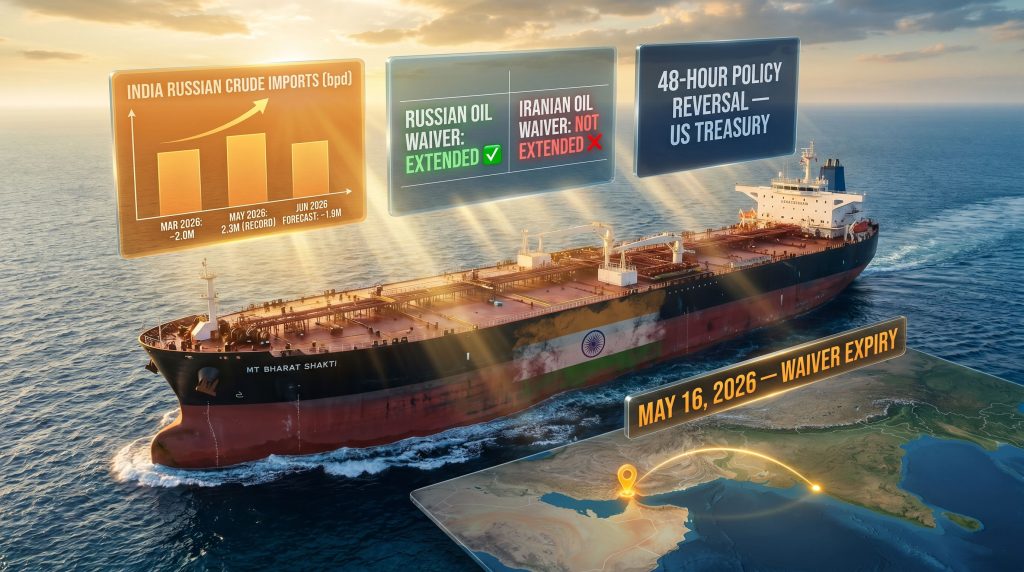
The initial India-specific authorisation was issued on March 5, 2026, before being expanded into a broader global authorisation covering additional importers. This expanded licence carried an expiry date of May 16, 2026, specifically covering the delivery of already-loaded cargoes. That final element, known as a stranded cargo provision, is legally meaningful. It acknowledges the practical reality that crude oil shipments require weeks of transit time and cannot be halted mid-voyage without causing significant market disruption and contractual disputes.
The waiver does not signal a relaxation of the broader Russia sanctions architecture. It is a market-stabilisation mechanism with a fixed expiry, not an ideological repositioning by Washington.
A critical distinction worth understanding is that Russian crude oil does not face the same blanket sanctions structure applied to Iranian oil. Washington has applied diplomatic pressure to encourage India to reduce Russian purchases, framing this as part of broader efforts to constrain Moscow's energy revenues. However, the legal exposure for importing Russian crude is categorically different from importing Iranian oil, which remains under comprehensive prohibition.
How a 48-Hour Policy Reversal Revealed the Real Pressure Points
From Non-Renewal to Renewed Licence in Under Two Days
One of the most revealing aspects of this episode is not the waiver itself, but the speed and manner in which US policy reversed course. According to Reuters, around May 12 to 13, 2026, US Treasury Secretary Scott Bessent indicated publicly that the waiver would not be renewed. Within approximately 48 hours, the Treasury published a renewed licence on its official website, effectively overturning that position without fanfare.
This kind of rapid reversal is uncommon in sanctions policy, where even minor changes to authorised activities typically involve extended interagency review processes. The speed of the reversal points to significant behind-the-scenes pressure from multiple directions simultaneously.
Several converging forces appear to have driven the outcome:
- Global crude price volatility intensified by West Asia supply disruptions created immediate market instability that policymakers could not ignore.
- Strait of Hormuz transit risk elevated the cost and insurance premiums associated with conventional supply routes, making alternative sourcing economically painful for importers.
- Lobbying from importing nations and downstream refiners created a coalition of economic stakeholders with strong incentives to push for continuation.
Notably, the Iranian oil waiver was not extended during this same window, reinforcing the interpretation that the Russian carve-out is driven by market conditions rather than any broader reassessment of geopolitical posture.
Comparing the Two Waiver Decisions: Russia vs. Iran
| Factor | Russian Oil Waiver | Iranian Oil Waiver |
|---|---|---|
| Extension granted (May 2026) | Yes | No |
| Policy justification | Market stabilisation | Geopolitical pressure maintained |
| Primary beneficiary | India and global importers | Not applicable |
| Cargo coverage | Already-loaded vessels | Not applicable |
| Secondary sanctions risk | Conditional and manageable | Comprehensive prohibition maintained |
The asymmetry between these two decisions is analytically important. It tells market observers that the US is willing to prioritise crude market stability over ideological consistency when the economic stakes are high enough, but only selectively and only within defined parameters. Consequently, the oil markets and trade war dynamics continue to shape how these decisions unfold in practice.
What Is India's Strategic Energy Position in This Equation?
The Scale of Dependency and the Economics of Discounted Crude
India ranks among the world's largest crude oil importers by volume, with a structural dependency on seaborne crude that makes supply route disruptions acutely painful. The ongoing West Asia conflict has complicated access to conventional supply corridors, with approximately half of India's standard import routes exposed to elevated risk and cost.
Against this backdrop, discounted Russian Urals crude has offered Indian state-owned refiners a compelling economic proposition. The price differential between Russian grades and Middle Eastern or West African alternatives represents a meaningful cost advantage that flows directly into refinery margins and, ultimately, downstream fuel pricing for consumers.
The data on India's import behaviour during the waiver window is striking:
| Period | Russian Crude Import Volume | Key Driver |
|---|---|---|
| Post-waiver (March 2026) | Approximately 2.0 million bpd | Initial authorisation and refinery ramp-up |
| May 2026 (peak recorded) | 2.3 million bpd (record high) | Pre-deadline cargo loading surge |
| May 2026 (full-month forecast) | Approximately 1.9 million bpd | Kpler predictive modelling estimate |
The pre-deadline surge to a record 2.3 million barrels per day in May 2026 is a textbook example of rational market behaviour under regulatory uncertainty. Indian refiners, recognising the finite window of the authorisation, maximised cargo loading to lock in supply at advantageous pricing before the May 16 cutoff. These oil price movements reflect the broader volatility shaping energy procurement decisions across the region.
Why India's Official Silence Speaks Volumes
Both India's Oil Ministry and the Ministry of External Affairs declined to comment publicly on the waiver extension request. This deliberate absence from the public record reflects a well-established posture: New Delhi consistently frames energy procurement decisions as sovereign economic choices rather than political statements. By remaining silent, Indian officials avoid being seen as either endorsing US sanctions policy or openly defying it.
This matters for a deeper reason. Indian officials communicated to their US counterparts, through direct channels rather than public statements, that energy supply stability is a national economic priority. The downstream concern cited was significant: prolonged supply disruptions carry the risk of worsening cooking gas shortages affecting tens of millions of Indian households, a politically sensitive issue with direct implications for domestic stability.
What Happens to India's Oil Supply If the Waiver Is Not Renewed?
The Counterfactual: Higher Costs, Wider Deficits, and Downstream Inflation
The economic consequences of a waiver expiry without renewal would not be abstract. Indian state-owned refiners would face an immediate need to source replacement crude from higher-cost markets. The realistic alternatives carry meaningful price premiums:
- Middle Eastern light and medium grades, priced at or near Brent benchmarks
- West African crude varieties such as Nigerian Forcados, similarly Brent-linked
- US WTI grades, which carry transatlantic freight costs that erode pricing advantages
Each of these alternatives would increase crude acquisition costs for Indian refiners compared to discounted Russian Urals. Those increased costs would eventually flow through to domestic fuel pricing, LPG supply chains, and ultimately the consumer price index. For an economy where fuel and cooking gas costs carry significant political weight, the inflationary pass-through risk is not trivial.
India's current account deficit is also structurally sensitive to crude price movements. Elevated acquisition costs for the nation's largest single import category would widen the deficit, creating pressure on the rupee and potentially tightening broader monetary conditions.
Short-Term Certainty vs. Long-Term Structural Vulnerability
The waiver, even when extended, only provides planning certainty within its defined window. Refiners operating under time-limited authorisations face an inherent challenge: capital allocation decisions, supply agreements, and hedging strategies all require longer-term visibility than a rolling 60-to-90 day licence provides.
This structural ambiguity explains the aggressive inventory-building behaviour observed ahead of the May 16 deadline. Strategic cargo loading serves as a risk mitigation tool when regulatory certainty is unavailable, effectively using physical storage to bridge the policy uncertainty gap.
How the West Asia Conflict Reshapes the Geopolitics of Russian Oil
The Hormuz Chokepoint as a Structural Catalyst for Policy Change
The Strait of Hormuz represents one of the most consequential geographic bottlenecks in global energy markets. A significant share of the world's seaborne crude transits this narrow passage, and any credible threat to its operational integrity sends ripple effects through global pricing and insurance markets.
The ongoing Iran conflict has elevated war risk premiums, complicated vessel scheduling, and introduced genuine uncertainty into the routing calculus for energy importers across Asia. For India specifically, where geographic proximity makes the Gulf a primary supply region, this disruption carries outsized consequences.
Russian Urals crude, delivered via Arctic and Baltic routes entirely outside the Hormuz risk zone, has functionally served as a conflict hedge for Indian refiners. The economic logic is straightforward: replace disrupted barrels that carry elevated logistics risk with discounted barrels routed through lower-risk sea lanes. In addition, the geopolitical oil price pressures stemming from the conflict continue to reinforce this substitution dynamic.
The Sanctions Consistency Problem
Critics of the waiver policy raise a legitimate structural concern: selective, market-driven authorisations risk undermining the credibility of the broader Russia sanctions framework. If sanctioned parties and their trading partners observe that economic pressure generates regulatory relief, the deterrent logic of sanctions begins to erode at the margins.
The optics are also notable. As reported by Bloomberg, the US is simultaneously maintaining comprehensive prohibition on Iranian oil while relaxing restrictions on Russian crude access — a distinction that requires careful diplomatic management with Gulf partners and other regional stakeholders who interpret US energy policy as a signal of geopolitical priorities. Furthermore, the broader geopolitical trade tensions in the region only amplify the complexity of these competing policy signals.
The next major ASX story will hit our subscribers first
Three Scenarios for Post-May 16 Policy Direction
The waiver's expiry creates genuine uncertainty across three plausible trajectories:
- Rolling short-term extensions remain the most likely near-term outcome given the market stabilisation rationale. Indian refiners maintain access to Russian crude but operate under persistent planning uncertainty as each renewal cycle approaches.
- Full waiver expiry without renewal would force an immediate pivot to alternative crude sources, generating higher acquisition costs, current account pressure, and downstream inflationary risk. This outcome appears less likely given the 48-hour reversal episode that preceded the May 16 deadline.
- Broader policy recalibration involving a more durable framework, potentially linked to India-US bilateral energy dialogue or broader trade negotiations, remains speculative but represents the most strategically coherent resolution for both parties.
Disclaimer: The scenario projections outlined above represent analytical interpretations based on publicly available information and known policy frameworks. They do not constitute investment advice or predictive claims about future regulatory outcomes. Sanctions policy is inherently subject to rapid change based on geopolitical developments that cannot be reliably forecast.
Key Takeaways: India's Russian Oil Waiver at a Glance
- The initial India-specific waiver was issued on March 5, 2026, later expanded globally, with the current authorisation expiring May 16, 2026.
- Indian officials communicated supply stability concerns to US counterparts through direct channels, citing West Asia conflict disruptions and domestic energy security risks including cooking gas shortages.
- India seeks extension of US waiver on Russian oil imports amid a record surge, with Indian crude imports reaching 2.3 million bpd in May 2026, and full-month volumes projected at approximately 1.9 million bpd based on Kpler predictive data.
- A rare 48-hour policy reversal by the US Treasury reversed an initial non-renewal announcement, reflecting the depth of market pressure and the scale of economic interests at stake.
- The Iranian oil waiver was not extended in the same window, demonstrating that the Russian carve-out operates under a distinct and market-driven policy rationale.
- Post-May 16 policy direction remains uncertain, with rolling extensions representing the most plausible near-term path but longer-term structural resolution still absent.
Readers seeking ongoing coverage of India's energy policy developments, crude import dynamics, and global energy market shifts can find related analysis and reporting through ET EnergyWorld at energy.economictimes.indiatimes.com.
Want to Stay Ahead of the Next Major Resource Discovery Shaping Global Markets?
Whilst geopolitical forces continue to reshape energy supply chains and commodity flows, Discovery Alert's proprietary Discovery IQ model scans ASX announcements in real time, delivering instant notifications on significant mineral discoveries — turning complex market signals into actionable investment opportunities before the broader market catches on. Explore how historic mineral discoveries have generated exceptional returns and begin your 14-day free trial today to position yourself ahead of the market.