August 6, 2026
The Underground Bet That Could Reshape Global Mineral Supply Chains
For most of the twentieth century, the logic of resource wealth was straightforward: whoever controlled hydrocarbons controlled geopolitical leverage. Yet a quieter, slower-moving transition has been underway beneath the surface of that assumption. As the world's industrial base reconfigures around electrification, advanced manufacturing, and clean energy infrastructure, the definition of strategic resource wealth is being rewritten. The metals and minerals required to build electric motors, grid-scale batteries, wind turbine components, and semiconductor systems are becoming the new currency of industrial power. Within that context, Saudi Arabia's mineral endowment is attracting a level of attention that would have seemed improbable two decades ago.
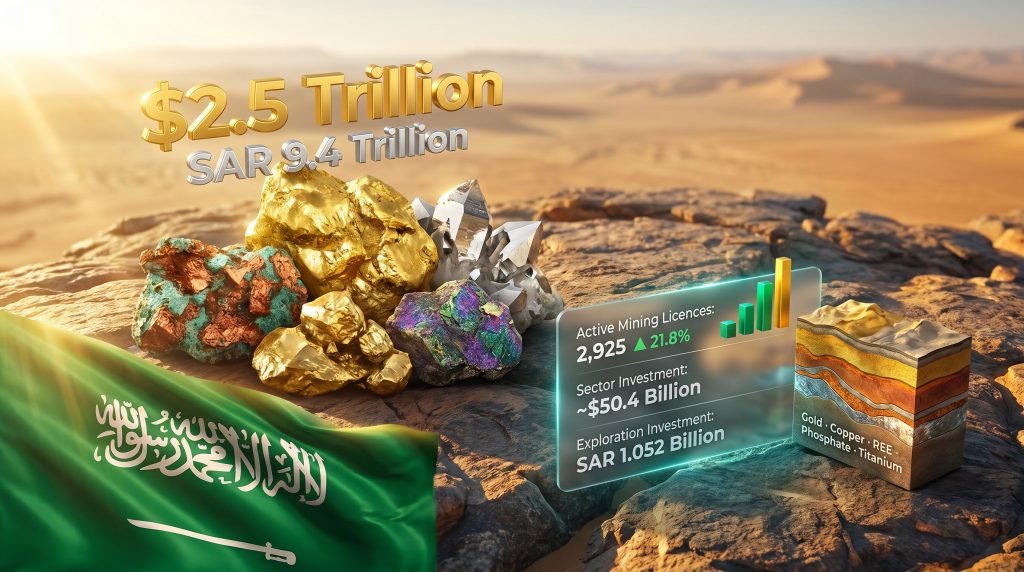
Saudi Arabia's mining wealth estimated at $2.5 trillion — specifically SAR 9.4 trillion — according to reporting by the Saudi Press Agency as cited by TradeArabia in May 2026. That figure represents far more than an accounting exercise. It signals a structural repositioning of the Kingdom within global resource markets at precisely the moment when critical minerals demand is being aggressively contested by the world's largest economies.
When big ASX news breaks, our subscribers know first
What the $2.5 Trillion Valuation Actually Represents
Before examining what this figure means for global supply chains, it is worth understanding what it is and what it is not. The SAR 9.4 trillion valuation reflects geological survey estimates conducted as part of Saudi Arabia's broader National Mining Strategy, itself a pillar of the Vision 2030 economic transformation agenda. It is a reserve valuation estimate, not a confirmed resource figure in the technical mining sense.
In mining industry terminology, resource estimates are classified on a confidence spectrum ranging from inferred resources (lowest confidence, based on limited sampling) through indicated (moderate confidence) to measured resources (highest confidence, supported by detailed drilling and sampling). Beyond that, reserves are further classified as probable or proven depending on feasibility and economic viability assessments. A government geological survey estimate of this scale will typically sit closer to the inferred end of that spectrum until independent technical audits, drilling programmes, and bankable feasibility studies are completed.
Investor note: The distinction between a government-estimated mineral wealth figure and an investment-grade resource classification is material. Historical precedent in other emerging mining jurisdictions has shown that headline valuations can be revised significantly as independent technical work advances. The $2.5 trillion figure should be understood as a ceiling of geological potential rather than a confirmed reserve base.
That caveat acknowledged, the directional signal remains significant. Saudi Arabia's subsurface has been systematically underexplored relative to comparable geological terrains elsewhere in the world. The Precambrian Arabian Shield, which forms the geological backbone of the western part of the Kingdom, is a craton-scale rock formation of substantial age whose mineral-forming potential has been incompletely mapped. Cratons of equivalent age and structural character, such as the West African Craton and the Canadian Shield, host world-class deposits of gold, copper, and base metals. The Arabian Shield equivalent has received a fraction of the exploration investment directed at those formations over the past century.
The Mineral Composition: Why the Mix Matters More Than the Total
The headline valuation draws attention, but the composition of Saudi Arabia's reserve base is what makes the strategic calculus genuinely interesting. The Kingdom's identified mineral assets span a range that aligns directly with the demand profile generated by the global energy transition. Furthermore, the breadth of the commodity mix strengthens the case that this is not a single-commodity story but a diversified resource opportunity.
Key mineral categories within the Saudi reserve base include:
- Gold and copper, concentrated within the Arabian Shield geological formation, with estimates suggesting substantial reserve life horizons for both commodities
- Rare earth elements (REEs), which carry outsized strategic weight given that global REE processing capacity remains heavily concentrated in China, creating supply chain vulnerability for Western industrial nations
- Phosphate, which connects to global food security themes through fertiliser production and is increasingly relevant to emerging battery chemistry research
- Titanium, a high-value metal with demand concentrated in aerospace, defence, and clean energy turbine manufacturing
- Base metals including zinc and lead across polymetallic deposit zones that remain underexplored
The strategic significance of REEs in particular deserves careful framing. Rare earth elements are not rare in the geological sense; they are relatively abundant in the Earth's crust. What makes them strategically sensitive is that economic deposits require specific geological conditions to form. Consequently, the processing of REE ore into usable separated oxides involves complex hydrometallurgical techniques where China has built a commanding industrial advantage over decades.
Rare earth supply chains outside Chinese-controlled networks are therefore not simply an economic opportunity but a geopolitical one. Whether Saudi Arabia's REE deposits are of sufficient grade and scale to compete as a processing source remains to be fully established through technical work.
2025 Sector Performance: Reading the Metrics Correctly
The confirmed performance data for Saudi Arabia's mining sector in 2025 provides the most reliable foundation for assessing the trajectory of this transformation.
| Metric | 2025 Figure | Notes |
|---|---|---|
| Total mineral wealth estimate | SAR 9.4 trillion (~$2.5 trillion USD) | Government geological survey estimate |
| Sector investment | SAR 189.4 billion (~$50.4 billion USD) | Total capital deployed across sector |
| GDP contribution | SAR 138 billion | Direct mining sector contribution |
| Active mining licences | 2,925 | Up from 2,401 in 2024 |
| Year-on-year licence growth | 21.8% | Calculated increase: 2,401 to 2,925 |
Source: Saudi Press Agency as reported by TradeArabia/Zawya, May 2026
The 21.8% year-on-year growth in active mining licences is the metric most worth examining from an investor psychology perspective. Licence issuance is a leading indicator of sector momentum rather than a lagging one. It measures the pipeline of exploration and development activity rather than current production, which means it tells us something about where the sector will be in three to five years rather than where it is today. The expansion of Saudi mining licences typically precedes reserve upgrades, resource announcements, and eventually production milestones by a multi-year lag.
The separation between total sector investment (SAR 189.4 billion) and GDP contribution (SAR 138 billion) also reveals something important: capital is currently flowing into the sector at a rate that substantially exceeds its current economic output. This pattern is characteristic of an industry in active build-out phase, where upfront capital expenditure on exploration, infrastructure, and processing facilities precedes the production revenues that will eventually generate GDP contribution.
The Industrial Ecosystem Strategy: Beyond Raw Extraction
One of the less-discussed dimensions of Saudi Arabia's mining ambition is the deliberate effort to build industrial depth around the mineral extraction base rather than simply exporting raw ore. This downstream integration logic reflects a hard-learned lesson from the history of resource-dependent economies: exporting unprocessed commodities generates far less economic value per tonne than exporting processed or refined materials, let alone finished manufactured goods.
The 2025 industrial achievements reported alongside the mining sector data illustrate this broader ecosystem-building approach concretely. The foundation stone for a Hyundai Motor Company manufacturing plant with an annual production capacity of 50,000 vehicles was laid during 2025, described explicitly as supporting the localisation of the automotive industry and enhancing local content. Separately, the Kingdom launched its first integrated biologics plant alongside an insulin manufacturing facility capable of producing 15 million pens annually, framed as advancing pharmaceutical security and self-sufficiency in healthcare industries.
These investments are not directly mining projects, but they reveal the logic of the broader industrial policy: build a manufacturing base capable of absorbing and processing domestically sourced materials while simultaneously reducing import dependence across multiple strategic sectors. In mining-adjacent terms, this means that the infrastructure, skilled workforce, regulatory capacity, and logistics networks being built for automotive and pharmaceutical manufacturing also create enabling conditions for mineral processing and refining industries. Saudi exploration licences and downstream industrial investment, furthermore, appear to be advancing in deliberate parallel rather than in sequence.
The combination of resource extraction ambition and downstream manufacturing investment represents a more sophisticated approach to resource industrialisation than simple ore export strategies pursued by many emerging mining jurisdictions.
Structural Risks That Investors and Observers Should Not Overlook
A balanced assessment of Saudi Arabia's mining transformation requires honest engagement with the execution challenges that could constrain the sector's development trajectory.
Water scarcity is perhaps the most fundamental operational constraint. Large-scale mineral processing operations, particularly hydrometallurgical facilities for REE separation or copper refining, require substantial water inputs. Saudi Arabia's arid environment means that water for industrial mining operations must either be sourced from desalination, trucked from distant sources, or recycled through closed-loop systems. Each of these options adds cost and complexity relative to mining operations in water-abundant jurisdictions.
Reserve classification risk is the technical challenge of converting geological survey estimates into bankable resource figures. The journey from a government-estimated mineral wealth number to an investment-grade resource classification requires independent geological auditing, systematic drilling programmes, metallurgical testing, and full feasibility studies. This process takes years and frequently results in revisions to initial estimates as the quality and continuity of mineralisation becomes better understood.
Fiscal regime competitiveness matters enormously for attracting the international mining majors and mid-tier producers whose technical expertise and capital are needed to advance projects. Saudi Arabia's royalty structures, profit-sharing arrangements, and local content requirements will be benchmarked by potential investors against established mining jurisdictions including Australia, Canada, and Chile. Where those terms are less competitive, project economics suffer.
Geopolitical context adds a layer of uncertainty that cannot be modelled with precision. The broader GCC region has experienced periods of elevated geopolitical tension that affect investor risk perception, insurance costs, and financing terms for large capital projects, regardless of the specific conditions within Saudi Arabia itself.
The next major ASX story will hit our subscribers first
Scenario Projections: Three Pathways to 2035
Given the variables in play, three broad development scenarios frame the range of plausible outcomes for Saudi Arabia's mining sector through 2035.
| Scenario | Core Assumptions | Projected Annual GDP Contribution | Key Risk Factors |
|---|---|---|---|
| Accelerated Development | Exploration capital fully deployed, major international joint ventures established, bidding rounds oversubscribed | SAR 300 billion+ | Dependent on water and power infrastructure scaling to match ambition |
| Base Case Progression | Steady licence growth, moderate foreign direct investment, incremental infrastructure build | SAR 180-220 billion | Vision 2030 targets broadly met; sector doubles from current base |
| Execution Constrained | Infrastructure delays, geological disappointments, geopolitical disruption to FDI flows | SAR 100-130 billion | Sector grows but underperforms stated ambitions; reserve upgrades lag |
Note: Scenario projections are speculative analytical constructs and should not be taken as forecasts. Actual outcomes will depend on commodity prices, geological results, capital market conditions, and geopolitical factors that cannot be predicted with certainty.
The Geopolitical Dimension: A New Front in the Critical Minerals Race
The global competition for critical mineral supply security has intensified considerably as Western industrial nations and their allies pursue strategies to diversify away from single-source dependency. This is particularly acute for materials where Chinese processing and refining dominance creates structural vulnerability. In this context, energy transition minerals are increasingly at the centre of strategic national policy decisions across multiple governments simultaneously.
Why Does Saudi Arabia's Position Matter Geopolitically?
Saudi Arabia's emerging role in this landscape is genuinely novel. The Kingdom occupies a position that few other mineral-rich nations can replicate: it has substantial capital reserves from hydrocarbon revenues available to co-invest in infrastructure and processing capacity, existing diplomatic relationships spanning both Western and Asian economies, and a mineral endowment that aligns with the specific commodity categories most urgently sought by supply chain diversification programmes. According to analysis published by Arab News, the Kingdom's strategic positioning within global mineral markets is being closely monitored by international investors and policymakers alike.
Whether Saudi Arabia ultimately becomes a preferred partner jurisdiction for Western nations seeking non-Chinese REE and critical metal supply chains will depend on factors that extend beyond geological potential. The terms on which international mining companies can access deposits, the transparency and predictability of the regulatory environment, and the pace at which processing infrastructure can be built domestically will all determine whether the Kingdom's mineral wealth translates into actual supply chain integration with allied industrial economies.
The 21.8% growth in active mining licences, the expansion of exploration investment, and the confirmed sector investment figures for 2025 collectively suggest the build-out is progressing. However, as CNN's coverage of the Saudi minerals investment conference highlights, whether it progresses at the pace and scale that the SAR 9.4 trillion headline figure implies remains the central question that the next decade of geological and industrial work will answer.
Frequently Asked Questions
What is Saudi Arabia's total estimated mineral wealth?
Saudi Arabia's mining wealth estimated at $2.5 trillion is expressed formally as SAR 9.4 trillion, based on geological surveys conducted under the Kingdom's National Mining Strategy as part of Vision 2030, according to the Saudi Press Agency.
How many active mining licences does Saudi Arabia currently hold?
As of 2025, the number of valid mining licences reached 2,925, representing a 21.8% increase from the 2,401 licences recorded in 2024, according to the Saudi Press Agency.
What minerals are most significant within Saudi Arabia's reserve base?
The most strategically relevant commodities include gold, copper, rare earth elements, phosphate, and titanium, concentrated primarily within the Precambrian Arabian Shield geological formation in the western part of the Kingdom.
How much did the mining sector contribute to Saudi GDP in 2025?
The mining sector contributed SAR 138 billion to Saudi Arabia's gross domestic product in 2025, with total sector investment reaching SAR 189.4 billion (approximately $50.4 billion USD) during the same period.
Is the $2.5 trillion figure a confirmed resource estimate?
No. The $2.5 trillion valuation is a government geological survey estimate and should not be treated as an investment-grade resource classification. Confirmed reserve figures require independent technical auditing, systematic drilling programmes, metallurgical testing, and feasibility studies that typically take several years to complete.
Disclaimer: This article contains forward-looking analysis, scenario projections, and speculative assessments that are not guarantees of future outcomes. Readers should conduct independent research and seek qualified financial and geological advice before making any investment decisions. Figures sourced from the Saudi Press Agency via Zawya/TradeArabia (May 2026) reflect government estimates and have not been independently verified by this publication.
Want to Stay Ahead of the Next Major Mineral Discovery Before the Broader Market Catches On?
Saudi Arabia's emerging critical minerals landscape is reshaping global supply chains, and Discovery Alert's proprietary Discovery IQ model delivers real-time alerts on significant ASX mineral discoveries — instantly converting complex geological data into actionable investment insights for both short-term traders and long-term investors. Explore historic examples of major discoveries and their exceptional returns, then begin your 14-day free trial at Discovery Alert to position yourself ahead of the market.