June 25, 2026
When a Multilateral Forum Becomes a Conflict Zone
Global energy markets have long operated on the assumption that the Strait of Hormuz remains open. That assumption is the invisible foundation beneath oil pricing, shipping insurance, refinery schedules, and sovereign budget projections across dozens of nations. When military activity threatens that corridor, the consequences are not contained to the belligerents — they radiate outward through every economy that depends on seaborne energy flows. In 2026, that disruption has collided directly with the institutional architecture of one of the world's most closely watched multilateral blocs.
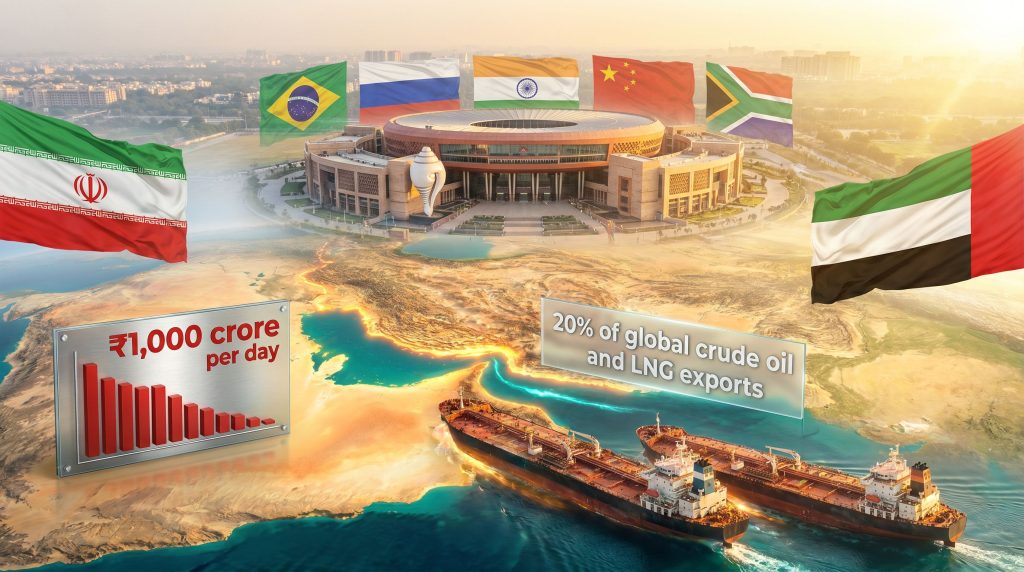
The Iran war and oil crisis are now the defining issues at the 2026 BRICS Foreign Ministers' Meeting in India, transforming what was scheduled as a structured economic cooperation forum into something closer to an emergency diplomatic session. The gathering, held on May 14 and 15 at Bharat Mandapam in New Delhi, carries weight far beyond its agenda — because the fault lines running through the Middle East now run directly through the membership list of the bloc itself.
When big ASX news breaks, our subscribers know first
The Structural Paradox at the Heart of an Expanded BRICS
When BRICS was established in 2009, its founding logic was relatively coherent: Brazil, Russia, India, China, and South Africa represented large emerging economies seeking greater collective influence within Western-dominated institutions like the International Monetary Fund and the World Bank. The bloc functioned as an advocacy forum, not a security organisation, and internal ideological divergence was manageable.
The expanded bloc looks fundamentally different. With Egypt, Ethiopia, Indonesia, Iran, and the United Arab Emirates now part of the grouping, BRICS has become far more geographically and ideologically diverse. That diversity has introduced a contradiction that no institutional design anticipated: two member states are now on opposing sides of an active military conflict.
Iran and the UAE both carry full BRICS membership. The United States and Israel launched a coordinated military campaign against Iran on February 28, 2026, and subsequent Iranian strikes on Fujairah port in UAE territory have placed these two bloc members in direct confrontation. The forum that was designed to amplify collective emerging-market voices now finds itself hosting adversaries at the same table.
Furthermore, the broader geopolitical landscape shaping these tensions has already been reshaping commodity markets well before this crisis reached its current intensity.
"This is an unprecedented stress test for the bloc's institutional design. BRICS was built on economic solidarity, not conflict mediation — yet it now contains a live military dispute between two of its own members."
India's Chairmanship: Enormous Leverage, Enormous Exposure
India holds the BRICS rotating chair in 2026, which makes New Delhi the architect of the agenda, the convener of discussions, and the face of whatever outcome emerges. Indian Foreign Minister Subrahmanyam Jaishankar is leading the two-day session, and Prime Minister Narendra Modi is scheduled to meet with attending foreign ministers, signalling how much strategic significance New Delhi is assigning to this gathering.
That chairmanship comes with real leverage — India can shape which issues are foregrounded and how discussions are framed. However, it also comes with enormous diplomatic exposure. India is simultaneously:
- A major crude oil importer that depends on Gulf energy flows for economic stability
- An investor in Iranian infrastructure through the Chabahar port project
- A trade and diplomatic partner of the UAE, which supplies between 9 and 11 percent of India's crude oil
- A country with deep bilateral ties to Russia, as evidenced by Jaishankar's engagement with Foreign Minister Sergey Lavrov on energy, trade, and connectivity issues upon his arrival in New Delhi
Each of these relationships pulls in a different direction when the subject is the Iran conflict, making India's position as chair not merely a procedural role but a genuinely consequential diplomatic balancing act.
Why the Strait of Hormuz Makes This a Global Economic Crisis
Understanding why the Iran war and oil situation dominate the BRICS agenda requires understanding what the Strait of Hormuz actually represents in quantitative terms. This narrow maritime corridor, positioned between Iran and Oman, serves as the transit point for approximately 20 percent of all global crude oil and liquefied natural gas exports. No other single chokepoint in the world carries that volume of energy cargo.
When military activity disrupts vessel movement through that corridor, the effects are not regional — they are global. Insurance premiums on maritime cargo spike immediately. Spot prices for crude oil reflect the supply uncertainty. Refinery operators in energy-importing nations begin contingency planning. Central banks in affected economies face inflationary pressure that monetary policy tools cannot easily neutralise.
The oil market impact of sustained disruptions around Gulf shipping routes and the Strait of Hormuz has continued to drive volatility in oil and gas markets since the February 28 conflict began, increasing pressure specifically on energy-importing economies. India is named explicitly as one of the most exposed.
| Energy Security Metric | Context |
|---|---|
| Strait of Hormuz share of global crude/LNG exports | Approximately 20% |
| India's crude oil sourced from the UAE | 9 to 11% of total imports |
| India's economic dependency | Structural reliance on Middle Eastern energy and fertiliser |
| Gulf disruption transmission mechanism | Price volatility, supply uncertainty, inflationary pressure |
It is worth noting that some tanker traffic through the strait has continued despite the conflict. Shipping data tracked by LSEG shows Japanese-linked crude oil carriers transiting the Hormuz corridor as recently as May 14, 2026, suggesting the disruption is characterised by elevated risk and constrained flow rather than a complete maritime blockade. This distinction matters for pricing models and for understanding the ceiling of economic damage if the conflict escalates further.
Internal BRICS Divisions: The Consensus Problem
The central diplomatic challenge at the New Delhi meeting is whether members representing fundamentally opposed positions can produce a unified public statement. The evidence suggests they cannot — at least not without significant compromise.
Iran has been actively seeking BRICS member support for statements condemning the US-Israeli military campaign. The UAE, also a member, is diplomatically aligned in opposition to Iranian military activity, particularly following strikes on Fujairah port on UAE territory. These are not abstract disagreements about trade policy or development finance architecture — they reflect live military and political hostility between member states.
Russia adds a further layer of complexity. Lavrov's attendance and his bilateral engagement with Jaishankar covered trade, energy, and connectivity frameworks, with Jaishankar noting that political cooperation becomes more valuable, not less, during periods of global uncertainty and volatility. Russia's own fraught relationship with Western powers shapes its posture on any statement that references US military action, but its interests do not align perfectly with Iran's either.
China's position is particularly consequential. Beijing has historically maintained economic relationships with both Iran and Arab Gulf states simultaneously, and the available reporting does not confirm whether Chinese representatives attended the May 14 session or what formal position Beijing has articulated on the conflict. This ambiguity is itself a signal of China's strategic preference for non-commitment in situations where alignment carries costs.
India's foreign ministry spokesman Randhir Jaiswal, when asked directly about whether a joint communiqué would be released, indicated only that the situation would develop as discussions progressed — declining to confirm any predetermined outcome. That careful non-commitment from the chair nation reflects the depth of the consensus problem.
What a Failed Joint Statement Would Actually Signal
The absence of a consensus communiqué from the New Delhi meeting would carry meaning beyond the immediate diplomatic embarrassment. BRICS has positioned itself as a credible alternative pole of global governance, capable of coordinating policy responses among major economies outside Western institutional frameworks.
If the bloc cannot produce a unified statement during one of the most significant geopolitical and energy crises of 2026, that positioning is materially weakened. For the leaders' summit scheduled later in 2026, this creates a credibility problem. Foreign ministers failing to align on basic language around a conflict involving two of their own members would place summit-level ambitions for economic coordination, de-dollarisation discussions, and development finance reform on significantly weaker institutional footing.
India's Three-Dimensional Energy Security Problem
For India specifically, the diplomatic stakes of the BRICS meeting are inseparable from concrete economic and infrastructure interests. Three distinct pressure points define New Delhi's posture at the table:
- Maritime passage security: Indian energy tankers require reliable transit through the Strait of Hormuz. Any escalation that restricts this passage translates directly into domestic energy supply disruption and price increases for Indian consumers and industry.
- Chabahar port continuity: India has made long-term infrastructure investments in Iran's Chabahar port as part of a connectivity corridor linking South Asia to Central Asia while bypassing Pakistan. Any deterioration in India-Iran relations risks undermining a project of substantial strategic and economic value that took years to develop.
- UAE supply chain protection: With the UAE supplying between 9 and 11 percent of India's crude oil, Iranian military activity on Emirati soil represents a direct threat to a critical supply relationship. The strikes on Fujairah port have elevated this concern from theoretical to operational.
Iran has indicated some willingness to provide assurances regarding safe passage for Indian-flagged vessels through the Strait of Hormuz. This signal functions as a calibrated diplomatic gesture, designed to prevent India from shifting its neutral posture toward closer alignment with Western positions on the conflict. Whether such assurances carry operational weight given the broader Gulf volatility remains an open question contingent on how the conflict evolves.
The Dollar Debate and the Longer Economic Agenda
Beneath the crisis-driven agenda, the New Delhi meeting was intended to advance substantive economic cooperation discussions that have been building across BRICS for several years. The energy price shock from the Iran conflict has paradoxically intensified rather than displaced one of those longer-term debates: reducing dependence on the US dollar for cross-border energy transactions.
An oil price shock of this magnitude compounds existing pressures on non-dollar economies, since elevated prices carry both higher commodity costs and currency conversion burdens simultaneously. Energy-importing BRICS members — particularly India, Egypt, and Ethiopia — face both higher commodity prices and currency conversion costs simultaneously. This dynamic sharpens the appeal of bilateral currency settlement arrangements and alternative payment mechanisms that BRICS members have discussed for years without producing binding frameworks.
In addition, the broader shift toward a multipolar world economy has accelerated precisely because crises like this one expose how deeply dependent emerging economies remain on dollar-denominated energy systems. Energy-exporting members face a more complex calculation. Higher prices benefit export revenues in nominal terms, but accelerated demand destruction among importing economies and potential long-term shifts toward alternative energy sources represent countervailing risks that make pure export-revenue maximisation a shortsighted objective.
Consequently, safe-haven gold demand has also risen sharply among BRICS economies seeking to hedge against the currency and inflation risks that Gulf disruption continues to generate.
The next major ASX story will hit our subscribers first
Three Scenarios for What Comes Next
The outcomes from the New Delhi meeting can be mapped across three broadly distinct scenarios, each with different implications for BRICS as an institution and for regional energy market stability:
Scenario One: Diplomatic Breakthrough (Low Probability)
A joint statement acknowledges the humanitarian and economic consequences of Gulf conflict without explicitly assigning blame in a manner that alienates either Iran or the UAE. India secures bilateral energy security commitments from both. This outcome would require compromises that current public positions make unlikely.
Scenario Two: Managed Ambiguity (Most Probable)
No joint communiqué is released. Bilateral meetings produce working-level agreements on energy passage and trade continuity that satisfy immediate practical needs without requiring ideological alignment. BRICS maintains its institutional framework while demonstrating that it can operate through bilateral channels even when multilateral consensus fails.
Scenario Three: Fragmentation Signal (Meaningful Risk)
The meeting concludes without consensus or substantive bilateral outcomes. Iran and UAE representatives issue competing public characterisations of the discussions, exposing the bloc's internal contradictions to international observation. The credibility of BRICS as a coherent force is materially damaged ahead of the leaders' summit.
Frequently Asked Questions
Why is the Iran war and oil crisis dominating the 2026 BRICS Foreign Ministers' Meeting in India?
The conflict that began on February 28, 2026, directly involves two BRICS member states — Iran and the UAE — as adversaries, while simultaneously disrupting the energy supply chains that all member economies depend on. The Strait of Hormuz, which carries approximately 20 percent of global crude oil and LNG exports, has experienced sustained volatility since the campaign began, making energy security the unavoidable central issue.
Is Iran actually a member of BRICS?
Yes. Iran joined the expanded BRICS grouping as part of the bloc's recent enlargement, alongside Egypt, Ethiopia, Indonesia, and the United Arab Emirates. This means two nations currently engaged in active military hostilities both hold full membership in the same multilateral forum, creating an unprecedented institutional challenge.
Why does the Strait of Hormuz matter so much to global oil markets?
The Strait of Hormuz is a narrow maritime corridor through which roughly 20 percent of the world's crude oil and liquefied natural gas transits. There is no practical alternative routing for most of this cargo. Any military activity or significant disruption in the vicinity creates immediate supply uncertainty that translates into price volatility across global energy markets, with inflation consequences for every energy-importing economy.
What does India stand to lose from the Iran conflict?
India faces exposure on multiple fronts simultaneously: disruption to crude oil and fertiliser imports from the Middle East, uncertainty around its Chabahar port infrastructure investment in Iran, and supply chain risks from Iranian military activity against the UAE, which supplies between 9 and 11 percent of India's crude oil. The conflict has cast uncertainty over India's economic growth outlook for 2026.
Will BRICS issue a joint statement from the New Delhi meeting?
This remains genuinely uncertain. India's foreign ministry, when asked directly, declined to confirm whether a communiqué would be produced, indicating only that outcomes would be communicated as they developed. Deep divisions between members on both the Middle East conflict and broader criticisms of Western powers make consensus on formal language politically difficult.
What is the Chabahar port and why does it matter to India?
Chabahar is a deepwater port on Iran's southeastern coast in which India has made significant long-term infrastructure investments. It functions as a connectivity corridor linking South Asia to Central Asia without routing through Pakistan, giving India strategic trade access it cannot achieve through alternative geography. Any deterioration in India-Iran relations resulting from the 2026 conflict puts that investment and its strategic rationale at risk.
What the New Delhi Meeting Reveals About a Changing World Order
The 2026 BRICS Foreign Ministers' Meeting in India is not simply a diplomatic gathering disrupted by an inconvenient conflict. It is a visible demonstration of what happens when a multilateral institution designed for economic advocacy is confronted with the raw material of geopolitical reality.
The expansion that was meant to amplify BRICS influence has introduced contradictions the bloc's founders never anticipated — and the Iran war and oil crisis have arrived precisely when those contradictions are most exposed. Whether the meeting produces consensus, managed ambiguity, or open fragmentation, its outcome will function as a leading indicator of whether an expanded BRICS can survive the complexity it has chosen to embrace.
Ready to Position Yourself Ahead of the Next Major Market-Moving Event?
The geopolitical tensions reshaping global energy markets and commodity prices create both risk and opportunity for investors — and Discovery Alert's proprietary Discovery IQ model delivers real-time alerts on significant ASX mineral discoveries, turning complex market signals into actionable insights before the broader market reacts. Begin your 14-day free trial today and explore Discovery Alert's discoveries page to understand how major discoveries have historically generated substantial returns even amid global uncertainty.