
August 6, 2026
When the Chokepoint Becomes the Crisis: Understanding the 2026 Strait of Hormuz Shock
Global energy markets are built on a deceptively fragile premise: that the physical infrastructure connecting production to consumption will remain open. For decades, the vulnerability of the Strait of Hormuz has been debated in academic papers and geopolitical risk models, treated as a theoretical worst-case scenario rather than an operational reality. In 2026, that theoretical risk became concrete, and the consequences have reshaped the foundational assumptions underpinning global refined fuel markets.
What makes the current Strait of Hormuz refined fuel demand decline so analytically distinct is not simply its severity, but its origin. This is not a demand recession. It is not a behavioural shift away from fossil fuels. It is a structurally enforced contraction, where consumption is being compressed by the physical unavailability of product rather than by declining willingness or capacity to pay. That distinction changes everything about how markets, governments, and industries must interpret and respond to what is unfolding.
When big ASX news breaks, our subscribers know first
The Numbers That Define an Unprecedented Contraction
To understand the scale of what analysts at S&P Global Energy have been tracking, it helps to start with the raw projections before moving to their interpretation.
According to S&P Global Energy's May 2026 analysis, the data establishes a contraction without parallel in the modern era of global petroleum markets:
| Metric | Q2 2026 (Year-on-Year) | Q3 2026 (Year-on-Year) | Full-Year 2026 Average |
|---|---|---|---|
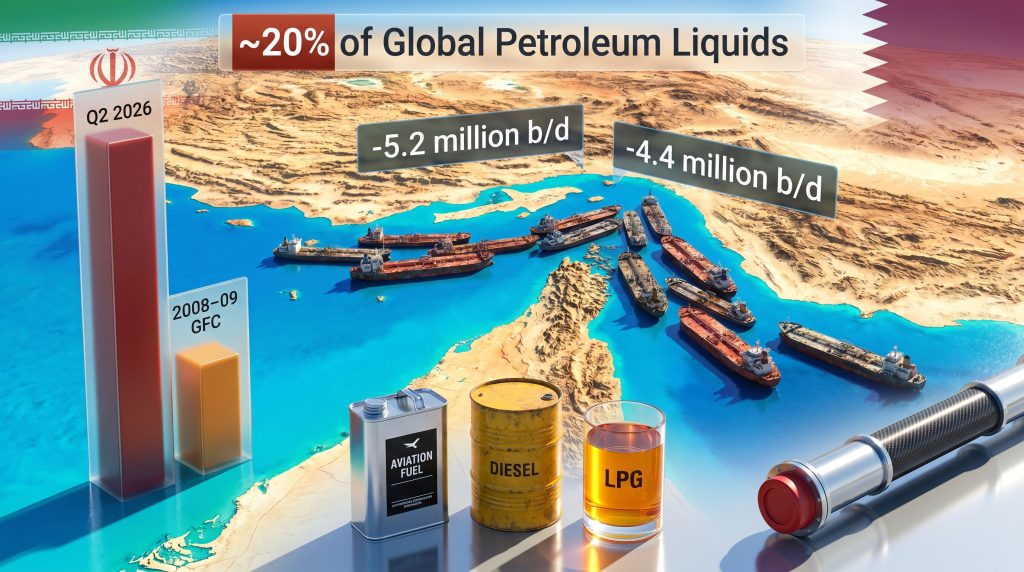
| Global Refinery Run Decline | -5.2 million b/d | -2.7 million b/d | -1.9 million b/d |
| Refined Product Demand Decline | -4.4 million b/d | -2.2 million b/d | -1.8 million b/d |
| Demand Estimate Revision vs. Pre-Crisis | -4.7 million b/d | N/A | N/A |
To place these figures in historical context: the projected second-quarter 2026 refined product demand decline exceeds more than twice the pace recorded during the weakest quarter of the 2008–09 Global Financial Crisis, according to S&P Global Energy's assessment. That prior benchmark represented the deepest peacetime demand destruction in the modern oil era. The 2026 contraction has eclipsed it by a factor that demands serious attention from every sector dependent on refined petroleum products.
The projections are based on S&P Global Energy's working assumption that effective closure of the Strait of Hormuz persists through May 2026, followed by gradual resumption of oil flows. Whether that timeline materialises remains deeply uncertain, and any extension of blockade conditions would push these figures further into historically unprecedented territory. Furthermore, crude oil price trends entering 2026 had already signalled elevated market fragility, making the shock considerably harder to absorb.
Daniel Evans, Vice-President and Global Head of Fuels and Refining Research at S&P Global Energy, has stated that markets have now crossed a point of no return in terms of the crisis dynamic. Given the operational and logistical delays between any potential restart of Strait flows and the arrival of meaningful product market relief, the market system cannot rebalance through supply recovery alone. Demand must now act as the primary balancing mechanism, with severe curtailment expected at minimum through early Q3 2026. (S&P Global Energy, May 2026, via ETEnergyWorld)
Why Refined Products Have No Escape Route
The Strait of Hormuz is a navigational channel approximately 33 kilometres wide at its narrowest point, connecting the Persian Gulf to the Gulf of Oman and onward to global shipping lanes. It is the transit corridor for roughly 20% of global petroleum liquids, making it the most consequential single point of vulnerability in the entire global energy supply chain.
Between 2022 and 2024, crude and condensate transit through the Strait had already been declining, falling by approximately 1.6 million b/d to reach around 20 million b/d by 2024. Several structural factors contributed to this pre-crisis reduction:
- OPEC+ voluntary production restraints reduced Gulf export volumes across this period, reflecting OPEC's market influence on global supply management
- Disruptions at Bab al-Mandeb rerouted significant volumes of Saudi Arabian crude through the East-West pipeline instead
- The UAE's Fujairah bypass pipeline, with a capacity of approximately 1.8 million b/d, reduced Strait dependency by an estimated 0.4 million b/d
- Expansion of local refining capacity within Gulf producer nations reduced the volume of crude requiring export
By 2025, tanker tracking data indicated flows had fallen further to approximately 13 million b/d of oil equivalents. Then April 2026 arrived.
The critical structural insight that separates this crisis from prior Hormuz disruption scenarios is the distinction between crude oil and refined products. Crude oil benefits from partial bypass alternatives: the Fujairah pipeline, the East-West pipeline, and the option of extended Cape of Good Hope routing at significant cost and time delay. Refined petroleum products have none of these options.
Approximately 3 million b/d of refined product exports and 1.5 million b/d of LPG that transit the Strait have no viable bypass infrastructure. The combination of pipeline incompatibility, product degradation concerns during extended transit, and the absence of equivalent alternative export terminals makes the refined product constraint absolute in a way that crude oil constraints are not. This structural asymmetry is the core mechanism converting what began as a crude supply disruption into a full-scale refined fuel demand crisis.
The Escalation Sequence: From Friction to Near-Total Closure
Understanding how the 2026 Strait of Hormuz refined fuel demand decline reached its current severity requires tracing the escalation pathway rather than treating April 2026 as a singular event.
The crisis developed through a compounding sequence:
- 2022–2024: Geopolitical friction and deliberate rerouting decisions gradually reduced Strait transit volumes by approximately 1.6 million b/d
- 2025: Tanker tracking data confirmed flows had contracted further to approximately 13 million b/d of oil equivalents, reflecting both OPEC+ restraints and elevated risk premiums deterring discretionary transit
- April 2026: Near-total blockade conditions emerged following Iranian military actions, including strikes targeting regional refinery infrastructure and Qatari LNG facilities
- May 2026: S&P Global Energy's analytical framework assumes effective closure persisting through May, with contested and gradual resumption assumed thereafter
What makes the April 2026 escalation particularly damaging is that Iranian military strikes created a dual constraint rather than a single supply disruption:
- Upstream constraint: Crude production trapped behind the blockade cannot reach export terminals, eliminating feedstock supply to importing refineries
- Downstream constraint: Regional refining infrastructure within the Gulf has itself been physically degraded, reducing the processing capacity available even if crude flows partially resume
This dual constraint eliminates the normal market response mechanism. In a standard supply disruption, refineries can typically accelerate runs on available crude to compensate for product shortages. However, when refinery capacity is itself damaged, this compensating mechanism is unavailable. Consequently, the scale of oil market disruption now extends far beyond what conventional crisis modelling had anticipated.
Regional Exposure: Not All Markets Are Equal
The Strait of Hormuz refined fuel demand decline has not landed uniformly across global markets. Geographic exposure reflects structural dependency on Gulf crude and product flows, creating a tiered hierarchy of vulnerability.
| Region | Hormuz Crude Dependency | Exposure Level | Primary Risk Drivers |
|---|---|---|---|
| Asia (China, India, Japan, South Korea) | ~84% of Hormuz crude flows | Critical | Refinery run cuts, LNG shortages, economic cascade |
| Middle East (non-Gulf) | Direct (refinery damage) | Severe | Infrastructure strikes, local supply loss |
| Europe | Moderate (indirect) | High | Replacement supply competition, summer demand |
| North America | Low | Moderate | Seasonal demand, global price contagion |
| Latin America and Africa | Low to Moderate | Moderate | Import competition, bidding disadvantage |
Asia represents the most acutely exposed region. Approximately 84% of crude and condensate transiting the Strait flows to Asian buyers, and 83% of LNG exports through Hormuz are destined for Asian markets. China, India, Japan, and South Korea simultaneously face refinery run cuts and end-product shortages. Together, Asia and Europe account for approximately 3.1 million b/d of the projected Q2 2026 refinery run reductions, according to S&P Global Energy's analysis.
Europe entered the crisis having recovered to approximately 70% of pre-COVID refined product demand levels by 2025, leaving the continent more exposed than during the post-pandemic trough. Competition for replacement crude supplies from alternative origins is intensifying pricing pressure across European product markets, and the summer transportation fuel demand peak is compounding inventory drawdown pressure. In addition, geopolitical trade tensions are limiting Europe's ability to rapidly secure alternative supply arrangements.
Poorer import-dependent nations, particularly across East Africa, face a distinct and often underappreciated risk: being systematically outbid for available product cargoes by wealthier competing buyers. This demand destruction by pricing exclusion is less visible in aggregate data but carries severe humanitarian and economic implications at the national level.
Karim Fawaz, Executive Director of Fuels and Refining at S&P Global Energy, has articulated the geographic contagion dynamic clearly: the demand crisis originated in West Asia and Asia, and the longer it persists, the higher the probability that large demand declines spread to other regions through either elevated prices or direct physical unavailability of product. (S&P Global Energy, May 2026, via ETEnergyWorld)
The Fuel Types Facing the Sharpest Pressure
Not all refined products face equivalent risk within this supply shock. The vulnerability hierarchy reflects storage characteristics, pre-existing market conditions, and the degree of supply substitutability.
Aviation fuel sits at the apex of vulnerability. It carries the lowest storage capacity of major refined product categories and degrades more rapidly than diesel or gasoline, creating an inherently short supply chain that cannot accommodate extended disruption. Airline networks dependent on Middle Eastern hub airports face compounding operational and fuel cost risk with no rapid-scale alternative supply source available.
Diesel arrived at the crisis having already experienced structural market tightness entering 2026. The Hormuz disruption has materially worsened the supply outlook for the sectors most dependent on middle distillates: haulage, agriculture, mining, and construction. These sectors represent the most economically vulnerable end-users because they have limited ability to substitute fuels or defer consumption.
LPG and petrochemical feedstocks face a specific volumetric constraint: approximately 1.5 million b/d of LPG exports transiting the Strait are now effectively trapped. Downstream petrochemical production chains, including methanol synthesis and polyethylene manufacturing, face feedstock shortages with cascading implications across global manufacturing supply networks.
The next major ASX story will hit our subscribers first
The Call on Demand Curtailment: A New Framework for Energy Markets
The conceptual innovation that S&P Global Energy's analysis has introduced to this crisis is the framing of a call on demand curtailment. This analytical construct parallels the traditional energy economics concept of the call on OPEC, which describes the volume of supply that OPEC must provide to balance global markets after accounting for all other supply sources.
The call on demand curtailment describes the volume of consumption that must disappear from the market given fixed supply constraints and limited inventory draw capacity. It is a demand-destruction requirement rather than a supply-provision requirement, and its emergence as a central market concept reflects how fundamentally this crisis has inverted normal energy market dynamics.
The mechanism through which demand curtailment spreads operates through three distinct channels:
- Price mechanism: Elevated refined product prices suppress discretionary consumption across transportation, industrial, and residential sectors as buyers face an effective demand tax imposed by supply scarcity
- Physical availability constraints: In markets where product cannot be sourced at any price, consumption is directly curtailed regardless of willingness to pay, representing the most severe form of demand destruction
- Geographic contagion: Demand destruction originating in West Asia and Asia propagates outward as higher prices and tighter physical availability spread through interconnected global product markets over weeks and months
A critical amplifying factor is the inadequacy of global inventory buffers. Petroleum product inventories entered this crisis at levels insufficient to absorb a multi-month supply disruption of this magnitude. According to the IEA's oil market reporting, inventory drawdown provides a finite bridge between disruption and market rebalancing, but once that buffer is exhausted, demand curtailment becomes the only available clearing mechanism. That exhaustion threshold may already have been crossed in the most exposed markets.
Sector-by-Sector Economic Impact
The economic consequences of a sustained Strait of Hormuz refined fuel demand decline extend well beyond energy sector balance sheets. The transmission mechanisms into the broader economy are diverse and compounding:
| Sector | Primary Impact | Secondary Risk |
|---|---|---|
| Aviation | Fuel availability and cost pressure | Route cancellations, passenger demand suppression |
| Agriculture | Diesel shortages for machinery and irrigation | Food production disruption, price inflation |
| Mining and Extraction | Diesel dependency for heavy equipment | Output reductions, commodity supply chain stress |
| Petrochemicals | Feedstock shortages (LPG, naphtha) | Manufacturing slowdowns, polymer price spikes |
| Freight and Logistics | Diesel cost escalation | Supply chain delays, consumer goods inflation |
| Power Generation | Fuel oil and diesel substitution for gas | Electricity price surges, grid reliability risk |
One dimension of the crisis that receives limited attention is the strategic paradox facing Iran. The country's crude export capacity of approximately 1.5 million b/d generates an estimated $105 billion annually in revenue. A sustained Hormuz closure inflicts proportional fiscal damage on Iran's own government budget, creating a complex internal calculus around blockade duration and escalation management. This mutual economic vulnerability represents one of the few structural incentives for eventual negotiated reopening of the waterway.
Recovery Scenarios and the Duration Question
The question that markets, governments, and industries most urgently need answered is not how bad this crisis is, but how long it lasts. Three broad pathways exist, each with materially different implications:
Scenario 1: Rapid Diplomatic Resolution (Q3 2026)
- Oil flows resume by mid-Q3 2026
- Product market normalisation delayed by 2–4 months due to logistical bottlenecks across the crude-to-product supply chain
- Full demand recovery unlikely before Q1 2027 even under optimistic assumptions
Scenario 2: Protracted Partial Reopening (Q4 2026)
- Gradual, contested reopening with intermittent disruption episodes
- Sustained demand suppression extending through the northern hemisphere winter heating season
- Structural refinery capacity damage extends the recovery timeline well into 2027
Scenario 3: Extended Closure Beyond 2026
- Prolonged blockade forces permanent demand destruction in price-sensitive markets
- Accelerated energy transition investment in affected regions as governments reassess structural hydrocarbon dependency
- Permanent rerouting of some crude and product trade flows toward non-Gulf origins, reshaping global refining and logistics networks
A critical near-term stress test identified by S&P Global Energy is the northern hemisphere summer travel season. Reuters reports that global oil supply could plunge below demand this year if the Iran conflict deepens, with seasonal aviation and road transportation fuel demand arriving into a severely depleted supply environment potentially accelerating the demand curtailment dynamic beyond current projections, particularly if blockade conditions persist into June and July.
Even under the most optimistic scenario, the operational pipeline between crude flow resumption and pump-level product availability cannot be compressed below several months. Crude must transit to refinery terminals, feedstocks must be processed through full refining cycles, and product must be distributed through wholesale and retail networks before any consumer-facing relief materialises. This irreducible lag is a technical reality that political or diplomatic solutions cannot shortcut.
The Structural Lesson the 2026 Crisis Has Exposed
Beyond the immediate market dynamics, the 2026 crisis has exposed three structural vulnerabilities in the global energy system that will define investment and policy priorities for the decade ahead:
- Single-point dependency in refined product supply chains has no viable bypass infrastructure, leaving markets fundamentally exposed to Strait disruption in ways that crude oil markets are not
- Strategic inventory buffers are sized for short disruptions, not multi-month blockade scenarios, meaning the gap between theoretical reserve capacity and actual shock absorption has been dramatically exposed
- Demand curtailment as a market-clearing mechanism is a concept that energy markets were not structurally prepared to operationalise, creating coordination failures across sectors that rely on uninterrupted refined fuel access
The implications for long-term refining investment strategy are significant. Furthermore, growing energy transition pressures are now intersecting with the crisis response, as governments reassess whether accelerating renewable infrastructure offers a faster path to energy security than rebuilding hydrocarbon supply chains.
The crisis has demonstrated that geographic diversification of refining capacity, investment in alternative product export infrastructure, and the development of regional strategic reserves sized for extended disruption scenarios are not optional risk management measures but essential components of energy security architecture.
The 2026 Strait of Hormuz refined fuel demand decline has functioned as a live stress test of global energy system resilience. The results reveal an absence of adequate bypass infrastructure for refined products, insufficient strategic inventory depth for multi-month disruptions, and a speed of supply-to-demand propagation that exceeded nearly all pre-crisis modelling assumptions. These findings will define energy security capital allocation priorities across both public and private sectors for years to come.
This article draws on analysis published by S&P Global Energy in May 2026 as reported by ETEnergyWorld (published May 14, 2026). Projections regarding demand decline, refinery run reductions, and recovery timelines are based on S&P Global Energy's modelling assumptions and are subject to significant uncertainty depending on geopolitical developments. This content does not constitute financial or investment advice. Readers seeking further context on Strait of Hormuz transit flows should consult resources published by the U.S. Energy Information Administration and the Oxford Institute for Energy Studies.
Want to Capitalise on the Market Disruptions Reshaping Global Commodity Supply Chains?
Discovery Alert's proprietary Discovery IQ model delivers real-time alerts on significant ASX mineral discoveries — instantly identifying actionable opportunities in the commodities most exposed to global supply shocks like the 2026 Hormuz crisis, from diesel-dependent mining operations to critical minerals driving the energy transition. Explore historic discoveries and the returns they generated on Discovery Alert's dedicated discoveries page, and begin your 14-day free trial today to position yourself ahead of the market.