May 14, 2026
The Price Signal Markets Are Sending About the Strait of Hormuz
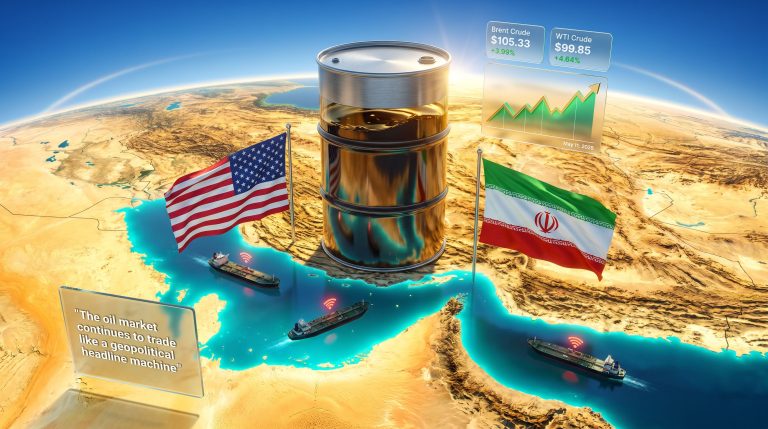
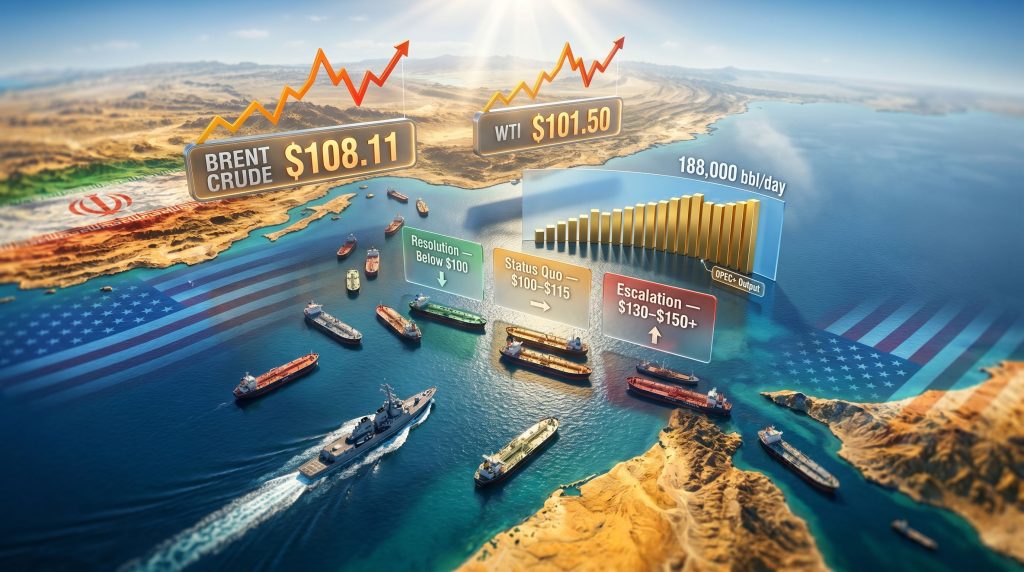
When oil slips after Trump says US will assist ships stranded in Strait of Hormuz, the expected market response would be a meaningful retreat in crude benchmarks. Instead, on the morning of May 4, 2026, Brent crude barely flinched. The benchmark slipped just six cents, or 0.1%, to $108.11 per barrel, while West Texas Intermediate edged down 44 cents, or 0.4%, to $101.50. Both prices held comfortably above the psychologically and economically significant $100 threshold.
That muted reaction tells experienced energy market observers something far more important than any single diplomatic headline: traders are no longer pricing the Strait of Hormuz crisis as a temporary disruption. They are pricing it as a structural condition. Understanding why requires examining both the physical geography of global oil supply and the specific mechanics of how this crisis unfolded. For broader context, reviewing crude oil price trends helps explain why markets remain so resilient under sustained geopolitical pressure.
When big ASX news breaks, our subscribers know first
Why the Strait of Hormuz Is Irreplaceable in Global Oil Supply Architecture
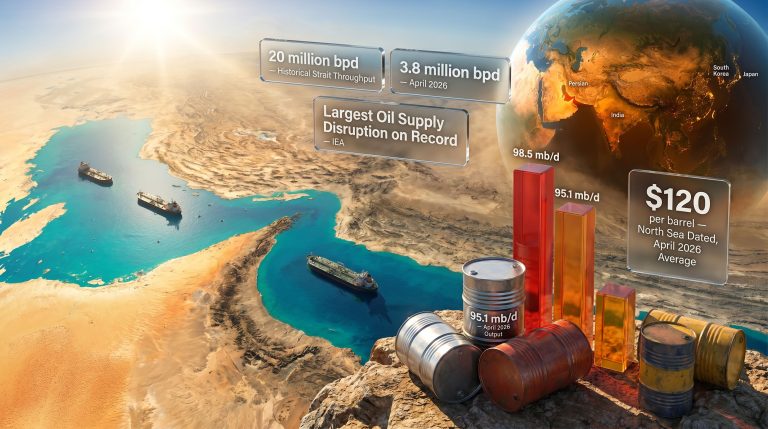
The Strait of Hormuz is a narrow maritime corridor connecting the Persian Gulf to the Gulf of Oman. At its most constrained point, the navigable channel spans approximately 33 kilometres, yet through this slim passage flows roughly 20% of the world's daily oil supply under normal operating conditions. No other chokepoint in global energy infrastructure carries comparable weight.
What makes the strait uniquely influential is the concentration of major petroleum exporters positioned behind it. Saudi Arabia, Iraq, Kuwait, the UAE, and Iran all depend on the waterway for a significant proportion of their crude export capacity. Alternative export routes exist for some producers, including Saudi Arabia's East-West Pipeline to the Red Sea, however aggregate spare pipeline capacity across the region falls far short of replacing full Hormuz throughput.
How Physical Disruption Translates Into Benchmark Pricing
Oil markets price risk through a layered mechanism that blends current physical reality with forward-looking uncertainty. When the strait is disrupted, two distinct forces drive prices higher simultaneously:
- The immediate barrel deficit: tankers cannot complete voyages, refineries draw down inventories faster than they can be replenished, and regional supply-demand balances tighten within days.
- The forward uncertainty premium: traders and risk desks embed a risk premium into futures contracts reflecting their assessment of how long the disruption will persist and what escalation scenarios are plausible.
This second factor is particularly important for understanding why the current price level has proven so resilient. Even if physical flows were partially restored tomorrow, the forward uncertainty premium would not deflate until markets observed consistent, verifiable evidence of sustained normalisation over multiple weeks. The oil geopolitical risks at play here extend well beyond a single presidential announcement.
The Sequence of Events That Locked In Triple-Digit Crude Prices
Iran's effective restriction of commercial shipping through the Strait of Hormuz, which triggered the initial price surge above $100 per barrel in early 2026, set off a chain of escalating actions and counter-responses. These have progressively reduced the market's willingness to price in any quick resolution.
Brent crude reached as high as $102.93 per barrel in the immediate aftermath of the disruption, reflecting the initial shock premium. U.S. President Donald Trump subsequently announced a naval blockade of Iranian ports, effective May 10, 2026, a decision that intensified the geopolitical complexity rather than resolving it.
Trump's Vessel Assistance Commitment and Its Market Limitations
On Sunday, May 4, 2026, President Trump announced that the United States would guide commercial vessels safely out of the Strait of Hormuz. The announcement, reported by Reuters, produced the marginal price decline noted above. What it did not produce was any material shift in the fundamental conditions sustaining elevated prices.
The reason is straightforward: the commitment addresses navigation logistics for vessels already stranded within the strait. It does not resolve the underlying geopolitical dispute, eliminate the physical hazards within the waterway, or create the conditions necessary for major international shipping operators to resume normal transit scheduling. Markets processed the announcement accordingly, recognising the distinction between a symptom being treated and a disease being cured.
As Phillip Nova analyst Priyanka Sachdeva noted in commentary reported by Arab News on May 4, 2026, the market remains tightly supported by persistent supply disruptions and geopolitical uncertainty. The analyst's assessment was clear: unless a sustained and verifiable resolution restores normal flows through the strait, prices are likely to hold at elevated levels with risks skewed toward further upside rather than downward correction.
The US-Iran Diplomatic Deadlock Explained
The surface-level narrative of the crisis describes a standoff between Washington and Tehran. The deeper structural problem, however, is a sequencing deadlock that has made near-term resolution exceptionally difficult.
Negotiations between the two countries continued through the weekend of May 3–4, 2026, with both sides exchanging formal positions. The core impasse involves the order in which concessions must be made. Tehran has indicated it will not engage substantively in nuclear discussions until after rival blockades on Gulf shipping are lifted.
The Trump administration, which has identified securing a nuclear agreement with Iran as a foreign policy priority, requires progress on nuclear matters as a precondition for adjusting its own blockade posture. Neither party's preconditions are compatible with the other's, creating a diplomatic loop with no obvious exit mechanism.
This sequencing deadlock has material implications for oil market timing. Every week of unresolved negotiations is another week during which physical flows remain constrained, inventories continue to draw down globally, and the forward uncertainty premium remains embedded in price discovery. Furthermore, OPEC's market influence becomes increasingly limited when the primary export corridor is operationally impaired.
Why the OPEC+ Output Increase Provides No Real Relief
On the same weekend as Trump's vessel assistance announcement, OPEC+ confirmed a production target increase for June 2026. The decision affects seven member nations and represents a meaningful headline figure, but its practical impact on oil market dynamics is close to zero whilst the Strait of Hormuz remains operationally constrained.
| OPEC+ Factor | Detail |
|---|---|
| June 2026 output increase | 188,000 barrels per day |
| Members covered | Seven OPEC+ nations |
| Consecutive monthly increase | Third in a row |
| UAE participation | Departed OPEC on May 1, 2026; excluded |
| Real-world delivery capacity | Severely limited whilst Hormuz disruption persists |
The Arab News report covering the decision noted explicitly that the higher production volume will remain largely on paper for as long as the Iran conflict continues to disrupt Gulf oil supply routes. This represents a critical structural irony: the very alliance tasked with managing global supply balances is announcing higher targets through the same corridor that has become impassable.
The UAE's departure from OPEC on May 1, 2026, further complicates the picture. The June increase was calibrated as the May agreement minus the UAE's allocated share, reflecting the membership change. Regardless of the arithmetic, the fundamental constraint remains physical rather than political.
The Paper Barrel Problem
A distinction well understood within energy trading circles but less visible to general observers is the gap between paper barrels and wet barrels. Paper barrels are production targets, futures contracts, and announced volumes. Wet barrels are physical crude oil that has been loaded onto a tanker and delivered to a refinery.
OPEC+ can increase paper barrel targets by any amount it chooses. Converting those targets into wet barrels requires an unobstructed export route, and right now, the primary export route for the majority of Gulf producers is operationally impaired.
Global Economic Exposure and the Regional Dimension
The economic consequences of sustained $100-plus crude pricing are not distributed evenly across the global economy. Asia-Pacific nations bear disproportionate exposure due to their structural dependence on Middle Eastern crude imported through the Strait of Hormuz. Japan's Prime Minister publicly described the oil crisis as having an enormous impact across the Asia-Pacific region, a statement that reflects the acute vulnerability of energy-import-dependent economies to this specific disruption.
Japan, South Korea, India, and China collectively represent some of the largest consumers of Gulf crude globally. Unlike European importers, which have expanded access to Atlantic Basin supply routes, Asian refiners have fewer short-term substitution options when Hormuz throughput declines. The result is that elevated energy import costs feed directly into manufacturing cost structures, inflation dynamics, and current account balances across the region simultaneously.
China's Position as a Complicating Variable
China's response to the crisis introduces an additional layer of complexity. Beijing formally rejected U.S. sanctions targeting Chinese refineries over alleged purchases of Iranian crude, as reported by Arab News. China's continued engagement with Iranian oil exports effectively creates a sanctions leakage problem that reduces the economic pressure Washington can apply to Tehran through energy isolation.
For oil market analysts, this dynamic introduces a supply-side variable that is difficult to model precisely. If Chinese refineries continue absorbing Iranian crude volumes outside of Western sanctions enforcement reach, Iran retains export revenue that partially cushions its economic position, potentially reducing the urgency of a negotiated settlement from Tehran's perspective.
Saudi Arabia's Diplomatic Calculus
Saudi Arabia's United Nations envoy issued a formal call for the free flow of commercial shipping through the Strait of Hormuz. Riyadh's position reflects the intersection of economic and security interests. Saudi Arabia is both a major oil exporter that benefits from elevated prices in some respects and a regional power with strong interests in maritime stability. A prolonged closure of the strait disrupts the broader Gulf commercial ecosystem in ways that extend well beyond crude oil pricing.
The next major ASX story will hit our subscribers first
Scenario Pathways: What Could Move Prices From Here?
Analyst consensus as of early May 2026 reflects a market that sees risk as asymmetric and tilted toward further upside. In addition, the trade war oil impact continues to add another layer of downward demand pressure that complicates the overall price outlook. Three broad scenarios capture the range of plausible price trajectories:
| Scenario | Catalyst Required | Brent Price Direction |
|---|---|---|
| Full Resolution | Formal US-Iran agreement, verified shipping restoration | Significant decline below $100 |
| Extended Stalemate | Diplomatic deadlock continues, partial transit resumption | Range of $100 to $115 sustained |
| Escalation | Further military engagement or blockade expansion | Potential move toward $130 to $150 and beyond |
The resolution scenario carries historical precedent worth noting. During an earlier phase of the crisis, when Iran announced the strait was completely open for commercial shipping, oil prices fell approximately 10% within a single trading session. A credible, verified diplomatic resolution accompanied by confirmed mine clearance and resumed commercial transit could produce a similarly rapid downside correction.
However, energy risk analysts have observed that even after physical flows resume following geopolitical disruptions, risk premiums tend to persist in futures pricing for weeks to months. Markets require demonstrated stability, not just announced stability, before fully releasing the geopolitical premium embedded during crisis periods.
Markets are not simply pricing today's barrel deficit. They are pricing the probability distribution of every possible outcome between now and when the strait is verifiably normalised, weighted by severity and duration. That calculation currently resolves to a number above $100 per barrel.
What the Muted Market Response Actually Reveals
The most analytically significant data point from May 4, 2026 is not the price level itself. It is the ratio between the significance of the intervention and the scale of the market response. A direct presidential commitment of U.S. naval resources to resolving the immediate shipping crisis produced a price decline of less than half a percent.
That relationship reveals the depth of structural scepticism embedded in current crude pricing. Consequently, for those monitoring the current oil market overview, this muted reaction is perhaps the most telling indicator of where trader sentiment genuinely sits.
Traders are not ignoring Trump's announcement. They are assigning it an appropriate probability weight within a broader uncertainty framework. This framework includes the unresolved nuclear negotiation, the ongoing physical hazards within the strait, the absence of shipping company commitments to resume normal operations, and the demonstrated capacity of this crisis to escalate in unexpected directions. Analysts covering the situation have consistently noted that headline diplomatic gestures have repeatedly failed to shift the fundamental supply calculus.
Until physical shipping flows are verifiably restored and sustained over a sufficient period to demonstrate genuine normalisation, both Brent crude and WTI are likely to hold at structurally elevated levels. The fact that oil slips after Trump says US will assist ships stranded in Strait of Hormuz by mere cents rather than dollars is not a signal of resolution. It is a signal that the work of resolution has not yet begun.
This article contains forward-looking analysis and scenario projections based on information available as of May 4, 2026. Energy market conditions, geopolitical developments, and analyst forecasts are subject to rapid change. Nothing in this article constitutes financial or investment advice. Readers should conduct independent research before making any financial decisions.
Want to Identify the Next Major ASX Commodity Discovery Before the Market Does?
Whilst geopolitical shocks like the Strait of Hormuz crisis reshape global commodity pricing, Discovery Alert's proprietary Discovery IQ model delivers real-time alerts on significant ASX mineral discoveries — instantly translating complex data across more than 30 commodities into clear, actionable insights for investors at every level. Explore how historic discoveries have generated substantial market returns on the Discovery Alert discoveries page, and begin your 14-day free trial today to position yourself ahead of the next major market move.