August 19, 2026
The Infrastructure Logic Behind Permanent Nuclear Waste Disposal
Every major expansion of nuclear energy capacity carries an implicit question that policymakers rarely answer clearly: what happens to the waste? For decades, used nuclear fuel has accumulated at reactor sites across Canada, stored in interim dry cask systems that were never intended as permanent solutions. The absence of a credible long-term disposal pathway has acted as a quiet constraint on broader conversations about Canada nuclear waste repository federal support, creating regulatory uncertainty and limiting investor confidence in new builds. That dynamic is now shifting in a meaningful way.
Canada's Deep Geological Repository (DGR), proposed by the Nuclear Waste Management Organization (NWMO), has been formally nominated as a project of national interest under the Building Canada Act. This nomination, announced in June 2026, places the DGR within the same federal coordination framework as major transportation and energy infrastructure projects. Understanding what this means, and what it does not mean, requires unpacking both the regulatory architecture and the broader strategic logic that connects waste management to Canada's nuclear future.
When big ASX news breaks, our subscribers know first
What the Building Canada Act Actually Does
The Building Canada Act was enacted as part of Bill C-5, the One Canadian Economy Act, with the specific purpose of accelerating infrastructure that carries national economic and strategic significance. The legislation does not eliminate environmental assessments or override Indigenous rights protections. What it does is restructure the regulatory question from one of whether a project should proceed to how it will proceed in the most coordinated and efficient manner possible.
This is a subtle but consequential distinction. Projects listed under the Act benefit from consolidated federal permits and authorisations managed through a single coordinating body, the Major Projects Office, which was established in August 2025. Rather than navigating a fragmented multi-agency approval landscape, proponents work through a unified process designed to reduce duplication and compress timelines without compromising substantive review.
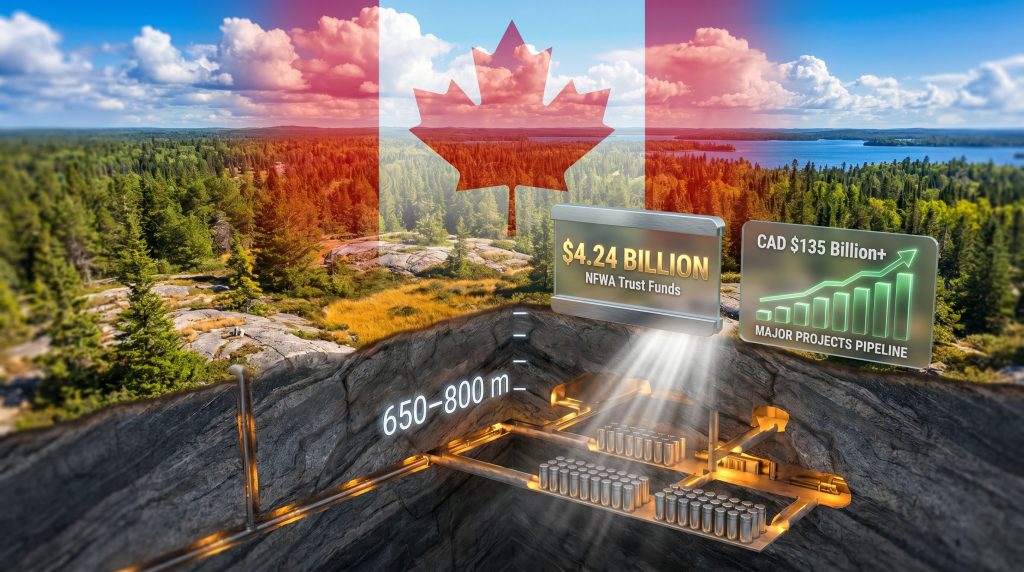
The DGR's referral to the Major Projects Office places it within a portfolio that now includes 16 projects and 7 transformative strategies, collectively representing more than CAD $135 billion (approximately USD $95 billion) in committed economic activity. Among those projects is the Darlington New Nuclear Project, Ontario Power Generation's initiative to develop the first of four planned small modular reactors using the BWRX-300 design.
The federal government's position is that listing under the Act provides confidence that key approvals will be granted, fundamentally reorienting the regulatory process toward implementation rather than feasibility gatekeeping.
Two of the three projects nominated alongside the DGR — the Mackenzie Valley Highway and the Grays Bay Road and Port Project — were referred to the Major Projects Office earlier and have already been assessed as strong candidates for inscription. The DGR's referral follows that same pathway.
Understanding the Deep Geological Repository
A deep geological repository safety design is not simply a reinforced underground bunker. It represents a multi-barrier containment system engineered to isolate high-level radioactive waste from the biosphere for timescales measured in hundreds of thousands of years. The design philosophy acknowledges that no institutional or engineered system alone can guarantee containment over such periods, so the approach combines multiple independent barriers: the waste form itself, engineered containment structures, and the stable geological formation surrounding them.
Canada's proposed DGR would be located at a depth of 650 to 800 metres below surface, targeting either crystalline or sedimentary rock formations in northwestern Ontario. The site selected in 2024, near the Wabigoon Lake Ojibway Nation and the Township of Ignace, sits approximately 200 kilometres northwest of Lake Superior.
DGR Technical and Project Parameters
| Feature | Detail |
|---|---|
| Proposed depth | 650 to 800 metres underground |
| Host geology | Crystalline or sedimentary rock |
| Location | Northwestern Ontario, near Ignace |
| Site selection completed | 2024 |
| Siting process duration | 14 years, consent-based |
| Construction target | Mid-2030s |
| Operational target | Early 2040s |
| Funding source | 100% NFWA Trust Funds (no taxpayer funding) |
| Trust Fund balance | CAD $4.24 billion accumulated |
The depth specification is worth noting in an international context. At 650 to 800 metres, Canada's DGR would be among the deepest proposed repositories globally, which carries significant implications for long-term geological stability and containment integrity. Deeper placement generally means greater isolation from surface hydrological systems and reduced risk of human intrusion over long timeframes. Furthermore, the Canadian Nuclear Safety Commission plays a critical independent role in verifying that these technical parameters meet the highest safety standards throughout the regulatory approval process.
The 14-Year Consent-Based Siting Process
One of the most frequently underappreciated aspects of the DGR programme is how the site was selected. The NWMO did not identify a geologically suitable location and then seek community acceptance, which is the conventional model for infrastructure siting. Instead, the process was inverted: communities were invited to express interest in learning more about hosting the repository, and only those that voluntarily engaged were considered.
This approach, grounded in the principle of free, prior, and informed consent (FPIC), represents a governance model that has attracted significant international attention. The 14-year process involved sustained technical and social engagement with multiple communities before the Wabigoon Lake Ojibway Nation and the Township of Ignace emerged as the selected host location in 2024.
Canada's consent-based methodology is considered by many in the international nuclear waste governance community to be one of the most rigorous community-driven siting processes ever implemented for nuclear infrastructure.
The involvement of the Minister of Crown-Indigenous Relations in the project nomination is not incidental. It signals that the DGR's advancement is being treated as an exercise in reconciliation as much as infrastructure development, with Indigenous partnership embedded as a structural feature of the project rather than a consultative afterthought.
Who Pays, and Who Oversees
The financial architecture of the DGR is built on a legal principle established under the Nuclear Fuel Waste Act (2002): the organisations that generate nuclear waste bear full financial responsibility for its permanent management. No taxpayer funding is involved.
Annual contributions from Canada's nuclear fuel waste owners are deposited into independently managed trust funds. The contributing entities are:
- Ontario Power Generation
- NB Power
- Hydro-Québec
- Atomic Energy of Canada Limited (AECL)
The NFWA Trust Funds have accumulated a total of $4.24 billion, designated to cover the full lifecycle of the DGR including construction, operations, long-term monitoring, decommissioning, and permanent closure.
Federal oversight operates through three distinct bodies, each with a defined and non-overlapping role:
- The Minister of Energy and Natural Resources holds supervisory authority over the NWMO's implementation plan.
- The Canadian Nuclear Safety Commission (CNSC) governs technical licensing and safety standards.
- The Impact Assessment Agency of Canada (IAAC) leads the environmental and social impact review.
This separation of oversight functions ensures that no single agency controls both the promotion and the safety evaluation of the project, a structural safeguard that underpins the credibility of the regulatory process. In addition, the NWMO's memorandum of understanding with Canadian Nuclear Laboratories further strengthens the technical collaboration underpinning the project's long-term success.
How the DGR Connects to Canada's Nuclear Energy Strategy
Canada's national Nuclear Energy Strategy, unveiled in June 2026, is organised around three strategic pillars. The DGR sits squarely within the third: long-term waste management. However, its significance extends well beyond waste containment.
The practical reality is that the long-term disposal question is a prerequisite for expanding nuclear capacity. Regulatory bodies, investors, and host communities for new reactor projects all require confidence that the full lifecycle of nuclear fuel — including its ultimate disposition — has a credible and approved pathway. Without a functioning DGR programme, every new reactor proposal carries an unresolved liability. Consequently, the Canada nuclear waste repository federal support now embedded in the Building Canada Act directly strengthens the nuclear growth investment case for new capacity development.
Canada's Nuclear Strategy: Key Pillars and Linked Projects
| Strategic Pillar | Related Initiative |
|---|---|
| New nuclear capacity | Darlington New Nuclear Project (BWRX-300 SMR) |
| Fuel supply security | Canadian uranium sector development |
| Long-term waste management | NWMO Deep Geological Repository |
The Darlington New Nuclear Project, which is also referred to the Major Projects Office, represents the first of four planned small modular reactors at Ontario Power Generation's existing site. The progression of that project is directly linked to the DGR: demonstrating that Canada has a credible waste management pathway strengthens the case for additional nuclear capacity, particularly as SMRs generate a distinct waste profile that will require long-term management planning of its own.
The next major ASX story will hit our subscribers first
Canada in the Global Repository Landscape
Canada is not alone in pursuing deep geological disposal, but the scale and depth of the proposed DGR — combined with the rigour of its siting process — position it distinctively within the international landscape.
Global Deep Geological Repository Programmes: Comparative Overview
| Country | Programme | Status | Depth |
|---|---|---|---|
| Finland | Onkalo (Posiva) | Under construction | ~400 to 450 m |
| Sweden | SKB Repository | Approved, pre-construction | ~500 m |
| Canada | NWMO DGR | Federal nomination stage | 650 to 800 m |
| France | Cigéo (Andra) | Licensing stage | ~500 m |
| USA | Yucca Mountain | Politically stalled | ~300 m |
Finland's Onkalo repository is the most advanced in the world and has provided a practical reference point for other national programmes, including Canada's. One of the key lessons drawn from Onkalo is the value of early and sustained community engagement, a lesson the NWMO built into its process from the outset.
The United States' experience with Yucca Mountain offers the cautionary counterpoint. Despite decades of technical work and significant federal investment, the project became politically paralysed, leaving the US without a viable long-term disposal pathway. Canada's consent-based approach was partly designed to avoid precisely that outcome by building community ownership into the siting process rather than imposing a federal decision on unwilling host communities.
The Impact Assessment Process and What It Involves
The DGR is subject to review under the Impact Assessment Act, a process expected to be among the most extensive environmental and social reviews in Canadian history. Assessment criteria include human health impacts, environmental integrity, the rights and interests of Indigenous peoples, and broader socio-economic effects on the region.
The "one project, one review" model applied through the Major Projects Office is intended to eliminate the duplication that previously occurred when multiple federal agencies conducted overlapping assessments. This does not reduce the depth of scrutiny; it consolidates it into a more coherent and efficient process.
For the DGR's construction timeline, the assessment process is a critical path item. The mid-2030s construction target and early 2040s operational target are contingent on the impact assessment proceeding on schedule, which is one of the practical reasons why the Building Canada Act nomination carries real project significance.
Frequently Asked Questions About the Canada Nuclear Waste Repository
Is the DGR safe for surrounding communities?
The repository design relies on a multi-barrier containment approach combining engineered structures (waste containers, buffer materials, and vault sealing systems) with the inherent stability of deep geology. The CNSC independently verifies safety standards against decades of peer-reviewed technical research. The design is not a novel concept; it reflects the global scientific consensus on best practice for high-level radioactive waste isolation.
How does this affect Indigenous land rights?
FPIC requirements are legally embedded in the project's framework. The Wabigoon Lake Ojibway Nation's participation was structured through the NWMO's consent-based siting process, and the federal Crown-Indigenous Relations portfolio is formally involved in the project's oversight and nomination. Indigenous participation plans are also incorporated into the economic framework for the construction and operation phases.
What happens to used nuclear fuel in the interim?
Used nuclear fuel is currently held in dry storage facilities at reactor sites across Canada. Dry storage technology, which uses inert gas and passive cooling within sealed metal or concrete containers, is a well-established bridging solution capable of safely containing fuel for decades. It is not a permanent disposal method and is not intended to substitute for the DGR.
Who covers the costs?
The project is entirely funded through the NFWA Trust Funds, with no taxpayer contribution. The accumulated balance of CAD $4.24 billion is managed independently and designated exclusively for DGR-related costs across all project phases.
What the Federal Nomination Signals for Canada's Nuclear Sector
The DGR's inclusion in the Building Canada Act framework is best understood not as a singular event but as a structural signal about the direction of Canadian energy and infrastructure policy. Furthermore, several implications are worth tracking in the context of the broader uranium market supply dynamics and the geopolitical shifts reshaping global nuclear fuel chains, including the Russian uranium import ban and evolving uranium supply geopolitics that are increasing the strategic premium on domestically managed nuclear programmes.
- Regulatory certainty is now a federal commitment. The shift from a "whether" to a "how" regulatory posture reduces one of the key risks that has historically complicated long-duration infrastructure investment.
- The waste management question is being treated as a strategic enabler. Federal ministers framed the Canada nuclear waste repository federal support explicitly in terms of its capacity to unlock new nuclear builds and strengthen energy sovereignty, not merely as a compliance obligation.
- Reconciliation is embedded as a project condition, not an add-on. The structural involvement of the Crown-Indigenous Relations portfolio signals that Indigenous partnership is a non-negotiable feature of how the project proceeds.
- Canada's model may influence global governance thinking. The combination of a consent-based siting process, independent financial trusts, and a multi-agency oversight structure offers a governance template that other countries grappling with repository siting challenges may look to as a reference.
- The broader CAD $135 billion+ infrastructure agenda provides political and institutional momentum. The DGR does not exist in isolation; it is embedded within a nation-building infrastructure push that spans energy, transportation, and reconciliation objectives.
Disclaimer: This article is intended for informational purposes only and does not constitute financial or investment advice. Timelines, project details, and regulatory outcomes discussed herein are subject to change. Readers should consult primary sources and relevant regulatory bodies for the most current project information.
Want to Stay Ahead of the Next Major ASX Mineral Discovery?
Discovery Alert's proprietary Discovery IQ model delivers real-time alerts on significant ASX mineral discoveries, turning complex mineral data into actionable insights for both short-term traders and long-term investors — explore the historic returns major discoveries have generated and begin your 14-day free trial at Discovery Alert to position yourself ahead of the broader market.