August 19, 2026
The Quiet Revolution Inside Environmental Commodity Markets
Corporate sustainability strategies have quietly crossed a threshold that most observers have not yet fully registered. For years, the dominant instrument in clean energy procurement was the annual Renewable Energy Certificate, a simple, fungible token representing one megawatt-hour of electricity generated from solar, wind, or hydropower. That model served corporate reporting frameworks adequately when sustainability ambitions were modest and regulators accepted broad approximations. However, a convergence of forces, including artificial intelligence-driven electricity demand, round-the-clock operational requirements, and increasingly rigorous disclosure standards, has exposed the structural limitations of that approach.
The result is a fundamental product diversification across environmental commodity markets. Nuclear-sourced certificates are emerging as a distinct and increasingly liquid asset class, and Xpansiv nuclear credit trading is positioning itself at the centre of this transformation through its CBL spot exchange, the world's largest environmental commodity trading platform.
When big ASX news breaks, our subscribers know first
Understanding Emission-Free Energy Certificates and How They Differ From RECs
At their core, Emission-Free Energy Certificates (EFECs) operate on a similar mechanical principle to Renewable Energy Certificates. Each certificate represents one megawatt-hour of electricity generated from a qualifying zero-carbon source. The critical distinction lies in what qualifies as the underlying generation asset.
RECs were architecturally designed around variable renewable generation, primarily solar and wind. EFECs, by contrast, encompass dispatchable zero-carbon sources, with nuclear power being the most significant current contributor. This apparently subtle difference carries profound implications for corporate buyers operating facilities that require continuous, weather-independent power. Furthermore, understanding the broader uranium market dynamics helps contextualise why nuclear-sourced certificates are gaining such significant traction.
How the Certificate Lifecycle Works
The process from generation to retirement follows a structured chain of custody:
- A nuclear facility produces verified emission-free electricity and the output is recorded by grid operators.
- A registry infrastructure issues one EFEC for each MWh of qualifying generation.
- Certificates are listed on CBL's spot exchange, where price discovery occurs in real time.
- Corporate buyers purchase and retire certificates to support Scope 2 market-based accounting claims.
- Retirement records are maintained in the registry for audit purposes, supporting CDP, GRI, and TCFD disclosures.
Comparing the Key Environmental Certificate Types
| Certificate Type | Energy Source | Market Scope | Primary Buyer | Verification Method |
|---|---|---|---|---|
| REC | Solar, Wind, Hydro | Broad / Voluntary | Corporates, Utilities | Registry-based |
| EFEC | Nuclear + Emission-Free | PJM, NEPOOL | Tech Companies, Industrials | Registry + Grid Attribution |
| ZEC | Nuclear (State-level) | State Programs | Utilities | State Policy Mechanism |
| Carbon Credit | Various Offset Projects | Global Voluntary | Corporates | Third-Party Verified |
| SAF Certificate | Sustainable Aviation Fuel | Aviation Sector | Airlines | Book-and-Claim |
One dimension of EFECs that receives insufficient attention is their potential for hourly granularity. While current contracts are structured on an annual basis, hourly EFECs represent the next evolution, allowing buyers to match verified zero-carbon generation to actual consumption at every hour of the day. This capability would directly satisfy the 24/7 carbon-free electricity procurement standards being championed by major technology companies.
How CBL Functions as the Central Liquidity Hub for Nuclear Certificates
The CBL exchange operates as a centralised marketplace where multiple environmental commodity types trade side by side, creating a single liquidity pool that reduces transaction costs and improves price transparency. This stands in contrast to the fragmented, relationship-dependent over-the-counter markets that previously dominated this space.
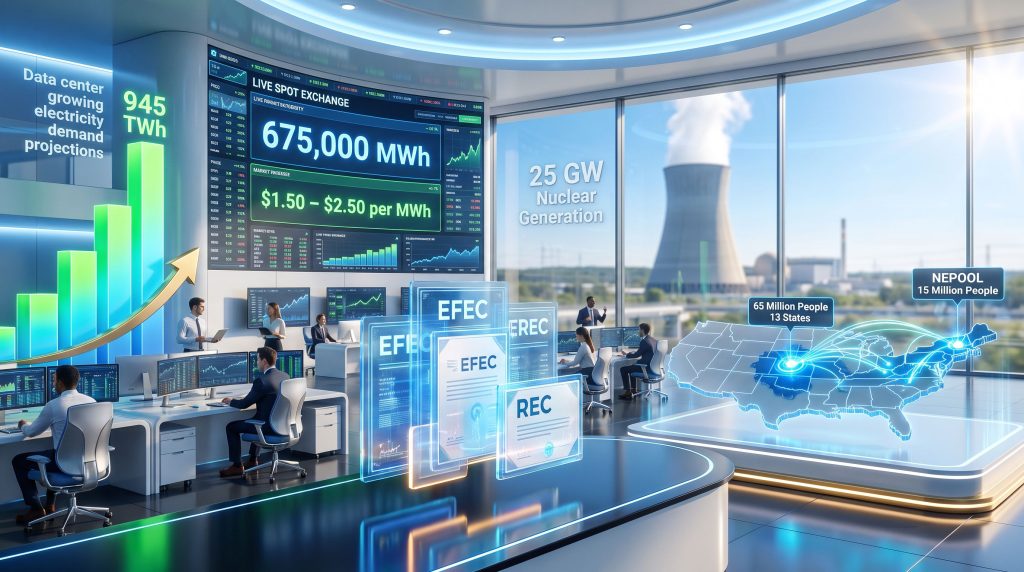
Xpansiv's registry network currently supports more than 25 GW of nuclear generation, representing approximately one-quarter of total U.S. nuclear capacity. Alongside this, the platform tracks more than 90 GW of renewable energy across North America. The exchange has crossed the $1 trillion threshold in cumulative environmental commodity trading volume, a milestone that signals institutional-scale participation rather than niche market activity.
The PJM EFEC Launch: A Market Velocity Benchmark
When PJM EFECs debuted on CBL in 2024, the market response was immediate and decisive. According to Xpansiv's own reporting, 675,000 MWh of nuclear certificates traded within the first week, representing one of the fastest adoption rates for any new environmental commodity product in the exchange's history. Early price discovery placed nuclear certificates in the $1.50 to $2.50 per MWh range, reflecting the early-stage nature of the market but confirming genuine institutional demand rather than speculative activity.
"The velocity of the PJM EFEC launch was not an accident. It reflected years of suppressed institutional demand for a liquid, exchange-traded nuclear certificate product that simply did not previously exist in accessible form."
NEPOOL EFECs: Geographic Expansion and What It Means
The addition of New England Power Pool (NEPOOL) EFECs to CBL's product lineup extends nuclear certificate trading to a second major U.S. competitive electricity market. The geographic coverage contrast is worth examining in detail:
- PJM covers 13 states plus Washington D.C., serving approximately 65 million people and representing the largest competitive electricity market in North America by load.
- ISO New England (NEPOOL) serves approximately 15 million people across Connecticut, Maine, Massachusetts, New Hampshire, Rhode Island, and Vermont.
Together, these two regions encompass some of the most electricity-intensive industrial, commercial, and digital infrastructure in the United States. The expansion of NEPOOL coverage significantly broadens the addressable buyer pool, adding New England manufacturers, financial institutions headquartered in Boston, and technology operators running data infrastructure throughout the region.
Xpansiv Senior Vice President Russell Karas indicated that the NEPOOL EFEC launch reflects the company's broader strategy of supporting dispatchable, emissions-free electricity as industry works to keep pace with accelerating demand and energy transition and security objectives.
Why AI and the EV Revolution Are Structurally Changing Nuclear Certificate Demand
The energy intensity of artificial intelligence infrastructure is now large enough to reshape global electricity markets. The International Energy Agency projects that global data center electricity consumption will surpass 945 terawatt-hours annually by 2030, exceeding Japan's entire current national electricity use. AI workloads are the primary driver of this growth.
The 24/7 CFE Problem That Nuclear Uniquely Solves
The challenge facing corporate sustainability officers is not simply reducing average carbon intensity. It is demonstrating that clean electricity was actually being generated and consumed at the same time, in the same grid region, during every operational hour. This concept, known as 24/7 carbon-free electricity (CFE) matching, is where traditional annual RECs fail and where nuclear certificates offer a structurally superior answer.
Solar panels generate electricity only during daylight hours. Wind turbines depend on atmospheric conditions. Neither source can guarantee output at 2:00 AM when a hyperscale AI inference cluster is processing its heaviest overnight workloads. Nuclear reactors, operating at approximately 92–93% capacity factors — the highest of any generation technology — deliver consistent output regardless of weather, season, or time of day.
The EV Demand Layer
Approximately 21 million EVs were sold globally in 2025, representing nearly one in four new passenger vehicles. This electrification of transport is not simply an environmental story. It is a baseload demand story. Unlike consumer electronics, EV charging often concentrates during evening hours when solar generation has ceased, adding load precisely when renewable intermittency is most acute. This dynamic reinforces the grid-level value of nuclear baseload generation and, by extension, the value of nuclear certificates to utilities managing Scope 2 obligations.
What the Technology Sector's Nuclear Pivot Signals
Microsoft, Amazon, Google, and Meta have each entered into direct agreements with nuclear operators to secure long-term clean baseload electricity supplies. These corporate power purchase agreements (PPAs) are complementary to, rather than competitive with, spot certificate markets. A company securing a nuclear PPA still requires exchange-traded EFECs to cover the difference between contracted volumes and actual consumption across all facilities, creating a permanent structural demand for spot market liquidity that CBL is designed to serve.
Nuclear's Current Role in Global and U.S. Electricity Supply
The statistical footprint of nuclear power in clean electricity generation is frequently underappreciated in mainstream sustainability discussions.
| Metric | Value | Source |
|---|---|---|
| Share of global electricity from nuclear | ~9% | IEA |
| Share of global low-emissions electricity from nuclear | ~25% | IEA |
| U.S. nuclear share of national electricity | ~20% | IEA |
| U.S. nuclear share of carbon-free electricity | ~50% | IEA |
| Projected U.S. nuclear capacity growth to 2050 | ~2x current capacity | Bloomberg Intelligence |
| Global nuclear generation trajectory | Record high in 2025, rising in 2026 | IEA |
The IEA confirms that global nuclear generation is on track to reach a record high in 2025, with further growth projected through 2026 driven by new reactor completions in China, India, and South Korea, alongside reactor restarts in Japan and continued strong output from the United States and France. Bloomberg Intelligence projects U.S. nuclear capacity will double by 2050, which would substantially expand the certificate supply base available for EFEC issuance over the long term. In addition, the ongoing Russian uranium import ban is reshaping global nuclear fuel supply chains in ways that further elevate domestic nuclear generation as a strategic priority.
How Environmental Markets Are Evolving Beyond Carbon Offsets
The voluntary carbon market built its initial architecture around a simple proposition: generate or avoid emissions somewhere, verify that activity, and sell the resulting credit to a buyer wanting to offset their own footprint. That model served a purpose but carried well-documented integrity risks, including permanence concerns for nature-based offsets and additionality questions for certain project categories.
The shift now underway is more sophisticated. Corporate buyers are moving from purchasing offsets toward acquiring verified clean electricity attribute certificates — instruments that do not claim to remove carbon from the atmosphere but instead provide auditable evidence that zero-carbon electricity was generated and consumed within a specific grid region.
The Expanding Environmental Commodity Universe
| Instrument | What It Verifies | Corporate Use Case | Market Maturity |
|---|---|---|---|
| Carbon Credit | Emissions avoided or removed | Scope 1 and 3 offsetting | Established |
| REC (Annual) | Renewable electricity consumed | Scope 2 reporting | Established |
| EFEC (Nuclear) | Emission-free electricity, 24/7 capable | Scope 2 + CFE goals | Emerging |
| Methane Certificate | Reduced methane emissions | Supply chain claims | Early-stage |
| SAF Certificate | Sustainable aviation fuel use | Scope 3 travel emissions | Early-stage |
This diversification reflects a maturation of corporate climate strategy rather than a rejection of earlier instruments. Carbon credits remain relevant for Scope 1 and Scope 3 obligations. However, for Scope 2 electricity reporting — particularly under GHG Protocol market-based accounting methods — the quality bar has risen significantly. EFECs meet that bar in a way that annual RECs increasingly struggle to when applied to always-on infrastructure. Consequently, understanding uranium supply and demand fundamentals becomes increasingly relevant as nuclear certificate markets mature.
The next major ASX story will hit our subscribers first
Corporate Buyer Scenarios: Who Is Purchasing Nuclear Certificates and Why
Understanding the practical buyer landscape helps clarify why Xpansiv nuclear credit trading has attracted institutional participation so rapidly.
Scenario A: Hyperscale Technology Operator
A company running dozens of data centres across PJM and NEPOOL territories faces a structural mismatch between its annual renewable energy matching and its actual hourly clean electricity consumption. EFEC procurement fills the gaps during overnight, cloudy, or low-wind periods, enabling genuine 24/7 CFE claims rather than annual approximations.
Scenario B: Heavy Industrial Manufacturer
A manufacturing facility operating continuous processes in the PJM region has Scope 2 emissions reduction targets embedded in its science-based targets commitment. Nuclear EFECs provide grid-region-matched, cost-effective verification without requiring the legal complexity and capital commitment of a direct nuclear PPA.
Scenario C: Financial Institution
A major bank seeking to verify clean electricity consumption across owned and leased office space in New England can now use NEPOOL EFECs to retire registry-verified certificates. These align with the GHG Protocol's market-based Scope 2 accounting method, producing auditable evidence for ESG disclosures without bilateral counterparty negotiation.
The Forward Trajectory: Where Nuclear Certificate Markets Are Heading
Several structural catalysts are positioned to expand the nuclear certificate market over the coming years:
- Geographic expansion of EFEC trading to additional U.S. grid regions beyond PJM and NEPOOL, potentially including MISO, CAISO, and ERCOT as nuclear certificate frameworks develop.
- Hourly EFEC contracts representing the most significant near-term product evolution, enabling granular 24/7 CFE matching and satisfying the next generation of corporate reporting requirements.
- Small Modular Reactor (SMR) commercialisation could dramatically expand the geographic reach of EFEC issuance, bringing nuclear certificate supply to grid regions currently underserved by large conventional reactors.
- International EFEC frameworks in European and Asian markets where nuclear revival is accelerating, potentially creating cross-border clean electricity certificate markets with structural similarities to CBL's current architecture.
Furthermore, the clean energy transition is accelerating corporate demand for credible, dispatchable clean electricity verification at a pace that annual renewable certificates alone cannot satisfy.
"As corporate net-zero commitments mature from annual carbon matching toward continuous clean electricity verification, the structural demand for nuclear certificates is likely to intensify, particularly among technology, financial services, and heavy industrial sectors operating in regions with high nuclear generation density."
The broader implication extends beyond any single exchange or product launch. Environmental commodity markets are completing a transition from simple offset mechanisms toward sophisticated, multi-instrument clean electricity verification ecosystems. For instance, Constellation and Xpansiv's collaboration to launch EFEC trading represents precisely the kind of institutional partnership that is accelerating this structural shift. Nuclear energy, long treated as a peripheral consideration in sustainability procurement strategies, is now occupying a central and structurally irreplaceable position in that ecosystem. The expansion of Xpansiv nuclear credit trading into New England is a data point in a much larger recalibration of how corporate clean electricity demand is measured, verified, and valued.
This article contains forward-looking projections and market analysis based on publicly available data from the IEA, Bloomberg Intelligence, and Xpansiv. Past trading volumes and price indications do not guarantee future market performance. Readers should conduct independent research before making any investment or procurement decisions related to environmental commodity markets.
Want to Stay Ahead of the Next Major Resource Discovery Driving the Clean Energy Transition?
Discovery Alert's proprietary Discovery IQ model instantly identifies significant ASX mineral discoveries — including the uranium and critical minerals underpinning nuclear energy's resurgence — delivering real-time, actionable alerts before the broader market reacts. Explore historic discoveries and their returns to understand the scale of opportunity, then start your 14-day free trial at Discovery Alert to position yourself ahead of the next major find.