July 30, 2026
The Hidden Economics of North American Energy Integration
Few trade relationships in the world are as structurally resistant to political disruption as the one binding Canadian oil production to American refining capacity. Before examining the current tariff dispute between Ottawa and Washington, it is worth understanding a foundational truth about continental energy markets: physical infrastructure, not policy rhetoric, ultimately governs how crude oil moves across borders. Pipelines do not care about tariff schedules. Refineries configured for specific crude grades cannot pivot overnight. And investment decisions made across decades do not unwind because of a trade deadline.
This structural reality sits at the heart of why Canada remains a reliable oil supplier despite U.S. tariffs, and why the current tension, however real its economic consequences, is unlikely to sever the world's most integrated bilateral energy relationship. Furthermore, understanding the current crude oil market overview helps clarify just how deeply these two economies are entwined.
When big ASX news breaks, our subscribers know first
Understanding the Scale of Canada–U.S. Energy Dependency
Production, Export Concentration, and Refinery Configuration
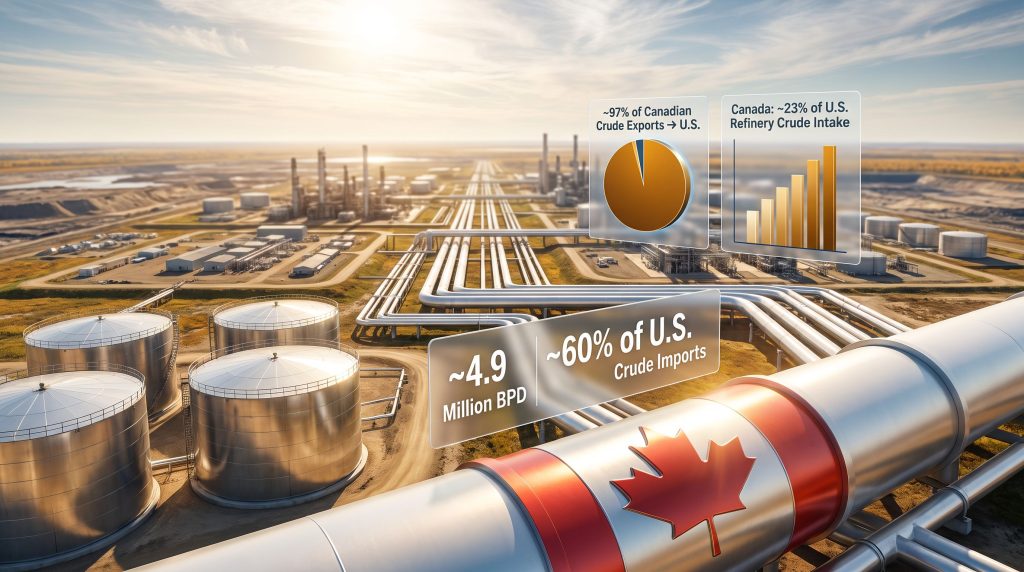
Canada's petroleum sector is not a marginal contributor to North American energy security. The country produced approximately 4.9 million barrels per day (bpd) of crude oil in 2023, placing it firmly among the world's top petroleum producers. Crucially, the destination of that output is overwhelmingly singular.
| Metric | Figure |
|---|---|
| Canadian crude production (2023) | ~4.9 million bpd |
| Share of Canadian crude exports to U.S. | ~97% |
| Canada's share of total U.S. crude imports | ~60% |
| Canada's share of U.S. refinery crude intake | ~23% |
These numbers reveal something that trade policy commentary frequently understates: Canadian crude does not merely supplement U.S. supply. It forms the structural backbone of American refinery throughput, particularly across Midwest and Gulf Coast facilities purpose-built to process heavy sour grades like Western Canadian Select (WCS).
Replacing this volume would require either:
- Costly capital retrofits at U.S. refining facilities to handle lighter crude grades
- Access to comparable heavy crude from suppliers carrying substantially greater geopolitical risk
- A multi-year infrastructure buildout that no trade deadline can accelerate
What Western Canadian Select Actually Is, and Why It Matters
Western Canadian Select is the benchmark heavy sour crude grade produced from Alberta's oil sands. It trades at a persistent discount to West Texas Intermediate (WTI), the North American light crude benchmark. This discount, known as the WCS-WTI differential, is not arbitrary. It reflects real differences in crude quality, transportation costs, and refinery configuration requirements.
Heavy sour crude contains higher sulphur content and requires more complex refining processes to convert into usable petroleum products. Refineries built to handle this type of feedstock, called coking refineries or complex refineries, represent multi-billion dollar capital investments that cannot be easily repurposed. This is precisely why U.S. refinery dependency on Canadian barrels is not a preference. It is an engineering constraint.
According to research from the C.D. Howe Institute quantifying U.S. benefits from Canadian crude, the economic advantages flowing to American refiners and consumers from this deeply integrated supply relationship are substantial and rarely captured in headline trade statistics.
When tariffs are applied to Canadian crude imports, the WCS-WTI differential functions as the primary pressure valve. Widening spreads effectively transfer the tariff burden downstream onto Canadian producers, partially insulating U.S. refiners from the full nominal cost of the levy.
Tariff Economics: Who Actually Pays When Canadian Crude Is Taxed
The Asymmetric Burden Distribution Mechanism
A critical distinction frequently lost in trade war commentary is the difference between supply reliability and producer profitability. These are not the same thing, and conflating them leads to significant analytical errors. Indeed, understanding how U.S. tariffs affect commodity markets more broadly provides useful context for interpreting these dynamics.
How tariff costs actually flow through the supply chain:
- U.S. refiners initially face higher nominal input costs on Canadian crude purchases
- Because Canadian producers have no alternative buyer capable of absorbing their volumes at comparable scale, competitive pressure forces WCS prices lower
- The WCS-WTI differential widens, partially offsetting the tariff cost for U.S. refiners
- Canadian upstream operators absorb a disproportionate share of the total tariff burden through compressed netback prices
- End consumers at the pump experience minimal direct impact in the near term
This mechanism explains why analysts broadly agree that crude flows between Canada and the U.S. are likely to continue even under tariff conditions. The economics are painful for Canadian producers but do not create the physical supply disruption that would be required to force a genuine break in the relationship.
Downstream Consequences for Alberta's Fiscal Position
The margin compression effect carries significant implications beyond individual producer balance sheets. Alberta's provincial government revenues are structurally tied to WCS netback pricing through royalty and resource tax receipts. Sustained tariff-driven spread widening would:
- Compress royalty income across the province's oil sands sector
- Reduce capital available for upstream reinvestment and expansion
- Dampen exploration and development activity in new oil sands projects
- Create fiscal pressure on provincial services and infrastructure programmes
This domestic economic sensitivity is one reason the Carney government's decision to avoid retaliatory export restrictions carries real political weight inside Canada, not just in bilateral trade negotiations.
Canada's Strategic Policy Calculation: Reliability Over Retaliation
Why the Carney Government Rejected Export Weaponisation
During a visit to Alberta, Prime Minister Mark Carney made clear that Canada's identity as a dependable, long-term commodity supplier represents a strategic asset worth protecting. His government's position marks a deliberate departure from the approach examined under former Prime Minister Justin Trudeau, whose administration explored the potential use of export taxes on strategic commodities including oil, uranium, and potash as negotiating leverage against U.S. trade policy.
Carney's government concluded that short-term retaliatory leverage was not worth the long-duration reputational cost. This is a sophisticated strategic calculation that deserves unpacking. Moreover, the broader U.S.-Canada trade war context makes this decision all the more consequential for Canadian producers and investors alike.
| Retaliatory Tool | Short-Term Leverage | Long-Term Risk |
|---|---|---|
| Oil export curbs | Moderate pressure on U.S. refiners | Permanent damage to Canada's supplier reputation |
| Uranium/potash export taxes | Raises U.S. industrial input costs | Accelerates U.S. diversification investment |
| Targeted commodity embargoes | Political signalling value | Triggers alternative supply chain development |
The logic is straightforward: supplier reputation is a long-duration asset. Once a producing nation signals willingness to politicise commodity flows, buyers begin hedging against that risk. Over time, this accelerates investment in alternative supply infrastructure, reducing the leveraging nation's market power precisely when it may need it most.
The Provinces Versus the Federal Government
An underappreciated dimension of Canada's internal policy debate is the tension between provincial governments, particularly Alberta's, and the federal administration in Ottawa. Some Alberta officials have explicitly noted that Canada's position as the largest foreign oil supplier to the U.S. creates a theoretical point of leverage in trade negotiations.
Carney's deliberate rejection of this framing represents a federal override of provincial instincts, grounded in a longer strategic view of Canada's global energy positioning. However, the proposed tariffs on Canadian energy exports continue to create friction between federal priorities and provincial economic interests.
The August 19 Deadline and What It Means for Markets
Anatomy of the Current Escalation
The current tariff dispute did not emerge abruptly. It is the most recent episode in an extended cycle of escalating trade tensions. The Trump administration threatened 50% import tariffs on a range of Canadian manufactured goods, with targeted categories including dairy products, automotive components, alcoholic beverages, and building materials.
Critically, bulk commodities including crude oil and potash were excluded from the threatened tariff tranche. This exclusion is not incidental. It reflects Washington's recognition of its own structural dependency on Canadian inputs that cannot be quickly replaced.
Key developments in the escalation timeline:
- Trump administration announces 50% tariff threat on Canadian manufactured goods
- Commodities including oil and potash are explicitly carved out of the threatened measures
- Canadian trade officials travel to Washington for bilateral framework negotiations
- Carney government states publicly that it is pursuing a comprehensive agreement benefiting both countries
- Carney simultaneously signals that all response options remain available, preserving negotiating ambiguity
- August 19 set as the trigger date for new tariff implementation if talks fail
Three Scenarios for the Post-Deadline Landscape
Scenario 1: Negotiated Framework Agreement
A pre-deadline deal suspends or reduces threatened tariffs on manufactured goods. Canadian crude flows continue undisrupted, the WCS differential stabilises, and Canada's supplier credibility is reinforced in global energy markets.
Scenario 2: Partial Implementation on Non-Commodity Goods
Tariffs proceed on dairy, automotive, and consumer categories while oil and potash remain exempt. Canadian producers face indirect economic pressure through broader macroeconomic effects but supply continuity is maintained. The bilateral relationship remains strained but operationally functional.
Scenario 3: Escalation to Commodity-Level Tariffs
Talks collapse and tariffs are extended to energy commodities. The WCS-WTI differential widens significantly, compressing Canadian producer margins. Canada explores retaliatory measures while publicly maintaining reliability commitments. Long-duration infrastructure diversification investment accelerates.
Can Canada Ever Meaningfully Reduce Its U.S. Export Dependency?
The Infrastructure Constraint That Overrides Market Intent
The 97% concentration of Canadian crude exports flowing to the U.S. is not a policy preference. It is the outcome of decades of pipeline investment oriented toward a single consuming market. Redirecting this volume, even partially, would require overcoming substantial physical and commercial barriers. In addition, geopolitical tensions reshaping trade globally are making alternative market development an increasingly urgent policy priority in Ottawa.
| Diversification Constraint | Detail |
|---|---|
| Pacific-facing pipeline capacity | Trans Mountain expansion adds capacity but insufficient for meaningful volume rebalancing |
| Asian refinery compatibility | Global heavy crude demand is geographically concentrated; not all refineries process WCS-grade oil |
| Pricing competitiveness | Logistics and pricing on Pacific routes remain less favourable than integrated U.S. pipeline networks |
| Timeline for structural rebalancing | Meaningful export diversification would require 5 to 10+ years of sustained infrastructure investment |
This constraint creates a dual dynamic that is rarely articulated clearly: Canada's inability to quickly redirect exports simultaneously limits its retaliatory leverage over Washington and deepens U.S. refiner dependency on Canadian supply. Both countries are locked into the relationship by infrastructure reality, regardless of what either government signals publicly.
The next major ASX story will hit our subscribers first
The Broader Strategic Value of Canada's Supplier Reputation
Why Reliability Is Worth More Than Retaliation
Canada's standing as a geopolitically stable, high-volume, long-term energy supplier carries value that extends well beyond the bilateral U.S. relationship. This reputation shapes:
- Attractiveness for foreign direct investment in upstream oil sands development
- Credibility in multilateral energy security discussions at forums like the International Energy Agency
- Pricing leverage in future diversified export markets, particularly as Trans Mountain capacity grows
- Positioning as a trusted partner in global critical minerals and energy transition supply chains
The Carney government's explicit protection of this reputation, even at the cost of forgoing short-term retaliatory leverage, represents a deliberate prioritisation of long-term geopolitical capital over immediate tactical advantage. As Reuters reporting on U.S. dependence on Canadian oil has noted, industry voices have consistently argued this dependency should itself deter aggressive tariff action.
Canada's value to global energy markets is not simply a function of how much oil it produces. It is a function of how reliably it delivers that oil, across political cycles, trade disputes, and market downturns. That track record, once compromised, is extraordinarily difficult to rebuild.
Frequently Asked Questions: Canada Oil Supply and U.S. Tariffs
Is Canada still the largest supplier of oil to the United States?
Yes. Canada supplies approximately 60% of all U.S. crude oil imports and accounts for roughly 23% of total U.S. refinery crude intake, making it the dominant foreign source of petroleum for American industrial and energy needs by a considerable margin. Canada remains a reliable oil supplier despite U.S. tariffs precisely because this scale of integration cannot be unwound through political decree alone.
Would U.S. tariffs on Canadian crude actually interrupt supply flows?
Analysts broadly agree that crude flows are likely to continue even under tariff conditions. The primary effect would be a widening of the WCS-WTI price differential, compressing Canadian producer margins rather than severing the physical supply relationship.
Why can't Canada simply redirect oil exports to Asia?
Canada's export infrastructure is overwhelmingly oriented toward the U.S. market. While the Trans Mountain pipeline expansion has created additional Pacific-facing capacity, the volume is insufficient to meaningfully redirect the approximately 97% of Canadian crude currently flowing to American refineries. A structural rebalancing would require a decade or more of new infrastructure investment, financing, and commercial agreements.
Has Canada considered restricting oil exports as a retaliatory measure?
The concept was examined under the previous Trudeau administration, which explored export taxes on oil, uranium, and potash as potential trade leverage tools. The current Carney government has moved away from this approach, publicly stating that Canada's long-term value as a dependable energy supplier outweighs the tactical benefits of commodity supply restrictions. This position is further supported by analysis of the co-evolution of the Canada-U.S. oil industry, which demonstrates how deeply intertwined these two energy economies have become over decades of shared infrastructure development.
Disclaimer: This article contains forward-looking analysis, scenario projections, and macroeconomic commentary for informational purposes only. It does not constitute financial or investment advice. Readers should conduct independent research before making any investment or trading decisions related to energy markets or Canadian equities.
Want to Stay Ahead of Major Commodity Discoveries Driving the Next Market Move?
Discovery Alert's proprietary Discovery IQ model instantly scans ASX announcements across 30+ commodities — including energy-related plays — delivering real-time alerts on significant mineral discoveries so subscribers can act before the broader market reacts. Explore historic examples of discoveries that generated exceptional returns and begin a 14-day free trial to secure a market-leading edge.