July 29, 2026
When Rain Fails, Coal Steps In: Understanding India's Hydro-Thermal Energy Dependency
India's power sector carries a structural vulnerability that rarely surfaces during good monsoon years but becomes impossible to ignore when rainfall falters. Across the southern states, electricity grids have been engineered around the assumption that monsoon-fed reservoirs will reliably fill each year, sustaining hydroelectric output through the dry months that follow. When that assumption breaks down, the Karnataka coal power drought energy crisis becomes the defining story of the season.
This is not a new dynamic. However, the 2026 drought season has brought it into sharp relief across Karnataka, where the Karnataka Power Corporation Limited (KPCL) has mounted one of its most aggressive coal procurement campaigns in recent memory, racing to fill the generation void left by depleted reservoirs before demand pressures overwhelm the grid.
When big ASX news breaks, our subscribers know first
The Structural Fragility Behind Karnataka's Power System
Karnataka's electricity generation portfolio has historically leaned on hydropower for a significant share of its baseload supply. The state's river systems, fed primarily by the southwest monsoon, drive turbines at dozens of stations across the Western Ghats and the Deccan plateau. In a normal rainfall year, this arrangement is economically efficient: hydropower carries minimal fuel costs, responds quickly to demand fluctuations, and produces no direct carbon emissions.
The problem is the word normal. Karnataka's catchment zones are acutely sensitive to variations in monsoon onset, intensity, and distribution. A deficit of even 15 to 20 percent in seasonal rainfall can translate into reservoir storage levels that fall well below operational thresholds for sustained power generation. When inflows drop, water managers face difficult trade-offs between irrigation, drinking water supply, and power production. Electricity generation frequently loses out.
How the Cascade Effect Unfolds
This creates a cascading effect that moves quickly through the system:
- Reduced reservoir inflows lower available head pressure at dam-based generating stations
- Lower head pressure reduces turbine output, sometimes forcing units offline entirely
- The resulting generation shortfall must be absorbed by other sources or purchased from the open market
- Thermal plants, already operating at baseline loads, are called upon to ramp up significantly
- Higher thermal generation requires more coal, more transport capacity, and more operational readiness than the system typically maintains during well-watered years
Furthermore, what makes the 2026 situation particularly acute is that this cascade is happening at scale simultaneously across multiple catchment zones, compressing the timeline for response and leaving KPCL with limited margin for error. These coal supply challenges underscore just how fragile the system's foundations can be.
KPCL's Three-Station Thermal Strategy
With hydropower generation curtailed, KPCL's thermal fleet has become the load-bearing pillar of Karnataka's grid. Three stations anchor this strategy:
| Thermal Station | Location | Primary Fuel Source | Key Role in 2026 Response |
|---|---|---|---|
| Raichur Thermal Power Station (RTPS) | Raichur, Karnataka | WCL-supplied coal + additional allocation | Primary load carrier; largest beneficiary of WCL agreement |
| Yermarus Thermal Power Station | Raichur district, Karnataka | Coal India supply chain | Supplementary thermal output |
| Ballari Thermal Power Station (BTPS) | Ballari, Karnataka | Baranj Captive Mine (Units 1 and 2) | Captive supply chain; significant dispatch increase |
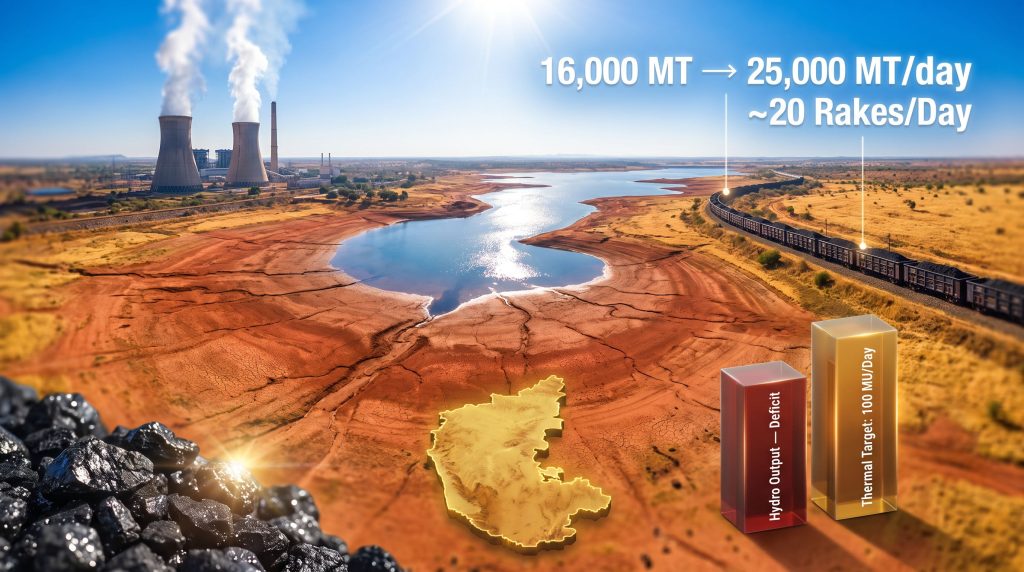
The combined output target across these three stations is approximately 100 million units (MU) of electricity per day. Sustaining that level of generation is not simply a matter of keeping boilers running. It requires a continuous, precisely coordinated fuel supply chain delivering roughly 20 coal rakes daily to keep stockpiles at operational levels.
Each standard coal rake used in India carries approximately 3,500 to 4,000 metric tonnes of coal. At 20 rakes per day, KPCL needs between 70,000 and 80,000 metric tonnes of coal delivered to its plants daily just to maintain the 100 MU target. This is a logistics operation of considerable complexity, involving mine coordination, railway scheduling, unloading infrastructure capacity, and plant-level stockyard management.
How KPCL Secured Additional Coal Supply
To close the gap between existing coal allocations and the volumes required for maximum thermal output, KPCL took a direct, delegation-based approach. A team led by KPCL Managing Director Rajendra Cholan, IAS, travelled to Nagpur, Maharashtra, to negotiate face-to-face with Western Coalfields Limited (WCL) and conduct an inspection of the Baranj Captive Coal Mine.
The outcomes of that engagement were significant:
- WCL committed to supplying an additional 4,000 metric tonnes of coal per day to RTPS, on top of existing contracted volumes
- Coal India Limited provided assurances of one to two additional rakes per day for RTPS, calibrated to real-time demand signals from KPCL
- The Baranj Captive Coal Mine increased daily dispatch from 16,000 metric tonnes to 25,000 metric tonnes, an uplift of 9,000 metric tonnes per day representing a 56% increase in captive mine output for BTPS Units 1 and 2
Key Data Summary:
- WCL incremental allocation to RTPS: +4,000 MT/day
- Baranj Mine daily dispatch: 16,000 MT increased to 25,000 MT (+9,000 MT/day)
- Additional Coal India rakes committed for RTPS: 1 to 2 per day
- Daily rake requirement to sustain 100 MU thermal output: approximately 20 rakes
The captive mine arrangement for BTPS Units 1 and 2 deserves particular attention from a supply security standpoint. Captive mines provide cost certainty that spot market purchases cannot. When a utility like KPCL is forced into large open-market coal transactions during a national supply tightening period, it typically pays a significant premium over the administered Coal India price. Proposals such as an India coal trading exchange could, in future, offer greater price transparency for utilities navigating these pressures.
Solving the Logistics Equation: Railway Rake Availability
Securing coal allocation agreements is only half the operational challenge. Higher coal supply commitments deliver no actual generation unless the physical transport capacity exists to move coal from mines in Maharashtra to power stations in Karnataka on schedule.
KPCL's delegation addressed this directly during their Nagpur visit by engaging senior officials of Central Railway. The discussion centred on securing guaranteed availability of empty railway rakes, the return leg of the coal transport cycle that often creates bottlenecks when demand spikes simultaneously across multiple utilities.
Railway authorities confirmed that the required rake volumes would be made available to KPCL on demand. This assurance matters because rake shortages are a well-documented constraint in India's coal logistics system. When multiple state utilities compete for the same pool of empty rakes during peak demand periods, delays at the loading end propagate into stockpile drawdowns at the plant end, ultimately threatening generation continuity.
The three-way coordination required here — between mine output scheduling, railway rake positioning, and plant-level unloading and stockyard capacity — is where drought-year coal emergencies typically break down. KPCL's pre-emptive engagement across all three dimensions reflects an awareness of where the system's stress fractures lie.
The Financial Logic: Why Coal Stockpiling Beats Market Procurement
From a fiscal management perspective, KPCL's coal stockpiling drive is as much a financial risk mitigation exercise as it is an operational one. India's short-term power market, the Indian Energy Exchange (IEX), experiences significant price spikes during periods of regional supply stress. During past Karnataka drought years, open-market power purchase costs have risen sharply, sometimes exceeding Rs 10 to 12 per unit during peak scarcity periods, compared to the substantially lower effective cost of generation from coal-fed state-owned thermal plants. Monitoring energy price trends across markets helps utilities anticipate and plan for these fluctuations.
The arithmetic strongly favours front-loading coal procurement:
- Contracted coal supply from Coal India subsidiaries arrives at regulated prices, providing cost predictability
- Captive mine supply carries even lower effective costs, with no spot premium exposure
- Open market power purchases during drought-driven scarcity can cost multiples of thermal generation, placing significant pressure on state electricity department finances
- Load shedding, the alternative when neither coal nor market power is available, carries economic and political costs that are difficult to quantify but historically significant
KPCL's Energy Minister KJ George confirmed that the utility had taken all necessary steps to procure additional coal and maintain thermal plant readiness, including ensuring that all three thermal stations were prepared through maintenance protocols and operational readiness checks ahead of the sustained high-load period.
The next major ASX story will hit our subscribers first
The Broader Water-Coal Nexus in Indian Power Planning
The Karnataka coal power drought energy crisis reflects a pattern that is becoming more visible across India's power sector as climate variability intensifies. The intersection of water stress and thermal generation creates compounding risks that energy planners have historically treated as separate concerns.
Thermal power plants shut down by water crises are a documented reality in India, as riverside stations rely on adequate river flows for cooling systems and ash management. Extended drought periods can reduce water availability at these facilities, constraining their ability to operate at full capacity precisely when they are most needed to compensate for hydropower shortfalls.
Karnataka's thermal stations in Raichur and Ballari draw cooling water from river systems that are themselves under stress during deficient monsoon years. While this has not yet triggered formal operational constraints in 2026, it represents a secondary vulnerability that existing energy security frameworks do not adequately capture.
Renewables: Capable but Not Yet Dispatchable Enough
Karnataka is among India's leading states for installed renewable energy capacity, with substantial solar and wind generation across its northern and coastal districts. However, renewable energy solutions alone cannot yet fully bridge the gap when hydropower falters at scale.
Why Intermittency Remains the Core Problem
Solar and wind generation are intermittent: they produce electricity when the sun shines or wind blows, not necessarily when grid demand requires dispatchable power. Hydroelectric generation, by contrast, is dispatchable: operators can increase or decrease output on command, making it functionally similar to thermal generation in its ability to follow load curves.
Without large-scale grid storage to firm up renewable output, Karnataka's solar and wind capacity cannot replicate the flexibility that hydropower provides. Battery storage at grid scale remains limited in India's southern states, and pumped hydro projects — the most promising long-duration storage option — require the same water resources that are under drought stress.
This creates an uncomfortable but clear near-term reality: coal remains Karnataka's only readily available dispatchable backup when hydro fails at scale. Moreover, the broader energy transition pressures facing the country make resolving this intermittency challenge increasingly urgent.
What a More Resilient Karnataka Energy System Would Require
The current crisis points toward a set of structural reforms that, if implemented, would reduce Karnataka's vulnerability to future monsoon deficits. As droughts and blackouts continue to cost India significant energy capacity, the case for systemic reform becomes increasingly compelling:
- Accelerated grid-scale battery storage deployment to firm renewable generation and reduce reliance on thermal dispatch during hydro shortfalls
- Diversification of inter-state transmission connectivity, enabling Karnataka to import surplus power from states with different climatic profiles and generation mixes
- Demand-side management programmes that incentivise large industrial consumers to shift loads away from peak deficit periods
- Renewable firming contracts that bundle solar or wind capacity with storage commitments, creating genuinely dispatchable clean generation
- Long-term coal inventory protocols that specify minimum stockpile thresholds calibrated to projected monsoon deficit scenarios rather than average-year assumptions
The Karnataka coal power drought energy crisis is, in a meaningful sense, a planning failure as much as it is a weather event. The meteorological patterns that produce deficient southwest monsoons are not new. What has changed is the frequency and severity with which they are occurring — a shift that demands a corresponding update to the planning assumptions embedded in Karnataka's energy infrastructure strategy.
Frequently Asked Questions: Karnataka Coal Power and the 2026 Drought Crisis
Why does a monsoon deficit reduce electricity output in Karnataka?
Karnataka's hydroelectric stations are fed by reservoirs and river systems that depend on annual monsoon rainfall for replenishment. When seasonal rainfall falls below average across catchment zones, reservoir inflows decline, water levels drop, and the head pressure available to drive turbines decreases. The result is a direct and often significant reduction in hydroelectric generation capacity that cannot be compensated without activating alternative sources.
What is KPCL and why is it central to Karnataka's drought response?
KPCL, the Karnataka Power Corporation Limited, is the state-owned entity responsible for operating Karnataka's thermal, hydro, and other generation assets. As the primary generation utility, KPCL manages the fuel procurement, plant operations, and capacity planning decisions that determine whether the state can maintain adequate electricity supply during periods of stress.
How much coal does KPCL need daily to sustain maximum thermal output?
Achieving a daily thermal generation target of approximately 100 million units requires around 20 coal rakes per day. Each rake carries roughly 3,500 to 4,000 metric tonnes of coal, meaning total daily coal consumption across RTPS, Yermarus, and BTPS approaches 70,000 to 80,000 metric tonnes at full output.
What is the Baranj Captive Coal Mine and why does it matter for supply security?
The Baranj Captive Coal Mine in Maharashtra provides dedicated coal supply to Units 1 and 2 of the Ballari Thermal Power Station. Unlike coal purchased through competitive or spot market channels, captive mine supply arrives at lower, more predictable cost. During the 2026 drought response, daily dispatch from Baranj was increased from 16,000 to 25,000 metric tonnes, a 56% increase that significantly reduces BTPS's exposure to open-market price volatility.
Could Karnataka face load shedding if coal procurement targets are not met?
Historical precedent strongly suggests yes. During previous drought years, generation shortfalls that outpaced coal supply and open-market procurement capacity have led to scheduled and unscheduled load shedding, particularly in rural and peri-urban areas. The cost of this outcome — both in direct economic impact on industrial and agricultural consumers and in political terms — is a key driver behind KPCL's aggressive pre-emptive coal stockpiling approach.
Is there a longer-term solution to Karnataka's drought-power vulnerability?
The long-term pathway involves diversifying Karnataka's generation mix away from weather-dependent sources, accelerating grid-scale storage deployment, and investing in inter-state transmission infrastructure that allows the grid to draw on surplus generation from less drought-affected regions. In the near term, however, the Karnataka coal power drought energy crisis confirms that coal-fired thermal generation remains the only scalable, dispatchable backup available when hydro output collapses.
Readers seeking ongoing analysis of India's coal supply dynamics, renewable energy transition, and state-level grid management can explore further coverage through ET EnergyWorld at energy.economictimes.indiatimes.com.
Want to Stay Ahead of the Next Major Commodity Discovery Driving These Energy Trends?
The coal supply dynamics reshaping India's power sector highlight just how rapidly commodity markets can shift — and how quickly informed investors must act. Discovery Alert's proprietary Discovery IQ model delivers real-time ASX mineral discovery alerts, turning complex commodity data into actionable investment opportunities the moment they are announced — start your 14-day free trial today, or explore historic discovery returns to understand the scale of what early positioning can mean.