July 29, 2026
The Quiet Revolution Happening Inside Metals Recycling Facilities
Across industrial history, the recycling of metals has been defined by brute-force thermodynamics. Scrap went in, heat was applied, and metal came out. For decades, this basic formula changed very little. What is happening now, however, represents something categorically different. The advancements in technology for the metals recycling industry are not incremental upgrades to existing processes. They are a structural reimagining of what a recycling facility is, what it can recover, and how precisely it can do so.
The convergence of artificial intelligence, sensor-based sorting, advanced metallurgical chemistry, and digital supply chain infrastructure is transforming secondary metals production into a high-precision industrial discipline. Understanding where this transformation stands today, and where it is heading, matters enormously for manufacturers, resource strategists, and sustainability planners alike.
When big ASX news breaks, our subscribers know first
Why the Industry Reached an Inflection Point
Several compounding pressures have made technological complacency in metals recycling economically and regulatorily untenable.
Global demand for secondary raw materials is rising as manufacturers seek to reduce their exposure to primary commodity price volatility. At the same time, scrap streams are becoming significantly more complex. The proliferation of advanced alloys in automotive manufacturing, the surge in end-of-life electronics, and the growing volume of lithium-ion battery waste have all introduced material compositions that conventional mechanical processing simply cannot handle efficiently.
Tightening emissions frameworks across the European Union, the United States, and Asia-Pacific are adding further pressure. Regulators are increasingly treating secondary metals production not merely as waste management, but as a critical input to decarbonisation strategy. Facilities that cannot demonstrate emission reductions and responsible sourcing practices are finding themselves excluded from the supply chains of major downstream manufacturers.
The economic logic is equally compelling. Poor metal recovery yields represent direct revenue loss. Processing a tonne of mixed electronic waste through outdated methods and recovering only a fraction of the recoverable gold, copper, or palladium is not a neutral outcome. It is a quantifiable cost. Technology adoption has shifted from capital expenditure to competitive necessity.
What "Advanced Technology" Actually Means on the Facility Floor
The phrase advanced technology is often applied loosely. In the context of metals recycling, it encompasses a genuinely broad stack of capabilities. The modern high-performance recycling facility integrates sensor-based separation hardware, machine learning classification systems, robotic handling equipment, advanced metallurgical processing, and digital monitoring infrastructure. These layers do not operate independently. Their value is largely multiplicative, with each system improving the performance conditions for the next.
"The modern recycling facility increasingly resembles a data centre as much as an industrial plant, with sensor arrays, AI inference engines, and digital supply chain tools layered alongside traditional metallurgical processes."
Sorting Technologies: Precision at Industrial Speed
Sorting metals from heterogeneous waste streams remains one of the most operationally critical steps in the entire recycling process. It is also the area where technology has delivered some of its most measurable performance gains.
Sensor-Based Separation Systems
Eddy current separators are widely deployed for recovering non-ferrous metals, including aluminium, copper, and zinc, from conveyor-fed mixed waste streams. These systems operate on the principle of induced electrical currents interacting with conductive materials, physically ejecting non-ferrous metals from the stream without contact. Increasingly, they are paired with downstream AI verification systems that confirm separation accuracy in real time.
Magnetic separation systems remain standard for ferrous metal extraction. Contemporary iterations use variable-field electromagnets and high-gradient configurations to improve recovery of fine ferrous particles that earlier equipment would have missed.
X-ray fluorescence and X-ray transmissive sorting represent the most significant recent hardware advances in the sector. XRF technology enables elemental composition identification without any physical contact with the material, identifying what a piece of metal actually is at an atomic level. XRT systems differentiate materials by atomic density, making it possible to distinguish between alloy grades within the same broad metal family. Combined XRF and XRT systems are now capable of performing this alloy-grade differentiation at genuine industrial throughput speeds.
| Sorting Technology | Primary Application | Key Advantage | Maturity Level |
|---|---|---|---|
| Eddy Current Separator | Non-ferrous recovery | High throughput | Mature |
| Magnetic Separation | Ferrous extraction | Low operating cost | Mature |
| XRF Sorting | Elemental identification | Non-destructive analysis | Established |
| XRT Sorting | Density-based separation | Alloy-grade differentiation | Growing |
| AI Vision Systems | Multi-material classification | Real-time adaptive sorting | Emerging to Established |
Artificial Intelligence: The Processing Brain Behind the Hardware
Sensor hardware captures data. Artificial intelligence determines what to do with it. The integration of machine learning into recycling operations is reshaping sorting accuracy, operational efficiency, and market intelligence simultaneously.
AI Vision Systems in Practice
AI-driven vision systems pair high-resolution cameras with machine learning models trained to analyse material geometry, surface texture, colour, and spectral signatures at speed. These systems classify and route materials far more consistently than manual inspection, and unlike human workers, their accuracy does not degrade across shift cycles or in response to fatigue.
Critically, these models improve continuously. Each classification decision adds to the training dataset, meaning that a well-implemented AI vision system becomes progressively more accurate as it processes more material. Contamination rates in sorted output streams fall measurably over time as the model refines its ability to distinguish increasingly similar materials.
Predictive Analytics and Real-Time Process Optimisation
AI applications in recycling extend well beyond visual sorting. Furthermore, AI-powered process optimisation is being applied to forecast scrap value fluctuations, directly informing inventory holding strategies. Facilities that can anticipate price movements in copper, aluminium, or nickel scrap have a material advantage in optimising when to sell processed output.
At the process level, AI systems are dynamically adjusting furnace temperatures, separation parameters, and feed rates based on live sensor inputs. The practical result is that facilities can maintain consistent output quality even as the composition of input scrap varies significantly from batch to batch. This is a more significant capability than it might initially appear. Input variability is one of the defining operational challenges in recycling, and AI-driven parameter adjustment addresses it directly.
"AI-based technologies can optimise recycling operations by adjusting critical operational parameters in real time, enabling facilities to maintain output quality even as input material composition fluctuates significantly."
Robotics: Precision Handling in Hazardous Environments
Robotic systems are addressing two simultaneous problems in metals recycling: the physical limitations of human sorting at high speeds and the worker safety risks associated with handling hazardous scrap materials.
Industrial robotic sorters deployed on high-speed picking lines operate consistently across continuous cycles, without the error rate variability introduced by human fatigue. They are particularly effective in e-waste disassembly and printed circuit board processing, where the combination of speed, precision, and hazardous material content makes manual handling both inefficient and dangerous.
Collaborative robots, or cobots, are emerging in semi-structured environments where full automation is not yet viable. These systems are designed to work alongside human operators, handling tasks such as fine disassembly of consumer electronics and battery packs, significantly reducing direct worker exposure to toxic substances including lead, cadmium, and brominated compounds.
The measurable outcomes of robotic integration include higher throughput per labour hour, reduced contamination in sorted metal streams, and improved worker safety metrics across facilities handling electronic scrap and industrial residues.
The next major ASX story will hit our subscribers first
Metallurgical Innovation: Recovering What Conventional Smelting Loses
The limitations of pyrometallurgical processing have become increasingly apparent as scrap streams grow more complex. High-temperature smelting blends or destroys minor metals that have significant value, and it generates substantial emissions at a time when the regulatory environment for industrial carbon output is tightening considerably.
Hydrometallurgy as an Emissions-Conscious Alternative
Hydrometallurgical processing uses aqueous chemical solutions to selectively dissolve and recover target metals from complex scrap. Operating at significantly lower temperatures than conventional smelting, the approach produces fewer gaseous emissions and generates waste streams that are far more controllable. For recovering copper, nickel, cobalt, and precious metals from e-waste, hydrometallurgy enables selective extraction from multi-metal scrap streams where traditional smelting would lose or dilute the minor metal content entirely.
The yield purity improvements are particularly significant. Higher purity output from the recycling process reduces the downstream refining requirements that add both cost and emissions to the overall supply chain.
Plasma Arc Technology: Processing Beyond Conventional Capability
Plasma arc technology is gaining industrial traction for its ability to handle materials that conventional smelters cannot process efficiently. Electrically generated plasma arcs achieve temperatures far exceeding standard furnace ranges, making it possible to process electronic waste, automotive shredder residue, and industrial by-products that would otherwise require landfill disposal or be processed at significant quality loss.
The technology's particular advantage is its tolerance for heterogeneous and heavily contaminated input materials. As scrap streams become more complex, this capability becomes more strategically valuable. Commercial-scale plasma arc deployments are now operational across Europe and Asia, moving the technology beyond pilot status.
Induction Furnaces and Hydrogen-Based Reduction
Induction furnace technology uses electromagnetic induction rather than combustion to generate heat, delivering measurably lower electricity consumption per tonne of processed metal and a significantly reduced direct emissions profile compared to coke-fired alternatives. Faster heat-up cycles and more precise temperature control also improve output consistency.
In addition, flash Joule heating is an emerging thermal innovation that processes scrap at extremely high temperatures in milliseconds, showing particular promise for recovering critical minerals from e-waste with minimal energy input. Hydrogen-based direct reduction processes replace coke entirely as the reducing agent in iron and steel production. Several pilot and commercial-scale hydrogen DR facilities are now operational in Europe, representing a meaningful near-term pathway for reducing the carbon intensity of secondary steel processing.
The Energy Case for Secondary Production
The energy efficiency differential between primary and secondary metal production is one of the most compelling sustainability arguments for accelerating advancements in technology for the metals recycling industry.
| Metal | Primary Production Energy (GJ/tonne) | Secondary Production Energy (GJ/tonne) | Energy Saving |
|---|---|---|---|
| Aluminium | ~170 | ~10 to 15 | ~92% |
| Copper | ~35 | ~7 to 10 | ~75 to 80% |
| Steel | ~20 to 25 | ~8 to 10 | ~55 to 65% |
| Lead | ~25 | ~3 to 5 | ~75 to 85% |
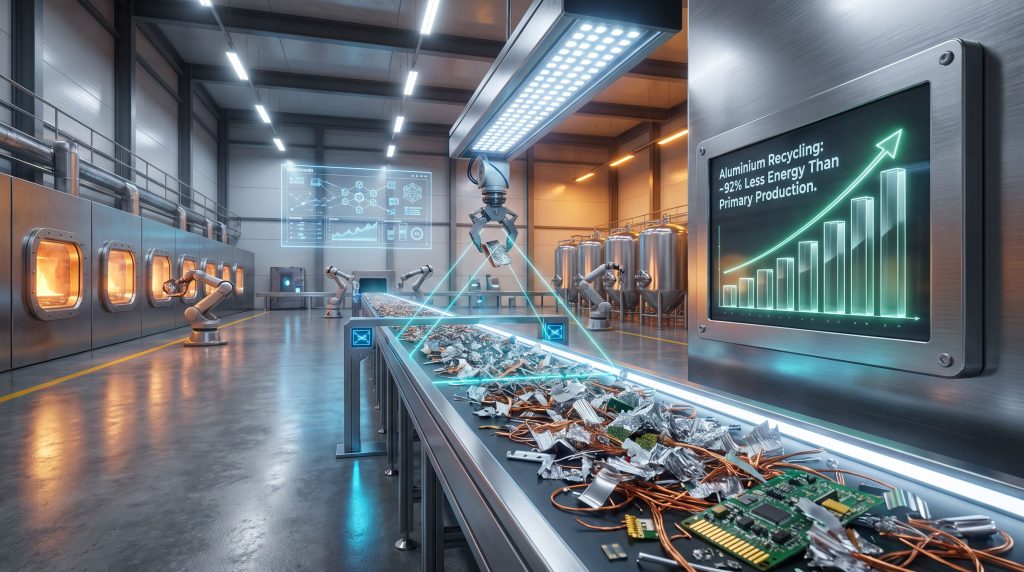
"Recycling aluminium requires approximately 92% less energy than producing it from bauxite ore, making advanced aluminium recycling technology one of the highest-leverage interventions available to industrial decarbonisation strategies."
These figures underscore why advanced recycling technology is increasingly framed not just as a circular economy tool, but as a direct decarbonisation mechanism for energy-intensive manufacturing sectors. Consequently, the World Economic Forum has highlighted metal recycling as one of the most impactful opportunities available to accelerate the global energy transition.
E-Waste: The Highest-Value, Highest-Complexity Challenge
Electronic waste occupies a unique position in the secondary metals landscape. Its material composition is simultaneously more valuable and more hazardous than almost any other scrap category.
Printed circuit boards contain gold, silver, copper, palladium, and rare earth elements at concentrations that frequently exceed those found in primary ore deposits. One tonne of mobile phones contains an estimated 250 to 350 grams of gold, compared to typical primary gold ore grades that rarely exceed 5 to 10 grams per tonne at operating mines. Copper recovery from e-waste streams is now economically competitive with primary copper production at current commodity prices.
At the same time, these materials are embedded alongside lead, mercury, cadmium, and brominated flame retardants, requiring multi-stage processing that combines mechanical, chemical, and thermal methods with significant worker protection requirements.
Bioleaching represents one of the most intriguing emerging responses to this challenge. Using microorganisms to extract metals from e-waste, the approach reduces dependence on harsh chemical reagents and offers a more sustainable recovery pathway for precious metals from circuit boards. Bioleaching is currently transitioning from laboratory and pilot scale toward early commercial deployment. Electrochemical deposition methods for high-purity precious metal recovery from leachate solutions are also advancing alongside it.
The urban mining economics are compelling enough that dedicated facilities targeting specific high-value metal categories are attracting growing commercial investment globally. The EV battery recycling process is, furthermore, emerging as one of the most strategically significant subsets of this challenge, given the volume of end-of-life battery packs entering scrap streams globally. This has, in turn, driven battery recycling expansion across multiple continents as major industrial players move to secure critical mineral recovery capabilities.
Digital Infrastructure: Traceability as a Competitive Asset
As demand for verified recycled metal content grows, digital traceability is transitioning from a voluntary capability to a compliance requirement.
Blockchain-based systems create immutable records documenting material origin, processing history, and chain of custody. These records support responsible sourcing verification for downstream manufacturers navigating increasingly stringent supply chain due diligence requirements. The EU Battery Regulation and broader Critical Raw Materials Act frameworks are driving mandatory traceability requirements that will affect battery-grade metal supply chains in particular.
Digital product passports encode material composition, recycled content percentage, and processing pathway in a format that allows buyers to independently verify recycled metal quality claims. These are transitioning from voluntary best practice toward regulatory baseline requirements within EU circular economy policy architecture.
IoT sensor networks embedded across conveyor systems, sorting equipment, and furnaces monitor operational variables continuously, feeding real-time data into centralised process management dashboards. Predictive maintenance algorithms operating on this data are reducing unplanned downtime and extending equipment lifespan across facilities that have made the infrastructure investment.
| Operational Area | IoT Application | Performance Benefit |
|---|---|---|
| Equipment monitoring | Vibration and temperature sensors | Reduced unplanned downtime |
| Material flow tracking | Weight and volume sensors | Improved throughput accuracy |
| Energy management | Power consumption monitoring | Lower energy cost per tonne |
| Quality control | Inline composition sensors | Consistent output specification |
| Maintenance scheduling | Predictive failure modelling | Extended equipment lifespan |
The Technology Roadmap Ahead
The near-term period through to 2027 is expected to see broader deployment of AI vision systems across mid-sized recycling facilities, expansion of cobot adoption into automotive shredder residue processing, and the transition of digital product passports from voluntary to compliance-driven adoption.
Between 2027 and 2032, the trajectory points toward fully autonomous sorting and processing facilities with minimal human intervention requirements, closed-loop quality management systems that adjust processing parameters without operator input, and the commercial scaling of bioleaching and electrochemical recovery for critical minerals including lithium, cobalt, and rare earth elements.
Digital twin technology, which creates virtual replicas of physical processing environments, is already demonstrating value for process optimisation and virtual commissioning. Its integration into continuous facility management represents one of the more transformative medium-term developments in operational management. According to Markets and Markets, the global metal recycling market is projected to grow substantially through this period, driven largely by technology-enabled improvements in recovery rates and the rising value of secondary critical minerals.
Frequently Asked Questions
What is the most impactful recent advancement in metals recycling technology?
The convergence of AI-driven vision systems with XRF and XRT sensor-based sorting represents the most operationally significant recent development. Together, these technologies enable facilities to sort a broader range of materials with greater purity and throughput than was previously achievable with either system operating independently.
How does hydrometallurgy differ from conventional smelting?
Hydrometallurgy uses aqueous chemical solutions to selectively dissolve and recover metals at much lower temperatures, producing fewer gaseous emissions and enabling recovery of minor metals that would be lost or blended in high-temperature pyrometallurgical processing. It is particularly effective for complex e-waste and multi-metal scrap streams.
Why is e-waste considered the highest-value recycling challenge?
The precious and critical metal concentrations in printed circuit boards frequently exceed those found in primary ore deposits, while the simultaneous presence of hazardous substances requires sophisticated multi-stage processing. The combination of high value and processing complexity makes it both the most rewarding and most technically demanding segment of secondary metals recovery.
What role does blockchain play in metals recycling supply chains?
Blockchain creates tamper-resistant records of material origin, processing steps, and custody transfers, enabling manufacturers and regulators to verify recycled content claims independently. It is becoming particularly important for battery-grade metal supply chains where regulatory traceability requirements are intensifying. The EV battery recycling process is one area where such traceability frameworks are advancing rapidly.
Is bioleaching commercially ready for e-waste processing?
Bioleaching is at an early commercial deployment stage, with particular promise for recovering precious metals from circuit boards without the hazardous chemical reagents required by conventional hydrometallurgical approaches. Scale-up economics and processing speed remain active areas of development.
Key Takeaways
The advancements in technology for the metals recycling industry represent a genuine structural transition rather than incremental improvement. The convergence of multiple technology layers is producing outcomes that no single technology could achieve independently:
- Sorting precision is advancing through combined XRF, XRT, AI vision, and robotic handling systems working in sequence
- Metal recovery rates are improving through hydrometallurgical, electrochemical, and plasma arc processing innovations that recover metals conventional smelting loses
- Digital infrastructure through IoT, blockchain, and digital twins is transforming both operational management and supply chain transparency
- Decarbonisation is being driven by induction furnaces, hydrogen-based reduction, and renewable energy integration across electrically intensive processes
- E-waste represents the highest-value opportunity in secondary metal recovery, with urban mining economics increasingly competitive with primary production
- Regulatory momentum is accelerating technology adoption, particularly around traceability and recycled content verification in battery and critical mineral supply chains
"The metals recycling industry is undergoing a fundamental transition from a largely mechanical, labour-intensive process toward a high-precision, data-driven, and increasingly automated industrial system. Facilities investing in technology integration now are positioning themselves for competitive advantage as regulatory requirements tighten and demand for verified secondary materials continues to grow."
Disclaimer: This article contains forward-looking statements, market projections, and technology forecasts based on current industry trends and publicly available data. These projections involve inherent uncertainty and should not be interpreted as investment advice or guaranteed outcomes. Readers should conduct independent research before making any investment or operational decisions based on the information presented here.
Want to Stay Ahead of the Next Major Critical Minerals Discovery?
As the metals recycling revolution drives surging demand for critical minerals like lithium, cobalt, and copper, the opportunities emerging on the ASX are moving fast — Discovery Alert's proprietary Discovery IQ model delivers real-time alerts the moment significant mineral discoveries are announced, ensuring subscribers can act on actionable opportunities before the broader market catches on. Explore historic discoveries and their remarkable returns on Discovery Alert's dedicated discoveries page, and begin your 14-day free trial today to position yourself ahead of the market.