
July 29, 2026
When Governance Moves Faster Than Infrastructure: The Real Story Behind Indonesia's Nickel Export Crisis
Global commodity markets have learned to expect volatility from geopolitical shifts, demand cycles, and price corrections. What they are far less prepared for is regulatory paralysis — the kind that emerges not from a deliberate policy decision, but from the gap between a government's ambitions and its operational capacity to execute them. That gap is precisely what has brought Indonesia's processed nickel export sector to a near standstill in mid-2026, and understanding why requires looking well beyond the headlines.
When big ASX news breaks, our subscribers know first
Indonesia Nickel Exports Delayed by Rare Earth Checks: What's Actually Happening
The phrase Indonesia nickel exports delayed by rare earth checks has circulated widely since late July 2026, but it risks oversimplifying a structurally complex problem. This is not an export ban. Indonesian authorities have not reversed course on the country's downstream processing strategy. Instead, what has emerged is a compliance architecture that was introduced before the systems needed to implement it were in place.
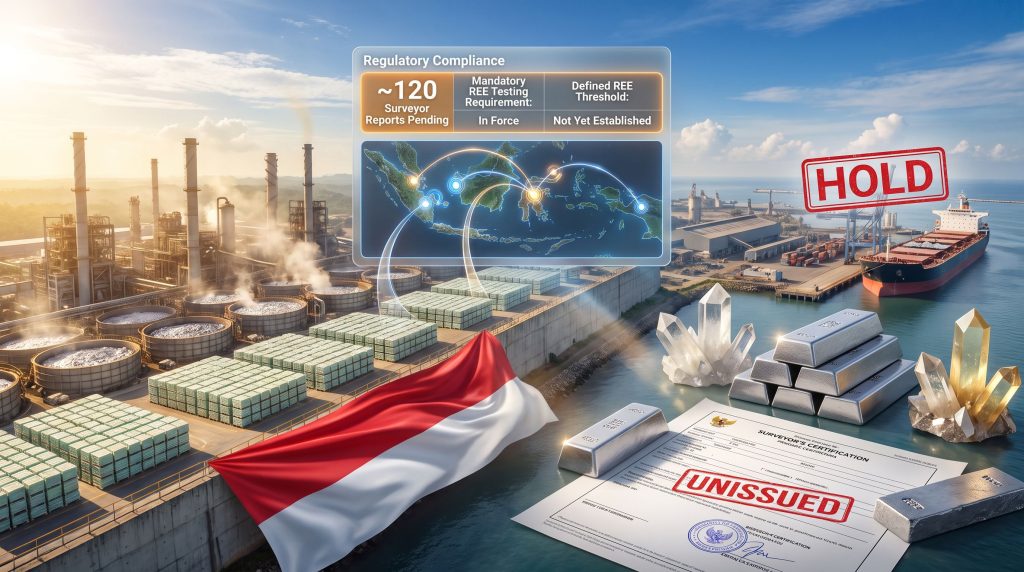
Indonesia's nickel smelter association FINI confirmed on July 29, 2026, that approximately 120 surveyor reports remained unissued across multiple commodity streams and mining regions. Without those reports, export clearance cannot proceed. Affected products span nickel pig iron (NPI), ferronickel, nickel matte, mixed hydroxide precipitate (MHP), bauxite, and alumina — covering some of the most strategically significant mineral exports in global supply chains today.
The Corruption Case That Triggered a New Testing Regime
The chain of events began on July 7, 2026, when Indonesia's attorney general's office identified three suspects in a corruption investigation linked to the minerals export sector. The government's response was to introduce mandatory testing for rare earth element (REE) content, uranium, and thorium in processed mineral export cargoes, requiring surveyors to certify the composition of each shipment before clearance is granted.
The intent behind the measure is defensible. Indonesia's rare earth supply chains, which occur naturally as a trace by-product within nickel laterite ore deposits, remain largely unquantified at a commercial scale. Establishing a testing framework creates the data foundation needed for any future REE resource strategy. However, the mechanism was activated before the regulatory scaffolding around it was ready.
FINI identified three distinct failure points creating the current bottleneck:
- Regulatory ambiguity — No defined threshold has been established specifying what level of REE content would trigger export restrictions versus simply being recorded for inventory purposes.
- Operational unreadiness — Testing equipment is insufficient across key export hubs, meaning even willing compliance is physically impossible in many locations.
- Coordination gaps — Multiple government agencies are involved in the process without a clearly designated lead authority, creating confusion over responsibility and sign-off procedures.
Without a defined permissible limit for REE content, surveyors are unable to issue clearance certificates even for cargoes that would almost certainly fall within any reasonable compliance threshold. The regulatory machinery is running, but without the essential parameters that would allow it to produce an outcome.
The Geology Behind the Problem: Why REEs Appear in Nickel Products
To understand why this testing regime is technically complex to implement, it helps to understand the geology involved. Indonesia's nickel deposits are predominantly laterite type, formed through intensive tropical weathering of ultramafic rocks over millions of years. These deposits are chemically heterogeneous, meaning the trace element composition — including rare earth concentrations — varies considerably depending on the specific deposit, the depth of the ore horizon being processed, and the processing method applied.
Rare earth elements such as cerium, lanthanum, neodymium, and praseodymium accumulate in laterite weathering profiles through a process of residual enrichment. When nickel laterite ore undergoes hydrometallurgical processing to produce MHP or high-pressure acid leach (HPAL) outputs, these REEs are concentrated into processing residues and, in some cases, into intermediate products themselves.
The critical commercial point, which FINI has explicitly flagged, is that extracting and purifying rare earth elements from nickel processing streams remains technologically and economically unproven at commercial scale in Indonesia. The presence of REE content in a nickel product does not automatically make that product a commercial rare earth source. Furthermore, the concentration levels involved — typically measured in parts per million rather than the percentage-grade thresholds seen in dedicated REE deposits — do not currently justify the capital and processing costs of REE recovery from nickel intermediates.
This distinction matters enormously from a regulatory design perspective. Treating trace REE presence as a compliance trigger for export restriction conflates resource inventory objectives with export control mechanisms — a conceptual error with serious operational consequences. The broader context of rare earth market dominance globally adds further complexity to how nations approach these regulatory decisions.
Regional Impact: Which Mining Hubs Are Most Exposed
The geographic footprint of the bottleneck is broad, reflecting Indonesia's status as the world's largest nickel producer and a major supplier of bauxite and tin.
| Mining Region | Primary Export Commodities | Exposure Level |
|---|---|---|
| Sulawesi | NPI, MHP, ferronickel, nickel matte | Very High — largest nickel processing hub |
| West Kalimantan | Bauxite, alumina | High — major bauxite export region |
| Bangka Belitung | Tin | Moderate — surveyor backlog confirmed |
Sulawesi carries the heaviest burden. The island hosts the majority of Indonesia's nickel smelting and hydrometallurgical processing capacity, much of it developed over the past decade in direct response to the country's 2020 nickel ore export ban. The irony is notable: the downstream processing industry that Indonesia spent years incentivising through trade policy is now itself subject to the new compliance burden.
Understanding the Nickel Intermediate Product Landscape
For investors and buyers unfamiliar with nickel processing terminology, the range of affected products carries significantly different market implications:
- Nickel Pig Iron (NPI): A low-grade ferronickel substitute containing roughly 10–15% nickel, produced primarily in electric arc furnaces. Indonesia is a dominant global supplier, with NPI feeding Chinese stainless steel production at scale. Export delays here create direct pressure on stainless steel input costs.
- Mixed Hydroxide Precipitate (MHP): A battery-grade intermediate typically containing around 35–40% nickel and 15–20% cobalt. MHP is a critical upstream precursor for nickel sulphate production used in lithium-ion battery cathodes. Supply disruptions in this category have direct implications for EV battery supply chains.
- Ferronickel: A higher-purity iron-nickel alloy used predominantly in stainless steel production, widely exported to Asian steel mills.
- Nickel Matte: A sulphide intermediate used in further hydrometallurgical refining to produce high-purity nickel products.
The Government Response: Political Signals Versus Operational Reality
A coordination meeting convened by Indonesia's Presidential Staff Office on July 28, 2026 produced a commitment that previously delayed shipments of processed mining products would be permitted to proceed. According to reporting on Indonesia's export clearance progress, by July 29, however, the approximately 120-report backlog remained unresolved.
This gap between high-level political assurance and ground-level administrative execution is not unique to this episode. It reflects a structural tension in Indonesian resource governance, where policy signals frequently precede the administrative infrastructure required to operationalise them. Resolving the backlog requires two things to happen in parallel: the government must establish defined REE content thresholds that give surveyors a clear compliance benchmark, and adequate testing equipment must be deployed to key hubs.
Industry's Nuanced Position
FINI's response to the testing programme is instructive because it avoids a simple oppositional stance. The association has stated publicly that it supports mandatory REE testing as a mechanism for building Indonesia's national resource inventory. The objection is not to the principle of testing but to the automatic triggering of export restrictions based solely on the detection of REE as a trace by-product in products that are otherwise legally cleared for export.
This is a technically sophisticated position. It draws a clear line between resource identification — which serves a legitimate national interest — and export restriction, which requires a separate regulatory and commercial justification that does not currently exist for trace REE content in nickel intermediates. Indonesia's nickel industry challenges of this kind are increasingly drawing international scrutiny.
Supply Chain Risks for Downstream Buyers
Indonesia's outsized position in global nickel supply means that any sustained disruption carries consequences well beyond its borders. Indonesia's nickel role in the energy transition makes it a critical upstream supplier for battery materials and stainless steel alike, and the country accounts for a dominant share of global NPI production.
Short, medium, and long-term risk profiles diverge considerably:
- Short-term: Cargo clearance delays increase shipping lead times, raise demurrage costs, and tie up working capital for both exporters and buyers. Spot market tightness may emerge if the backlog is not resolved within weeks.
- Medium-term: Sustained regulatory uncertainty incentivises downstream buyers to accelerate supply diversification strategies. Alternative nickel producers in the Philippines, Russia, Canada, and emerging projects in Australia could benefit from Indonesian disruption if buyers seek to reduce single-country exposure.
- Long-term: If Indonesia successfully designs and enforces a REE threshold framework, it could establish a precedent that other resource-rich nations consider adopting, adding a new compliance layer to global mineral trade flows.
Furthermore, indonesian nickel price trends suggest that any sustained supply disruption is likely to feed through into broader price volatility across downstream markets. Analysis from Reuters via TradingView confirms that authorities have been working to address the bottleneck, though resolution timelines remain uncertain.
The next major ASX story will hit our subscribers first
Three Regulatory Scenarios Worth Watching
Disclaimer: The following scenarios represent analytical projections based on observable regulatory patterns and are not predictions of specific outcomes. Commodity markets involve significant uncertainty, and investors should seek independent financial advice.
| Scenario | Description | Key Risk Factor |
|---|---|---|
| Rapid Resolution | Thresholds defined within weeks; backlog cleared quickly | Technically complex; politically motivated but administratively difficult |
| Prolonged Ambiguity | Inter-agency disagreement delays thresholds for months | Consistent with historical Indonesian regulatory implementation timelines |
| Expanded REE Controls | Testing data used to justify restrictions on REE-bearing export products | Lower probability near-term but strategically plausible given global REE competition dynamics |
The middle scenario carries the highest probability weighting based on observable patterns in Indonesian resource policy implementation. Defining scientifically defensible thresholds for REE content across a diverse range of processed nickel products — each with different geological origins and processing histories — is a technically demanding exercise that cannot be completed quickly without accepting oversimplification.
Frequently Asked Questions
Is this the same as Indonesia's nickel ore export ban?
No. Indonesia's nickel ore export ban, enforced since 2020, targeted raw unprocessed ore to drive domestic smelting investment. The 2026 disruption affects processed and intermediate nickel products — the very output the ore ban was designed to create. These are fundamentally different policy instruments affecting different stages of the value chain.
Can REEs in nickel products be commercially extracted?
Not currently at meaningful scale in Indonesia. The REE concentrations present in nickel processing streams are typically measured in parts per million. Recovering and purifying those elements requires further technological development and economic feasibility work before any commercial pathway could be justified.
How long could delays continue?
Resolution depends on the government establishing clear REE content thresholds and deploying adequate testing infrastructure to key hubs in Sulawesi, West Kalimantan, and Bangka Belitung. As of late July 2026, no confirmed timeline exists for either step.
What does this mean for nickel prices?
Short-term tightness in NPI and MHP supply could exert upward pressure on nickel prices, particularly if Chinese stainless steel and battery materials producers face supply shortfalls. However, nickel markets are influenced by a wide range of factors, and investors should not rely on single-event analysis for trading or investment decisions.
Want to Stay Ahead of the Next Major Mineral Discovery on the ASX?
Discovery Alert's proprietary Discovery IQ model delivers real-time alerts on significant ASX mineral discoveries — including nickel, rare earths, and battery materials — turning complex market developments into clear, actionable insights for investors at every level. Explore historic examples of exceptional discovery returns and begin your 14-day free trial today to position yourself ahead of the market.