July 29, 2026
The Quota Mirage: Why OPEC+'s Paper Barrels Don't Always Reach Global Markets
There is a persistent and often misunderstood gap at the heart of global oil market analysis: the difference between what a producer agrees to supply and what it can actually deliver. For decades, oil market observers have tracked OPEC+ quota announcements as though they were direct proxies for physical supply. In reality, the relationship between formal production targets and barrels reaching export terminals is far more complicated. Understanding this gap is essential to interpreting what OPEC+ may pause oil output increases after September 2026 actually means for energy markets heading into early 2027.
When big ASX news breaks, our subscribers know first
How OPEC+ Governs Production: More Than a Single Switch
The Architecture of Quota-Setting
OPEC+'s production governance operates across multiple overlapping layers. At the broadest level, the alliance assigns baseline quotas to each member, representing an agreed ceiling for daily output. On top of these baselines sit voluntary cut arrangements, negotiated separately and subject to different compliance mechanics. The two layers do not always move in tandem, which is why media coverage of OPEC+ decisions can appear contradictory when comparing headline quota figures to actual supply data.
The alliance reaches its production decisions through a consensus-based monthly review process. Ministers and energy officials from member states convene, assess prevailing market conditions, and either hold, raise, or lower quota targets. Crucially, these reviews are designed to be reactive rather than prescriptive. Understanding the OPEC meeting impact on physical supply is, however, critical to interpreting alliance decisions accurately.
Voluntary Cuts vs. Baseline Quotas: A Critical Distinction
The 2023 voluntary production cut of 1.65 million barrels per day, introduced by a subset of alliance members including Saudi Arabia, Russia, Iraq, Kuwait, Algeria, Kazakhstan, and Oman, was always intended to be temporary. These cuts were layered on top of existing baseline quotas and were designed to be unwound gradually as market conditions stabilised. The unwinding process began in April 2026 and has proceeded in monthly increments.
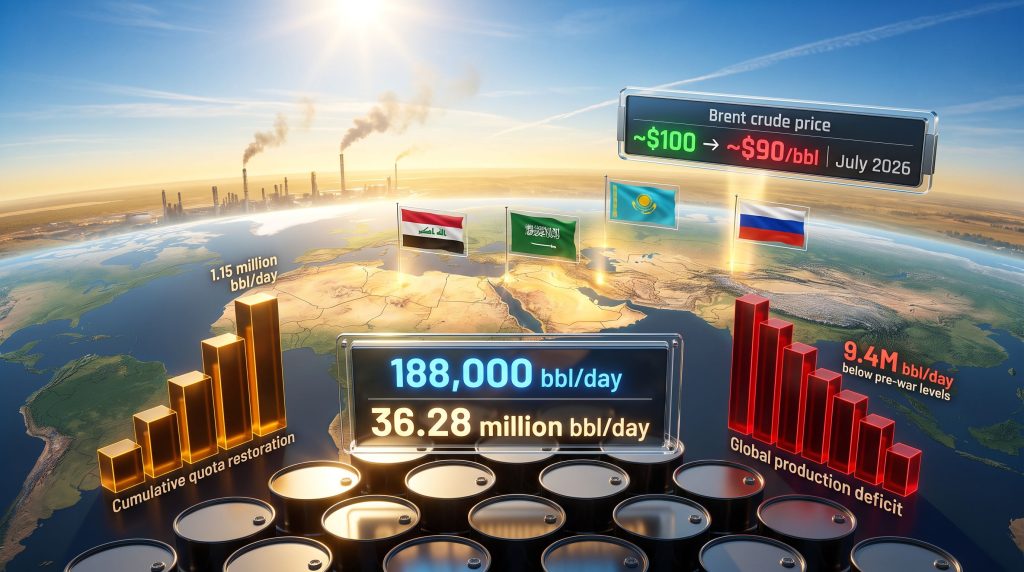
As of late July 2026, approximately 1.15 million barrels per day of quota capacity has been formally restored across four consecutive monthly increases, according to Reuters calculations. The September increase of 188,000 barrels per day, which the alliance is widely expected to approve at its August 2 virtual meeting, would complete this unwinding cycle. Once the voluntary cut layer is fully removed, the broader group-wide production framework reverts to baseline quota architecture, which operates under separate parameters and a different negotiating timeline.
The Four-Phase Quota Restoration Cycle: Where Things Stand
Key Data Snapshot: OPEC+ Production Metrics (July 2026)
| Metric | Value |
|---|---|
| Planned September quota increase | 188,000 bbl/day |
| Cumulative quota restoration since April 2026 | ~1.15 million bbl/day |
| Original 2023 voluntary production cut | 1.65 million bbl/day |
| OPEC+ actual output (June 2026) | 36.28 million bbl/day |
| Estimated gap below pre-war production levels | ~7 million bbl/day |
| IEA-reported global production deficit vs. pre-war | 9.4 million bbl/day |
Key Insight: The distance between OPEC+'s formal quota restoration and actual physical supply growth is one of the most consequential and under-reported dynamics in global oil markets. Quota arithmetic does not equal barrel delivery.
Official OPEC data for June 2026 placed alliance-wide production at 36.28 million barrels per day, a figure sitting roughly 7 million barrels per day below pre-war production levels. The IEA's July 2026 market report put the global supply shortfall versus pre-conflict baselines at an even wider 9.4 million barrels per day. Furthermore, these figures illustrate that four consecutive months of quota increases have not translated into proportional supply growth, because actual output is constrained by factors that quota decisions cannot resolve.
Why OPEC+ May Pause Oil Output Increases After September
Three Strategic Drivers Behind the Proposed Freeze
The case for pausing quota increases from October 2026 through January 2027 rests on three distinct but interconnected strategic considerations. OPEC's market influence extends well beyond the headline numbers, and these drivers reflect that complexity:
-
The quota-to-reality gap: Several member nations are structurally incapable of matching their assigned production targets in the near term. Raising quotas for members who cannot physically comply inflates headline supply expectations without adding real barrels to the market, ultimately undermining the credibility of the alliance's signalling function.
-
2027 quota architecture negotiations: The current production framework expires in January 2027, at which point a new quota system must be in place. Designing and negotiating that architecture requires political bandwidth and analytical groundwork that cannot happen simultaneously with ongoing monthly quota adjustments.
-
Geopolitical risk assessment: Active conflict dynamics, particularly involving Iran and ongoing threats to Red Sea shipping lanes, have injected material uncertainty into forward supply projections. A more cautious posture reduces the risk of the alliance being caught having raised quotas into a supply shock it cannot control.
Is the Pause Confirmed?
As of the time of writing, the proposed pause from October through January remains under internal discussion and has not been formally confirmed. Sources cited by Reuters describe it as a serious option ahead of the August 2 meeting, but alliance decisions require member consensus and can shift based on last-minute market developments. Investors and analysts should, consequently, treat the pause as a high-probability scenario rather than a finalised policy position.
The 2025 precedent is instructive here. Earlier discussions about pausing quota hikes that year revealed the internal tensions between members with fiscal breakeven oil prices above current market levels and those with greater tolerance for price softness. That episode demonstrated that OPEC+ pause discussions can stall or accelerate rapidly depending on geopolitical events occurring in the days before a formal meeting.
The Member-Level Problem: Who Cannot Keep Up With Their Quotas
Infrastructure and Conflict Constraints Across Key Producers
The gap between quota and reality is not uniform across OPEC+ members. Specific structural and operational factors are constraining output for several of the alliance's most significant producers:
-
Iraq continues to face chronic export infrastructure bottlenecks, with pipeline capacity, port logistics, and investment limitations all preventing actual output from reaching assigned ceiling levels.
-
Kazakhstan experienced a material production reduction following drone strike damage to the Caspian Pipeline Consortium terminal on the Black Sea, a critical chokepoint for the country's oil export pathway.
-
Russia has suffered repeated disruptions to refinery operations as a result of Ukrainian drone strikes, limiting its ability to process crude for export even when wellhead production continues.
-
Saudi Arabia retains meaningful spare production capacity but faces escalating exposure to infrastructure risk given the broader regional conflict environment, which constrains its willingness to commit to sustained output expansion.
Analytical Note: When multiple OPEC+ members simultaneously face physical output constraints, the alliance's formal quota decisions function more as a market communication tool than as a direct supply management instrument. The real variable driving global supply is geopolitical stability, not quota arithmetic.
This dynamic has profound implications for how energy analysts and commodity traders should interpret OPEC+ announcements. A quota increase from a member that cannot physically deliver additional barrels is, in market terms, a signal rather than a supply event. It influences price expectations and trader positioning without necessarily altering the volume of oil reaching refineries.
Market Response: Volatility, Geopolitical Premiums, and Price Discovery
Brent Crude Swings in Late July 2026
| Date | Brent Crude Price | Trigger Event |
|---|---|---|
| July 24, 2026 | Approached ~$100/bbl | Renewed Red Sea export threats |
| July 28, 2026 | Retreated to ~$90/bbl | US-Iran suspension of military exchanges |
The $10 per barrel swing in Brent crude prices within a single week in late July 2026 illustrates how profoundly geopolitical risk premiums are distorting price discovery in oil markets. When threat escalation and de-escalation cycles can move prices by double digits over days, the traditional supply-and-demand pricing framework becomes increasingly difficult to apply with precision. For a broader view of oil prices and geopolitics, the interplay between conflict risk and market sentiment has rarely been more pronounced.
Goldman Sachs analysts, as reported by OilPrice, characterise OPEC+'s current strategy primarily as a market confidence mechanism, positioning the alliance as a reliable backstop supply provider ready to increase output once conditions allow, rather than as an actor actively managing physical barrels in real time. This framing matters because it redefines the purpose of quota decisions from supply control to sentiment management.
The next major ASX story will hit our subscribers first
Scenario Analysis: What Happens After September?
Three Pathways for Global Oil Supply Dynamics
Scenario A: Pause Holds Through January 2027
If OPEC+ freezes quotas as discussed, the supply outlook through early 2027 remains heavily dependent on geopolitical stabilisation in conflict-affected production regions. With the IEA already reporting a 9.4 million barrel per day global shortfall versus pre-war levels, any further disruption could push Brent significantly higher even without a formal production cut.
Scenario B: Geopolitical Stabilisation Prompts Early Quota Resumption
A durable reduction in Middle Eastern conflict intensity, combined with recovery at the Caspian Pipeline Consortium terminal and reduced Russian refinery disruption, could create conditions under which OPEC+ elects to resume quota increases before January 2027. This scenario would likely be accompanied by moderate downward price pressure as both quota and physical supply expand.
Scenario C: New Disruption Forces Emergency Quota Reversal
If a major new supply shock occurs, whether through escalation in the Strait of Hormuz, renewed attacks on Gulf infrastructure, or significant demand deterioration from global economic slowdown, OPEC+ retains the policy flexibility to reverse recent quota increases. In addition, the trade war impact on oil remains a live variable, capable of shifting demand projections considerably within the planning horizon.
The January 2027 Transition and Its Strategic Implications
The expiry of the current quota architecture in January 2027 represents more than an administrative milestone. It is the point at which OPEC+ must renegotiate the fundamental basis on which production entitlements are distributed across members. Countries with expanded production capacity since the last baseline was set will push for higher allocations. Those whose output has been structurally impaired will resist cuts to their nominal entitlements.
Navigating this renegotiation while simultaneously managing a volatile geopolitical environment makes the case for a clean pause considerably stronger from the alliance's internal cohesion perspective. For oil-dependent economies across Africa, the Middle East, and Central Asia, the outcome of January 2027 quota negotiations will have fiscal consequences that extend well beyond energy markets.
Frequently Asked Questions: OPEC+ Production Pause After September 2026
What exactly is OPEC+ proposing to do after September 2026?
The alliance is considering leaving production quotas unchanged from October 2026 through January 2027, effectively freezing the quota level reached after the September increase is implemented. OPEC demand forecasts will play a key role in shaping whether that freeze holds or is revised earlier than planned.
Has the pause been officially confirmed?
No. As of late July 2026, it remains under internal discussion ahead of the August 2 virtual ministerial meeting. It has not been formally adopted by the alliance. Reporting from Euronews confirms that the most recent formal decision centred on the September production boost, with subsequent months still subject to review.
How does a quota freeze differ from a production cut?
A freeze maintains existing quota ceilings without reduction. A cut would actively lower the volume members are permitted to produce. In the current context, given that actual output already sits below quota ceilings for many members, even a freeze may have limited near-term supply impact.
Which members have the most spare capacity heading into Q4 2026?
Saudi Arabia retains the largest buffer of spare production capacity within OPEC+. The UAE also maintains meaningful spare capacity, although its role in the voluntary cut framework has shifted following its exit from the original arrangement in May.
What would cause OPEC+ to abandon the pause and resume increases?
A significant and sustained reduction in geopolitical risk premiums, combined with evidence that member nations are closing the gap between quota ceilings and actual output, would be the most likely triggers for resuming quota increases ahead of the January 2027 system transition. Analysis from Energy Now suggests that the alliance is weighing precisely these variables ahead of upcoming ministerial discussions.
Key Risks and Uncertainties Through Early 2027
Several risk vectors could materially alter the trajectory of OPEC+ policy over the coming six months:
-
Geopolitical escalation: Further attacks on Gulf energy infrastructure, expanded Red Sea shipping disruptions, or new Iranian conflict dynamics could simultaneously constrain physical supply and complicate the diplomatic environment in which quota decisions are made.
-
Demand-side deterioration: A sharper-than-expected global economic slowdown, amplified by trade policy uncertainty and tightening financial conditions, could reduce oil consumption growth and shift the supply-demand balance in ways that make further quota increases politically and economically untenable.
-
Alliance internal cohesion: Divergent fiscal breakeven oil prices across member states create fundamentally different incentive structures for production policy. Members requiring higher prices to balance national budgets will resist quota increases that depress prices, while those with lower fiscal breakevens may favour faster restoration of output.
-
Credibility risk: Perhaps the most underappreciated risk is the reputational cost of repeatedly raising quotas that cannot be physically fulfilled. If markets conclude that OPEC+'s formal decisions are systematically disconnected from deliverable supply, the signalling power of those decisions, which Goldman Sachs identifies as central to the alliance's current strategy, erodes significantly.
Summary: What the Proposed Pause Signals About OPEC+'s Strategic Position
- The proposed freeze covers the October 2026 through January 2027 window, pending confirmation at the August 2 virtual meeting
- The September increase of 188,000 bbl/day would complete the full unwinding of the voluntary cut cycle that began in 2023
- Actual OPEC+ production sits approximately 7 million bbl/day below pre-war levels, meaning that quota decisions carry limited near-term physical supply impact
- The IEA estimates a global production shortfall of 9.4 million bbl/day relative to pre-conflict baselines
- Goldman Sachs frames OPEC+'s current strategy as a market confidence signal, not a direct supply management intervention
- The pause is not yet a confirmed decision, with internal discussions ongoing ahead of the August 2 meeting
- January 2027 quota renegotiations represent a more consequential long-term variable than the near-term pause itself
This article is intended for informational purposes only and does not constitute financial or investment advice. Oil market forecasts and geopolitical scenarios involve significant uncertainty. Readers should conduct independent research and consult qualified advisors before making investment decisions based on commodity market analysis.
Want to Stay Ahead of the Next Major ASX Mineral Discovery Linked to Energy Market Shifts?
While OPEC+'s quota mechanics shape global commodity sentiment, Discovery Alert's proprietary Discovery IQ model scans ASX announcements in real time, instantly identifying significant mineral and energy-related discoveries before the broader market reacts — explore historic discovery returns on Discovery Alert's dedicated discoveries page and begin a 14-day free trial to secure a genuine market-leading edge.