July 29, 2026
When a Blending Mandate Becomes an Energy Doctrine: Understanding Indonesia's B50 Inflection Point
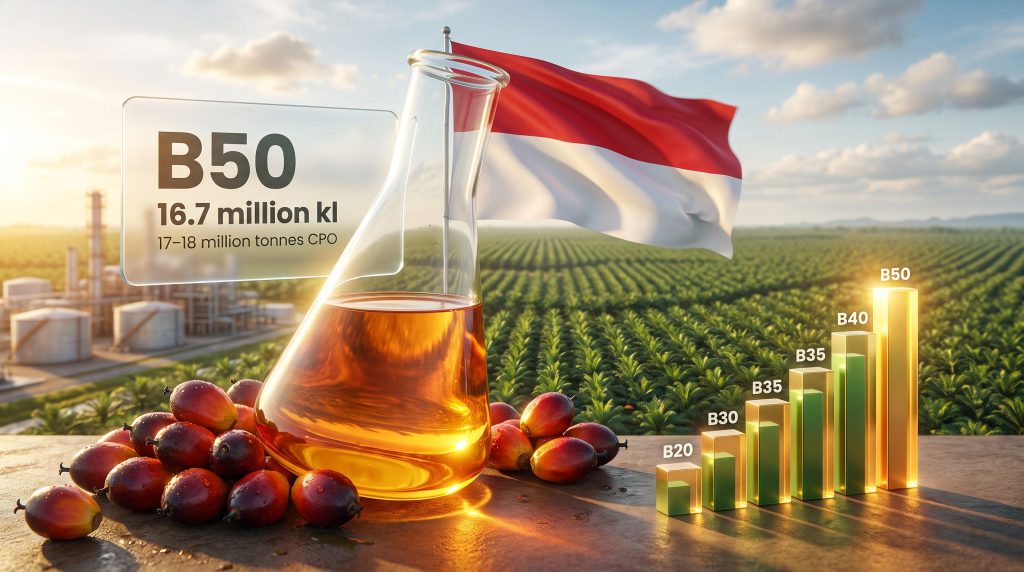
Most biofuel mandates around the world operate as marginal policy instruments, nudging fossil fuel consumption slightly downward while keeping existing supply chains largely intact. Indonesia's trajectory is different. Over roughly a decade, the country has systematically escalated its biodiesel blending requirements from 20 percent to 30 percent, then to 35 percent, 40 percent, and now 50 percent. Each step compresses fossil diesel demand while simultaneously absorbing a growing share of the nation's dominant agricultural commodity. The B50 mandate is not simply the next increment in that sequence. It represents a threshold at which domestic policy begins to meaningfully reshape global commodity flows, with Indonesia B50 biodiesel production volumes now commanding serious attention from analysts worldwide.
When big ASX news breaks, our subscribers know first
How Indonesia's Biodiesel Quota System Actually Functions
Understanding the significance of Indonesia B50 biodiesel production volumes requires first understanding the administrative architecture that makes the programme operate. The Ministry of Energy and Mineral Resources (ESDM) sits at the apex of the allocation process, distributing annual production volumes across Indonesia's licensed biodiesel manufacturers. These are not aspirational targets but operational quotas that determine how much each producer can supply into the blending system in a given year.
The supply chain flows through a structured sequence:
-
ESDM issues production volume allocations to each of the 26 licensed biodiesel producers.
-
Producers supply biodiesel to fuel distribution companies at pricing equivalent to fossil gasoil.
-
The Badan Pengelola Dana Perkebunan Kelapa Sawit (BPDPKS), Indonesia's palm oil plantation fund management agency, bridges the cost differential between biodiesel production and fossil diesel pricing for subsidised deliveries.
-
Fuel distributors then blend biodiesel with fossil diesel and deliver the combined product to end consumers across Indonesia's distribution network.
The BPDPKS funding mechanism is a critical and often underappreciated element of this system. The agency collects export levies on palm oil and palm-derived products and channels those revenues into subsidy payments for biodiesel producers supplying the public service obligation (PSO) sector. This creates a structural feedback loop: when global crude palm oil (CPO) prices rise, export levy revenues increase, giving BPDPKS greater capacity to fund PSO subsidies, which in turn supports higher domestic CPO absorption and reduces export volumes, consequently exerting further upward pressure on international CPO prices. Furthermore, these commodity price impacts extend well beyond Indonesia's borders, influencing vegetable oil benchmarks globally.
Indonesia B50 Biodiesel Production Volumes: The 2026 Allocation in Detail
For 2026, ESDM has allocated a total of 16.7 million kiloliters (kl) of biodiesel production volume across 26 licensed producers, according to reporting by Argus Media. This compares with an allocation of 15.6 million kl that had been set at the start of the year under the prior B40 framework, representing an incremental increase of approximately 1.1 million kl in formally allocated volume.
| Metric | B40 Framework (Early 2026) | B50 Framework (July 2026) |
|---|---|---|
| Total Annual Allocation | ~15.6 million kl | 16.7 million kl |
| Number of Licensed Producers | 26 | 26 |
| PSO Sector Volume | Not disclosed separately | 8.2 million kl |
| Non-PSO Sector Volume | Not disclosed separately | 8.5 million kl |
| Full B50 Demand Estimate | — | ~19–20 million kl/yr |
| Estimated Capacity Shortfall | — | ~4 million kl |
The allocation is divided almost equally between two distinct categories:
-
PSO sector (8.2 million kl): Covers subsidised fuel users including public transportation fleets, government services, agricultural machinery operations, and micro-enterprise fuel consumers. Deliveries in this category are supported by BPDPKS subsidy payments.
-
Non-PSO sector (8.5 million kl): Covers commercial and industrial end-users operating at market-based pricing, including private transport operators, general mining operations, manufacturing facilities, and power generation plants.
The near-equal split between PSO and non-PSO volumes is a deliberate policy signal. Earlier iterations of the Indonesian biodiesel programme were weighted more heavily toward subsidised PSO consumption. Broadening the mandate to balance commercial and industrial users against subsidised channels increases the programme's resilience to BPDPKS funding pressures, since non-PSO volumes do not draw on the plantation fund's subsidy mechanism.
The Gap Between Allocated Volumes and Full B50 Coverage
How Large Is the Shortfall?
A critical dimension of the current situation is the distance between what has been allocated and what full B50 implementation actually demands. Industry body APROBI has estimated that complete B50 coverage of Indonesia's diesel consumption would require approximately 19 to 20 million kl per year, implying that the 2026 allocation of 16.7 million kl covers only around 83 to 88 percent of the volume needed for comprehensive mandate compliance.
The gap between current allocation and full B50 demand stands at approximately 4 million kl, a volume shortfall that reflects both capacity utilisation constraints and the administrative complexity of recalibrating quota distributions across 26 producers simultaneously.
Compounding this shortfall is a notable implementation lag. Despite the B50 mandate officially taking effect at the beginning of July 2026, biodiesel producers operated without confirmed volume allocations for most of that month. This type of regulatory transition gap is not unprecedented in Indonesia's biodiesel programme history, but it carries real commercial consequences. Producers who had been operating under expired B40 allocations faced contractual uncertainty, and downstream distributors encountered planning difficulties in managing blending operations during the interregnum.
Installed Capacity Versus Operational Reality
Does Indonesia Have Enough Production Infrastructure?
A common misconception in assessments of Indonesia's biodiesel programme is to equate installed nameplate capacity with usable production output. Indonesia's reported installed biodiesel production capacity is estimated at approximately 19.6 to 22 billion litres, which on paper comfortably exceeds the 19 to 20 million kl required for full B50 coverage.
| Capacity Indicator | Estimated Figure |
|---|---|
| Reported Installed Capacity | ~19.6–22 million kl |
| 2026 Allocated Production Volume | 16.7 million kl |
| Utilisation Rate (Approximate) | ~76–85% of installed capacity |
| Industry-Estimated Additional Capacity Needed | ~4 million kl |
The gap between installed capacity figures and operational output reflects several structural constraints:
-
Scheduled maintenance downtime reduces effective annual throughput at individual plants.
-
Feedstock logistics and CPO delivery timing create periodic production bottlenecks, particularly at facilities located further from palm oil processing centres in Sumatra and Kalimantan.
-
Geographic distribution requirements across Indonesia's archipelago of more than 17,000 islands create storage, blending, and transport challenges that constrain how quickly biodiesel volumes can reach end consumers in remote markets.
-
Higher concentrations of fatty acid methyl esters (FAME) in B50 blends introduce operability challenges in cooler highland regions and can affect cold flow properties, requiring specialised handling at certain distribution points.
Industry groups have consistently argued that installed capacity must exceed projected demand by a buffer margin to account for these operational realities, making the apparent adequacy of Indonesia's production infrastructure less reassuring than headline figures suggest. For a broader perspective on how such energy transition trends are reshaping industrial supply chains, the parallels with other sectors are instructive.
CPO Feedstock Demand: Quantifying the Agricultural Scale of B50
The transition from B40 to B50 carries implications that extend well beyond fuel distribution logistics. Indonesia's biodiesel programme is almost exclusively dependent on crude palm oil and its derivatives, including refined, bleached, and deodorised palm oil (RBDPO), as its production feedstock. The jump to B50 is projected to increase annual CPO consumption for biodiesel by approximately 3.5 to 4 million metric tonnes, pushing total domestic CPO usage for the programme to an estimated 17 to 18 million tonnes annually.
| Blend Level | Estimated Annual CPO Demand for Biodiesel |
|---|---|
| B35 | ~10–11 million tonnes |
| B40 | ~13–14 million tonnes |
| B50 | ~17–18 million tonnes |
To contextualise this scale: Indonesia produces approximately 45 to 47 million tonnes of CPO annually, maintaining its position as the world's dominant palm oil supplier. Redirecting 17 to 18 million tonnes domestically for biodiesel production means the B50 programme consumes roughly 37 to 40 percent of total national CPO output. This proportion is significant enough to function simultaneously as an agricultural support mechanism for the country's smallholder palm farming sector, a price stabilisation policy for domestic CPO markets, and a structural cap on Indonesian CPO export availability.
For global buyers of palm oil, particularly in India, China, Pakistan, and the European Union, this domestic absorption dynamic represents a supply constraint that will not resolve without a corresponding expansion in Indonesian plantation productivity or a policy reversal. Neither is imminent. In this context, commodity trade volatility is likely to intensify for markets that depend heavily on Indonesian palm oil exports.
The next major ASX story will hit our subscribers first
How Indonesia's B50 Compares to Global Biodiesel Mandates
Placing Indonesia's mandate in global context clarifies why it commands disproportionate attention from commodity analysts and biofuel market participants worldwide. According to research published in Renewable and Sustainable Energy Reviews, high-blend biodiesel mandates in major producing nations are increasingly becoming a decisive factor in shaping both agricultural commodity flows and energy security strategies.
| Country | Current Mandate | Primary Feedstock | Annual Biodiesel Volume (Approximate) |
|---|---|---|---|
| Indonesia | B50 (2026) | Palm oil (CPO/RBDPO) | ~16.7–20 million kl |
| Brazil | B14–B15 | Soybean oil | ~7–8 billion litres |
| United States | RFS-based (~B5–B7 avg.) | Soybean/canola oil | ~6–7 billion gallons |
| Malaysia | B20 (B30 targeted) | Palm oil (CPO) | ~3–4 million kl |
| European Union | ~8–10% (energy basis) | Rapeseed/soybean/UCO | Varies by member state |
Indonesia's B50 mandate is the most aggressive biodiesel blending policy by absolute volume of any major economy. The feedstock advantage conferred by domestic palm oil production differentiates Indonesia's programme fundamentally from soybean-dependent mandates in Brazil and the United States, where feedstock costs are more volatile and the agricultural supply chain lacks Indonesia's degree of vertical integration between plantation, crushing, and biodiesel production.
A Decade of Escalating Mandates: Historical Volume Trajectory
| Year | Blend Level | Approximate Annual Volume (kl) | Key Development |
|---|---|---|---|
| 2016–2019 | B20 | ~6–8 million | Mandatory blending framework established |
| 2020 | B30 | ~9–10 million | Accelerated amid CPO surplus conditions |
| 2022–2023 | B35 | ~10–12 million | Gradual post-pandemic step-up |
| 2024–2025 | B40 | ~15.6 million | Significant volume expansion |
| 2026 (current) | B50 | 16.7 million (allocated) | Transition allocation; full demand ~19–20 million |
Each successive blend increase has required a corresponding revision to ESDM production quotas and BPDPKS funding commitments. The political economy behind the accelerating timeline reflects a convergence of palm oil industry interests, energy import cost pressures from fossil diesel procurement, and increasingly prominent carbon emissions reduction objectives at the national policy level. Furthermore, the programme's scale now intersects directly with broader questions around critical minerals and energy security, as nations compete to reduce dependence on imported fossil fuels.
Key Risks That Could Undermine B50 Execution
Financial and Technical Vulnerabilities
Several structural and financial risks warrant careful attention from market participants monitoring Indonesia's biodiesel programme.
Financial sustainability of BPDPKS: The fund's capacity to maintain PSO subsidy payments depends on the differential between CPO export prices and domestic biodiesel production costs. During periods of depressed palm oil prices, levy revenues contract while the cost gap between biodiesel and fossil diesel can widen, creating potential funding shortfalls. Historical precedent is instructive: BPDPKS experienced payment delays to biodiesel producers during the low CPO price environment of 2019 to 2020, creating temporary cash flow stress across the producer base.
Engine compatibility at higher blend ratios: The technical compatibility of B50 blends with existing diesel engine fleets, particularly older commercial vehicles and agricultural equipment, remains an area of ongoing concern. Original equipment manufacturers have taken varied positions on warranty coverage for fuel systems operating continuously on B50 blends. Additionally, fleet operators have raised questions about long-term injector wear and cold-start performance under higher FAME concentrations.
Non-PSO compliance enforcement: Monitoring commercial and industrial end-users to ensure mandate compliance across manufacturing, mining, and power generation sectors presents logistical challenges that are qualitatively different from policing retail fuel distribution points.
Administrative transition gaps: The July 2026 experience, where the mandate was formally active for nearly a month before producers received confirmed volume allocations, illustrates an execution risk that recurs with each blend level transition. These gaps create market uncertainty and can disrupt supply continuity during periods when downstream operators most need clarity. Indeed, Indonesia's biodiesel rollout and its effects on palm oil supply are being closely scrutinised by international commodity markets precisely because of these recurring administrative challenges.
Strategic Outlook: What Comes After B50
The trajectory of Indonesia's blending programme invites speculation about whether a B60 mandate is a realistic medium-term prospect. Based on the historical escalation pattern, which has moved in 5 to 10 percentage point increments at intervals of roughly two to three years, a further increase is not implausible within the 2028 to 2030 timeframe. However, the B50 threshold introduces technical constraints around engine compatibility and CPO feedstock availability that did not apply at lower blend ratios, potentially moderating the pace of future escalation.
Disclaimer: Forward-looking projections regarding future blend levels, CPO demand, and global price impacts are speculative in nature and subject to policy, agricultural, and macroeconomic variables that cannot be predicted with certainty. This article does not constitute financial or investment advice.
Three developments deserve particular attention from those tracking this space over the next several years:
-
Whether Indonesia pursues second-generation biodiesel pathways, specifically hydroprocessed esters and fatty acids (HEFA), to diversify beyond conventional FAME production and address engine compatibility concerns at higher blend ratios.
-
How CPO export volume trends evolve as domestic absorption continues to increase, since this metric serves as a leading indicator for global vegetable oil price benchmarks across soybean oil, sunflower oil, and rapeseed oil markets.
-
Whether Indonesia moves to position its biodiesel programme within international carbon credit market frameworks, which could introduce a parallel revenue stream for the BPDPKS mechanism and improve the programme's long-term financial sustainability independent of palm oil price cycles.
For commodity traders, agricultural analysts, and energy policy researchers, the global commodity demand outlook makes clear that Indonesia B50 biodiesel production volumes represent more than a domestic fuel standard. They are a material force reshaping global vegetable oil trade flows, biofuel investment priorities, and the competitive dynamics of an industry that is still defining its long-term structure.
Want to Stay Ahead of Commodity Shifts Reshaping Global Markets?
Indonesia's B50 mandate is just one example of the macro forces driving dramatic swings in commodity supply chains — and Discovery Alert's proprietary Discovery IQ model translates these market-moving dynamics into real-time ASX mineral discovery alerts, delivering actionable opportunities directly to subscribers before the broader market reacts. Explore historic discoveries and their extraordinary returns on Discovery Alert's dedicated discoveries page, and begin your 14-day free trial today to position yourself ahead of the next major market shift.