July 29, 2026
Why the Global Aluminium Market Is Rewarding Specification-Grade Exporters
The aluminium industry is undergoing a quiet but consequential structural shift. For decades, the dominant trade narrative centred on primary metal flows, with large-scale producers shipping commodity-grade ingots to downstream fabricators worldwide. That model is giving way to something more sophisticated. Buyers across automotive, electronics, and industrial manufacturing are increasingly specifying alloy grades tailored to exact performance requirements. India aluminium alloy exports 1.2 million tonnes is best understood through this lens of rising specification-driven demand.
Rather than simply scaling up primary metal output, India's aluminium industry has progressively moved up the value chain, developing the metallurgical expertise, quality infrastructure, and production capacity to serve specification-driven buyers in markets as demanding as Japan, Taiwan, and the United States. Furthermore, the top aluminium producers globally are taking note of India's rapid ascent in the alloy segment.
When big ASX news breaks, our subscribers know first
From Ingot Supplier to Alloy Exporter: Understanding the Value Chain Transition
The distinction between non-alloyed primary aluminium and unwrought aluminium alloys matters enormously in trade economics. Primary aluminium is essentially a commodity, priced closely to the London Metal Exchange benchmark with limited differentiation between producers. Unwrought alloys, by contrast, are engineered materials containing precisely controlled additions of silicon, magnesium, copper, manganese, or zinc, each combination producing specific mechanical properties suited to casting, forging, or extrusion applications.
This distinction drives per-tonne valuation differences. Alloy-grade exports consistently command premiums over standard primary ingot because buyers are paying not just for metal content but for metallurgical consistency, traceability, and compliance with international specifications such as ASTM, JIS, or European EN standards. Consequently, the growing appetite for a low-carbon metals premium is further reinforcing this pricing divergence.
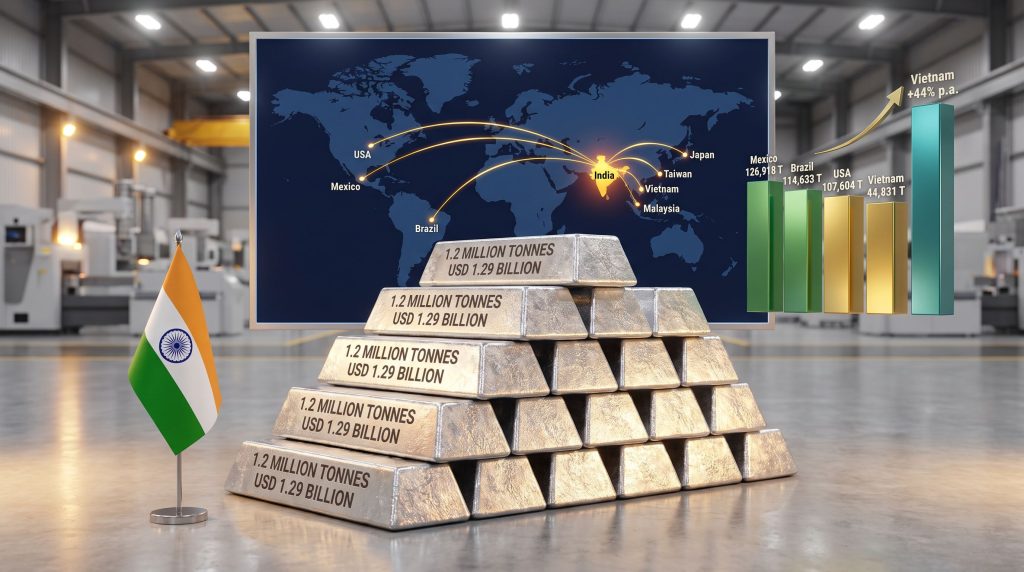
India's 1.2 million tonnes of unwrought aluminium alloy exports in FY2025-26, generating approximately USD 1.29 billion in export value, reflects this maturation. The export value per tonne implied by these figures indicates a product mix that has moved well beyond commodity-grade pricing. According to India's aluminium export data, this trajectory has been building steadily over several years.
The Integrated Value Chain That Enables Indian Alloy Production
India's structural advantage in alloy production begins well upstream. The country holds significant domestic bauxite reserves concentrated in Odisha, Jharkhand, and Chhattisgarh, providing feedstock security that many competing exporters lack. This integrated bauxite-to-alumina-to-aluminium value chain compresses production costs at every stage, creating a cost base that supports competitive export pricing without sacrificing margin.
The step-by-step production and export pathway looks like this:
- Bauxite extraction from domestic reserves in Odisha, Jharkhand, and Chhattisgarh
- Alumina refining converting bauxite ore to alumina at integrated refinery complexes
- Primary smelting via electrolytic reduction to produce primary aluminium metal
- Alloying and casting incorporating elements such as silicon, magnesium, and copper to produce specification-grade unwrought alloys
- Quality certification involving testing against buyer-specified standards including ASTM, JIS, and EN norms
- Export logistics through major Indian ports including Mundra, JNPT, and Vizag
- End-use application in automotive casting, electronics, industrial machinery, and construction in destination markets
Where India's Aluminium Alloy Is Going: A Market-by-Market Analysis
The Top Five Destination Markets
The geographic distribution of India's alloy exports reveals a deliberate penetration of high-consumption industrial economies rather than opportunistic trade flows.
| Rank | Country | Volume (Tonnes) | Share of Total Exports | 2021-2025 Annual Growth |
|---|---|---|---|---|
| 1 | Mexico | 126,918 | 10.6% | +6% per annum |
| 2 | Brazil | 114,633 | 9.58% | +1% per annum |
| 3 | United States | 107,604 | 8.99% | Not specified |
| 4 | Japan | 92,750 | 7.75% | Not specified |
| 5 | Taiwan | 90,060 | 7.52% | Not specified |
Mexico's position as the single largest destination market is not accidental. The country's deep integration into North American automotive supply chains creates sustained, specification-driven demand for aluminium casting alloys used in engine components, transmission housings, and structural parts. Mexico's 6% annual import growth rate from India between 2021 and 2025 reflects both the expansion of automotive production capacity in that country and India's improving ability to meet quality and delivery requirements of Tier 1 and Tier 2 automotive suppliers.
Brazil's 114,633-tonne import volume, while growing at a more modest 1% annually, represents a structurally important relationship driven by infrastructure development, transportation equipment manufacturing, and Brazil's own downstream aluminium processing sector.
The Precision Markets: United States, Japan, and Taiwan
The presence of the United States, Japan, and Taiwan in the top five is particularly significant from a quality credentialing perspective. These are not volume-driven commodity buyers. However, it is worth noting that US aluminium tariffs introduce an element of policy uncertainty that Indian exporters must monitor closely.
Japan's role as a buyer carries specific implications for Indian producers. Japanese manufacturing culture demands exceptional metallurgical consistency, and sustained export volumes to Japan effectively serve as a quality benchmark certification that strengthens India's credibility across other markets. Taiwan's electronics and precision engineering sector similarly prioritises alloy purity and dimensional consistency over price alone.
India's ability to retain and grow these high-specification buyer relationships will ultimately determine whether its alloy export story represents a durable structural shift or a volume-driven price cycle.
Southeast Asia: The Fastest-Growing Export Frontier
Beyond the top five, the most compelling growth narrative in India's alloy export portfolio is unfolding in Southeast Asia.
| Market | Annual Import Growth Rate from India (2021-2025) |
|---|---|
| Vietnam | +44% per annum |
| Malaysia | +12% per annum |
Vietnam's 44% annual growth rate in aluminium alloy imports from India between 2021 and 2025 is an extraordinary figure by any measure. It reflects the intersection of two powerful forces: Vietnam's rapid industrialisation, driven by substantial foreign direct investment inflows into electronics, automotive components, and consumer goods manufacturing, and India's competitive positioning on price, product availability, and supply reliability.
Malaysia's 12% annual growth rate, while less dramatic, points to a different dynamic. Malaysia operates a sophisticated downstream aluminium processing industry and functions partly as a re-export hub within the ASEAN manufacturing network. Indian alloy flowing into Malaysia is often further processed before reaching end-users across the broader Southeast Asian region.
The maritime logistics geography between India and Southeast Asia also works in Indian exporters' favour. Shorter transit times compared to routes from the Middle East or China translate to lower working capital requirements for buyers and greater supply chain responsiveness.
Global Consumption Growth: The Macro Tailwind Behind India's Expansion
India's export momentum does not exist in isolation. It is supported by a global aluminium consumption trajectory that is generating sustained incremental demand.
| Year | Global Aluminium Consumption |
|---|---|
| 2024 | 101.6 million tonnes |
| 2025 | 104.01 million tonnes |
| 2026 (forecast) | 106.4-106.8 million tonnes |
The projected addition of approximately 5 million tonnes of annual consumption between 2024 and 2026 requires diversified sourcing. Supply chain disruptions experienced across multiple industries since 2020 have accelerated procurement diversification strategies among major industrial buyers. The traditional reliance on Chinese primary aluminium supply is being reconsidered not only for cost reasons but for geopolitical risk management.
This supply chain reconfiguration directly benefits India. The so-called China+1 sourcing strategy, in which buyers qualify a second supplier outside China for critical materials, has elevated India's profile across multiple alloy-consuming sectors. Indian producers have been strategic in capitalising on this opening, investing in quality systems and capacity to position themselves as credible alternative suppliers rather than a secondary fallback option.
The EV and Lightweighting Megatrend
One of the less-discussed but structurally significant drivers of alloy demand is the global automotive transition to electric vehicle platforms. The EV transition demand is placing a premium on aluminium alloys in several specific applications:
- Battery enclosure structures requiring high-strength, thermally stable alloy grades
- Motor housings and power electronics components demanding precise casting alloy specifications
- Structural body components where aluminium replaces steel for weight reduction and range extension
- Suspension and chassis components utilising wrought alloy grades with high fatigue resistance
This is not a temporary demand pulse. As EV platform proliferation accelerates across North America, Europe, Japan, and Southeast Asia, the ongoing requirement for engineered aluminium alloys will intensify. Indian producers developing the metallurgical capabilities to supply EV-specification alloy grades are positioning themselves for the demand curve of the next decade.
How India Compares to Other Major Alloy Exporters
| Exporter | Key Strengths | Primary Markets | Competitive Risk to India |
|---|---|---|---|
| China | Scale, cost, product breadth | Global | Overcapacity, trade restrictions |
| Russia | Low-cost energy, primary metal supply | Europe, Asia | Geopolitical sanctions limiting reach |
| Middle East (UAE, Bahrain) | Energy cost advantage, proximity to Europe | Europe, Asia | Growing downstream alloy capability |
| India | Integrated value chain, trade relationships, value-added pivot | Americas, SE Asia, East Asia | Energy costs, certification gaps |
| Canada | Green aluminium credentials, US proximity | North America | Higher cost base |
Russia's reduced access to Western markets following geopolitical developments since 2022 has created specific market gaps in Europe and parts of Asia that Indian exporters have partially filled. The Middle Eastern producers, particularly EMAL in the UAE and ALBA in Bahrain, represent the most structurally similar competitive threat to India, combining energy cost advantages with expanding downstream processing capabilities. In addition, the broader alumina market pressures affecting global supply chains continue to influence competitive positioning across all major exporting nations.
The next major ASX story will hit our subscribers first
Understanding India's Total Aluminium Trade Portfolio
It is important to contextualise the india aluminium alloy exports 1.2 million tonnes figure within India's broader aluminium trade footprint to avoid misreading its significance.
| Export Category | Volume / Value | Notes |
|---|---|---|
| Unwrought aluminium alloys (FY25-26) | 1.2 million tonnes / USD 1.29 billion | Primary focus of this analysis |
| Alloyed aluminium (WITS/Comtrade, 2024) | ~604,281 tonnes / ~USD 1.25 billion | Narrower HS code classification |
| Total aluminium and products exports (2024) | ~USD 7.25 billion | Includes all downstream fabricated goods |
| Unwrought aluminium all types (2019-20) | ~1.96 million tonnes | Historical benchmark for scale |
The USD 1.29 billion in alloy export value represents a meaningful but not dominant share of India's total aluminium trade portfolio of approximately USD 7.25 billion. The balance reflects substantial additional export value from fabricated downstream products including extrusions, rolled products, foil, and wire. This layered export portfolio indicates an aluminium sector generating value across multiple product tiers simultaneously.
Discrepancies between industry-reported tonnage figures and customs database classifications typically arise from differences in HS code scope, reporting period conventions, and treatment of tolling arrangements or re-exports. The 1.2 million tonne figure should be understood as reflecting unwrought alloy products specifically, within a much larger total aluminium trade context.
Key Risks That Could Constrain Export Growth
India's alloy export trajectory faces several substantive risks that merit sober assessment:
- Energy cost exposure: Aluminium smelting is among the most energy-intensive industrial processes. India's electricity costs remain higher than those of Gulf-based competitors, and power price volatility directly affects export competitiveness at the margin
- Currency dynamics: INR/USD exchange rate movements affect realised export revenues and can erode pricing competitiveness in USD-denominated trade flows
- Chinese overcapacity: Excess Chinese aluminium production capacity creates persistent downward pressure on global alloy benchmarks, compressing margins for all competing exporters
- Freight cost sensitivity: Rising shipping rates on the India-Americas and India-Southeast Asia trade lanes reduce net export margins, particularly for lower-specification alloy grades where price competition is most intense
- US trade policy uncertainty: Potential tariff adjustments affecting aluminium imports into the United States could redirect purchasing decisions among North American buyers
- Certification gaps in premium segments: Aerospace and advanced engineering alloy grades require quality certifications that remain works in progress for most Indian producers, limiting addressable market scope in the highest-value segments
The Strategic Outlook: Can India Sustain This Trajectory?
The near-term growth catalysts through 2027 are well-defined. Automotive alloy demand from Mexico, Japan, and the United States shows structural durability. Vietnam and Malaysia's industrial expansion trajectories remain intact. EV platform proliferation is intensifying the demand for engineered alloy grades globally. Furthermore, India's competitive positioning relative to geopolitically constrained Russian supply and premium-priced Canadian green aluminium remains favourable.
The longer-term strategic question is whether Indian producers will invest sufficiently in three critical capability areas:
- Green aluminium credentials: ESG-sensitive buyers in Europe and North America are increasingly demanding low-carbon footprint aluminium. India's energy mix evolution and investment in renewable-powered smelting will determine whether Indian alloy can access this premium segment
- Advanced alloy grade development: Moving from standard casting alloys into aerospace, automotive structural, and electronics-grade alloys requires metallurgical R&D investment and international certification work that takes years to complete
- Energy cost competitiveness: Sustained investment in energy infrastructure and power purchase agreements at major smelting operations will be decisive in maintaining cost parity with Middle Eastern competitors
With global aluminium consumption forecast to approach 107 million tonnes by 2026 and India's alloy export infrastructure maturing rapidly, the conditions exist for India to consolidate a position among the world's leading aluminium alloy exporters within the next five years, provided quality certification and energy competitiveness investments keep pace with volume ambitions.
Key Metrics at a Glance
| Metric | Data Point |
|---|---|
| Total alloy export volume (FY25-26) | 1.2 million tonnes |
| Total export value (FY25-26) | USD 1.29 billion |
| Largest destination market | Mexico (126,918 tonnes / 10.6%) |
| Second largest destination | Brazil (114,633 tonnes / 9.58%) |
| Fastest-growing destination | Vietnam (+44% per annum, 2021-2025) |
| Global aluminium consumption (2024) | 101.6 million tonnes |
| Global aluminium consumption forecast (2026) | 106.4-106.8 million tonnes |
| India's total aluminium and products exports (2024) | ~USD 7.25 billion |
Frequently Asked Questions: India Aluminium Alloy Exports
What does India's 1.2 million tonne aluminium alloy export figure represent?
It represents the total volume of unwrought aluminium alloy products exported by India in FY2025-26, valued at approximately USD 1.29 billion. This category covers specification-grade alloy ingots and billets rather than fabricated downstream products such as extrusions or rolled sheet.
Which country is India's largest aluminium alloy export destination?
Mexico absorbs the highest volume at approximately 126,918 tonnes, representing 10.6% of India's total alloy export volume, driven primarily by its automotive and industrial manufacturing sector.
Why is Vietnam's import growth from India significant?
Vietnam recorded a 44% annual growth rate in aluminium alloy imports from India between 2021 and 2025. This reflects Vietnam's rapid industrial expansion and India's improving competitive positioning in Southeast Asian supply chains. According to India's aluminium industry analysis, this growth aligns with broader national strategies for strengthening export competitiveness.
What is driving global aluminium demand growth?
Global aluminium consumption is projected to rise from 101.6 million tonnes in 2024 to an estimated 106.4-106.8 million tonnes in 2026, driven by automotive lightweighting demands, EV platform proliferation, infrastructure investment, and electronics manufacturing growth across developing economies.
What are the main risks to India's alloy export growth?
The primary risks include energy cost competitiveness relative to Gulf-based producers, Chinese overcapacity creating price pressure, freight rate volatility on key trade lanes, US trade policy uncertainty, and the need for continued investment in advanced alloy grade certification to access premium buyer segments.
Want to Identify the Next Major Mineral Discovery Before the Market Does?
Discovery Alert's proprietary Discovery IQ model delivers real-time alerts on significant ASX mineral discoveries — including those shaping the global metals supply chains driving demand for commodities like aluminium — instantly translating complex data into actionable investment insights for traders and long-term investors alike. Explore historic discoveries and their exceptional returns to understand why being first to a major find can be transformative, and begin your 14-day free trial today to position yourself ahead of the broader market.