July 29, 2026
India's Maritime Energy Chokepoint Crisis: When Geography Becomes Economic Destiny
Few vulnerabilities in modern economic geography are as structurally entrenched as a large, fast-growing economy's dependence on narrow maritime corridors it neither controls nor can easily bypass. For India, Bab el-Mandeb and Strait of Hormuz disruptions impact on India energy imports is not a theoretical risk scenario confined to defence planning documents. It is the lived architecture of the country's energy economy, played out daily across two of the world's most geopolitically volatile waterways: the Strait of Hormuz at the mouth of the Persian Gulf and the Bab el-Mandeb at the southern tip of the Red Sea.
Understanding the full depth of this exposure requires moving beyond headline crude prices and into the layered mechanics of how energy disruptions transmit through import volumes, freight markets, insurance pricing, currency dynamics, and ultimately the inflation that households absorb at petrol pumps and LPG distribution points.
When big ASX news breaks, our subscribers know first
The Architecture of India's Maritime Energy Dependency
India is the world's third-largest oil consumer, importing roughly 85% of its crude oil requirements. Unlike continental economies with overland pipeline access to multiple supplier regions, India's hydrocarbon supply chain is almost entirely seaborne. This creates an inescapable geographic concentration: the majority of those imports must pass through one or both of the two chokepoints that bookend the Persian Gulf and Red Sea corridor.
Approximately one-third of India's total trade volume transits these two passages, according to analysis by CareEdge Ratings. The energy component of that figure is even more concentrated. Consider the commodity-level breakdown:
| Energy Commodity | Estimated Share Transiting Hormuz-Linked Routes |
|---|---|
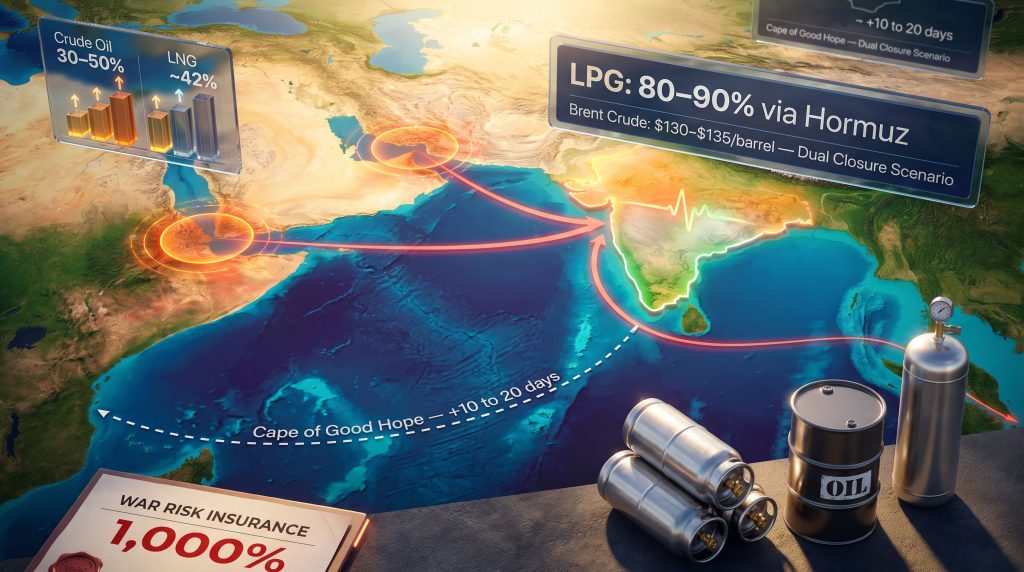
| Crude Oil | 30 to 50% of total imports |
| LNG | Approximately 42% of total imports |
| LPG | 80 to 90% of total imports |
These are not marginal dependencies. They represent the structural plumbing of India's energy system, and any sustained blockage at either chokepoint creates immediate and cascading economic consequences. Furthermore, the global LNG supply outlook adds further complexity to how India navigates these supply pressures in 2025 and beyond.
Why LPG Is the Most Politically Dangerous Vulnerability
When analysts discuss Hormuz disruption risk, crude oil naturally dominates the conversation. Yet the more acute short-term pressure point may be LPG, a fuel that receives comparatively little attention in strategic energy discussions despite its outsized social significance.
With an estimated 80 to 90% of India's LPG imports sourced from Gulf-linked supply chains, a sustained Hormuz disruption would translate within weeks into cooking gas shortages affecting hundreds of millions of households. LPG in India is not a premium commodity. It is the primary cooking fuel for a substantial portion of the lower-income population, particularly in states where the transition away from biomass has been driven by government schemes over the past decade.
Unlike refined petroleum products where there is some degree of demand flexibility and substitution, LPG disruption hits a non-negotiable daily household need. The political sensitivity of this exposure significantly amplifies the macroeconomic risk calculus for any Indian government managing a Hormuz crisis.
Bab el-Mandeb: The Indirect Chokepoint With Direct Consequences
While Hormuz represents a direct volumetric threat to India's energy supply, the Bab el-Mandeb operates through a different but equally damaging transmission channel. A closure or sustained disruption at this Red Sea gateway does not immediately cut off supply. Instead, it forces vessels to reroute around the Cape of Good Hope, adding an estimated 10 to 20 days to voyage times for ships that would otherwise transit the Suez Canal.
This logistical detour compounds across every layer of the shipping cost structure:
- Higher bunker fuel consumption per voyage due to longer routes
- Elevated charter rates as vessels are tied up for longer per journey cycle
- War-risk insurance premiums that spiked by as much as 1,000% during recent Red Sea disruption episodes
- Expanded working capital requirements for Indian importers managing longer inventory cycles
- Delayed delivery schedules that cascade into downstream production planning
The insurance premium shock deserves particular attention because it is a cost that falls disproportionately on the importer rather than the cargo seller. Unlike crude price increases, which carry some potential for downstream pass-through, insurance cost surges are largely absorbed as a direct margin compression event for Indian trading and refining companies. For further context on oil market trade disruptions and their broader pricing consequences, the dynamics at play in 2025 are particularly instructive.
The Russian Crude Paradox
India's strategic pivot toward discounted Russian crude after 2022 was widely interpreted as a successful diversification away from Gulf supply dependency. The reality is more nuanced. A significant portion of Russian crude delivered to India is routed via pathways that either cross the Red Sea or benefit from the Suez Canal's shorter voyage economics.
A sustained Bab el-Mandeb disruption therefore introduces a paradox: the diversification strategy that was meant to reduce India's Gulf exposure simultaneously becomes more expensive and logistically constrained precisely when Red Sea tension is highest. As reported by the Times of India, Red Sea route disruptions threaten not only Saudi but also Russian crude supply to India, underscoring that the diversification benefit does not disappear, but its economic efficiency erodes materially when alternative routing corridors are themselves compromised.
How a Dual Chokepoint Closure Transmits Through India's Economy
CareEdge Ratings has described the current situation as India's most significant energy shock since March 2026, and the macroeconomic transmission channels extend well beyond the refinery gate. A simultaneous multi-week closure of both the Strait of Hormuz and the Red Sea corridor would transmit economic damage through at least four interconnected pathways:
- Import Bill Expansion: Elevated crude and LNG spot prices directly inflate India's total energy import expenditure, widening the trade deficit in nominal terms.
- Current Account Deterioration: With Brent crude already above $100 per barrel following the collapse of the US-Iran ceasefire, further escalation toward the $130 to $135 per barrel range modelled under a dual closure scenario would add an estimated $3 to $5 billion per month to India's crude import bill alone.
- Rupee Depreciation Pressure: Rising import costs increase foreign exchange demand, placing downward pressure on the rupee and raising the effective cost of all USD-denominated imports across the broader economy.
- Domestic Inflation Transmission: Higher landed energy costs propagate through transport, fertiliser manufacturing, aviation fuel, and household energy expenditure, generating broad-based consumer price index pressure.
Sector-Level Vulnerability Across the Indian Economy
| Sector | Primary Exposure Channel | Risk Severity |
|---|---|---|
| Crude Oil and Petroleum Refining | Direct price and volume disruption | Very High |
| LPG Distribution | Volume dependency via Hormuz-linked routes | Very High |
| Fertiliser Manufacturing | Natural gas and naphtha feedstock cost escalation | High |
| Aviation | Jet fuel cost inflation | High |
| Basmati Rice Exports | Freight delays and logistics cost escalation | Medium to High |
| Plastic-Based Packaging | Petrochemical feedstock cost increases | Medium |
CareEdge Ratings specifically flagged that Indian companies operating across these affected sectors face margin pressure from three simultaneous directions: higher raw material costs, elevated logistics and insurance expenses, and increased working capital requirements as supply cycles lengthen. The broader commodity price impacts on company performance in 2025 illustrate how this three-pronged compression can be particularly damaging for mid-tier companies with limited balance sheet flexibility.
The Fiscal and Monetary Policy Dilemma
At the sovereign level, a sustained dual chokepoint disruption forces India's economic policymakers into a difficult trilemma. Each response option carries significant costs:
- Expanding fuel subsidies to protect households from LPG and petrol price shocks provides social stability but widens the fiscal deficit and constrains capital spending.
- Allowing price pass-through to consumers controls fiscal damage but accelerates consumer price inflation, threatening the Reserve Bank of India's inflation targeting mandate and potentially triggering monetary tightening.
- Drawing down foreign exchange reserves to defend the rupee buys time but depletes buffers that serve other macroeconomic stabilisation purposes.
The combination of a widening current account deficit, rupee depreciation, and domestic inflation creates a policy environment where no instrument fully resolves the underlying pressure without generating secondary consequences elsewhere in the economic system. In addition, India LNG import taxes add a further layer of structural cost pressure that compounds these fiscal trade-offs.
The next major ASX story will hit our subscribers first
Strategic Infrastructure Gaps That This Crisis Has Exposed
Beyond the immediate market dynamics, the Bab el-Mandeb and Strait of Hormuz disruptions have highlighted structural inadequacies in India's long-term energy security architecture that cannot be addressed through short-term trading decisions alone:
- Strategic petroleum reserve capacity remains insufficient to buffer supply disruptions beyond a matter of weeks rather than the months that serious geopolitical escalation might require.
- LNG terminal infrastructure is concentrated in ways that limit the ability to rapidly absorb supply from non-Gulf, non-Red Sea origin points such as Australian or US-origin LNG travelling via alternative ocean routes.
- Bilateral long-term supply agreements that lock in delivery via Cape-routed tankers or Pacific routing pathways are underdeveloped relative to India's growing LNG demand trajectory.
- Domestic renewable energy capacity represents the only structural demand-side hedge against import dependency, but the transition timeline remains measured in decades rather than years.
Furthermore, the oil price rally driven by tariff pressures and geopolitical tensions has reinforced just how exposed India's import-dependent energy model remains to external shocks. As research published via ResearchGate on the economic consequences of a Strait of Hormuz conflict confirms, the de facto and de jure implications for India are substantial and multidimensional.
The current disruption environment is not simply a temporary geopolitical shock. It is a stress test revealing the gap between India's energy consumption growth trajectory and its energy security infrastructure maturity. The policy response required extends well beyond emergency procurement into multi-year structural investment decisions.
Frequently Asked Questions: Bab el-Mandeb and Strait of Hormuz Disruptions and India
What percentage of India's crude oil imports pass through the Strait of Hormuz?
Available estimates place between 30% and 50% of India's total crude oil imports as transiting the Strait of Hormuz under normal operating conditions, making it the single most consequential maritime chokepoint for India's energy supply continuity.
How does a Bab el-Mandeb closure affect India differently from a Hormuz closure?
A Bab el-Mandeb closure primarily functions as a logistics cost amplifier, adding 10 to 20 days to voyage times via Cape of Good Hope rerouting and triggering freight, charter rate, and insurance cost inflation. A Hormuz closure directly threatens supply volumes, particularly for LPG where import dependency on Gulf routes reaches 80 to 90%, and for LNG where approximately 42% of imports transit this corridor.
What do analysts project for oil prices under a simultaneous dual chokepoint closure?
CareEdge Ratings analysis projects Brent crude could rise to the $130 to $135 per barrel range under a multi-week simultaneous closure scenario, compared to the $100-plus per barrel level already observed following the breakdown of the US-Iran ceasefire.
Which Indian sectors are most exposed to chokepoint-driven disruptions?
The highest-risk sectors are crude oil refining, LPG distribution, fertiliser manufacturing, and aviation. Medium-to-high risk exposure extends to basmati rice exports via logistics cost inflation and plastic-based packaging through petrochemical feedstock price escalation.
How is India currently managing this chokepoint risk?
The primary mitigation in operation has been accelerated sourcing of discounted Russian crude to reduce Gulf-origin dependency, combined with ongoing efforts to broaden LNG procurement and build strategic petroleum reserve capacity. However, all current mitigation strategies carry structural limitations when both chokepoints face concurrent, sustained disruption.
This article draws on analysis and reporting from ET EnergyWorld, available at energy.economictimes.indiatimes.com. The price projections and scenario analysis referenced herein represent modelled estimates and analyst forecasts, not guaranteed outcomes. Readers should not treat any content in this article as financial or investment advice.
Want To Stay Ahead of the Commodity Disruptions Reshaping Global Energy Markets?
Discovery Alert's proprietary Discovery IQ model delivers real-time alerts on significant ASX mineral discoveries, instantly translating complex market shifts into actionable investment opportunities — explore historic discovery returns to understand the scale of what early positioning can deliver, then begin your 14-day free trial at Discovery Alert to secure your market-leading advantage.