July 29, 2026
The Hidden Architecture of an Oil Price Shock
Most commodity price moves unfold gradually, shaped by inventory cycles, seasonal demand shifts, and incremental supply decisions. Geopolitical oil shocks operate on an entirely different clock. They can reprice a barrel of crude by five percent within hours, collapse that premium just as fast on a single diplomatic headline, and then rebuild it again before the trading session ends. Understanding why oil is rebounding on Iran conflict and Strait of Hormuz risk requires more than tracking a price chart. It demands a structural understanding of how military risk converts into energy market mathematics.
When big ASX news breaks, our subscribers know first
What a Geopolitical Risk Premium Actually Means for Oil Traders
The term "risk premium" is used frequently in financial media but rarely explained with precision. In crude oil markets, it refers to the additional price that buyers are willing to pay above what pure supply-demand fundamentals would justify, specifically to compensate for the probability that supply could be physically disrupted.
This premium does not behave like a conventional market signal. It does not respond to inventory data or refinery utilisation rates. It responds to news flow, military posture, and diplomatic credibility. Key characteristics that distinguish it from demand-driven price moves include:
- It can appear and dissolve within a single trading session
- It inflates across multiple markets simultaneously, including crude benchmarks, tanker insurance, and refined product futures
- It is asymmetric: bad news inflates it faster than good news deflates it
- It embeds a forward-looking probability estimate, not a current supply shortfall
According to analysis from Naeem Aslam, Chief Investment Officer at Zaye Capital Markets, geopolitical tensions involving Iran, Gulf producers, or the Strait of Hormuz have the capacity to restrict exports, delay shipping, and raise freight costs. Critically, he noted that progress in negotiations would remove part of that premium and expose oil prices more directly to underlying supply and demand conditions. This framing captures the dual-edged nature of the current environment: risk premiums are both justified and fragile. Furthermore, understanding oil price volatility trends helps contextualise just how rapidly these premiums can shift.
Why the Strait of Hormuz Is Irreplaceable in Global Energy Logistics
The Geography That Cannot Be Engineered Around
The Strait of Hormuz is a maritime passage roughly 33 kilometres wide at its narrowest navigable point, connecting the Persian Gulf to the Gulf of Oman. Its significance to global energy systems is not merely historical. It remains structurally irreplaceable for a specific reason: the volume of crude oil it channels exceeds what any combination of overland pipeline infrastructure can reliably absorb.
| Metric | Data Point |
|---|---|
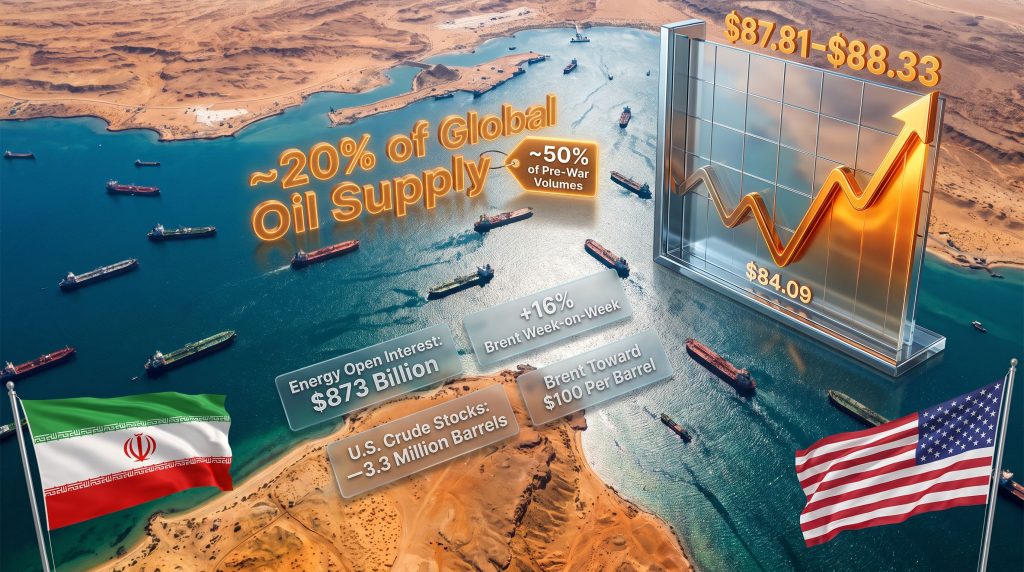
| Share of global oil supply transiting the strait | Approximately 20% |
| Current throughput vs. pre-conflict levels | Approximately 50% of pre-war volumes |
| Pipeline re-routing volumes compensating for lost sea lanes | Approximately 7.0 million barrels per day |
| Risk status of re-routed pipeline flows | Increasingly vulnerable as conflict persists |
The figures from J.P. Morgan's commodities research team clarify the severity of the situation. Current shipments through the strait are running at roughly half of pre-conflict levels, with pipeline re-routing filling part of the gap. However, those alternative flows are themselves becoming increasingly exposed to infrastructure risk as the conflict extends. This is not a temporary logistical inconvenience. It is a structural degradation of the global oil supply network's most critical node. For broader context on oil markets and trade wars, the interaction between geopolitical flashpoints and supply chains creates compounding risk.
Why Partial Disruption Produces Disproportionate Price Reactions
A counterintuitive aspect of Hormuz risk is that partial disruption often generates price responses that appear larger than the actual volume shortfall would warrant. According to research on the Strait of Hormuz crisis, several mechanisms explain this:
- Tanker operators face elevated war-risk insurance premiums, which can add $1 to $3 or more per barrel to effective delivery costs, even for voyages that complete successfully
- Vessel re-routing adds days to transit times, compounding into downstream inventory shortfalls at refineries
- Buyers secure supply preemptively, pulling forward demand in spot markets and driving near-term prices higher
- Futures markets price in tail-risk scenarios, not just the central case, meaning even a 10% probability of full closure can embed a significant premium across the entire forward curve
Key Mechanism: Even if crude production volumes remain unchanged, the cost of physically moving oil from the Persian Gulf to global end markets rises sharply during conflict periods. This functions as an invisible supply reduction that never appears in production statistics but is felt immediately in prices.
The Intraday Price Sequence That Defined July 29, 2026
From Diplomatic Optimism to Ballistic Missile Reports
The crude oil price action on July 29, 2026 provides a compressed case study in how geopolitical signals interact with market positioning. The sequence unfolded in distinct stages:
- Diplomatic signal: U.S. President Donald Trump publicly indicated that the United States and Iran were engaged in substantive negotiations, generating expectations that military disruption risk was receding
- Initial price decline: Brent crude fell as low as approximately $84.09 per barrel, as traders reduced risk premium exposure on the basis that diplomacy could protect regional energy flows
- Escalation reversal: Reports of Iranian ballistic missile attacks on U.S. forces snapped a three-day price decline that Saxo Bank described as Brent's worst three-day slide since April 2020
- Secondary risk signal: President Trump's warning that unsuccessful negotiations could produce very strong military action reinforced the embedded risk premium
- Mediation collapse: Iran's rejection of an Omani-brokered proposal to reopen the Strait of Hormuz eliminated a near-term de-escalation pathway that markets had partially priced in
- Price recovery: Brent rebounded sharply, trading near $87.81 to $88.33 per barrel, representing an approximately 4.4 to 5 percent single-session gain
Saxo Bank's assessment was direct: Iran's refusal of the Omani mediation plan could, in their view, sustain a risk premium embedded in the forward price curve. This is a significant analytical point. A risk premium embedded in the curve, rather than only in spot prices, suggests institutional participants are pricing conflict persistence, not just today's headlines. Consequently, the oil and geopolitics analysis framework becomes essential for interpreting these curve dynamics accurately.
Institutional Capital Flows Reveal the Scale of Market Repositioning
What Derivatives Markets Are Saying Beyond the Spot Price
Spot price movements capture public attention, but the derivatives market data released by J.P. Morgan's commodities research team reveals the true scale of capital reallocation occurring beneath the surface.
| Metric | Value |
|---|---|
| Total estimated open interest in energy markets (week ending approximately July 25) | $873 billion |
| Week-on-week increase in open interest | +6% (+$51 billion) |
| Brent/WTI price increase week-on-week | +16% |
| TTF European natural gas price increase week-on-week | +14% |
| Contract-based capital inflows week-on-week | +$19 billion |
J.P. Morgan's research team noted that last week's escalation in Middle East conflict propelled Brent prices toward the $100 per barrel threshold. The combination of a $51 billion increase in open interest alongside $19 billion in fresh contract inflows represents a meaningful institutional repositioning event, not retail speculation. When energy markets absorb this volume of capital in a single week, it signals that large funds are treating geopolitical risk as a structural feature of the near-term price environment, not a temporary spike to be faded.
What $100 Oil Would Mean Across the Global Economy
- Refined product prices including gasoline, diesel, and jet fuel would rise with a typical lag of two to six weeks
- Emerging market economies with significant fuel import dependency face simultaneous currency depreciation and domestic inflation pressure
- Central banks already navigating uncertain demand conditions would face stagflationary cross-currents that complicate both rate and growth decisions
- Energy-intensive sectors including aviation, shipping, and petrochemicals would face acute margin compression, potentially triggering demand destruction that ultimately reduces oil consumption and caps the price move
The Three Forces Competing Against the Geopolitical Premium
Why the Crude Oil Rebound Is Not a One-Way Trade
The oil rebound driven by Iran conflict and Strait of Hormuz risk does not exist in isolation. Three distinct macro forces are simultaneously applying downward pressure on prices, creating a tug-of-war dynamic that experienced traders are actively navigating.
Consumer Confidence and the Demand Signal Problem
The U.S. Consumer Confidence Index registered 90.8 in the most recent reading, falling below both the prior upwardly revised level of 92.2 and the consensus forecast of 92.3. Softer household sentiment is a leading indicator for reduced consumer spending, travel frequency, and ultimately fuel consumption. However, as Zaye Capital Markets analysis noted, weaker economic data also reduces pressure for further monetary tightening, which provides a partial offset to the demand headwind.
Physical Market Support from U.S. Inventory Drawdowns
U.S. crude stockpiles reportedly declined by 3.3 million barrels during the week ending July 24. Falling inventories provide a physical market floor independent of geopolitical dynamics. The analytical tension is whether tightening physical supply can counterbalance the demand uncertainty created by deteriorating consumer confidence, particularly if the Federal Reserve delivers a hawkish message.
The Federal Reserve as an Oil Price Variable
The Federal Open Market Committee rate decision and accompanying press conference represent a significant near-term price variable that many retail participants underestimate. The Fed inflation projections carry particular weight here, as the transmission mechanism operates through the U.S. dollar:
- A hawkish Federal Reserve signal strengthens the U.S. dollar, which makes dollar-denominated crude more expensive for non-U.S. buyers, compressing demand and pushing prices lower
- A dovish signal improves global risk appetite, supports demand expectations, and effectively acts as a multiplier on any existing geopolitical upside
Investor Note: Dollar-oil correlation is not static. During periods of acute geopolitical risk, the correlation can temporarily break down as supply disruption fears override currency dynamics. Traders should not assume dollar strength will mechanically cap oil prices if Hormuz disruption escalates materially.
The next major ASX story will hit our subscribers first
OPEC vs. IEA: The Competing Supply-Demand Frameworks
Two Institutional Outlooks Pointing in Different Directions
| Institution | 2026 Demand Growth Forecast | Implied Price Bias |
|---|---|---|
| OPEC | Approximately 1.0 million barrels per day growth | Constructive to bullish |
| IEA | Supply growth plus uneven demand may limit sustained price increases | Cautious to neutral |
The divergence between OPEC and IEA outlooks creates genuine analytical uncertainty for medium-term price forecasting. OPEC's market influence remains a central variable in this equation, particularly as its approximately 1.0 million barrel per day demand growth projection supports a structural floor under prices. In addition, the IEA's supply-side warnings suggest the price ceiling may be lower than current geopolitical premiums imply. The critical variable is whether Middle East disruption transitions from episodic to structural.
Three Scenario Pathways for Crude Oil Prices
Scenario 1: Diplomatic Resolution
Successful U.S.-Iran negotiations reopen Strait of Hormuz shipping lanes to full capacity. The risk premium dissolves rapidly. Brent likely retreats toward the $70 to $75 per barrel range as prices re-anchor to fundamental supply-demand conditions.
Scenario 2: Sustained Partial Disruption (Base Case)
Conflict persists without full-scale escalation. The strait operates at reduced but stable capacity. Pipeline re-routing continues absorbing partial shortfalls. Brent consolidates in the $80 to $95 per barrel range, with the precise level determined by inventory trends and Federal Reserve signalling.
Scenario 3: Full Escalation or Infrastructure Damage
A significant attack on Gulf energy infrastructure or a prolonged strait closure pushes Brent toward or beyond $100 per barrel. The International Energy Agency activates emergency strategic reserve releases. Sustained high prices ultimately trigger demand destruction that brings the market back into equilibrium, but with substantial economic damage along the transmission path.
The Tanker Market: The Invisible Transmission Belt Between Conflict and Consumer Prices
One of the least-discussed but most consequential channels through which Middle East conflict reaches consumers is the tanker freight market. The price of physically moving crude oil from the Persian Gulf to refining centres in Europe, Asia, and North America is not fixed. It responds dynamically to perceived risk along shipping corridors.
During conflict escalation periods, war-risk insurance premiums can add meaningful per-barrel costs to delivered crude prices, even when the underlying production and export volumes remain unchanged. Vessel operators redirect ships away from high-risk corridors, reducing effective tanker supply in the affected region and pushing freight rates higher. These elevated freight costs are absorbed initially by refiners, who then pass them through to wholesale and retail fuel prices with a lag that typically ranges from two to four weeks. Analysis of Strait of Hormuz shipping dynamics from CNBC illustrates how rapidly these logistics bottlenecks can cascade through global supply chains.
Lesser-Known Dynamic: War-risk insurance premiums on Hormuz-transiting tankers are not publicly reported in real-time, meaning retail market participants often do not recognise the freight cost escalation until it appears in downstream fuel prices. By that point, the crude futures market has already moved.
Key Data Summary: What the Numbers Are Telling Us
| Variable | Current Reading | Market Implication |
|---|---|---|
| Brent crude price | Approximately $87.81 to $88.33 per barrel | Elevated risk premium embedded in spot price |
| Intraday low before rebound | Approximately $84.09 per barrel | Diplomatic optimism briefly reduced premium |
| Strait of Hormuz throughput | Approximately 50% of pre-war levels | Structural tightness in seaborne crude supply |
| Pipeline re-routing compensation | Approximately 7.0 million barrels per day | Alternative flows increasingly vulnerable |
| U.S. crude inventory change | -3.3 million barrels (week ending July 24) | Physical supply support confirmed |
| Energy derivatives open interest | $873 billion | Significant institutional capital positioned long |
| Week-on-week open interest increase | +$51 billion (+6%) | Large-scale institutional repositioning event |
| U.S. Consumer Confidence Index | 90.8 (missed 92.3 forecast) | Demand headwind partially offsetting risk premium |
| OPEC 2026 demand growth forecast | Approximately 1.0 million barrels per day | Structural demand floor intact |
Frequently Asked Questions on the Oil Rebound and Iran Conflict Risk
Why is oil rebounding on Iran conflict and Strait of Hormuz risk specifically?
Iran launched ballistic missiles at U.S. forces, reversing a three-day price decline. Iran's simultaneous rejection of Omani-brokered mediation to reopen the Strait of Hormuz removed the most plausible near-term de-escalation pathway, causing institutional participants to re-embed risk premium across the crude forward curve.
Could the oil price rebound prove temporary?
Yes. Geopolitical risk premiums are inherently unstable. A credible diplomatic breakthrough, a reopening of Hormuz shipping lanes, or a strongly hawkish Federal Reserve signal could each reduce the premium meaningfully within a single session. The current rebound reflects probability-weighted disruption risk, not confirmed supply loss.
What would a sustained $100 per barrel oil price mean practically?
Beyond the headline figure, sustained triple-digit crude prices would flow through to retail fuel within weeks, add inflationary pressure to central bank calculations, compress margins across aviation and shipping industries, and potentially accelerate demand destruction in price-sensitive emerging markets. J.P. Morgan's commodities research team noted that last week's Middle East escalation already pushed Brent toward that threshold.
Why does Iran's rejection of the Omani mediation plan matter so much?
Oman has historically served as a trusted neutral intermediary between Iran and Western governments due to its stable diplomatic relationships with both sides. Rejection of an Omani-brokered proposal signals a hardening of Iran's negotiating posture and reduces confidence that a near-term de-escalation mechanism is available, which justifies a sustained risk premium in forward oil prices according to Saxo Bank's market assessment. Furthermore, Aberdeen Investments' analysis of Iran conflict scenarios highlights the specific triggers that could accelerate this risk premium well beyond current levels.
Disclaimer: This article is for informational purposes only and does not constitute financial or investment advice. Oil price forecasts and scenario projections involve significant uncertainty. Past price behaviour is not indicative of future outcomes. Readers should conduct independent research and consult qualified financial advisors before making investment decisions.
Want to Stay Ahead of the Next Major Commodity Discovery?
While geopolitical risk premiums reshape crude oil markets in real time, significant mineral discoveries on the ASX can generate equally dramatic price movements — and Discovery Alert's proprietary Discovery IQ model ensures subscribers receive instant alerts the moment those discoveries are announced. Explore historic examples of exceptional discovery returns and begin your 14-day free trial today to position yourself ahead of the broader market.