
July 29, 2026
The Infrastructure Behind the Energy Transition: Why Battery Storage Is the Defining Buildout of This Decade
Energy transitions are rarely smooth or linear. History shows that transformative infrastructure shifts, whether the buildout of transmission grids in the early twentieth century or the rapid expansion of natural gas networks in the 1980s, tend to follow a period of quiet accumulation before accelerating sharply when economic and technological conditions align. The global battery energy storage sector is now entering precisely that inflection point, and the numbers attached to it are difficult to contextualise without first understanding the structural forces that have made this moment inevitable.
The forecast that global battery energy storage capacity will increase sixfold by 2030 is not simply a projection about batteries. It is a statement about the fundamental architecture of modern electricity systems, the mineral supply chains underpinning them, and the geopolitical concentrations that may either accelerate or constrain the entire transition.
When big ASX news breaks, our subscribers know first
What Is Driving the Global Shift Toward Utility-Scale Battery Storage?
The Structural Forces Behind an Unprecedented Energy Infrastructure Buildout
Several converging forces have made large-scale battery storage not merely desirable but operationally essential. The rapid deployment of solar and wind generation has created electricity grids with fundamentally different characteristics from those designed around dispatchable fossil fuel plants. Renewable energy output fluctuates with weather and daylight, introducing variability that conventional grid management tools were never designed to handle at scale.
At the same time, electrification is accelerating across multiple sectors simultaneously. Electric vehicles, heat pumps, industrial processes, and data centre infrastructure are all adding new demand profiles to grids that were originally dimensioned for a narrower set of end uses. Each of these megatrends independently increases the need for flexible storage capacity. Together, they create a compounding demand signal that is proving difficult to satisfy with current infrastructure.
Why Renewable Intermittency Is the Core Problem Battery Storage Must Solve
The intermittency problem is more nuanced than it is often presented. The challenge is not simply that solar panels stop generating at night or that wind turbines produce nothing during calm periods. The deeper operational challenge is the mismatch between when renewable energy is abundant and when it is actually needed.
Solar-heavy grids regularly produce surplus electricity during midday hours, at precisely the moment when residential and commercial demand is relatively low. That surplus must either be curtailed, exported at low or negative prices, or stored for later use. Without adequate storage capacity, curtailment rates climb, reducing the economic returns on renewable investment and creating perverse incentives within wholesale electricity markets.
Battery storage resolves this mismatch by absorbing excess midday generation and releasing it during evening peak demand periods, a function that grid operators have historically relied on gas peaker plants to perform. As battery costs fall, storage is increasingly displacing those peaker assets on both economic and operational grounds.
How Electrification Megatrends Are Compounding Storage Demand Across Multiple Sectors
Perhaps the least appreciated driver of storage demand growth is the expansion of artificial intelligence computing infrastructure. Hyperscale data centres supporting AI workloads require both massive quantities of electricity and an uninterrupted power supply with millisecond-level continuity guarantees. Battery systems are increasingly replacing conventional uninterruptible power supply equipment in these facilities, while simultaneously providing peak shaving capabilities that reduce electricity procurement costs materially. The AI buildout has effectively created a second, fast-growing demand pool for battery storage assets that operates largely independently of grid-level renewable integration dynamics.
The Numbers Behind the Forecast: Quantifying a Sixfold Expansion by 2030
From 224.8 GW to 1,300 GW: Understanding the Scale of the Projected Buildout
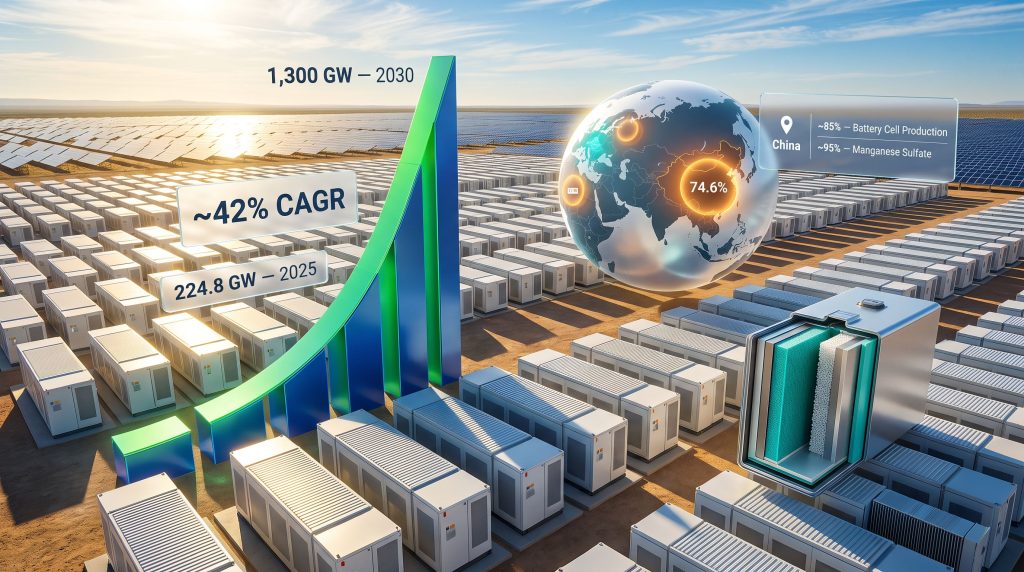
According to GlobalData's Strategic Intelligence: Batteries in Power (2026) report, published in late July 2026, global installed battery energy storage system capacity stood at approximately 224.8 GW at the end of 2025 and is projected to reach approximately 1,300 GW by 2030. That trajectory implies a compound annual growth rate of roughly 42%, sustained across five consecutive years.
To appreciate what this means in practical infrastructure terms, consider that achieving the forecast requires adding more than one gigawatt of new battery storage capacity every single day between 2025 and 2030. Annual deployment rates must not merely remain high but must accelerate year on year to meet the cumulative target. This is the kind of sustained industrial mobilisation that historically requires both private capital at scale and deeply integrated supply chains. Furthermore, the battery metals investment landscape will need to evolve substantially to keep pace with this demand trajectory.
Scale reference: Under the IEA's most aggressive scenario, battery storage capacity would expand approximately 14-fold from 2023 levels by 2030, with batteries projected to account for roughly 90% of all new storage capacity additions globally across that period.
How Different Analytical Frameworks Arrive at Different 2030 Targets
The variation in published forecasts reflects genuine methodological differences rather than disagreement about directional trends.
| Forecasting Body | 2030 Battery Storage Target | Methodology Basis |
|---|---|---|
| GlobalData (2026) | ~1,300 GW | Installed BESS capacity only |
| IEA Net Zero Emissions Scenario | ~1,200 GW battery; 1,500 GW total storage | All storage technologies combined |
| BloombergNEF | Scenario-dependent | Includes multiple storage type definitions |
GlobalData's figure covers installed battery energy storage systems specifically, while the IEA's outlook for battery demand of approximately 1,200 GW for battery storage sits within a broader 1,500 GW total storage target that also encompasses pumped hydro and other technologies. These distinctions matter when comparing headline numbers across sources.
What Is Changing Inside the Battery Technology Stack?
The Shift From Two-Hour to Four-Hour Systems: Why Duration Matters for Grid Operators
One of the most consequential and underreported shifts occurring within the battery storage market is the transition in system duration. Utilities are progressively standardising procurement around four-hour battery systems rather than the two-hour configurations that dominated early-generation deployments. This shift is not simply a technical preference. It reflects a fundamental change in how storage assets are valued and contracted within electricity markets.
A four-hour system can absorb the full volume of surplus midday solar generation that a two-hour system would need to curtail, and it can discharge for long enough to cover the evening demand ramp that typically peaks between four and eight hours after midday solar output begins to decline. From a grid operator's perspective, this duration profile makes four-hour storage a functional replacement for gas peaking capacity in a way that two-hour storage typically cannot achieve.
Lithium Iron Phosphate (LFP) Batteries: From Niche Chemistry to Market Majority
The chemistry transition underway within the battery industry carries significant supply chain implications that extend well beyond the technology itself.
- LFP batteries now represent close to 50% of the global electric vehicle battery market, up from under 10% in 2020
- LFP chemistry offers meaningful safety and cycle-life advantages over nickel-manganese-cobalt formulations, reducing thermal runaway risk and extending asset operational lifetimes
- The trade-off is energy density, with LFP cells storing less energy per unit of weight, making them better suited to stationary storage applications than to long-range passenger vehicles
- LFP's dominance creates a structural dependency on phosphoric acid, of which China supplies approximately 75% of global production capacity
Sodium-Ion Batteries: An Emerging Alternative With Strategic Mineral Advantages
Sodium-ion technology represents one of the more strategically interesting developments in battery chemistry, precisely because it reduces dependency on lithium, a mineral facing projected supply deficits. Sodium is abundant globally and does not require the same concentration of geographically constrained mining operations that lithium extraction demands. In addition, advances in direct lithium extraction technology are reshaping how conventional lithium supply is perceived, making the comparison between chemistries more dynamic than static reserves data alone would suggest.
However, sodium-ion batteries are not free of geopolitical concentration risk. China supplies approximately 95% of the manganese sulfate used in sodium-ion cell manufacturing, meaning a shift toward sodium-ion technology does not automatically reduce supply chain dependency on Chinese processing capacity. The IEA's Global Critical Minerals Outlook 2025 identifies sodium-ion as a credible emerging alternative, but one whose strategic mineral advantages may be more limited in practice than headline comparisons suggest.
How Battery Systems Are Expanding Beyond Grid Storage Into Data Centre Infrastructure
- Battery storage is progressively displacing conventional UPS systems in hyperscale data centres, which require both high power reliability and the ability to respond to fluctuations within milliseconds
- AI-driven data centre expansion is generating a fast-growing secondary demand pool for battery storage that operates largely independently of utility-scale renewable integration trends
- Peak shaving capabilities are enabling data centres to reduce electricity procurement costs, improving the economics of storage deployment within commercial and industrial applications
- This dual-market demand structure means that battery storage investment is no longer solely dependent on renewable energy deployment rates, giving the sector a more resilient demand base than earlier forecasts assumed
How Are Battery Costs Reshaping the Economics of Energy Storage Investment?
The 40% Price Decline Projection and What It Means for Project Returns
The IEA's Batteries and Secure Energy Transitions report projected in 2024 that lithium-ion battery prices would decline by approximately 40% between 2023 and 2030. This cost trajectory is already altering the investment calculus for utility-scale storage projects in ways that extend beyond simple margin improvement.
Falling battery costs change the threshold at which storage becomes economically preferable to alternative grid management tools. Each successive price reduction unlocks new market segments that were previously uneconomical, expanding the total addressable market faster than top-line growth figures suggest. Projects that required merchant revenue stacks or long-term capacity contracts to achieve bankability a few years ago are increasingly viable on shorter-term contracted revenue alone.
Hybrid Solar-Plus-Storage Projects: The Cost Efficiency Model Gaining Traction
The hybrid solar-plus-storage project structure has emerged as a particularly efficient deployment model for several interconnected reasons.
- Co-located solar and battery assets share a single grid connection, reducing the per-megawatt cost of transmission infrastructure
- Shared site development lowers land acquisition and permitting costs relative to standalone storage facilities developed independently
- The operational integration of generation and storage within a single asset creates revenue opportunities through both energy arbitrage and ancillary grid services simultaneously
- Utilities and independent power producers across major markets are increasingly preferring hybrid structures in competitive procurement processes, creating a self-reinforcing procurement trend
Who Controls the Global Battery Storage Market? A Geopolitical Concentration Analysis
China and the United States: The Two Markets That Define the Current Landscape
China and the United States together accounted for approximately 74.6% of global installed battery storage capacity at the end of 2025, according to GlobalData. Both markets have benefited from large-scale procurement programmes and established regulatory frameworks that reduce investment risk for private capital. The concentration of deployment in two jurisdictions reflects not only the scale of their electricity systems but also the depth of their domestic battery manufacturing ecosystems.
Europe's 15% Market Share Ambition and the Supply Chain Dependency Problem
Europe has set an ambition of capturing approximately 15% of global battery storage capacity by 2030, a target that would require a substantial acceleration of current deployment rates. The fundamental challenge is not financial or regulatory. It is structural.
China controls approximately 85% of global battery cell manufacturing capacity and more than 75% of the refining capacity for the raw materials used in battery production. Europe's battery manufacturing ambitions, represented by the so-called Gigafactory buildout across Germany, France, Sweden, and other member states, are progressing, but the upstream supply chain dependency on Chinese processing remains deep and difficult to unwind within a five-year horizon.
China's Dominance Across the Battery Value Chain: A Multi-Layer Analysis
| Battery Material | China's Global Market Share |
|---|---|
| Battery cell production | ~85% |
| Raw material refining capacity | >75% |
| Phosphoric acid (LFP batteries) | ~75% |
| Manganese sulfate (sodium-ion batteries) | ~95% |
This multi-layer dominance means that even as battery chemistry diversifies and new technologies emerge, China's strategic influence over global supply chains is unlikely to diminish materially in the near term. The IEA has specifically identified this concentration as a systemic risk for energy transition timelines globally.
The next major ASX story will hit our subscribers first
What Are the Critical Mineral Supply Risks That Could Constrain the 2030 Buildout?
The Projected Lithium and Copper Deficits: Understanding the Supply Gap
Supply risk context: The IEA projects a 40% lithium supply deficit and a 30% copper supply deficit by 2035 unless mining investment accelerates substantially beyond current committed levels. These projections represent the most significant systemic constraint on achieving the battery storage expansion trajectory that current forecasts describe.
The copper deficit deserves particular attention because copper is not a battery-specific mineral. It is a foundational component of virtually all electrical infrastructure, from grid cables and transformers to motor windings and charging equipment. A sustained copper supply crunch would constrain not just battery storage deployment but the broader electrification buildout on which battery demand depends.
Why Critical Mineral Concentration Risk Is a Systemic Threat to Energy Transition Timelines
The risk is not simply one of physical scarcity. Mineral supply chains are geographically concentrated at both the mining and processing stages, meaning that trade policy changes, export restrictions, or geopolitical disruptions can create supply shortfalls that physical reserves in the ground cannot quickly resolve. Processing capacity, which requires years and significant capital to develop, is the true bottleneck. Nations with large mineral reserves but limited processing infrastructure effectively remain commodity exporters rather than value chain participants. Consequently, the intersection of critical minerals and energy security has become one of the defining policy debates of the current decade.
Sodium-Ion Technology as a Partial Hedge Against Lithium Supply Constraints
Sodium-ion batteries offer a partial hedge against lithium supply constraints, but the qualifier matters. The technology reduces lithium exposure while introducing manganese sulfate dependency within a supply chain that is, if anything, more geographically concentrated than lithium processing. For investors and policymakers evaluating supply chain resilience, sodium-ion represents a diversification of risk rather than its elimination.
Why Is Africa Largely Absent From the Battery Storage Market Despite Its Mineral Wealth?
The Paradox of Resource Abundance and Market Marginalisation
Africa's position in the global battery storage economy is one of the most structurally anomalous features of the entire sector. The continent holds some of the world's largest reserves of minerals that are essential to battery manufacturing, including cobalt, lithium, manganese, and copper. Yet Africa's battery energy storage market was valued at approximately $80.8 million in 2025, according to Next Move Strategy Consulting, against a global battery storage market valued at approximately $50.81 billion in the same year, according to MarketsandMarkets. Africa's share amounts to well under 0.2% of global market value.
This is not simply a development gap. It is a structural paradox: the continent supplying raw materials foundational to the global energy transition is capturing almost none of the economic value generated by the industries those materials enable.
The Structural Barriers Preventing African Nations From Capturing Battery Value Chain Participation
- The absence of downstream processing infrastructure means African nations participate in the battery value chain primarily as raw material exporters, capturing the lowest-margin segment of the supply chain
- Regulatory and financing environments across many African markets remain misaligned with the requirements of large-scale battery storage project development, particularly around long-term power purchase agreements and grid access frameworks
- Grid infrastructure deficiencies in many regions reduce the addressable market for utility-scale storage deployment, creating a circular constraint where weak grids reduce storage demand and limited storage makes grid strengthening harder to finance
- The intensification of critical mineral supply constraints globally makes Africa's resource base increasingly strategically valuable, but translating geological wealth into market participation requires processing capacity, not just mining rights
What Would It Take for Africa to Move From Mineral Supplier to Battery Storage Market Participant?
The pathway from mineral supplier to battery storage market participant involves multiple sequential steps that cannot be compressed easily. Processing infrastructure must be developed domestically before value chain integration becomes possible. Regulatory frameworks governing power purchase agreements, grid access, and foreign investment must mature to attract the patient capital that large-scale battery storage projects require. Grid infrastructure must expand to create the domestic addressable market that justifies storage investment.
None of these conditions are impossible to achieve, but each requires sustained policy commitment and capital deployment over timeframes that extend well beyond single electoral cycles. As global supply chain pressures intensify and critical mineral diplomacy becomes a more prominent feature of international economic policy, Africa's geological endowment may become a stronger negotiating lever, but only if paired with domestic value-addition capacity.
FAQ: Global Battery Energy Storage Capacity Growth to 2030
What does the sixfold increase in global battery energy storage capacity actually mean?
According to GlobalData, global installed battery energy storage capacity is projected to grow from approximately 224.8 GW in 2025 to around 1,300 GW by 2030. Achieving this requires adding the equivalent of more than one gigawatt of new capacity every single day across that five-year period, at a compound annual growth rate of approximately 42%. The global battery storage capacity surge has been widely reported across the energy sector as one of the most significant infrastructure projections of the decade.
Which countries are leading global battery storage deployment?
China and the United States are the dominant markets, collectively accounting for approximately 74.6% of global installed capacity at the end of 2025. Europe is pursuing policies to achieve approximately 15% of global market share by 2030, though this target faces significant supply chain headwinds given China's manufacturing dominance.
Why are four-hour battery systems replacing two-hour systems?
Four-hour systems are operationally better aligned with solar-heavy electricity grids, where surplus generation peaks around midday and demand peaks in the evening. The longer discharge duration allows storage assets to capture substantially more value from energy arbitrage and grid services than two-hour systems can provide.
What critical mineral supply risks could slow the battery storage expansion?
The IEA projects a potential 40% lithium supply deficit and a 30% copper supply deficit by 2035 if mining investment does not accelerate substantially. China's control of processing capacity for multiple battery materials, including approximately 95% of manganese sulfate production, adds a further geopolitical dimension to supply risk. Furthermore, advances in lithium-ion battery recycling represent one potential avenue for partially offsetting these projected deficits over the longer term.
How does AI data centre expansion contribute to battery storage demand?
Hyperscale data centres require both large quantities of electricity and millisecond-level power continuity guarantees. Battery storage systems are progressively replacing conventional backup power infrastructure in these facilities, while peak shaving capabilities reduce electricity procurement costs. The rapid expansion of AI computing is creating a fast-growing secondary demand pool for battery storage that operates independently of renewable energy integration trends.
Key Takeaways: What the Sixfold Battery Storage Expansion Means for Energy Markets Through 2030
-
Global battery energy storage capacity to increase sixfold by 2030 is projected to reach approximately 1,300 GW, up from 224.8 GW in 2025, at a CAGR of approximately 42%
-
Falling lithium-ion battery costs, accelerating renewable deployment, and AI-driven data centre demand represent the three primary structural drivers of this expansion
-
China controls approximately 85% of battery cell manufacturing and more than 75% of raw material refining capacity, creating systemic concentration risk for global supply chains
-
The IEA's projected 40% lithium deficit and 30% copper deficit by 2035 represent the most significant constraints on achieving forecast growth targets
-
The shift from two-hour to four-hour battery systems reflects a market maturing around solar generation profiles rather than emergency backup functions
-
Africa's battery storage market represents less than 0.2% of global market value despite the continent holding substantial reserves of critical minerals, illustrating the gap between geological endowment and value chain participation
-
Sodium-ion batteries offer partial diversification from lithium supply risk but introduce concentrated dependency on manganese sulfate, of which China supplies approximately 95% globally
Disclaimer: This article contains forward-looking projections sourced from third-party research organisations including GlobalData, the International Energy Agency, Next Move Strategy Consulting, and MarketsandMarkets. These projections are subject to material uncertainty and should not be construed as financial advice. Actual outcomes may differ significantly from forecast figures depending on policy, technology, supply chain, and macroeconomic developments.
Want to Capitalise on the Mineral Discoveries Driving the Battery Storage Buildout?
The sixfold expansion in global battery energy storage capacity is creating urgent demand for lithium, copper, manganese, and other critical minerals — and significant ASX discoveries in these commodities can generate substantial returns for investors who act quickly. Discovery Alert's proprietary Discovery IQ model delivers real-time alerts the moment significant mineral discoveries are announced on the ASX, transforming complex geological data into actionable investment insights — explore the historic returns major discoveries have delivered and begin your 14-day free trial today to position yourself ahead of the broader market.