July 29, 2026
The Structural Forces Reshaping Australia's Domestic Gas Market
Energy markets rarely move in isolation. When wholesale prices fall sharply, the instinct is to celebrate without asking why, or more importantly, for how long. Australia's east coast gas prices lowest since 2021 is currently the defining feature of the domestic market: a five-year price low that reflects genuine supply adequacy, but also masks a more complex set of structural pressures building beneath the surface. Understanding what is driving the current pricing environment, and what could reverse it, is essential for households, businesses, and policymakers alike.
When big ASX news breaks, our subscribers know first
East Coast Gas Prices at Their Lowest Since 2021: What the Numbers Actually Show
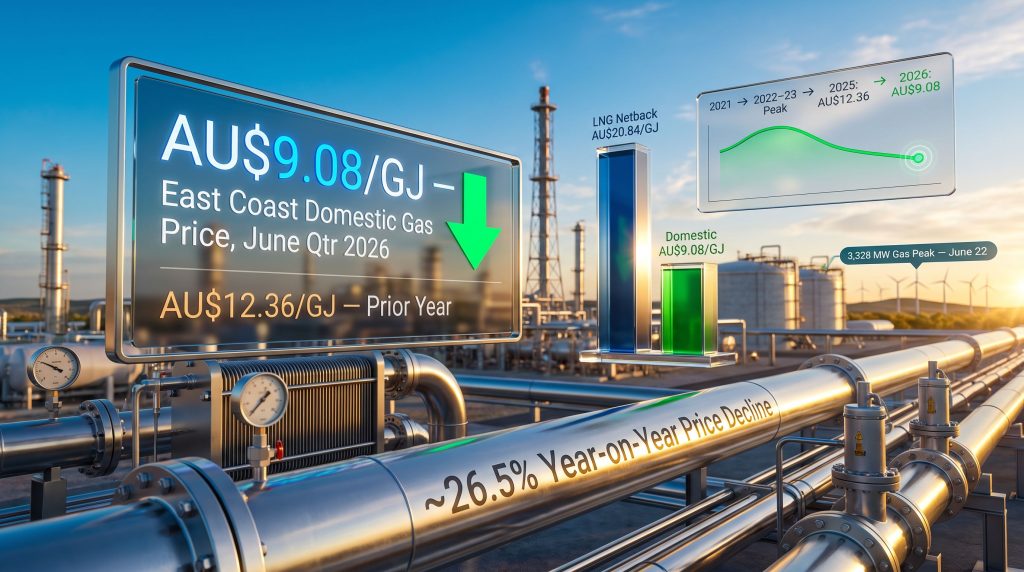
According to AEMO's latest Quarterly Energy Dynamics report, the average domestic gas price on Australia's east coast reached AU$9.08 per gigajoule (GJ) during the June quarter of 2026. This represents a decline of approximately 26.5% compared to the same period in 2025, when prices averaged AU$12.36/GJ.
The figure is significant for another reason entirely: it sits at less than 44% of the international LNG netback benchmark, which recorded AU$20.84/GJ over the same period. That produces a spread of AU$11.76/GJ between what domestic buyers pay and what international buyers would theoretically pay for the same molecule.
| Metric | Value |
|---|---|
| East Coast Domestic Gas Price (June Qtr 2026) | AU$9.08/GJ |
| East Coast Gas Price (June Qtr 2025) | AU$12.36/GJ |
| Year-on-Year Price Decline | ~26.5% |
| International LNG Netback Price | AU$20.84/GJ |
| Domestic-to-Netback Spread | AU$11.76/GJ |
| Domestic Price as % of LNG Netback | Less than 44% |
This level of divergence between domestic and export prices is among the widest recorded in the post-LNG export era, and it tells a clear story: the local market is well-supplied, and that supply is not being diverted offshore in volumes sufficient to tighten the domestic price. Furthermore, the natural gas price trends observed throughout 2025 set the stage for this more pronounced compression.
What Is Driving the Price Compression on the East Coast?
Supply Outpacing Demand Across the Network
Several intersecting forces have combined to push east coast gas prices lowest since 2021. These are not temporary distortions but rather a convergence of structural and cyclical factors:
- Domestic supply volumes have grown faster than consumption growth across the east coast pipeline network
- Reduced industrial gas demand during the quarter softened price pressure at the margin
- Seasonal heating demand was lower relative to prior-year comparisons, contributing to a mild demand profile
- Increased competition among producers has placed consistent downward pressure on contract pricing
Why the Domestic Market Is Decoupling from Global LNG Benchmarks
The AU$20.84/GJ international LNG netback reflects tighter global supply conditions, driven in part by sustained European energy security procurement following the structural shift away from Russian pipeline gas, as well as continued demand growth from Asian importers including Japan, South Korea, and China. The broader LNG supply outlook for 2025 and beyond helps contextualise why this decoupling has become so pronounced.
What the current pricing environment demonstrates is that Australia's east coast domestic market can, under conditions of adequate supply, operate largely independently of these global pressures. The netback price is not a ceiling on domestic pricing, but it does set the commercial incentive floor: when the gap between domestic and export prices widens, producers face growing pressure to prioritise LNG over domestic contracts.
A large and persistent spread between domestic and international gas prices is not purely a consumer benefit. It also represents a structural commercial tension for producers, who must balance contractual obligations to domestic buyers against the higher returns available from export markets. This tension is precisely the market dynamic that reservation frameworks are designed to manage.
Historical Price Context: 2021 to 2026
| Period | Approximate East Coast Gas Price |
|---|---|
| 2021 (Pre-Surge Baseline) | Comparable to current AU$9.08/GJ levels |
| 2022 to 2023 (Global Energy Crisis Peak) | Significantly elevated above AU$20/GJ at points |
| June Quarter 2025 | AU$12.36/GJ |
| June Quarter 2026 | AU$9.08/GJ |
The return to 2021-era pricing levels after the extreme volatility of the global energy crisis period represents a meaningful reversion. However, prices in 2021 were themselves considered historically low and were, in retrospect, part of a pre-crisis baseline that preceded the supply shocks caused by geopolitical disruptions in Europe. The Australian Energy Producers association has noted that this reversion, while welcome, should not be mistaken for a permanent structural shift.
How a Well-Supplied Market Protects Households and Businesses
The Economic Case for Supply Adequacy Over Price Controls
The economic benefits of lower wholesale gas prices flow through multiple layers of the economy. At the wholesale level, gas-dependent industries including fertiliser manufacturing, chemical processing, food production, and metals refining all face lower input costs when prices remain structurally below export parity.
At the commercial and industrial level, businesses operating on shorter-term supply contracts that reprice against spot market conditions benefit directly and quickly from price compression. Retailers, hospitality operators, and light industrial users with gas-intensive processes see genuine cost relief.
At the household level, the transmission is indirect but real. Retail gas pricing incorporates network transmission costs, retailer margins, and regulatory charges on top of the wholesale price, meaning consumer bills do not move in perfect lockstep with the wholesale market. However, sustained wholesale softness does ultimately reduce the upward pressure on retail pricing over time.
Australian Energy Producers CEO Samantha McCulloch stated publicly that the current pricing environment is clear evidence of what a well-supplied domestic market can achieve, and that the priority should be building on this foundation through policies that encourage new investment rather than constraining existing production.
Who Captures the Most Value from the Current Price Environment?
- Energy-intensive manufacturers where gas is a significant proportion of operating costs benefit most directly and immediately
- Commercial and industrial users on shorter repricing cycles capture benefits faster than long-term contract holders
- Electricity generators using gas-fired plants benefit from lower fuel input costs, which can flow through to the National Electricity Market
- Residential consumers benefit indirectly over medium-term pricing cycles, subject to the structure of retail contracts in each state
Gas-Fired Generation and Grid Reliability: The June 22 Case Study
One of the more striking data points from the June quarter sits beyond the pricing metrics entirely. On 22 June 2026, gas-fired electricity generation reached a daily average peak of 3,328 megawatts across the east coast grid, triggered by an extended period of low wind output affecting southern Australian states.
This single event functions as a stress test of the grid's dependency on dispatchable generation. Wind variability is not a fringe event; it is a structural characteristic of renewable-heavy electricity systems. As Australia's installed wind and solar capacity continues to expand, the frequency and intensity of periods requiring dispatchable backup will increase, not decrease.
| Grid Transition Factor | Implication for Gas Demand |
|---|---|
| Scheduled coal plant retirements | Increases reliance on gas for baseload and firming capacity |
| Expanding wind and solar penetration | Creates more frequent and deeper low-output periods |
| Battery storage at current scale | Insufficient to substitute for gas at multi-day event timescales |
| Electrification-driven demand growth | Adds system stress during renewable droughts |
The Dispatchability Premium: Why Gas Cannot Be Replaced Overnight
Battery storage technology has advanced considerably over the past decade, but grid-scale storage still cannot economically replicate the multi-day dispatchability that gas-fired generation provides. During a prolonged wind drought spanning several days across multiple states, the volume of stored energy required to fill the gap would exceed the installed battery capacity by an order of magnitude under current projections.
This creates what energy systems analysts describe as a dispatchability premium for gas: its value to the grid is not just its energy content, but its ability to be called on at any hour, in any season, for any duration. That attribute becomes more valuable, not less, as the grid's renewable share grows.
Gas-fired generation is not a legacy technology being phased out. In a grid undergoing rapid renewable expansion, it is the backstop that makes the transition technically feasible without compromising reliability standards.
Understanding the National Gas Reservation Framework
The Policy Architecture Under Federal Review
The federal government is currently working to finalise the design of a national gas reservation framework for Australia's east coast. The policy concept draws on the Western Australian Domestic Gas Policy, which has been in operation since 1979 and requires LNG exporters in that state to reserve 15% of production for domestic consumption before any volumes are exported.
The east coast market is structurally different from Western Australia's in several important ways. The east coast gas network connects multiple producing basins across Queensland, New South Wales, Victoria, and South Australia, feeds a much larger and more diverse industrial consumer base, and operates under different contractual and regulatory structures. Designing a reservation framework that functions effectively across this complexity is a non-trivial policy challenge.
Key Design Principles for an Effective Reservation Framework
- Reservation thresholds must be set at levels that incentivise new field development, not merely redistribute volumes from existing production
- Price-trigger mechanisms tied to domestic benchmark thresholds may deliver better outcomes than fixed volume mandates, which can create oversupply distortions
- Investment certainty provisions are essential to attract the long-cycle capital required for exploration and field development, where lead times commonly exceed a decade
- The framework must account for the natural production decline curves of existing fields, which cannot sustain current output levels indefinitely without ongoing capital investment
- Transition provisions for existing LNG export contracts would need careful design to avoid sovereign risk concerns that could deter future investment
The Critical Tension: Affordability vs. Investment Incentive
McCulloch's public commentary highlighted a fundamental policy tension: designing a reservation framework that forces structural oversupply into the domestic market could suppress wholesale prices to levels that make new gas field development commercially unviable. The consequence of that investment drought would not be permanently cheap gas — it would be scarcity and price spikes after 2030 as legacy fields deplete without adequate replacement supply.
In addition, the broader implications for Australia's energy exports underscore why policy calibration here carries consequences well beyond the domestic market.
The most effective long-term mechanism for domestic gas affordability is not mandated price suppression. It is sustained investment in new supply that keeps the market structurally well-supplied. These are not equivalent policy tools, and confusing them carries real economic risk.
The next major ASX story will hit our subscribers first
The Post-2030 Supply Cliff: A Risk That Current Prices Obscure
What AEMO's Gas Statement of Opportunities Has Previously Flagged
AEMO's Gas Statement of Opportunities (GSOO) has previously identified potential supply shortfalls emerging on the east coast after 2030 as legacy producing fields deplete. This is not a speculative concern — it reflects the physical decline curves of gas reservoirs, which are well-understood and quantifiable.
The fields currently supplying the east coast market have been producing for decades in some cases. Without sustained investment in new field development, including unconventional resources in emerging basins such as the Beetaloo Basin in the Northern Territory and the Taroom Trough in Queensland, the volume of gas available to the domestic market will decline materially through the 2030s.
Critically, current low prices, while beneficial to consumers in the short term, do not resolve this structural investment gap. In fact, they may exacerbate it by reducing the commercial returns available to justify the capital expenditure required for new exploration and development programmes. The ACCC has also cautioned that lower prices may not last without sustained investment signals.
Emerging Supply Basins and Their Development Timelines
Both the Beetaloo Basin and the Taroom Trough represent potentially significant unconventional gas resources, but they require substantial upfront capital, multi-year development timelines, and stable regulatory environments before they can contribute meaningfully to east coast supply. Operators including Tamboran Resources in the Beetaloo and Omega Oil and Gas in the Taroom Trough are actively progressing exploration and stimulation programmes, but commercial production at scale remains several years away for most projects.
This development lag is a critical consideration for policymakers. Decisions made today about reservation frameworks, investment conditions, and regulatory settings will determine whether replacement supply is available when it is needed in the early 2030s.
How Australian Domestic Gas Prices Compare Globally
| Market | Price Reference | Approximate Level (Mid-2026) |
|---|---|---|
| Australian East Coast (Domestic) | Wholesale spot/contract | AU$9.08/GJ |
| International LNG Netback (Australia) | Export parity benchmark | AU$20.84/GJ |
| U.S. Henry Hub | Benchmark futures | Approximately USD$3-4/MMBtu |
| European TTF | Spot gas benchmark | Elevated relative to pre-2022 norms |
| Asian LNG Spot (JKM) | Northeast Asian import benchmark | Reflecting sustained Asian import demand |
Australian domestic wholesale gas at AU$9.08/GJ remains higher in absolute terms than U.S. Henry Hub pricing, which reflects the much larger and more liquid U.S. gas market as well as different production economics. However, compared to European and Asian LNG benchmarks, Australian domestic consumers are currently accessing gas at a significant discount to global parity.
Three Structural Scenarios for East Coast Gas Pricing Through 2030
Scenario 1: Sustained Supply Adequacy
New investment in domestic gas fields keeps pace with natural field decline. Reservation frameworks are calibrated to encourage rather than deter development. Prices remain in the AU$9 to AU$12/GJ range through the decade, providing sustained relief for consumers and businesses.
Scenario 2: Investment Drought and Supply Tightening
Overly restrictive reservation requirements or prolonged price suppression deter new capital allocation. Legacy fields decline faster than replacement supply becomes available. Prices re-escalate toward export parity levels from 2028 onward, reversing current affordability gains precisely when grid reliability dependence on gas is at its highest. Furthermore, the renewable energy transition could accelerate this tightening if gas investment stalls during a critical grid transition period.
Scenario 3: Accelerated Demand Destruction Through Electrification
Industrial gas demand falls faster than anticipated as electrification of industrial processes and efficiency improvements reduce consumption. Supply adequacy is maintained not through new field investment but through demand contraction. This scenario preserves affordability but reduces the commercial case for the new supply needed to backstop the electricity grid during renewable droughts. Consequently, energy transition pressures may reshape the investment landscape in ways that make Scenario 3 more likely than current forecasts suggest.
Disclaimer: The scenarios above are illustrative projections based on current market dynamics and publicly available data. They do not constitute financial advice or definitive forecasts. Actual outcomes will depend on investment decisions, regulatory settings, technological developments, and global energy market conditions that cannot be predicted with certainty.
Frequently Asked Questions: East Coast Gas Prices in Australia
What does AU$9.08/GJ mean for the average consumer?
The AU$9.08/GJ figure is a wholesale price, representing what large-volume buyers pay in bulk transactions. Household retail gas prices incorporate additional costs including network transmission, distribution, retailer margins, and regulatory charges. The retail price consumers see on their bills will be materially higher than the wholesale benchmark, though sustained wholesale softness does reduce the upward pressure on retail pricing over time.
Why are Australian domestic prices so much lower than export prices?
When domestic supply is adequate relative to local demand, prices reflect the local supply-demand balance rather than international parity. The current surplus of east coast supply against domestic consumption requirements is the primary driver. If domestic supply were to tighten, the price gap with international netback would narrow as producers shifted volumes toward export markets.
What is the LNG netback price and how is it calculated?
The LNG netback price represents the theoretical equivalent value of gas sold domestically, calculated by taking the international LNG sale price and deducting the costs of liquefaction, shipping, and other export-related expenses. It serves as an indicator of what a producer could earn by exporting rather than selling domestically, and functions as a commercial opportunity cost benchmark. When domestic prices fall well below netback, as they have now, it signals the local market is generating returns significantly below export parity.
Could east coast gas prices rise again after their current lows?
Yes, this is a real and well-documented risk. If new gas field investment does not keep pace with the natural production decline of existing fields, supply tightness could emerge after 2030. AEMO's own Gas Statement of Opportunities has previously flagged this possibility. Current low prices are not a guarantee of future affordability without ongoing investment in replacement supply. The east coast gas prices lowest since 2021 therefore represent a window of opportunity, not a permanent state.
How does gas support renewable energy reliability?
Gas-fired power plants can be ramped up or down rapidly to compensate for fluctuations in wind and solar output. This technical characteristic, known as dispatchability, makes gas an essential complement to intermittent renewables. During extended periods of low wind or cloud cover across multiple states, battery storage at current installed scales cannot substitute for the volume and duration of firming capacity that gas provides.
For additional context on Australia's east coast gas market dynamics and AEMO's quarterly reporting methodology, readers can explore related coverage and data publications at Petroleum Australia and the Australian Energy Market Operator's official Quarterly Energy Dynamics series.
Want to Know Which ASX Energy and Resources Discoveries Could Signal the Next Major Market Opportunity?
Discovery Alert's proprietary Discovery IQ model delivers real-time alerts on significant ASX mineral discoveries the moment they are announced, transforming complex geological and commodity data into actionable investment insights for both short-term traders and long-term investors. Explore historic discoveries and their exceptional market returns, then start your 14-day free trial to position yourself ahead of the broader market.