July 29, 2026
The Structural Logic Behind Brazil's Expanding Trade Position
Few economic narratives in 2025 and 2026 have been as counterintuitive as Brazil's trade trajectory. While headlines fixate on US tariff escalation as a destabilising force for emerging market exporters, the Brazil trade surplus and US tariffs dynamic has continued to strengthen overall. This apparent contradiction resolves quickly once the underlying architecture of Brazil's export economy is examined properly. The country's commodity dominance, geographic export diversification, and deepening ties with Asian industrial buyers have combined to create a surplus engine that bilateral tariff friction cannot easily disrupt.
Understanding why requires moving past the surface-level narrative of tariffs as trade-killers and engaging with how commodity-dependent economies actually absorb and redirect trade pressure over time.
When big ASX news breaks, our subscribers know first
Who Actually Holds the Trade Surplus? Unpacking the US-Brazil Bilateral Data
The framing of US tariffs against Brazil as a deficit-correction mechanism falls apart under scrutiny of the actual bilateral trade data. Far from running a trade deficit with Brazil, the United States has maintained a consistent surplus position with Latin America's largest economy for more than 15 consecutive years through 2024.
The numbers are significant enough to reframe the entire policy debate:
| Metric | Value | Year |
|---|---|---|
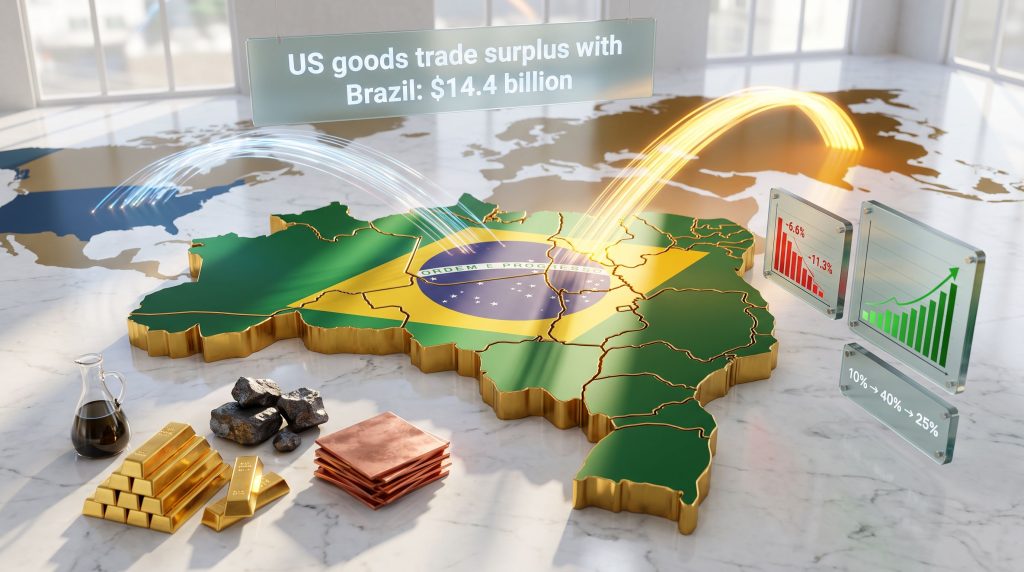
| US goods trade surplus with Brazil | $14.4 billion | 2025 |
| US services trade surplus with Brazil | $23.1 billion | 2024 |
| Combined US goods-and-services surplus with Brazil | $28.6 billion | 2024 |
| Duration of recurring US surplus with Brazil | 15+ consecutive years | Through 2024 |
This data highlights an unusual application of trade policy. Standard tariff justification frameworks centre on correcting a deficit position held by the imposing country. In the case of Brazil, the US holds the surplus across both goods and services, meaning the conventional trade-rebalancing rationale does not straightforwardly apply. Instead, the tariff escalation appears to reflect broader industrial policy objectives, geopolitical positioning relative to Brazil's deepening ties with China, and domestic political considerations rather than classical deficit remediation logic.
The Three-Phase Tariff Escalation Timeline
US tariff policy toward Brazilian goods moved through three distinct phases between April 2025 and mid-2026, each representing a material increase in bilateral trade friction:
- April 2025: A blanket 10% tariff was applied to Brazilian goods as part of a wider US trade policy recalibration targeting multiple countries simultaneously.
- July 2025: Brazil-specific tariffs were elevated sharply to 40%, signalling that Brazil had been specifically identified for targeted trade pressure rather than treated as an incidental casualty of broader measures.
- July 2026: The tariff structure was revised downward to a 25% rate applied to the majority of Brazilian goods under a separate trade investigation framework, introducing a new phase of structured but sustained friction.
The market response to this escalation was measurable but contained. Brazilian exports to the US declined 6.6% year-over-year across full-year 2025, followed by a sharper 11.3% year-over-year contraction in April 2026. Critically, these contractions in US-directed shipments have not translated into a deterioration of Brazil's overall trade surplus, for reasons rooted in the geographic composition of Brazilian export demand.
Brazil's Commodity Export Architecture and Why It Creates Surplus Resilience
The foundation of Brazil's trade surplus durability is a commodity export portfolio that is both globally irreplaceable and largely decoupled from US market conditions. Brazil operates as a tier-one supplier across multiple commodity categories simultaneously, a combination that few countries can match.
Core export pillars include:
- Iron ore, where the iron ore demand outlook positions Brazil as one of the world's two dominant suppliers alongside Australia
- Deepwater crude oil and heavy oil from offshore pre-salt basins, representing one of the most significant oil discoveries of the 21st century
- Copper and copper cathodes, with growing relevance as global electrification demand accelerates — a trend reflected in current copper market trends
- Gold, which trades on a global liquid market with effectively unlimited demand absorption capacity
- Soybeans, corn, and beef, where Brazil has become the world's largest or second-largest supplier across multiple categories
- Natural gas and LNG capacity, an expanding component of the export base
What makes this portfolio particularly resilient to bilateral tariff pressure is that none of these categories depends on US market access for price discovery or volume absorption. Iron ore prices are set in Asia. Crude oil is priced globally. Gold is a deep liquid market. Agricultural commodity flows follow global demand cycles anchored in Asian food security strategies. When the US introduces tariffs, Brazilian exporters can redirect volumes without fundamentally disrupting revenue.
The Pre-Salt Oil Factor: A Structural Advantage Few Analysts Emphasise
Brazil's offshore pre-salt oil basins deserve particular attention as an underappreciated driver of surplus expansion. The pre-salt layer, located beneath a thick stratum of salt deposits beneath the Atlantic seabed, hosts some of the highest-quality crude oil reserves discovered globally in recent decades. Pre-salt crude is characterised by relatively low sulphur content and high energy density, making it attractive to Asian refiners seeking premium feedstocks without paying Brent-grade premiums.
The development of pre-salt production capacity by Petrobras and its partners has materially increased Brazil's oil export volumes over the past decade, and ongoing field development continues to add production capacity. This structural expansion of oil export volume creates a durable upward bias in Brazil's goods export revenue that persists regardless of bilateral tariff conditions with the United States.
The Asia Pivot: How China Is Absorbing Brazilian Export Volumes
The geographic reorientation of Brazilian export flows toward Asia represents one of the most consequential structural shifts in Latin American trade geography over the past two decades. China has become Brazil's dominant trading partner, absorbing Brazilian iron ore, copper, agricultural commodities, and crude oil at volumes that dwarf US market capacity.
Market Structure Note: China's role as Brazil's primary export destination is not merely a cyclical demand story. It reflects long-term infrastructure investment by Chinese state entities in Brazilian port, rail, and logistics capacity, creating physical supply chains that reinforce and perpetuate the trade relationship independently of short-term price cycles.
For iron ore specifically, China steel and iron ore industries absorb approximately 70% of globally traded seaborne iron ore, meaning Brazil's largest single export category is effectively priced and cleared in Chinese markets. When US tariffs reduce American demand for Brazilian iron ore, the displacement effect on Brazil's total revenue is minimal because the US was never the marginal buyer driving price or volume.
A similar logic applies to copper cathodes, where Chinese manufacturing and infrastructure demand has kept absorption capacity elevated even as other economies have slowed capital expenditure. Brazil's copper export growth is structurally supported by Chinese electrification investment, renewable energy rollout, and urbanisation-driven construction activity.
Structural vs. Cyclical: Separating Durable Surplus Drivers from Temporary Amplifiers
Not all of Brazil's surplus expansion in 2025–2026 reflects permanent structural gains. A clear-eyed analysis requires separating the durable drivers from the amplifiers that could moderate as macro conditions normalise.
Structural drivers (durable and self-reinforcing):
- Continued pre-salt oil production ramp-up and new field development approvals
- Established iron ore and copper mining infrastructure with long remaining asset lives
- Agricultural export dominance secured by land availability, tropical climate advantages, and decades of productivity investment
- Deepening institutional trade ties with Chinese state importers and infrastructure investors
- Growing LNG export capacity as global gas demand expands
Cyclical amplifiers (present now but potentially temporary):
- Elevated Brent crude oil prices amplifying the dollar value of oil export revenue
- The copper price forecast remains at historically elevated levels driven by energy transition demand expectations
- The gold price forecast sits near record highs, adding outsized revenue from Brazil's gold export sector
- Accelerated Chinese commodity restocking cycles following prior inventory drawdowns
- Short-term trade flow redirection as Brazilian exporters actively reduce US-bound exposure
The distinction matters for projecting the 2027 surplus outlook. If commodity prices normalise toward long-run averages, Brazil's surplus would compress in dollar terms even if physical export volumes remain stable or grow. This is not a structural deterioration but a cyclical adjustment, and investors and analysts should model both scenarios rather than extrapolating current dollar surplus levels indefinitely.
Sector-by-Sector Exposure to US Tariff Risk
The tariff sensitivity of Brazil's export base is highly uneven across sectors. Understanding which industries face genuine revenue erosion and which are effectively immune provides a more precise picture of the actual economic cost of US tariff escalation.
| Export Sector | US Market Dependence | Tariff Sensitivity | Diversification Capacity |
|---|---|---|---|
| Iron Ore | Low | Low | High (China dominant buyer) |
| Crude Oil and Heavy Oil | Moderate | Moderate | High (multiple buyers) |
| Copper and Copper Cathodes | Low-Moderate | Moderate | High (Asia demand strong) |
| Gold | Low | Low | Very High (global liquid market) |
| Agricultural Commodities | Moderate | High | Moderate-High |
| Manufactured and Semi-Processed Goods | Higher | High | Lower |
The clearest vulnerability sits within Brazil's manufactured and semi-processed goods exports, which carry less substitutability and face more direct US tariff impact. Brazilian industrial exporters in sectors such as processed steel products, machinery components, and chemical intermediates face genuine revenue compression when US tariff rates reach 25–40%, because alternative buyers for these specific products are harder to identify rapidly.
This creates a two-speed economy within Brazil's export sector: commodity exporters absorbing tariff pressure with minimal disruption while manufactured goods producers bear a disproportionate share of the economic cost. The political economy implications of this distribution are significant, as industrial workers and manufacturers form a different constituency than commodity exporters backed by multinational capital.
The next major ASX story will hit our subscribers first
Currency Dynamics and the Competitiveness Multiplier
A dimension of Brazil's trade surplus story that receives insufficient attention is the role of the Brazilian real's exchange rate in amplifying export competitiveness. A weaker real relative to the US dollar reduces the production costs of Brazilian commodities in dollar-equivalent terms, making Brazilian exports more price-competitive on global markets even when physical productivity remains constant.
This dynamic creates a partial self-correcting mechanism within Brazil's trade position. Periods of elevated US tariff pressure that dampen export revenue and capital inflows can weaken the real, which in turn enhances the competitiveness of the broader export base and partially offsets the tariff impact. The net effect is a natural buffer against bilateral trade friction that purely tariff-focused analyses tend to underestimate.
The risk scenario runs in the opposite direction: if Brazil's political environment, a commodity price boom, or strong foreign capital inflows drive real appreciation, export competitiveness erodes across all sectors simultaneously, creating a more meaningful headwind to surplus sustainability than any US tariff regime currently in place.
Key Risks That Could Compress Brazil's Surplus Outlook
Risk Watch: While Brazil's trade surplus trajectory appears robust through 2026, several macro and geopolitical scenarios could materially compress surplus levels within a 12–24 month horizon.
The most significant downside risks include:
- Commodity price correction: A synchronised decline in iron ore, copper, and crude oil prices would directly reduce export revenue without a proportional reduction in import costs, compressing the surplus in dollar terms.
- Chinese industrial demand slowdown: A deceleration in Chinese manufacturing activity or a property sector correction reducing steel demand would simultaneously impact Brazil's two largest export categories, iron ore and copper.
- Currency appreciation shock: Rapid real strengthening driven by commodity windfalls or portfolio inflows would erode price competitiveness across the export base.
- Domestic political disruption: Brazil's electoral cycle introduces policy uncertainty around fiscal settings, royalty frameworks, and the regulatory environment for export-oriented industries.
- Multilateral tariff contagion: If US tariff policy encourages other trading partners to adopt protective measures, Brazil's export diversification strategy faces broader resistance simultaneously rather than isolated bilateral friction.
Frequently Asked Questions: Brazil Trade Surplus and US Tariffs
Does the US Have a Trade Deficit With Brazil?
No. The United States maintains a consistent goods and services trade surplus with Brazil. US goods exports to Brazil exceeded imports by $14.4 billion in 2025, with an additional $23.1 billion services surplus recorded in 2024, bringing the combined goods-and-services surplus to $28.6 billion for 2024.
Why Did the US Impose Tariffs on Brazil If It Already Has a Trade Surplus With Brazil?
The tariff measures appear to reflect objectives extending beyond bilateral trade balance correction. Potential motivations include domestic industrial policy goals targeting specific sectors, geopolitical considerations related to Brazil's deepening economic ties with China, and broader US trade strategy recalibration across emerging markets. Standard trade deficit remediation logic does not straightforwardly account for the decision given the US surplus position.
How Much Have US Tariffs Actually Reduced Brazilian Exports to the United States?
Brazilian exports to the US fell 6.6% across full-year 2025 and declined a further 11.3% year-over-year in April 2026, reflecting the cumulative impact of tariff rates escalating from an initial 10% through to 25–40%. The absolute revenue impact has been contained relative to Brazil's total export base because the US represents a minority share of overall Brazilian export volume.
Can Brazil Sustain a Large Trade Surplus Without Strong US Market Access?
Given the dominance of Asia-facing commodity trade flows in Brazil's export mix, the answer for the foreseeable future appears to be yes. The US market has never been the primary destination for Brazil's highest-volume export categories, and the structural reorientation of Brazilian trade toward China and broader Asian markets means the Brazil trade surplus and US tariffs relationship represents a meaningful but not decisive variable in Brazil's overall surplus trajectory. Furthermore, the Brazilian government's trade diversification strategy continues to reinforce this resilience by actively cultivating relationships with multiple trading blocs simultaneously.
This article presents factual analysis and forward-looking perspectives based on publicly available trade data and structural economic analysis. It does not constitute financial or investment advice. Forecasts and scenario projections involve inherent uncertainty and actual outcomes may differ materially from those described.
Want To Capitalise on the Commodity Discoveries Driving Brazil's Export Dominance?
Discovery Alert's proprietary Discovery IQ model delivers real-time alerts on significant ASX mineral discoveries across iron ore, copper, gold, and the commodities underpinning global trade shifts like those reshaping Brazil's surplus — explore historic discovery returns on Discovery Alert's discoveries page to understand the scale of opportunity, then begin your 14-day free trial at Discovery Alert to position yourself ahead of the broader market.