July 29, 2026
When Export Volume Beats Price: What WAEMU's Trade Reversal Really Signals
Monetary unions built on fixed exchange rates live and die by their external accounts. Unlike sovereign currency issuers that can depreciate their way out of a trade deficit, a pegged currency bloc must earn its foreign exchange the hard way: through exports. For the eight member states of the West African Economic and Monetary Union (WAEMU), that structural reality has defined more than a decade of economic vulnerability. The WAEMU trade surplus recorded in 2025 therefore marks a significant departure from a pattern of persistent merchandise deficits that quietly eroded the bloc's reserve buffers, even as individual economies grew and commodity sectors expanded.
What changed in 2025 was not simply a price spike. It was something more durable and analytically interesting: a production-led export surge that, combined with tightened foreign exchange repatriation rules, pushed WAEMU into its first merchandise trade surplus since 2011. Understanding the mechanics behind that shift, and its limits, matters far beyond the headline figure.
When big ASX news breaks, our subscribers know first
The Architecture of WAEMU's External Accounts
WAEMU comprises eight West African nations: Benin, Burkina Faso, Côte d'Ivoire, Guinea-Bissau, Mali, Niger, Senegal, and Togo. They share a single currency, the West African CFA franc, administered by the Central Bank of West African States (BCEAO) and pegged to the euro at a fixed rate.
That peg is the key to understanding why a trade surplus matters so acutely here. In a fixed exchange rate system, the central bank cannot adjust the exchange rate to correct external imbalances. Instead, it must hold sufficient euro-denominated reserves to defend the peg against conversion pressure. Export earnings are the primary mechanism through which those reserves are replenished.
A sustained trade deficit therefore does more than reflect an unfavourable trade position. It steadily draws down the reserve base that underpins monetary credibility across all eight member states. Conversely, a meaningful trade surplus rebuilds that base and reduces the bloc's dependence on external financing — an especially important consideration given that several WAEMU members currently operate under IMF programme frameworks.
It is equally important to distinguish between the merchandise trade balance and the current account balance. The former captures only goods. The latter incorporates services, income flows, and transfers. As we will examine, WAEMU's improvement in 2025 was concentrated at the merchandise level, while the broader current account remained under pressure.
Breaking Down the Numbers: WAEMU's 2025 Trade Surplus at a Glance
The headline figures, drawn from the BCEAO's 2025 annual report presented in Dakar on 22 July 2026, tell a striking story of export acceleration.
| Metric | 2024 | 2025 | Change |
|---|---|---|---|
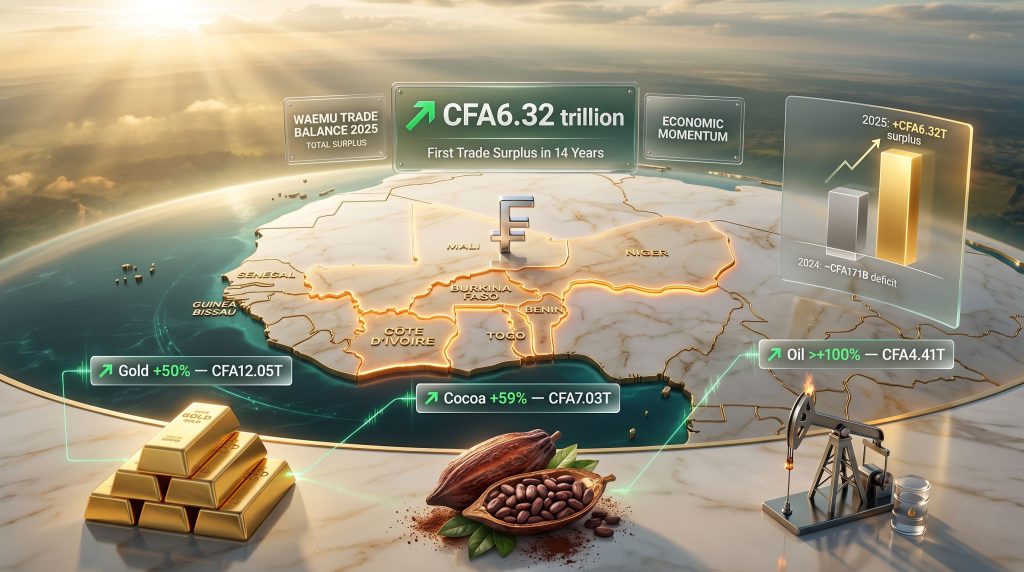
| Merchandise Trade Balance | -CFA171 billion (deficit) | +CFA6.32 trillion (surplus) | Turnaround of ~CFA6.49 trillion |
| Total Exports | ~CFA23.94 trillion (est.) | CFA33.18 trillion | +38.6% |
| Total Imports | — | — | +11.4% |
| Gold Exports | ~CFA8.03 trillion (est.) | CFA12.05 trillion | ~+50% |
| Cocoa Exports | ~CFA4.42 trillion (est.) | CFA7.03 trillion | +59% |
| Oil Exports | ~CFA2.15 trillion (est.) | CFA4.41 trillion | >+100% |
| Crude Oil Production | 192,942 bpd | 233,870 bpd | +21.2% |
| Foreign Exchange Reserves | — | Increased by >CFA8.4 trillion | Significant rebuild |
| BCEAO Export Price Index | +43.9% (prior year) | +13% | Moderation |
The asymmetry between export growth of 38.6% and import growth of just 11.4% produced the widest trade gap the bloc has recorded in well over a decade. Total merchandise exports reached CFA33.18 trillion, with gold, cocoa, and oil collectively accounting for approximately 71% of the total.
Quarterly Momentum Through Late 2025 and Into 2026
The surplus was not distributed evenly across the year. According to data reported by Ecofin Agency, the quarterly progression reveals an accelerating trend:
- Q3 2025 trade surplus: CFA279.8 billion
- Q4 2025 trade surplus: CFA3.31 trillion, representing export growth of 50.4% against import growth of just 3.5%
- Q1 2026 trade surplus: reportedly exceeded CFA3.071 trillion, described by analysts as a record quarterly outcome
- IMF-tracked overall balance for WAEMU: approximately $5,828 million, corroborating the BCEAO's external sector data
This quarterly trajectory matters because it demonstrates the surplus was building in scale rather than flattening, at least through the first quarter of 2026.
What Drove the Turnaround: A Three-Commodity Analysis
Gold: Volume Growth, Not Just Price Appreciation
Gold exports reached CFA12.05 trillion in 2025, up approximately 50% year-on-year, representing roughly 36% of WAEMU's total merchandise exports. For context, this single commodity category now dwarfs most other export lines in the bloc's trade accounts. Furthermore, the gold price outlook for the period provided a supportive backdrop, even as it was volume rather than price that largely drove the gains.
The critical analytical distinction here is between price-driven and volume-driven growth. The BCEAO's export price index rose only 13% in 2025, a sharp deceleration from the 43.9% surge recorded the prior year. That means the 50% gain in gold export value was substantially driven by higher production volumes rather than elevated prices alone.
This matters enormously for sustainability assessments. Price-driven surpluses are inherently transitory; when gold retreats from cyclical peaks, the revenue base shrinks accordingly. Production-driven surpluses reflect genuine capacity expansion in Mali and Burkina Faso's mining sectors, which is structurally more durable even if it remains exposed to operational and geopolitical risks. Indeed, mining geopolitics in the Sahel region continues to shape how reliably those production gains can be sustained.
A lesser-known but consequential policy layer also amplified the reserve impact: foreign exchange repatriation regulations introduced at end-2024 required gold and cocoa exporters to channel a larger proportion of their proceeds through the formal banking system. This regulatory mechanism effectively increased the monetary system's capture of export earnings beyond what the trade balance figures alone would indicate, providing an additional reserve-building tailwind without requiring any improvement in the underlying trade position.
Cocoa: The Price-Volume Sweet Spot
Cocoa exports climbed 59% to CFA7.03 trillion, driven by a particularly favourable intersection of price and volume conditions. Cocoa prices rose 64.8% in CFA-denominated terms, making this commodity the most price-sensitive contributor to the surplus.
Côte d'Ivoire, the world's largest cocoa producer by a significant margin, accounts for the overwhelming majority of WAEMU's cocoa export revenue. The country's structural position as a surplus economy within the bloc has historically insulated WAEMU's aggregate accounts from deteriorating further during deficit years. In 2025, that structural contribution was amplified by favourable market conditions.
However, cocoa also represents the bloc's most cyclically exposed surplus driver. Cocoa prices are notoriously volatile, subject to weather events across the growing regions of Côte d'Ivoire and Ghana, and vulnerable to demand-side softness in key consuming markets. Climate stress on yields adds a longer-term dimension to this exposure that production statistics alone do not capture.
Oil and Gas: Senegal's Structural Addition
Oil exports more than doubled to CFA4.41 trillion as new hydrocarbon production came on stream in Senegal, with Côte d'Ivoire and Niger also expanding output. Across the bloc, crude oil production rose from 192,942 barrels per day to 233,870 barrels per day, a volumetric increase of 21.2%. Notably, the oil price movements of 2025 created a dual effect, boosting export revenues for producer members while simultaneously inflating energy import costs for others.
Senegal's emergence as an oil and gas producer represents the most structurally significant new element in WAEMU's export mix. Unlike commodity price cycles, physical production infrastructure does not disappear when prices soften. Senegal's upstream capacity represents a permanent addition to the bloc's export base that will compound over time as further fields are developed.
A critical nuance: WAEMU remains a net hydrocarbon importer in aggregate. Higher global oil prices simultaneously boost the export revenues of Senegal and Niger while inflating the energy import bills of Benin, Togo, Burkina Faso, Mali, Guinea-Bissau, and Côte d'Ivoire. The net effect on the bloc's trade balance depends on the ratio of oil export volumes to oil import volumes, a balance that is shifting in favour of exporters but has not yet fully tipped.
Cotton: The Declining Pillar
Not all of WAEMU's agricultural exports participated in the 2025 boom. Cotton exports fell 16%, moving sharply against the broader trend. Cotton has historically been a flagship export for the bloc's landlocked members, particularly Burkina Faso, Mali, and Benin, representing an important source of rural income and foreign exchange in economies with limited alternative export options.
The decline raises questions extending well beyond a single year's data: competitiveness pressures from Central Asian producers, climate-driven yield instability, and the long-term viability of cotton as a development anchor for economies seeking to climb the value chain.
Member-State Asymmetry: Who Actually Drove the Surplus
One of the least discussed dimensions of the WAEMU trade surplus is how unevenly it is distributed across the union's membership.
| Country | Primary Export Contribution | Surplus/Deficit Tendency |
|---|---|---|
| Côte d'Ivoire | Cocoa, oil, cashew | Structurally surplus |
| Mali | Gold | Surplus-contributing |
| Burkina Faso | Gold, cotton | Mixed |
| Senegal | Oil, gas, phosphates | Emerging surplus contributor |
| Niger | Uranium, oil | Expanding |
| Benin | Cotton, re-exports | Deficit-prone |
| Togo | Phosphates, re-exports | Deficit-prone |
| Guinea-Bissau | Cashew | Deficit-prone |
"The 2025 surplus was concentrated in a small number of commodity categories and driven primarily by three of the eight member states. The aggregate surplus figure therefore overstates the breadth of the external improvement across the union as a whole."
Benin, Togo, and Guinea-Bissau remain structurally deficit-prone economies within the union. Their trade positions did not reverse in 2025, meaning the union-wide surplus masks a continuing divergence in external account health between the resource-rich and resource-poor members.
The Monetary Transmission: How the Surplus Strengthens the CFA Framework
For monetary economists, the most consequential aspect of the 2025 surplus is its interaction with the CFA franc peg. The BCEAO reported that foreign exchange reserves increased by more than CFA8.4 trillion over the year, a rebuild of substantial scale relative to the bloc's reserve base.
A stronger reserve position reduces several categories of vulnerability simultaneously:
- It provides greater capacity to absorb external shocks without peg pressure
- It reduces the cost of external borrowing by signalling improved creditworthiness
- It gives the BCEAO more monetary policy flexibility at the margin
- It reduces the political pressure on the CFA franc arrangement, which has faced sustained criticism from regional economists and policymakers who argue the peg constrains member states' economic sovereignty
The BCEAO's monetary policy response has reflected these improved external conditions. The central bank cut its benchmark policy rate to 3.0% on 4 March 2026, a signal of confidence in the improved external position. At its 10 June 2026 meeting, rates were held unchanged as Middle East-related oil price tensions introduced new uncertainty into the inflation and import cost outlook.
The 2026 regional growth forecast was simultaneously revised downward from 6.4% to 6.1%, reflecting the import cost impact of elevated energy prices — a reminder that the bloc's oil import dependency creates a direct transmission channel from global oil markets into domestic growth outcomes.
The next major ASX story will hit our subscribers first
Persistent Vulnerabilities: What the Surplus Does Not Resolve
The Services Deficit Problem
Despite the merchandise trade surplus, WAEMU's services account remained in deficit at CFA7.51 trillion in 2025. Services deficits of this magnitude are structurally common in developing economies that source shipping, insurance, financial services, engineering expertise, and technical consulting externally.
This services drain partially offsets the merchandise surplus, leaving the overall current account in deficit. It also highlights a deeper structural challenge: WAEMU economies remain largely positioned at the raw commodity end of global value chains, generating merchandise export revenue while paying for the services required to move, process, and finance those commodities.
Weakening Capital Inflows
The trade surplus did not arrive in a context of strengthening capital inflows. Quite the opposite:
- Foreign direct investment into WAEMU declined by CFA1.95 trillion in 2025
- Net external loan disbursements to member governments fell by CFA1.02 trillion after debt service payments
- Several member states remain under active IMF programmes, constraining fiscal space
The practical implication is that the trade surplus functioned primarily as a substitute for weakening external financing rather than as an additive improvement to the overall balance of payments. The bloc's total external position improved, but largely because stronger trade flows compensated for reduced capital account inflows rather than because both sides of the external account strengthened simultaneously.
Geographic Trade Concentration
WAEMU recorded trade surpluses with Europe, the rest of Africa, ECOWAS partners, and the Americas in Q4 2025. Its structural deficit with Asia — primarily for manufactured goods, electronics, and capital equipment — remained intact. The broader challenges of trade and supply chains at the global level have, however, created both disruptions and opportunities for the bloc as it navigates shifting sourcing patterns. Intra-WAEMU trade also remains underdeveloped relative to the bloc's stated integration objectives, limiting the extent to which member states can substitute regional supply for external imports.
Is 2025 a Structural Inflection or a Cyclical Peak?
The question that will define how this surplus is remembered in five years is whether it represents a genuine reconfiguration of WAEMU's external accounts or a favourable conjunction of commodity cycles. The commodity price impacts on the region's mining and energy producers have been profound, yet the durability of those gains remains a subject of ongoing debate.
Several factors support the structural interpretation:
- Senegal's oil and gas infrastructure is a permanent addition to the bloc's export capacity that will grow as further upstream development proceeds
- The foreign exchange repatriation regulation is a policy mechanism that will continue to amplify the reserve impact of exports regardless of price levels
- Volume-led rather than price-led export growth in gold suggests genuine production capacity expansion rather than a price windfall
- The BCEAO's export price index moderation from 43.9% to 13% actually demonstrates the surplus was achieved despite less favourable price conditions than in 2024
Several factors, however, support the cyclical interpretation:
- Gold has retreated from its peak to trade around $4,000 per ounce in mid-2026, creating a revenue headwind for Mali and Burkina Faso
- Cocoa prices, which surged 64.8% in CFA terms, are historically volatile and subject to rapid reversal
- The surplus is concentrated in three commodities and three member states, creating fragility in the aggregate figure
- Middle East tensions pushing global oil prices higher create import cost inflation that partially offsets export revenue gains
The 2011 precedent is instructive here. WAEMU's previous trade surplus also occurred in a favourable commodity price environment, and the bloc returned to persistent deficits through the following decade as prices weakened and import costs rose. Whether 2025 marks a more durable inflection depends critically on whether Senegal's structural oil and gas addition proves sufficient to prevent a return to deficit even as commodity price cycles turn.
What 2026 and Beyond Will Reveal
The September 2026 BCEAO monetary policy meeting is the next major checkpoint. The central bank's Q1 2026 assessment indicated continued improvement in WAEMU's external position, providing cautious grounds for optimism that the surplus was not purely a 2025 phenomenon. Research from Harvard's Growth Lab on WAEMU regional integration further suggests that deeper intra-regional trade linkages could reinforce this trajectory over the medium term.
The key variables to track through the remainder of 2026 include:
- Gold price trajectory: every sustained move below $3,500 per ounce materially compresses Mali and Burkina Faso's export revenues
- Cocoa harvest outcomes: climate events across Côte d'Ivoire's growing regions remain the primary near-term risk to cocoa export values
- Senegal's production ramp-up: the pace at which new oil and gas fields reach full capacity will determine how quickly the structural export base expands
- Middle East oil price dynamics: the pass-through from elevated import energy costs into the bloc's overall trade balance
- Cotton recovery prospects: whether landlocked agricultural exporters can reverse the 2025 decline and reduce the surplus concentration risk
Key Takeaways: Reading WAEMU's Trade Surplus Correctly
- The CFA6.32 trillion merchandise trade surplus is the largest external account improvement WAEMU has recorded since at least 2011, representing a turnaround of approximately CFA6.49 trillion in a single year
- The surplus was volume-led, not purely price-led, which gives it more structural credibility than a commodity price windfall alone would provide
- Concentration risk remains the central analytical caveat: three commodities and three member states drove the majority of the improvement, overstating the breadth of the gains
- The services deficit of CFA7.51 trillion and declining FDI are unresolved structural challenges that the merchandise surplus only partially offsets at the current account level
- Senegal's oil and gas production is the most structurally durable new element in the 2025 story, providing a foundation that does not depend on price cycles
- Foreign exchange repatriation regulations introduced at end-2024 are an underappreciated policy mechanism that amplified the reserve-building impact beyond what trade flows alone would suggest
- 2026 will be the definitive test: gold price softening and oil import cost inflation create opposing pressures that will determine whether the WAEMU trade surplus marks the beginning of a new external account regime or a temporary commodity-cycle peak
Readers seeking ongoing coverage of WAEMU's economic and monetary developments can explore reporting from Ecofin Agency at ecofinagency.com, which provides sector-focused analysis across West Africa's key economic pillars including finance, trade, energy, and public policy.
Want to Track the Next Major Mineral Discovery Before the Market Moves?
Discovery Alert's proprietary Discovery IQ model scans ASX announcements in real time, instantly converting complex commodity data across more than 30 minerals into clear, actionable insights — precisely the kind of edge that matters when production-led export surges, like those reshaping WAEMU's gold and energy sectors, signal structural shifts in global commodity demand. Explore how historic mineral discoveries have generated extraordinary returns and begin your 14-day free trial at Discovery Alert to position yourself ahead of the broader market.