July 29, 2026

The Quota Illusion: Why OPEC+ Output Decisions Are More About Market Signals Than Actual Barrels
Global oil markets have always been as much a psychological arena as a physical one. The history of commodity price formation reveals a consistent pattern: announced supply intentions move prices before a single additional barrel reaches port. This dynamic sits at the very heart of understanding why OPEC+ may pause oil output increases after September 2026, and why that decision carries implications far beyond the immediate arithmetic of barrels per day.
The gap between what OPEC+ declares and what it actually delivers has widened into one of the most consequential disconnects in modern energy markets. Understanding this gap, and the strategic reasoning behind it, requires looking past the quota headlines toward the structural realities shaping production across member states.
When big ASX news breaks, our subscribers know first
From Emergency Cuts to Managed Restoration: How OPEC+ Arrived at This Moment
When OPEC+ introduced its voluntary production cut of 1.65 million barrels per day in 2023, the strategic rationale was straightforward: post-pandemic demand recovery was uneven, recession fears were compressing price expectations, and the alliance needed a coordinated mechanism to defend member revenue floors without triggering a formal quota war.
Voluntary cuts are structurally distinct from mandatory quota reductions in ways that matter enormously for compliance dynamics. A voluntary cut relies on political solidarity rather than enforcement architecture, which means adherence tends to erode as member fiscal pressures mount. The UAE's decision to exit the voluntary framework in May 2026 illustrated this tension precisely, altering the collective output ceiling and accelerating the timeline toward full restoration.
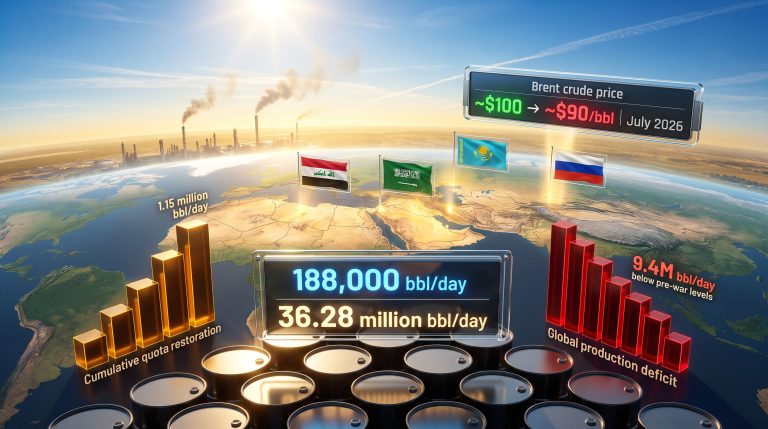
Since April 2026, the seven-nation core driving quota normalisation, comprising Saudi Arabia, Russia, Iraq, Kuwait, Algeria, Kazakhstan, and Oman, has collectively restored approximately 1.15 million barrels per day of production quotas through successive monthly increases. Furthermore, the proposed 188,000 bpd increase for September, expected to be approved at the August 2 meeting, would represent the fourth consecutive monthly quota rise and complete the full reversal of the 2023 voluntary cut programme. These OPEC production decisions reflect a broader strategic shift in how the alliance manages its collective output ceiling.
Key Context: The September increase, if approved, closes out an entire policy cycle. What follows is not simply a continuation of the same trend but rather a transition into a structurally different period of quota management leading into January 2027.
Three Pathways: Scenario Architecture for the October to January Window
The possibility that OPEC+ may pause oil output increases after September is not a single binary decision. It sits within a broader scenario matrix shaped by geopolitical variables, fiscal constraints, and demand trajectory.
| Scenario | Description | Primary Driver |
|---|---|---|
| Full Freeze (Oct–Jan) | Quotas held flat through January 2027 | Geopolitical uncertainty combined with demand softness |
| Conditional Pause | Freeze with review triggers tied to Brent price thresholds | Market volatility management and signalling credibility |
| Accelerated Reversal | Cuts reimposed if Brent falls below fiscal breakeven floors | Fiscal pressure in Saudi Arabia, Iraq, and Algeria |
January 2027 represents a genuine structural inflection point because a new quota allocation framework is scheduled to take effect at that date. This makes the October to January window a natural holding period rather than a directional commitment. The pause is best understood as a strategic buffer between two distinct quota regimes, preserving OPEC+'s negotiating leverage heading into 2027 architecture discussions.
A freeze through January also allows the alliance to enter the next round of quota setting from a position of relative market influence rather than reactive adjustment. If oil prices come under pressure during that window, the mere existence of withheld quota capacity functions as a credible implicit floor defence. Consequently, OPEC's market influence remains a powerful tool even when the alliance is technically holding output steady rather than actively cutting.
The Production Reality: Why Higher Quotas Have Not Moved Physical Supply
The most analytically underappreciated dimension of the current OPEC+ cycle is the growing divergence between quota decisions and deliverable supply. Official OPEC data confirmed the alliance produced 36.28 million barrels per day in June 2026, a figure that sits nearly 7 million barrels per day below pre-war production levels. The IEA's July 2026 market report placed the shortfall even higher, estimating global output 9.4 million bpd below pre-war benchmarks.
This gap is not primarily a compliance problem. It reflects a cluster of structural and geopolitical disruptions across key member states:
- Iraq continues to face persistent export infrastructure bottlenecks that prevent actual output from approaching assigned quotas despite declared willingness to produce more.
- Kazakhstan reduced throughput after drone strikes damaged the Caspian Pipeline Consortium terminal on the Black Sea, a critical export artery for Tengiz crude moving westward.
- Russia has absorbed repeated Ukrainian drone strikes targeting refinery infrastructure, constraining both processing capacity and export volumes in ways that are difficult to fully quantify from external data alone.
- Saudi Arabia retains meaningful spare production capacity but faces elevated exposure to export infrastructure disruption that creates asymmetric downside risk to actual supply delivery.
The core implication: When actual production runs approximately 7 million bpd below pre-war levels regardless of quota settings, the marginal quota decision has limited near-term physical supply impact. OPEC+ is managing perceptions and price anchors as much as it is managing barrels.
This creates a phenomenon sometimes described in trading circles as the paper barrel problem: markets price in quota decisions as if they translate directly into additional physical supply, when the infrastructure and geopolitical realities on the ground make actual delivery far more constrained. Traders who conflate paper quota increases with deliverable supply additions systematically misjudge the physical market balance.
Geopolitical Stress Vectors and the Chokepoint Premium
The speed and magnitude of recent oil price movements illustrate how tightly wound the geopolitical premium has become. Brent crude briefly approached $100 per barrel on July 24, 2026, driven by renewed threats to Red Sea export corridors. By July 28, prices had retreated to approximately $90 per barrel after the United States and Iran suspended their exchanges of strikes, according to Reuters.
That roughly $10 per barrel swing in four trading sessions occurred without any confirmed change in physical output. The market was repricing geopolitical risk probability, not responding to supply data. This behavioural dynamic has profound implications for how OPEC+ weighs its pause decision.
Iran operates outside the formal OPEC+ quota framework entirely, yet Iranian production levels directly influence global supply balances in ways that OPEC+ cannot control through its own architecture. US-Iran tensions function as a structural variable sitting outside the alliance's governance reach, yet forcing its way into every production strategy discussion. Goldman Sachs analysts have characterised OPEC+'s primary objective in the current environment as market signalling, demonstrating readiness to increase supply rather than immediately delivering additional physical barrels. In this context, the interplay between crude oil and geopolitics remains as consequential as ever.
The drone warfare dimension adds a further layer of complexity that conventional OPEC+ analysis tends to underweight. Asymmetric attacks on energy infrastructure, from the CPC terminal to Russian processing facilities, have introduced a new category of supply risk that sits between temporary outage and long-term capacity degradation. Distinguishing between recoverable disruptions and structural impairment requires granular infrastructure assessment that external analysts rarely have access to.
Brent Price Scenarios During the Freeze Window
For energy market participants, the practical question is what a production pause actually implies for Brent crude pricing through January 2027. Scenario modelling under the freeze framework suggests a wide range of outcomes depending on geopolitical trajectory and demand conditions.
| Scenario | Estimated Brent Range (Oct–Jan) | Key Assumption |
|---|---|---|
| Geopolitical escalation | $95–$105/bbl | Red Sea closure or major Iranian export disruption |
| Status quo freeze | $82–$92/bbl | No major supply shock; demand broadly stable |
| Demand softness | $72–$80/bbl | Global economic slowdown; non-OPEC supply growth continues |
| OPEC+ reversal with cuts reimposed | $85–$95/bbl | Proactive Saudi-led price floor defence |
The floor defence logic centres on member fiscal breakeven requirements. Saudi Arabia's breakeven oil price is widely estimated in the $70–$80 per barrel range, while Iraq and Algeria require higher prices to balance their national budgets. A sustained Brent decline toward the lower end of the demand softness scenario would likely trigger proactive intervention well before quotas were allowed to erode member sovereign revenue positions materially. However, the trade war oil impact on global demand adds another variable that could push prices toward the lower scenarios even without a formal supply increase.
The next major ASX story will hit our subscribers first
African OPEC+ Economies: The Fiscal Exposure Dimension
The freeze scenario carries specific implications for African producer economies within the OPEC+ framework that deserve careful attention. Algeria's hydrocarbon sector provides the dominant share of government revenues, making its fiscal position highly sensitive to both the volume and price dimensions of any quota freeze.
Nigeria, still navigating a production recovery trajectory following years of output decline driven by infrastructure theft and underinvestment, faces a double constraint: quota ceilings compress the upside from any successful output recovery, while price softness reduces revenue per barrel.
The infrastructure investment paradox is particularly acute in Africa. Higher quotas theoretically incentivise upstream capital expenditure by signalling that incremental production will find market access. A sustained freeze, however, reduces the near-term revenue visibility that national oil companies use to justify development spending authorisations. This creates a risk that extended output freezes delay project sanctioning across West and Central African deepwater basins, where long development lead times make revenue certainty a prerequisite for final investment decisions. Energy Now reports that further quota increases beyond September remain a live possibility, which could complicate this investment calculus further.
Five Analytical Conclusions for Energy Market Participants
Reading the OPEC+ pause through the correct analytical lens requires moving beyond the immediate quota arithmetic toward the structural dynamics driving the decision.
- The pause completes a policy cycle, not a directional pivot. September's increase finalises the unwinding of the 2023 voluntary cut programme. The freeze preserves optionality for 2027 negotiations rather than signalling a new bearish commitment.
- Physical supply remains constrained regardless of what quotas say. Infrastructure damage and geopolitical disruption mean actual output changes will continue to lag any quota decision by months or quarters.
- Price action is increasingly driven by geopolitical perception rather than supply fundamentals. The July 2026 price swing demonstrates that conflict signals now move markets faster and further than quota announcements.
- The January 2027 quota reset is the decision that actually matters. The October to January freeze is a placeholder. OPEC+'s structural direction will be determined by what emerges from the 2027 architecture negotiations.
- African producer fiscal positions remain the most exposed to extended freezes. Algeria, Nigeria, and other African member economies carry the least buffer against a scenario where both volume ceilings and price softness compound simultaneously.
Investor Consideration: Participants positioning around OPEC+ decisions should treat quota announcements as forward guidance instruments rather than supply change confirmations. The physical market response to any freeze will depend far more on geopolitical chokepoint risk and non-OPEC supply dynamics than on the quota numbers themselves. The broader question of whether OPEC+ may pause oil output increases after September ultimately hinges on how these structural pressures evolve over the coming months.
This article contains forward-looking analysis, scenario modelling, and price projections that are inherently uncertain and should not be construed as financial advice. Oil market conditions are subject to rapid change driven by geopolitical, macroeconomic, and operational factors. Readers should conduct independent research before making any investment or trading decisions.
Want Real-Time Alerts When Energy Market Shifts Create ASX Opportunities?
While geopolitical tensions and OPEC+ quota decisions continue to reshape global commodity markets, Discovery Alert's proprietary Discovery IQ model scans ASX announcements daily, delivering instant, actionable insights across 30+ commodities for investors at every experience level — explore historic mineral discovery returns or start your 14-day free trial today to position yourself ahead of the broader market.