July 10, 2026
When Fossil Fuel Giants and Clean Tech Leaders Find Common Ground
The global energy transition is rarely a clean, linear story. It is shaped by paradoxes, strategic miscalculations, and unexpected alliances forged not out of ideological alignment but economic necessity. Among the most intriguing of these emerging alignments is the deepening Canada and Saudi Arabia clean energy partnership, two nations whose energy identities once seemed irreconcilable, yet whose complementary strengths are increasingly driving them toward a shared commercial future.
To understand why this partnership matters beyond the headlines, it is worth stepping back from the announcement itself and examining the structural forces making it not just logical, but arguably inevitable. Global trade fragmentation, accelerating decarbonisation timelines, and the rising strategic value of critical minerals demand have created a window for bilateral partnerships that bypass traditional energy geopolitics entirely.
When big ASX news breaks, our subscribers know first
A Billion-Dollar Foundation: What Was Actually Signed
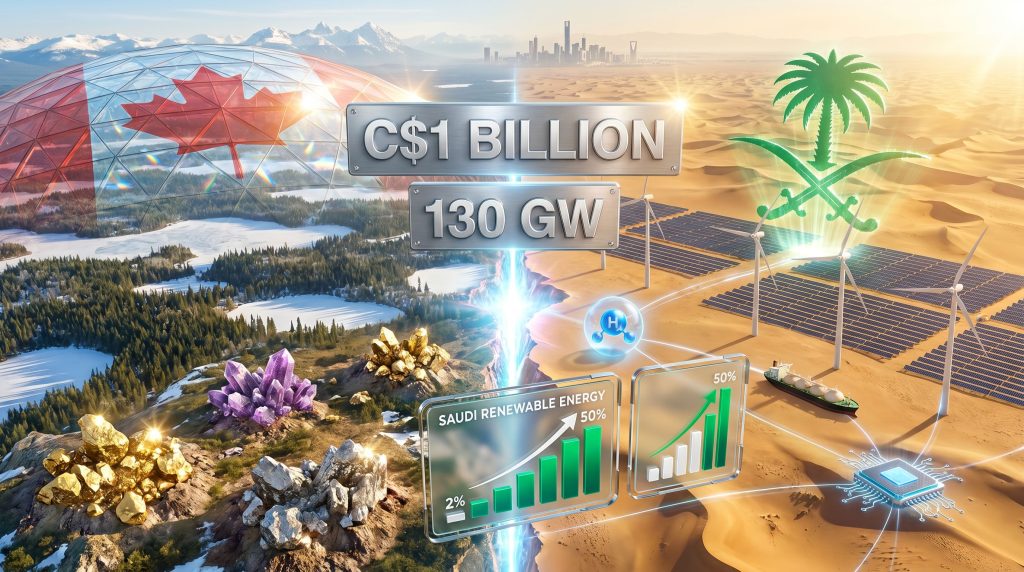
During Prime Minister Mark Carney's visit to Jeddah in 2026, the first Canadian prime ministerial visit to Saudi Arabia in 26 years, both nations formalised a broad economic realignment rather than a narrow sector-specific deal. The total value of commercial agreements signed exceeded C$1 billion (approximately US$730 million), spanning 13 individual commercial agreements and two government-level memorandums of understanding covering energy and artificial intelligence.
The institutional architecture established alongside these deals is arguably as significant as the financial figures. Key structural outcomes from the summit include:
- Establishment of the Canada-Saudi Arabia Coordination Council, providing an ongoing governance framework for bilateral cooperation
- Active negotiations toward a Foreign Investment Promotion and Protection Agreement (FIPA), targeting conclusion by early 2027
- Opening discussions on a double taxation treaty designed to reduce cross-border investment friction for businesses operating in both jurisdictions
- Confirmed Canadian participation in Expo 2030 Riyadh, offering a high-visibility platform for Canadian technology and engineering firms
"The distinction between a transactional trade announcement and a durable bilateral framework lies in institutional architecture. The Coordination Council and FIPA negotiations signal that both governments are investing in the legal and governance scaffolding needed to sustain commercial relationships across political cycles."
Furthermore, Carney's visit resulted in deeper Saudi mining and energy ambitions being formalised at the highest diplomatic level, reinforcing the seriousness with which both sides are approaching long-term collaboration.
Saudi Arabia's Energy Transformation: The Scale of the Challenge
To appreciate where Canadian expertise fits within Saudi Arabia's ambitions, it helps to understand the raw scale of the transformation underway. According to Ember's 2026 data, Saudi Arabia currently generates approximately 2% of its electricity from low-carbon sources, one of the lowest ratios among major economies globally.
Against that baseline, Vision 2030 targets are extraordinarily ambitious:
| Saudi Energy Metric | Current Status | 2030 Target |
|---|---|---|
| Low-carbon electricity share | ~2% of generation | 50% from renewables |
| Total renewable capacity | Nascent | ~130 GW installed |
| Estimated solar component | Minimal | ~58.7 GW |
| Wind energy component | Minimal | ~40 GW |
| Peak electricity demand | 90+ GW and rising | Continued growth projected |
What makes this transformation particularly challenging is that demand is not standing still. Population expansion, industrial diversification under Vision 2030, desalination infrastructure requirements, and the development of mega-projects including NEOM and The Line are pushing peak electricity demand beyond 90 GW and rising. Building 130 GW of new renewable capacity while simultaneously managing surging load growth requires the kind of engineering, project development, and grid management expertise that Saudi Arabia currently imports.
The Hydrogen Dimension: Where Canadian Expertise Becomes Critical
Beyond domestic electricity generation, Saudi Arabia is actively positioning itself as a future exporter of green hydrogen, a market that remains speculative but strategically significant. The NEOM Green Hydrogen Project targets production capacity of 600 tonnes per day, while the associated Oxagon industrial facility aims for 250,000 tonnes annually of clean hydrogen output. These are among the most ambitious hydrogen production targets anywhere in the world.
Canada's relevance here extends beyond generic clean energy expertise. Canadian companies bring specific, proven capabilities in:
- Hydrogen production technology and electrolyser integration
- Carbon capture and storage, honed through decades of application in Alberta's oil sands operations
- Liquefied natural gas infrastructure development and export logistics
- Large-scale industrial project engineering in challenging environmental conditions
The energy MOU signed during the summit formally covers all four of these domains: LNG, renewable energy systems, hydrogen, and carbon capture and storage. For Canadian CCS specialists in particular, this represents a meaningful near-term commercial opportunity, as Saudi Arabia's transition away from fossil fuel power generation will be gradual, requiring CCS deployment to bridge the gap between current gas dependency and longer-term decarbonisation commitments.
Artificial Intelligence: Sovereign Capability as a Strategic Objective
The AI dimension of this bilateral relationship reflects a broader Saudi ambition that extends well beyond technology adoption. The kingdom's goal is sovereign AI capability, the ability to develop, train, and deploy advanced models domestically rather than depending on foreign platforms.
The most significant private-sector deal to emerge from the summit was the agreement between Canadian AI company Cohere and Saudi Arabia's HUMAIN, in which HUMAIN committed at least 50 megawatts of dedicated computing capacity to support Cohere's next generation of foundation model development. This is not a software licensing arrangement. It represents a capital-intensive infrastructure commitment designed to create indigenous AI development capacity within Saudi Arabia.
Separately, Canadian cybersecurity firm BlackBerry and Aramco Digital entered exploratory discussions focused on secure industrial communications and digital infrastructure solutions, reflecting the intersection of Saudi Arabia's industrial digitisation agenda with Canadian expertise in secure enterprise communications.
"For Canadian AI and technology firms, early market positioning in Saudi Arabia carries compounding advantages. Sovereign AI ambitions require long-term partnerships, not one-time contracts, creating sustained revenue opportunities for firms that establish credibility early."
Critical Minerals: The Third Pillar Nobody Is Talking About Enough
While clean energy and AI attracted the bulk of public attention, the mining dimension of the Canada-Saudi Arabia partnership may represent the most structurally underappreciated opportunity in the entire agreement. The role of critical minerals and energy security in shaping this bilateral framework cannot be overstated.
Saudi Arabia has formally designated mining as the third pillar of its national economy, after oil and petrochemicals. The kingdom's estimated untapped mineral endowment is valued at approximately US$2.5 trillion, encompassing:
- Gold and silver deposits concentrated in the Arabian Shield geological formation
- Phosphate reserves with substantial export potential
- Copper, zinc, and lead in established mining districts
- Lithium and rare earth elements in formations that remain largely unexplored by modern methods
What is less commonly understood is that Saudi Arabia's mineral sector, despite its scale, lacks the institutional knowledge infrastructure that transforms geological endowment into operating mines. Exploration methodology, environmental baseline studies, mine financing structures, tailings management, and community engagement frameworks are all areas where Canadian expertise represents decades of accumulated practice that simply cannot be replicated quickly.
Canada's mining sector contributed approximately C$117 billion to national GDP in 2024, representing nearly 5% of the Canadian economy, according to Natural Resources Canada. The country ranks among the world's leading producers of potash, uranium, nickel, cobalt, aluminium, gold, and diamonds, many of which are direct inputs to battery manufacturing, electric vehicle supply chains, and renewable energy equipment production.
The minerals cooperation component of this partnership functions as a knowledge transfer and capacity building arrangement as much as a commercial one. Canadian firms are not simply seeking to extract Saudi resources. They are positioning to transfer the institutional capability that converts geological data into bankable mining projects. Importantly, Saudi exploration licences are increasingly being structured to attract exactly this kind of international partner, and Saudi mining licences are being reformed to lower barriers for foreign operators with proven technical credentials.
Canada's Broader Trade Diversification Context
The Canada and Saudi Arabia clean energy partnership does not exist in isolation. It forms part of a deliberate Canadian effort to reduce export concentration risk relative to the United States, as global trade patterns continue to fragment under geopolitical pressure. In this context, Canada's energy transition strategy is increasingly dependent on securing stable, long-term partners with complementary resource profiles.
Canada has signed approximately 69 critical mineral partnerships worth around $20 billion internationally, with the Saudi agreements forming one component of a broader diversification portfolio. A useful structural comparison is the Australia-Canada Clean Energy Partnership signed in March 2026, which features five formal pillars including hydrogen standards harmonisation and Indigenous engagement frameworks. The Saudi agreement takes a broader, less prescriptive form, reflecting the different maturity stages of the two bilateral relationships and the wider range of sectors covered.
The pension fund delegation announced during the summit is particularly worth monitoring. Canadian pension funds, some of the world's largest institutional investors, have well-established mandates for infrastructure assets with stable, long-duration yield profiles. Clean energy infrastructure and AI data centres in Saudi Arabia fit that profile precisely, and a completed FIPA would provide the legal protection architecture needed to unlock large-scale institutional capital flows.
The next major ASX story will hit our subscribers first
Three Investment Scenarios Worth Modelling
For investors and analysts assessing the commercial potential of the Canada-Saudi Arabia framework, three distinct scenarios are worth considering:
Scenario 1: Early mover advantage in Saudi renewables
Canadian engineering, construction, and clean technology firms that establish operational presence in Saudi Arabia now face limited direct competition from entrenched European and Asian players in specific technology niches. The 130 GW renewable buildout represents multi-decade contract pipelines in project development, grid integration, and operations management.
Scenario 2: Institutional capital flows follow FIPA completion
The pension fund delegation signals that institutional capital is already interested in Saudi clean energy and digital infrastructure assets. A completed FIPA in early 2027 would remove the primary legal risk barrier to large-scale commitments, potentially accelerating bilateral foreign direct investment well beyond the initial C$1 billion in announced agreements.
Scenario 3: The double taxation agreement creates a durable investment corridor
Combined with FIPA, a double taxation treaty would dramatically simplify the financial architecture for companies operating across both jurisdictions, reducing effective tax burdens and improving after-tax return profiles for bilateral investments. This combination of legal and fiscal instruments is what transforms a diplomatic announcement into a sustained commercial corridor.
Disclaimer: The scenarios described above represent analytical projections based on publicly available information. They are not investment recommendations. Actual outcomes will depend on negotiation timelines, market conditions, regulatory developments, and geopolitical factors that cannot be predicted with certainty.
Assessing the Substance: MOUs vs. Binding Commitments
A critical lens for evaluating any diplomatic commercial announcement is the distinction between memorandums of understanding and binding commercial contracts. MOUs establish frameworks and intentions. They are non-binding, legally speaking, and do not guarantee revenue realisation for any party.
Of the 13 commercial agreements signed during the summit, the proportion that represent binding contracts versus exploratory frameworks will significantly influence near-term execution timelines. The Cohere-HUMAIN computing capacity commitment represents the clearest example of a concrete, capital-backed arrangement. Others, including the BlackBerry-Aramco Digital discussions, remain explicitly exploratory.
Key execution risks that investors and analysts should track include:
- The pace of Vision 2030 implementation, which has already experienced timeline adjustments on several flagship projects
- Localisation requirements under Saudi industrial policy, which mandate minimum percentages of Saudi content in major contracts
- The existing market positions of European and Asian competitors in Saudi renewable energy procurement
- The limited operational footprint of most Canadian firms currently within the kingdom
Frequently Asked Questions: Canada and Saudi Arabia Clean Energy Partnership
What Did Canada and Saudi Arabia Agree to During the 2026 Bilateral Summit?
Both nations signed 13 commercial agreements and two government-level MOUs covering energy and AI, alongside the establishment of the Canada-Saudi Arabia Coordination Council as a standing bilateral governance body.
How Much Is the Canada-Saudi Arabia Partnership Worth?
Announced agreements total over C$1 billion (approximately US$730 million), with additional investment flows expected once FIPA negotiations conclude in early 2027.
What Clean Energy Technologies Are Covered by the Energy MOU?
The agreement spans liquefied natural gas infrastructure, renewable energy systems, hydrogen production and trade, and carbon capture and storage.
What Is Saudi Arabia's Renewable Energy Target Under Vision 2030?
Saudi Arabia is targeting 50% of electricity generation from renewables by 2030, with an approximate installed capacity goal of 130 GW.
When Will the Canada-Saudi Arabia FIPA Be Finalised?
Negotiations are targeting completion by early 2027, which would provide formal investment protection for Canadian companies and institutional investors operating in Saudi Arabia.
The Broader Signal: What This Partnership Tells Us About the Energy Transition
The Canada and Saudi Arabia clean energy partnership represents something more structurally significant than a bilateral trade announcement. It illustrates an emerging pattern in global energy transition diplomacy, where resource-rich nations with capital depth seek partnerships with technology-rich nations possessing engineering expertise, and where the architecture of those partnerships increasingly includes institutional governance mechanisms designed to outlast individual political administrations.
What distinguishes this framework from purely transactional energy deals is its deliberate breadth. By spanning clean energy, critical minerals, AI, infrastructure, healthcare, and education within a single bilateral framework anchored by institutional bodies and investment protection negotiations, both nations are signalling a relationship designed for compounding value creation over decades rather than years.
However, whether that ambition translates into executable project pipelines will depend on execution discipline, regulatory progress, and the institutional follow-through of the Coordination Council. The structural logic is sound, and the commercial opportunity on both sides is real.
For the latest developments in clean energy diplomacy, critical minerals investment, and the global energy transition, explore additional reporting and analysis at CarbonCredits.com.
Ready to Capitalise on the Next Major Critical Minerals Discovery?
Discovery Alert's proprietary Discovery IQ model instantly translates complex ASX mineral announcements into actionable insights, helping investors identify significant opportunities in critical minerals — the very commodities driving partnerships like Canada and Saudi Arabia's landmark clean energy framework — before the broader market reacts. Explore historic discoveries and their exceptional returns, then begin your 14-day free trial to position yourself ahead of the market.