
June 5, 2026
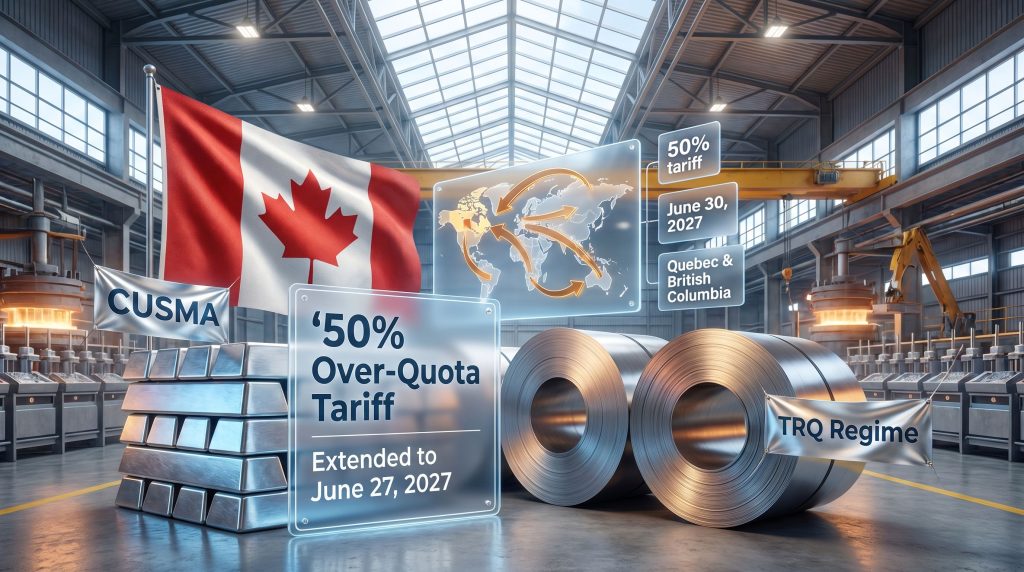
The Quiet Architecture of North American Metal Trade Policy
Most trade policy decisions generate headlines for a day before fading into regulatory footnotes. Tariff-rate quota extensions rarely make the front page. Yet the quiet machinery of quota thresholds, over-limit surcharges, and bilateral exemptions shapes the competitive landscape for entire industrial sectors, often more profoundly than the flashier announcements that dominate news cycles. Canada's decision to extend its Canada steel and aluminium tariffs extension framework into mid-2027 is precisely this kind of structural policy move, one that deserves closer examination than its modest press coverage might suggest.
When big ASX news breaks, our subscribers know first
Two Distinct Mechanisms, One Unified Objective
Understanding what Canada has actually proposed requires separating the policy into its two functional components, because they operate differently and serve subtly different purposes.
The first mechanism involves steel tariff-rate quotas (TRQs) applied to countries outside the Canada-United States-Mexico Agreement (CUSMA) trading bloc. These quotas establish volume ceilings for steel imports from non-CUSMA origins. Shipments that remain within those thresholds face standard applicable tariff rates. Any volume exceeding the quota triggers a 50% over-quota tariff surcharge, a rate steep enough to deter systematic quota-busting by low-cost exporters.
The second mechanism covers tariff relief provisions for eligible steel and aluminium products originating from the United States, including certain derivative steel categories. This component runs in the opposite direction politically — it preserves affordable access to American inputs for Canadian downstream manufacturers rather than restricting import flows.
Subject to final cabinet approval, both measures are set to remain in force through late June 2027, providing approximately 12 months of policy continuity from the point of announcement.
| Policy Mechanism | Applies To | Key Rate | Expiry (Proposed) |
|---|---|---|---|
| Steel Tariff-Rate Quotas | Non-CUSMA importers | 50% over-quota surcharge | June 27, 2027 |
| Tariff Relief Provisions | US-origin steel and aluminium inputs | Relief from applicable tariffs | June 30, 2027 |
| CUSMA Exemption | US and Mexico | Fully exempt from TRQ restrictions | Ongoing |
Trade Diversion: The Invisible Force Shaping Canadian Metal Markets
To understand why Canada considers this extension necessary, it helps to understand the mechanics of trade diversion — a phenomenon that receives far less public attention than it deserves given how significantly it can disrupt domestic industries.
When a major economy like the United States implements broad import tariffs on steel and aluminium, it does not cause global production to fall. Overseas producers, suddenly locked out of the American market, redirect their export volumes toward wherever barriers are lowest. Canada, sitting directly adjacent to the US and integrated into continental supply chains, becomes an attractive alternative destination. Furthermore, the resulting import surge creates artificial downward pressure on Canadian domestic metal prices, compressing margins for Canadian producers who have no connection to the original trade dispute that triggered the tariff. The broader consequences of US steel and aluminium tariffs have therefore reverberated well beyond American borders.
How the diversion cycle operates in practice:
-
The US imposes elevated tariffs on steel or aluminium from a major exporting nation.
-
Displaced export volumes seek lower-resistance markets, with Canada frequently targeted given its proximity and relatively open trade environment.
-
Artificially elevated import supply suppresses Canadian domestic spot prices below sustainable levels for local producers.
-
Canadian steel mills and aluminium smelters face margin compression despite having no competitive deficiency — they are simply absorbing the spillover from a trade conflict not of their making.
-
Canada's TRQ regime functions as a volume-limiting valve, absorbing modest import flows within quota while penalising surge volumes above the threshold with the 50% rate.
"Trade diversion is one of the least discussed but most commercially damaging second-order effects of major tariff escalations. Canadian producers are effectively collateral in bilateral disputes between larger economies, and the TRQ system is the policy instrument designed to absorb that impact."
Consequently, the global iron ore tariff impact extends into adjacent metal sectors, reinforcing why Canada has moved to extend its protective framework with deliberate precision.
Canada's Aluminium Sector: Structural Strengths and Policy Dependencies
Canada occupies a genuinely distinctive position in the global aluminium supply chain — one that is easy to underestimate without understanding the underlying economics of primary smelting.
Aluminium production is extraordinarily energy-intensive. The electrolytic reduction process that converts alumina into primary aluminium metal typically accounts for 30 to 40 percent of total production costs at a modern smelter, according to industry analysis. This means that access to low-cost, reliable electricity is not merely a competitive advantage — it is the foundational variable that determines whether a smelter is economically viable at all.
Why Canada's Energy Advantage Matters
Canada holds a structural edge here that very few nations can replicate. The concentration of hydroelectric generating capacity in Quebec and British Columbia provides Canadian smelters with access to electricity costs that are structurally lower than coal or natural gas-powered grids across much of Asia, Europe, and the United States. This gives Canadian primary aluminium a carbon intensity profile and a cost base that position it favourably in an era of increasing emphasis on green aluminium premiums.
This structural advantage, however, does not make Canadian producers immune to import-driven price pressure. A global aluminium price suppressed by diverted exports still compresses smelter margins regardless of operating efficiency. The aluminium tariff market impact is felt across the entire supply chain, making the tariff extension essential for preserving the policy environment within which Canada's competitive advantage can translate into commercial viability.
Key characteristics of Canada's aluminium industry:
- Primary smelting capacity concentrated in Quebec and British Columbia, leveraging hydroelectric power access
- Among the world's top aluminium-producing nations by primary output volume
- Significant employer in regional economies, making policy continuity a politically meaningful consideration
- Growing relevance in green aluminium supply chains given the low-carbon profile of hydropower-sourced production
- Deep integration with US downstream manufacturing sectors through established CUSMA supply chains
CUSMA Renewal: The Strategic Context That Changes Everything
The tariff extension cannot be properly understood in isolation from the CUSMA renewal process that is unfolding simultaneously. Canada formally notified both the United States and Mexico of its intention to proceed with CUSMA renewal ahead of the July 1 scheduled review trigger — a process that carries significant implications for how North American trade rules will be structured across the coming decade.
High-level bilateral discussions between Canadian and American officials resumed following a halt in October, with Canada's Minister of International Trade travelling to Washington for direct engagement with the US Trade Representative. Canada's Chief CUSMA Negotiator participated in those discussions alongside ministerial-level representation, signalling the diplomatic weight Canada is placing on this process. Mexico completed its own bilateral discussions with US officials and indicated support for a timely renewal outcome.
| Official | Role | Engagement |
|---|---|---|
| François-Philippe Champagne | Minister of Finance and National Revenue | Announced the tariff extension; framed it around jobs and regional prosperity |
| Dominic LeBlanc | Minister of International Trade | Led Canadian delegation in Washington bilateral talks |
| Janice Charette | Chief CUSMA Negotiator | Participated directly in Washington discussions |
| Jamieson Greer | US Trade Representative | Primary US counterpart in resumed bilateral dialogue |
The tariff extension serves a dual function within this context. It provides business certainty for Canadian manufacturers planning investment and procurement decisions during a period when the ultimate shape of renewed CUSMA rules remains uncertain. Simultaneously, it signals to trading partners that Canada is capable of independent trade policy action — a negotiating posture that carries its own diplomatic utility. In addition, the broader pressures from trade wars and supply chains have made this kind of policy continuity increasingly valuable.
How Canadian and American Tariff Architectures Compare
A direct comparison between the two countries' approaches to steel and aluminium import management reveals meaningful structural differences that are often overlooked in media coverage treating both regimes as equivalent protectionist measures.
| Policy Dimension | Canada | United States |
|---|---|---|
| Primary instrument | Tariff-rate quota with 50% over-quota rate | Broad tariff applied across import categories |
| CUSMA partner treatment | Fully exempt from TRQ restrictions | Subject to ongoing bilateral negotiation dynamics |
| Relief mechanisms | Horizontal relief for qualifying US inputs | Sector-specific exclusion application processes |
| Policy duration | Extended to June 2027 | Ongoing, subject to executive-level action |
| Design philosophy | Surgical, volume-threshold triggered | Broad-based, import-category triggered |
The TRQ-based model that Canada employs is architecturally more targeted than a flat-rate tariff applied uniformly across all import volumes. It allows low-to-moderate import flows to continue under standard rates, which supports domestic industries that rely on imported inputs for processing or further manufacturing, while specifically penalising the large-volume surges that characterise trade diversion events. This design preserves supply chain flexibility for downstream Canadian manufacturers while protecting primary producers from systematic undercutting.
The next major ASX story will hit our subscribers first
Which Canadian Industries Feel the Policy's Effects Most Directly
The tariff relief provisions for US-origin inputs are specifically calibrated to protect Canadian industries where American supply chains are deeply embedded in production processes.
Industries benefiting from tariff relief on US-origin inputs:
- Automotive manufacturing, which requires continuous access to flat-rolled steel and aluminium sheet products produced at US facilities integrated into continental just-in-time production networks
- Aerospace fabrication, dependent on specialised aluminium alloys and structural steel components often sourced from American suppliers with whom Canadian manufacturers have long-term technical relationships
- Health, safety, and national security applications, where supply chain interruption carries consequences that extend well beyond commercial disruption
Industries exposed to continued over-quota tariff risk:
- Steel importers sourcing from Asian, European, or other non-CUSMA origins who operate above quota thresholds
- Downstream manufacturers that cannot qualify for tariff relief exemptions and face elevated input costs
- Construction and infrastructure materials producers operating on thin margins where input cost increases are difficult to pass through to customers
However, for a broader view of how these pressures are reshaping the competitive landscape, the evolving dynamics across steel and iron ore markets provide important context for understanding where further disruption may emerge.
Frequently Asked Questions: Canada Steel and Aluminium Tariff Extension
What exactly is a steel tariff-rate quota?
A tariff-rate quota establishes a specific volume ceiling for imports from defined trading partners. Shipments below the threshold face standard tariff treatment. Volumes exceeding the ceiling trigger a higher penalty rate — in Canada's case 50% — designed to deter systematic over-quota importing without completely blocking trade flows. For further background on how these measures are being structured, Norton Rose Fulbright provides a detailed legal breakdown of Canada's announced trade measures.
Why is the extension being implemented now rather than earlier?
The timing aligns with both the natural expiry of the existing measures and the opening of the CUSMA renewal window. Extending the measures simultaneously with the formal CUSMA notification process ensures there is no policy gap during the negotiation period, which could otherwise create uncertainty for producers and importers making medium-term procurement and investment decisions.
Does the US face any tariff consequences when exporting steel or aluminium to Canada?
No. The United States retains its CUSMA-based exemption from Canada's TRQ restrictions entirely. Furthermore, qualifying US steel and aluminium products benefit from extended tariff relief provisions under the renewed framework, meaning eligible American exports into Canada continue to receive preferential treatment relative to non-CUSMA competitors. Expert commentary from PwC's tax insights on US tariff imposition further illustrates how these bilateral asymmetries are being interpreted across the professional services sector.
What happens if CUSMA renewal negotiations extend beyond the July 1 review date?
The tariff extension, running through to late June 2027, provides a policy buffer of approximately 12 months beyond the formal review trigger. This runway gives negotiators time to work through renewal terms without leaving Canadian metal producers exposed to an unprotected import environment in the interim.
Key Policy Parameters at a Glance
| Parameter | Detail |
|---|---|
| TRQ extension deadline | June 27, 2027 |
| Tariff relief extension deadline | June 30, 2027 |
| Over-quota tariff rate | 50% |
| CUSMA-exempt partners | United States and Mexico |
| Core policy objective | Trade diversion prevention and domestic industry protection |
| CUSMA formal review trigger | July 1 |
| Primary beneficiary sectors | Steel, aluminium, automotive, aerospace, national security applications |
The extension of the Canada steel and aluminium tariffs extension framework is less a dramatic policy pivot than a carefully calibrated act of continuity in a structurally uncertain trade environment. For producers, downstream manufacturers, and investors with exposure to North American metals markets, understanding the mechanics behind these measures provides a clearer picture of where competitive pressures are likely to originate and where policy buffers remain intact through the CUSMA renewal cycle.
This article is intended for informational purposes only and does not constitute financial, legal, or trade policy advice. Policy details described are subject to final cabinet approval and may be subject to change. Readers should consult appropriate professional advisors before making decisions based on the information contained herein.
Want to Stay Ahead of Major Mineral Discoveries Linked to North American Metal Market Shifts?
Discovery Alert's proprietary Discovery IQ model delivers real-time alerts on significant ASX mineral discoveries, instantly transforming complex commodity data into actionable investment insights — whether you're tracking steel, aluminium, or any of 30-plus commodities simplified into a single gold-equivalent metric. Explore how historic mineral discoveries have generated substantial returns and begin your 14-day free trial at Discovery Alert to position yourself ahead of the market.