June 5, 2026
Climate Volatility and the Hidden Vulnerability at the Heart of Global Trade
Most shipping chokepoints fail because of conflict, sanctions, or port congestion. The Panama Canal is different. Its capacity to move roughly 5% of total global maritime commerce is governed not by military posture or terminal infrastructure, but by rainfall patterns across a small Central American isthmus. That singular dependency on freshwater makes the canal a unique kind of systemic risk, one that oscillates with climate cycles rather than geopolitical calendars.
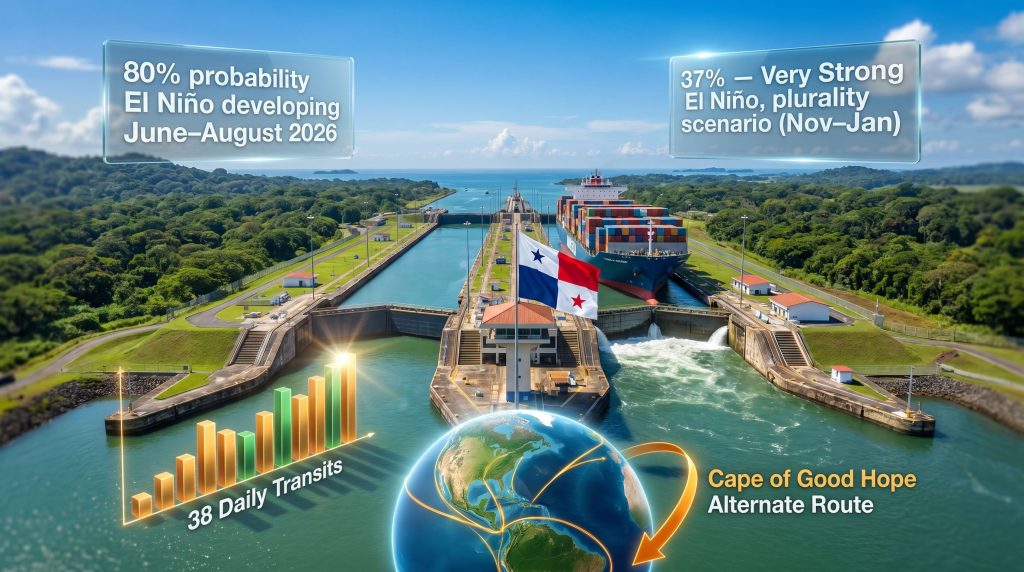
With leading meteorological agencies now projecting an 80% or greater probability of El Niño developing between June and August 2026, freight strategists, commodity traders, and supply chain planners are once again running scenarios around Panama Canal El Niño transit restrictions. The question is not simply whether restrictions will materialise, but whether the market is positioning early enough to absorb the disruption if they do.
When big ASX news breaks, our subscribers know first
How the Panama Canal's Lock System Creates a Freshwater Dependency
Understanding why El Niño threatens the canal requires grasping an engineering reality that most freight market participants overlook. The Panama Canal is not a sea-level waterway. It functions through a lock-based elevation system that physically raises vessels from the ocean into a network of elevated freshwater lakes before lowering them again on the opposite side.
Every single transit consumes a measurable volume of freshwater that drains irreversibly into the sea. The two main lock systems serve different vessel classes:
- Panamax locks handle smaller vessels and account for approximately 70% of all Panama Canal transits, making their uninterrupted operation essential to overall throughput
- Neopanamax locks accommodate the largest modern container ships and bulk carriers, and represent the higher-value, lower-frequency end of the canal's traffic mix
The freshwater source for both systems flows from Gatun Lake and Lake Alhajuela, the man-made reservoirs that power the lock cycles. When rainfall across Central America declines, those reservoirs recede, and the Panama Canal Authority (ACP) must choose between two uncomfortable options: reduce transit volumes or deplete water reserves needed for civilian consumption.
Lesser-Known Fact: The same reservoir system that powers canal operations supplies more than 50% of Panama's national population with potable water, according to the ACP. This dual-use dependency means drought conditions force a direct conflict between national revenue generation and civilian water security.
The 2023-2024 Episode: What Actually Happened and Why It Matters Now
The 2023-2024 El Niño event, which the World Meteorological Organization (WMO) subsequently classified as one of the five strongest on record, serves as the primary reference point for modelling the 2026-2027 risk environment. Its progression through the canal system followed a pattern that market participants should understand in granular terms.
Restriction Escalation Timeline
| Period | Action Taken | Vessels Primarily Affected |
|---|---|---|
| By 1 March 2023 | Initial draft restrictions imposed | Neopanamax locks |
| Mid-2023 onwards | Progressive tightening of draft limits | Neopanamax escalating |
| Throughout 2023-2024 | Panamax locks largely shielded | Smaller vessels protected |
| Post-drought | Full booking model restructured | All vessel classes |
Draft restrictions require operators to reduce cargo loads so vessels sit higher in the water column, consuming less freshwater per lock cycle. In practical terms, this forces one of three responses:
- Reduce cargo tonnage per voyage, increasing the number of trips required to move the same volume
- Split shipments across multiple smaller vessels, raising per-unit logistics costs
- Reroute entirely via alternative corridors such as the Suez Canal or the Cape of Good Hope, adding days or weeks to transit times
The ACP's strategic decision to concentrate initial restrictions on Neopanamax locks, rather than Panamax lanes, was deliberate. By protecting the 70% of transits flowing through Panamax infrastructure, the authority preserved the bulk of throughput while managing water consumption at the high-volume, high-displacement end of the fleet mix.
The Booking System Transformation: A Permanent Market Change
One consequence of the 2023-2024 drought that is frequently underweighted in freight market analysis is the permanent abandonment of the canal's traditional first-come, first-served transit model. The ACP replaced this with a pre-booked slot system supplemented by supplemental auction rounds, fundamentally altering how shipping lines plan capacity and price Panama Canal transits.
Strategic Implication: This structural change has permanently elevated planning complexity and cost uncertainty for any shipper relying on the canal, even during periods when no active restrictions are in force. The auction mechanism means slot scarcity can generate price spikes independent of physical water levels.
Probabilistic Outlook for 2026-2027: What the Data Actually Shows
The two foremost climate monitoring bodies tracking the 2026-2027 cycle have each published assessments that warrant close attention from anyone with Panama Canal exposure. Furthermore, the supply chain disruption risks associated with this cycle extend well beyond freight costs alone.
WMO Probability Estimates
The WMO has placed the probability of El Niño developing between June and August 2026 at 80%, with the likelihood of its persistence through at least November 2026 rising to near or above 90%. Critically, the WMO has characterised the expected event as likely to be at least moderate and possibly strong, leaving open the prospect of an episode comparable in severity to 2023-2024.
NOAA Strength Distribution (as of May 2026)
| Strength Category | Probability (Nov-Jan) |
|---|---|
| Very Strong (highest tier) | 37% (plurality scenario) |
| Strong | 30% |
| Moderate and below | Remaining distribution |
A 37% probability of a very strong event represents the single most likely outcome in NOAA's modelling. That same classification would place the 2026-2027 episode in the same tier as the drought that triggered the most severe Panama Canal El Niño transit restrictions in the modern operational era.
Forecasting Caveat: Probabilistic climate modelling carries inherent uncertainty, and actual conditions may diverge materially from current projections in either direction. Market participants should treat these figures as scenario inputs rather than deterministic forecasts, and position accordingly.
Why 2026 Is Not 2023: The Buffer That Currently Exists
Despite the severity of the probabilistic outlook, the ACP's current operational posture is substantially more resilient than it was at the comparable point in the previous cycle. Several factors distinguish the current starting position. According to recent reporting from Reuters, the ACP has confirmed no transit restrictions are anticipated through 31 December 2026.
- By 1 March 2023, Neopanamax draft restrictions were already active. As of mid-2026, the ACP has confirmed no transit restrictions are anticipated through 31 December 2026
- The canal is currently maintaining 38 daily transits while conducting weekly monitoring of lake levels
- The 2025 dry season was recorded as the wettest since 1950, providing an unusually high baseline water reserve entering the risk window
- Four operational water-conservation measures, implemented from December 2025 onwards, are actively reducing per-transit freshwater consumption
These four measures represent meaningful engineering adaptations that extend the operational window before restrictions become necessary:
- Vessel pairing in single lock lanes: Smaller ships are paired and lifted simultaneously, reducing total lock cycles per unit of throughput
- Water-saving basin utilization at Neopanamax locks: Recaptures a portion of water that would otherwise drain to the sea during each lock cycle, reducing net freshwater loss per transit
- Interior gate deployment: Creates tighter chambers for vessels smaller than full lock dimensions, reducing the water volume required per lift cycle
- Suspension of hydroelectric generation at Gatun Lake: Prioritises water retention over electricity production during the critical accumulation period
The combination of these measures with the historically wet preceding dry season explains why the ACP's water reserve baseline is, for now, considerably stronger than it was entering the 2023-2024 drought. The ACP has nonetheless stated explicitly that operational contingency planning for 2027 is already underway, acknowledging that historical patterns suggest the most pronounced impacts of moderate-to-strong El Niño events tend to manifest in the year following peak development. As shipping industry analysts note, the absence of near-term restrictions does not eliminate the medium-term risk exposure.
Commodity Flows Most Exposed to Panama Canal Transit Restrictions
The potential return of Panama Canal El Niño transit restrictions in 2027 does not occur in a neutral geopolitical environment. The closure of the Strait of Hormuz by Iran has already redirected significant volumes of Asian energy demand toward Atlantic Basin supply sources, making those buyers meaningfully more dependent on Panama Canal transits than they were during the 2023-2024 episode. This creates a compounding dynamic that did not exist in the prior cycle.
Consequently, the LNG supply outlook for Asian buyers is particularly sensitive to any return of canal restrictions, given the elevated reliance on Atlantic Basin sources following Hormuz disruptions.
| Commodity Segment | Exposure Level | Primary Risk Mechanism |
|---|---|---|
| LNG (Asian buyers, Atlantic supply) | Very High | Cape of Good Hope rerouting adds weeks of transit time |
| Crude oil and refined products | High | Freight rate escalation compresses refinery margins |
| Dry bulk (grains, coal, metals) | High | Voyage cost increases and delivery uncertainty |
| Container shipping | Moderate-High | Schedule disruption and slot scarcity drive rate spikes |
| Biofuels and feedstocks | Moderate | Growing Atlantic-Pacific trade flows increasingly canal-dependent |
Dual Chokepoint Scenario Warning: A simultaneously active El Niño drought at the Panama Canal and an ongoing Strait of Hormuz closure would represent a dual chokepoint stress event with no close historical precedent. The compounding effect on Asian energy buyers in particular warrants serious scenario modelling by freight and commodity market participants.
The next major ASX story will hit our subscribers first
Freight Market Dynamics Under a Restriction Scenario
If draft restrictions return at a scale comparable to 2023-2024, the transmission mechanism through freight markets would likely follow this progression:
- Panama Canal slot auction prices would escalate sharply as pre-booked capacity becomes scarce and supplemental auction rounds attract competitive bidding
- Tanker and LNG carrier day rates on long-haul alternative routes, particularly Cape of Good Hope circuits, would rise as vessel utilization increases on extended voyages
- Bunker fuel consumption would increase proportionally with longer voyage distances, feeding additional cost inflation through supply chains dependent on just-in-time delivery
- Fleet-wide vessel availability would tighten as ships spend more days at sea per voyage, effectively reducing the productive capacity of the global fleet across multiple segments simultaneously
In addition, the broader commodity price impacts across mining and energy sectors could be substantial, particularly if restrictions coincide with already-elevated freight benchmarks.
How the 2023-2024 and 2026-2027 Cycles Compare
| Dimension | 2023-2024 El Niño | 2026-2027 Outlook |
|---|---|---|
| WMO Classification | One of five strongest on record | At least moderate, possibly strong |
| Restrictions active by March | Yes, Neopanamax limits in force | No restrictions forecast through Dec 2026 |
| Baseline water reserve | Below average entering drought | Above average (wettest dry season since 1950) |
| Conservation measures active | Limited | Four measures deployed since Dec 2025 |
| Canal booking model | Transitioning away from first-come, first-served | Pre-booked/auction model fully operational |
| Strait of Hormuz status | Open | Closed, elevating Atlantic-Pacific energy flows |
| NOAA very strong probability | Not publicly pre-modelled | 37% (plurality outcome) |
Strategic Positioning Ahead of Potential 2027 Disruption
For market participants with material exposure to Panama Canal-dependent trade flows, the current period before any restrictions materialise represents the optimal window for contingency preparation. Key considerations include:
- Route optionality mapping: Calculate the landed cost differential between Panama Canal transit and Cape of Good Hope or Suez routing for key commodity flows under a moderate and severe restriction scenario
- Freight hedging instruments: Evaluate forward freight agreements (FFAs) or long-term charter arrangements to lock in capacity and rate certainty before potential 2027 rate escalation takes hold. Furthermore, exploring commodity hedging strategies more broadly may help offset exposure across multiple disrupted trade routes simultaneously
- Strategic inventory positioning: For commodities with extended supply lead times, particularly LNG and bulk agricultural products, assess whether forward inventory accumulation ahead of potential 2027 disruption is economically justified relative to current carrying costs
- Booking system fluency: Ensure logistics and procurement teams are operationally proficient in the ACP's pre-booked slot and supplemental auction model, which will be the only operational pathway during any future restriction period
- Geopolitical overlay modelling: Build Panama Canal restriction scenarios that explicitly incorporate the Strait of Hormuz closure as a concurrent constraint, rather than modelling each chokepoint in isolation. The intersection of crude oil trade geopolitics and climate-driven infrastructure risk is increasingly the dominant pricing dynamic in global energy freight
The structural lesson embedded in the 2023-2024 episode is that Panama Canal vulnerability to climate-driven disruption is not an anomaly. It is a recurring, partially forecastable feature of global trade infrastructure that rewards proactive management and penalises reactive responses. Institutions that treated the last drought as a one-time event are now facing the same Panama Canal El Niño transit restrictions risk cycle with less preparation time than those who began monitoring the 2026 climate signals months ago.
Disclaimer: This article contains forward-looking statements and probabilistic climate forecasts sourced from the WMO and NOAA. Actual conditions may differ materially from current projections. Nothing in this article constitutes financial or investment advice. Market participants should conduct independent analysis and consult qualified advisers before making commercial decisions based on any scenario discussed herein. Further commodity-specific market intelligence is available via Argus Media at argusmedia.com.
Want to Stay Ahead of the Commodity Disruptions That Major Trade Route Shocks Create?
When climate volatility and geopolitical chokepoints converge, the downstream effects on commodity prices and resource stocks can be swift and significant. Discovery Alert's proprietary Discovery IQ model delivers real-time alerts on significant ASX mineral discoveries, transforming complex market signals into actionable opportunities the moment they emerge — explore historic discoveries and the returns they generated to understand the scale of what early positioning can achieve, then begin your 14-day free trial to ensure you're never caught off guard when the next major market shift unfolds.