
August 11, 2026
Capital Efficiency Drives Nevada Gold Mining Evolution
Modern gold development has undergone a fundamental transformation since the commodity downturn of 2012-2015. Mining companies that pursued aggressive single-asset expansion strategies during this period encountered severe cost overruns, extended construction timelines, and balance sheet stress that permanently altered institutional investor expectations.
Today's mining finance environment prioritises incremental growth models that demonstrate consistent milestone achievement over rapid scaling approaches. Furthermore, this shift reflects hard-learned lessons about execution risk, commodity cycle alignment, and the importance of maintaining financial flexibility during multi-year development programmes. The i-80 Gold phased growth strategy exemplifies this evolving approach to sustainable mining development.
When big ASX news breaks, our subscribers know first
Nevada's Infrastructure Advantage for Modular Development
Nevada's mature mining jurisdiction offers unique advantages for companies implementing i-80 Gold phased growth strategy approaches. The state's established regulatory framework supports incremental permitting processes, allowing developers to align capital deployment with technical validation rather than committing to full-scale builds before operational assumptions are proven.
However, the incremental permitting insights reveal additional complexities that developers must navigate. Existing infrastructure density throughout Nevada's mining districts significantly reduces brownfield development costs compared to greenfield alternatives.
Companies can leverage established power grids, transportation networks, water rights, and processing facilities to support phased expansion without duplicating infrastructure investments across multiple sites. In addition, this approach aligns with broader mining industry evolution trends emphasising operational efficiency.
The concentration of skilled mining professionals and technical expertise in Nevada provides additional execution advantages. Consequently, companies can access experienced underground mining crews, metallurgical specialists, and equipment operators without the workforce development timelines required in frontier jurisdictions.
Processing Control Becomes Central to Investment Thesis Development
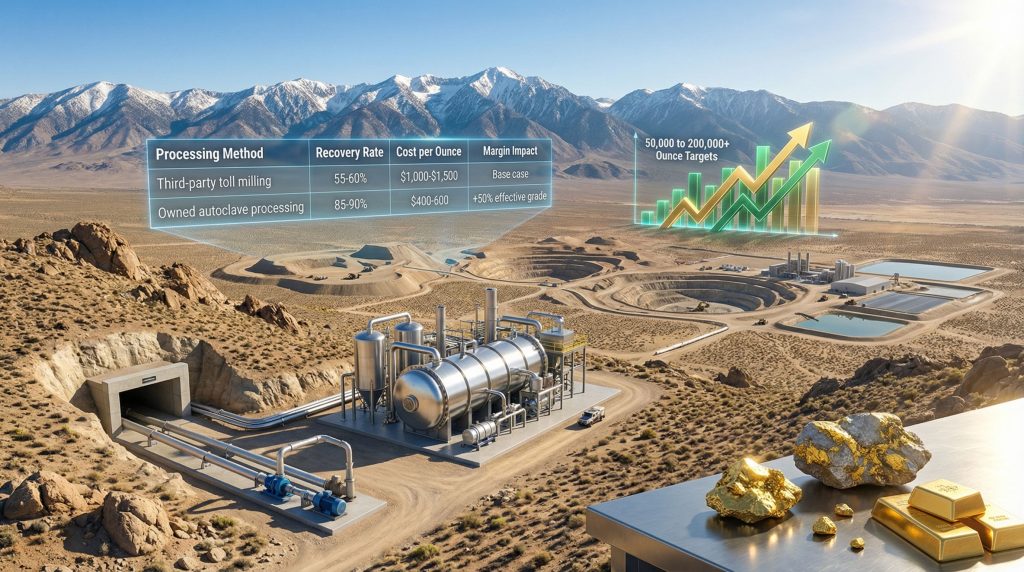
Third-party toll milling arrangements typically constrain refractory gold ore economics through limited recovery rates and embedded processing margins. Industry data indicates that toll milling operations often achieve 55-65% recovery rates for complex ore types, while owner-operated autoclave facilities can reach 85-90% recovery rates for the same material.
This recovery differential creates substantial economic leverage. For instance, improving recovery from 60% to 90% effectively increases the economic grade of an ore body by 50% without requiring additional drilling, mining, or geological risk. The mathematical relationship between recovery improvements and project net present value often exceeds the impact of grade increases achieved through exploration success.
Cost Structure Transformation Through Infrastructure Control
Toll milling cost structures typically include both processing fees and reduced payability terms that compound the economic burden on refractory ore producers. Industry benchmarks suggest that third-party processing arrangements can cost $800-1,500 per ounce depending on ore complexity and facility utilisation rates.
Owner-operated processing facilities eliminate these third-party margins while providing operational control over recovery optimisation, maintenance schedules, and throughput rates. Furthermore, the capital investment required for processing infrastructure can often be justified through the cumulative savings from eliminated toll milling fees and improved recovery rates over a facility's operating life.
| Processing Approach | Recovery Rate | Processing Cost/Oz | Economic Impact |
|---|---|---|---|
| Third-party toll milling | 55-65% | $800-1,500 | Baseline economics |
| Owned autoclave facility | 85-90% | $400-700 | +40% effective grade |
| Hybrid transitional model | 70-80% | $600-1,000 | Intermediate benefit |
Hub-and-Spoke Operations Optimise District-Scale Economics
Companies operating multiple assets within a geographic region can achieve significant economies of scale through centralised processing facilities. This hub-and-spoke model allows developers to feed ore from several mining operations into a single processing complex, reducing per-ounce capital intensity while maintaining operational flexibility.
Centralised processing provides additional advantages including simplified permitting requirements, consolidated environmental compliance, shared technical expertise, and the ability to blend ore types for optimal metallurgical performance. Moreover, companies can also maintain operations during routine maintenance at individual mining sites by continuing to process material from other locations.
Risk-Adjusted Development Frameworks Guide Capital Allocation
Modern mining development increasingly employs stage-gate frameworks that establish technical and economic validation points before major capital commitments. These frameworks require companies to demonstrate operational reliability, cost model accuracy, and permitting progress at each development phase before proceeding to larger-scale investment.
Stage-gate approaches allow companies to identify and address technical challenges at smaller scale and lower cost. For example, underground mining operations can validate ground conditions, mining rates, and equipment performance through limited development work before committing to full production infrastructure.
Permitting alignment represents another critical component of stage-gate development. Consequently, companies can sequence permit applications to match their development timeline, reducing carrying costs and regulatory complexity while maintaining project momentum.
Financial Structure Optimisation Across Development Phases
Phased development allows companies to optimise their financing mix across different project stages. Early-stage work including feasibility studies, pilot operations, and initial infrastructure can often be funded through equity or development credit facilities with limited dilution.
Larger capital expenditures including major equipment purchases and full-scale construction typically require project financing arrangements that can be negotiated once technical risk has been reduced through earlier development phases. In addition, this sequencing often results in more favourable financing terms and reduced cost of capital.
However, effective capital raising strategies become crucial during these critical development phases.
"The mining industry has learned that geological risk is manageable through modern exploration techniques and modelling. The real challenge is execution risk – delivering projects on schedule, within budget, and with the operational reliability necessary for consistent cash flow generation."
Technical Infrastructure Requirements Drive Underground Development
Underground mining operations in Nevada often encounter groundwater challenges that must be addressed through permanent dewatering infrastructure. While this represents an upfront capital requirement, successful dewatering typically enables access to higher-grade mineralisation at depth where ground conditions often improve significantly.
Improved ground conditions at depth frequently allow for higher mining rates, reduced dilution, and enhanced operational efficiency. These operational improvements can offset the initial dewatering investment through sustained production advantages and lower unit costs over the mine life.
Autoclave Refurbishment Supports Long-Term Processing Strategy
Autoclave processing technology requires specialised engineering expertise and equipment sourcing that can extend implementation timelines to 18-24 months for major refurbishment projects. However, properly executed autoclave operations provide decades of processing capability for refractory ore types.
Refurbishment projects allow companies to incorporate modern automation, environmental controls, and process optimisation technologies that can improve recovery rates and operational reliability compared to older installations. Furthermore, the engineering phase typically requires 6-12 months before physical implementation begins.
Companies must also ensure adequate spare parts inventory, specialised maintenance capabilities, and operator training programmes to support reliable autoclave operations over time. This aligns with I-80 Gold's strategic asset development approach in Nevada.
Production Scaling Pathways Create Multiple Value Inflection Points
Initial production phases focus on demonstrating operational reliability and cost model validation rather than maximum throughput. This approach allows companies to implement their i-80 Gold phased growth strategy by identifying and resolving operational challenges while maintaining cash flow generation and balance sheet strength.
Technical validation during Phase 1 operations typically includes confirmation of mining rates, equipment performance, metallurgical recovery, and cost structures under actual operating conditions. In addition, this operational data provides the foundation for subsequent expansion phases and supports more accurate economic projections.
Resource Expansion Supports Multi-Decade Production Profiles
Successful Phase 1 operations often generate cash flow that can fund continued exploration and resource definition work. This exploration typically focuses on extending known mineralised zones and identifying satellite deposits that can feed centralised processing facilities.
Resource expansion programmes can extend mine life projections and support larger-scale infrastructure investments by demonstrating sufficient ore reserves to justify major capital expenditures. Moreover, longer mine life also improves project economics by spreading fixed costs over larger production volumes.
The next major ASX story will hit our subscribers first
Margin Expansion Creates Non-Linear Economic Returns
Processing improvements that increase recovery rates create non-linear economic benefits compared to grade or volume increases alone. A 30-percentage-point improvement in recovery (from 60% to 90%) effectively increases the economic value of every ton of ore by 50% without requiring additional mining or geological risk.
This relationship between recovery optimisation and project economics explains why processing control often provides more predictable value creation than exploration success, particularly for companies operating in well-understood geological environments.
All-In Sustaining Cost Reductions Support Margin Expansion
Eliminating third-party processing fees and improving recovery rates directly reduces all-in sustaining costs per ounce produced. These cost reductions provide immediate margin expansion that compounds over the project life, particularly during periods of stable or rising gold prices.
Lower all-in sustaining costs also provide greater operating margin during commodity price downturns, reducing operational risk and supporting more consistent cash flow generation across commodity cycles.
| Development Phase | Target Production | Recovery Rate | AISC Impact |
|---|---|---|---|
| Current operations | 30,000-40,000 oz | 55-60% | Baseline |
| Phase 1 completion | 150,000-200,000 oz | 85-90% | -$400-600/oz |
| Full-scale operation | 600,000+ oz | 85-90% | Further economies |
Market Conditions Support Phased Development Approaches
Current gold market fundamentals including central bank accumulation, currency debasement concerns, and supply chain disruptions support favourable long-term pricing assumptions for development-stage producers. This environment allows companies to plan multi-year development programmes with confidence in sustained demand.
The gold market analysis reveals supportive trends that benefit phased development approaches. Furthermore, these approaches allow companies to align major capital deployment with commodity cycle timing, potentially capturing margin expansion during favourable pricing periods while maintaining financial flexibility during market uncertainty.
Credit Market Conditions Favour Disciplined Development Strategies
Institutional lenders increasingly prioritise mining companies that demonstrate capital discipline, execution track records, and operational cash flow generation. Phased development strategies that emphasise margin expansion over volume growth often receive more favourable financing terms.
Project financing arrangements for Phase 1 operations can establish lending relationships and demonstrate repayment capability that supports larger financing packages for subsequent expansion phases. Consequently, this approach reduces financing risk while potentially lowering the overall cost of capital.
Companies like I-80 Gold have demonstrated the effectiveness of this approach through their strategic development initiatives in Nevada.
Long-Term Production Profiles Support Investment Sustainability
Companies operating multiple mining assets across a district can maintain production flexibility and reduce operational risk compared to single-asset operations. This diversification allows for continued operations during maintenance periods, equipment upgrades, or temporary operational challenges at individual sites.
Portfolio approaches also support more efficient capital allocation by allowing companies to prioritise development spending toward the most economically attractive opportunities while maintaining optionality on secondary assets.
Resource Life Extension Strategies Enhance Project Economics
Successful operations often generate sufficient cash flow to fund continued exploration and resource definition work that can extend mine life projections beyond initial feasibility study assumptions. Extended mine life improves project economics by spreading infrastructure costs over larger production volumes.
Strategic asset acquisition during development phases can also provide feed material for centralised processing facilities, supporting higher capacity utilisation and improved unit economics. This approach particularly benefits companies operating in environments with record-breaking gold prices.
Critical Success Factors Define Execution Excellence
Phased development programmes require clearly defined technical and financial milestones that allow investors and management to assess progress against established timelines. Key milestones typically include feasibility study completion, permit approval, financing closure, and operational commissioning.
Consistent milestone achievement demonstrates execution capability and supports investor confidence in subsequent development phases. However, repeated milestone delays often signal underlying technical or financial challenges that may require strategy modification.
Operational Reliability Indicators Support Cash Flow Predictability
Underground mining operations must demonstrate consistent production rates, equipment availability, and recovery performance to support long-term economic projections. Operational reliability becomes particularly important for companies utilising debt financing that requires predictable cash flow for debt service.
Processing facility reliability is equally critical, particularly for refractory ore operations that require consistent autoclave performance and recovery rates. Furthermore, companies must maintain adequate spare parts inventory, technical expertise, and maintenance procedures to ensure continuous operations.
Financial Planning Integration Across Development Phases
Successful phased development requires integrated financial planning that accounts for working capital requirements, capital expenditure timing, debt service obligations, and equity market conditions across multi-year development periods.
Companies must also maintain adequate financial flexibility to address unexpected costs, timeline delays, or market condition changes without compromising project execution or operational performance.
Investment Decision Framework: Evaluating Phased Development Success
The transition toward phased development in Nevada gold mining reflects broader industry learning about capital efficiency, execution risk, and sustainable growth models. For investors evaluating these strategies, success metrics extend beyond traditional production volume measures to include margin expansion, operational reliability, and milestone achievement consistency.
Processing control represents a particularly important value driver, as the transition from third-party toll milling to owner-operated facilities can provide immediate margin expansion with quantifiable economic benefits. Companies that can demonstrate successful execution of these transitions often command valuation premiums compared to peers still dependent on external processing arrangements.
Nevada's infrastructure advantages and regulatory framework provide unique support for phased development approaches, reducing jurisdictional risk while enabling incremental expansion strategies. In addition, this combination of technical and regulatory factors positions Nevada-focused developers favourably compared to peers operating in less mature mining jurisdictions.
For institutional and sophisticated retail investors, the key evaluation criteria include management track records in executing complex development programmes, balance sheet strength to support multi-phase expansion, and technical validation of processing improvements and operational assumptions. Consequently, companies that can demonstrate consistent progress against established milestones while maintaining financial discipline often attract premium valuations as development progresses.
Future Outlook: Phased Development as Industry Standard
The evolution toward phased development strategies reflects permanent changes in mining industry capital allocation and risk management practices. As commodity price volatility continues and institutional investors demand greater capital discipline, companies that can demonstrate successful phased execution are likely to maintain competitive advantages in accessing growth capital.
Processing control will likely become increasingly important as ore grades decline and metallurgical complexity increases across the global gold mining industry. Companies that establish expertise in refractory ore processing and automation technologies may develop sustainable competitive advantages that support long-term value creation.
The integration of advanced exploration techniques, automated mining systems, and optimised processing technologies within phased development frameworks represents the likely future direction for Nevada gold development. Furthermore, companies that successfully combine these elements while maintaining financial discipline and execution focus will likely lead the next generation of mining industry growth.
Looking to Capitalise on Nevada's Gold Mining Renaissance?
Discovery Alert's proprietary Discovery IQ model delivers real-time alerts on significant ASX mineral discoveries, instantly empowering subscribers to identify actionable opportunities ahead of the broader market. Explore Discovery Alert's comprehensive discoveries page to understand why major mineral discoveries can lead to substantial market returns, then begin your 30-day free trial today to secure your market-leading advantage.