August 11, 2026
The Structural Bottleneck at the Heart of Australia's Critical Minerals Ambition
Global demand forecasts for energy transition minerals have never been more compelling on paper. The International Energy Agency projects that critical minerals demand for lithium, cobalt, nickel, and rare earth elements could increase by factors of four to six times by 2040 under accelerated decarbonisation scenarios. Yet the translation of geological endowment into actual supply chain contribution remains stubbornly difficult, and nowhere is this tension more acute than in Australia.
Australia's critical minerals sector holds some of the world's most significant reserves across dozens of commodity types, yet PwC's landmark analysis Can We Get Serious Now? Securing Australia's Critical Minerals Future reveals a sector that is far less investment-ready than its resource base would suggest. The PwC critical minerals investment pipeline assessment is not simply a data exercise; it exposes a compounding structural problem that cannot be solved through exploration activity alone.
When big ASX news breaks, our subscribers know first
What 907 Projects Actually Tell You About Investment Readiness
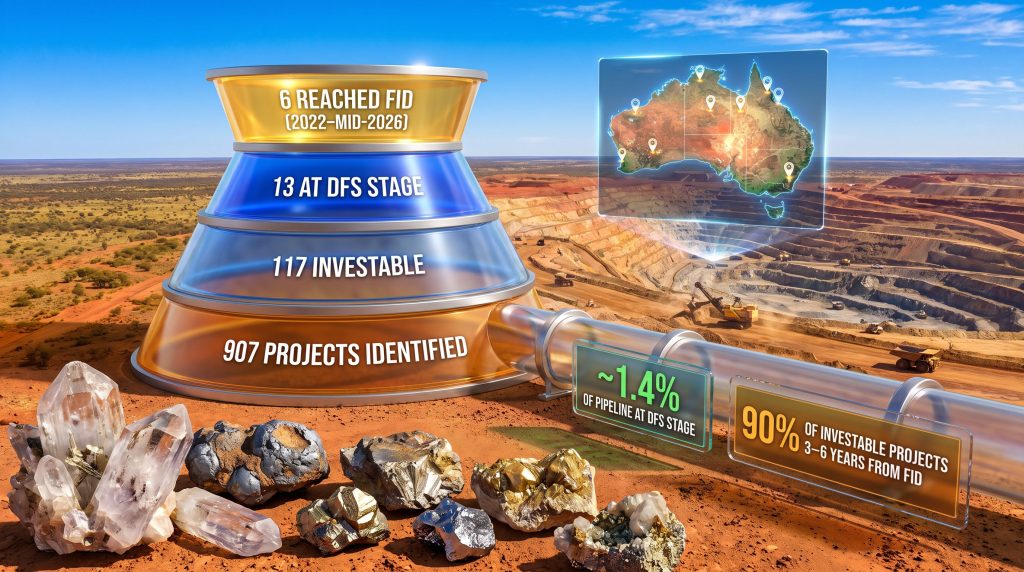
The headline figure in PwC's analysis is striking: 907 critical minerals projects have been identified across Australia. For a nation that routinely presents itself as a cornerstone supplier of the energy transition, that number might suggest a robust development pipeline. The reality, however, is considerably more sobering.
| Pipeline Stage | Number of Projects | Share of Total |
|---|---|---|
| Total identified projects | 907 | 100% |
| Investable universe | 117 | ~13% |
| At Definitive Feasibility Study (DFS) stage | 13 | ~1.4% |
| Processing facility projects identified | 8 | ~1% |
| Projects reaching FID (2022–mid-2026) | 6 | <1% |
The data presents a funnel with an extraordinarily narrow exit. Of the 907 projects catalogued, 74 per cent remain locked in exploration or early-stage reserves development, meaning they have not yet established the economic and technical parameters that financiers require before committing capital. Only 117 projects clear PwC's investability threshold, which incorporates factors such as resource definition maturity, commodity demand alignment, and project scale.
What makes these numbers particularly telling is the year-on-year trend. The previous PwC reporting cycle identified 124 investable projects, meaning the pipeline has contracted by a net seven projects rather than expanded. During a period of intensifying geopolitical urgency around critical minerals supply security, Australia's investment-ready pipeline is shrinking rather than growing.
Key Insight: Of the 907 critical minerals projects identified across Australia, only 13 have advanced to Definitive Feasibility Study stage, representing approximately 1.4% of the total pipeline. This structural bottleneck is the defining challenge for Australia's critical minerals ambitions.
What a Definitive Feasibility Study Actually Requires
A Definitive Feasibility Study milestone is frequently misunderstood outside technical circles. It is not simply an updated economic model or a more detailed scoping study. A DFS represents a full-scale engineering and geotechnical investigation that must demonstrate project viability to a level of confidence typically cited as plus or minus 10 to 15 per cent on capital and operating cost estimates. It involves:
- Detailed metallurgical testwork confirming processing routes and recoveries at scale
- Comprehensive geotechnical studies of pit walls, tailings facilities, and underground structures
- Front-end engineering design for processing plant and infrastructure
- Environmental baseline studies sufficient to support regulatory approval
- Binding or near-binding procurement cost estimates from major suppliers and contractors
The time and capital required to reach this stage from an early resource estimate commonly exceeds five years and tens of millions of dollars, which explains why only 13 projects in a field of 907 have cleared the bar.
Why the FID Bottleneck Is More Than a Timing Problem
Even among those 13 projects at DFS stage, the pathway to Final Investment Decision is far from assured. PwC's findings indicate that approximately 90 per cent of investable projects are between three and six years away from FID, with more complex operations, particularly those requiring bespoke hydrometallurgical or solvent extraction processing, potentially requiring a full decade. Between 2022 and mid-2026, just six projects formally reached FID, a conversion rate that is critically misaligned with the pace of global demand growth.
The reasons for this disconnect are structural rather than incidental:
1. The NPV Threshold Problem
Many projects in Australia's pipeline carry net present values below $500 million, the informal floor below which major institutional lenders and project finance banks become significantly less engaged. This threshold exists because the transaction costs, due diligence requirements, and risk management frameworks that underpin project finance are relatively fixed regardless of project size, making smaller projects disproportionately expensive to finance on a per-dollar basis.
2. The Junior Explorer Dominance Problem
Australia's pipeline is overwhelmingly populated by junior exploration companies with limited balance sheets. These entities are essential for discovery but structurally ill-suited to self-fund the journey from DFS to construction. The capital requirements at the construction stage, which can range from several hundred million to multiple billions of dollars, exceed the borrowing capacity of most juniors without strategic co-investors or major offtake backing.
3. The Processing Infrastructure Deficit
Perhaps the most underappreciated constraint is the near-absence of processing infrastructure across the project pool. PwC identified just eight processing facility projects across all 907 initiatives, representing roughly one per cent of the total. For many critical minerals, particularly rare earths, lithium chemicals, and battery-grade nickel, the ability to produce a market-ready product rather than a raw concentrate is the difference between a commercially viable operation and a marginal one. Without processing capacity, Australian projects remain exposed to price discounts and offtake uncertainty.
Analytical Note: The concentration of projects at early-stage development, combined with a thin processing infrastructure base, creates a compounding bottleneck, one that cannot be resolved through exploration activity alone.
The Commodity Composition Question: Are We Developing the Right Minerals?
Within the 117-project investable universe, commodity composition matters enormously. Lithium projects have dominated Australian critical minerals discourse over the past decade, driven by the spodumene boom in Western Australia's Pilbara and Goldfields regions. However, the lithium market's price volatility since late 2022 has had a pronounced effect on project progression rates, with lithium carbonate equivalent prices falling from highs above $80,000 per tonne in late 2022 to levels closer to $10,000 to $12,000 per tonne by mid-2024 before partial recovery.
This price cycle illustrates a broader risk: the projects that are most advanced in Australia's pipeline are not necessarily the ones most urgently demanded by global markets at any given point in time. Demand curves for different minerals evolve as battery chemistry technology matures. The shift toward lithium iron phosphate battery chemistries, for instance, reduces cobalt intensity per vehicle, while solid-state battery development could alter lithium demand profiles in ways that are not yet fully priced into long-dated project economics.
Rare Earths: A Separate Investment Logic
Rare earth projects occupy a distinct investment category that is frequently conflated with battery metals but operates under fundamentally different supply chain dynamics. The rare earth elements are not rare in geological terms; the challenge lies in the complexity of separating individual elements from mixed concentrates, a process that requires sophisticated solvent extraction circuits and generates significant waste streams that must be managed under strict environmental protocols.
Lynas Rare Earths stands as the benchmark for what an integrated Australian rare earths operation can achieve, having developed processing capacity both in Malaysia and, more recently, in Western Australia. The Lynas model demonstrates that rare earth project economics are heavily dependent on the ability to produce separated, specification-grade individual rare earth oxides rather than mixed concentrates, which typically attract substantially lower prices.
Geopolitically, rare earth supply has attracted concentrated attention from the United States, the European Union, Japan, and South Korea, all of which have been seeking to reduce dependence on Chinese processing dominance. China currently accounts for roughly 85 to 90 per cent of global rare earth processing capacity, a concentration that has generated sustained diplomatic and commercial interest in alternative sources. This geopolitical demand signal is real but does not automatically translate into project finance, which remains contingent on commercial offtake terms rather than strategic sentiment alone.
Where Government Policy Falls Short of the Pipeline's Actual Needs
PwC's analysis does not dispute the federal government's commitment to the critical minerals sector in principle. The Critical Minerals Facility, administered through Export Finance Australia, provides loan financing for late-stage and producing projects. The critical minerals strategic reserve and development programs have distributed grant funding across a range of project types. R&D co-investment mechanisms are also available under various innovation program structures.
The fundamental critique, however, is one of stage misalignment. The existing policy architecture has been largely calibrated to support projects that are already producing or within close proximity of production. This means the corridor between DFS completion and construction commencement, which is precisely where the pipeline is most constrained, receives disproportionately little structured support.
Policy Gap: PwC's analysis indicates that current federal incentive structures are not calibrated to the stage where the pipeline is most constrained, the pre-FID development corridor between DFS completion and construction commencement.
A useful comparative lens is the United States Inflation Reduction Act, which approached the critical minerals challenge from the demand side rather than the supply side. By attaching production tax credits and advanced manufacturing incentives to downstream offtake, the IRA created revenue certainty that improved the bankability of upstream projects without requiring direct project-level grants. Australia's predominantly supply-side approach, by contrast, has not delivered equivalent revenue visibility for pre-FID developers.
Brownfield Conversion and Shared Infrastructure: Underutilised Pathways
One of the more strategically interesting observations in PwC's work concerns the potential role of ageing refining and smelting assets as platforms for critical minerals processing conversion. Australia's industrial history has left a legacy of refining and smelting sites in locations such as Port Pirie, Townsville, Kwinana, and the Hunter Valley, many of which hold existing environmental licences, grid connections, port access, and skilled workforce proximity.
Repurposing these assets for green transition materials processing is not without technical complexity. The metallurgical requirements for producing battery-grade lithium hydroxide, cobalt sulphate, or separated rare earth oxides differ substantially from legacy base metals refining processes. However, the fixed infrastructure advantage of a brownfield site can reduce capital costs by 20 to 40 per cent compared to equivalent greenfield development, according to broader industry benchmarks for industrial conversion projects. This cost differential could be sufficient to push several sub-threshold projects above the $500 million NPV floor required for institutional financing.
Shared infrastructure models offer a parallel opportunity. Where multiple projects within a geographic cluster cannot individually justify the capital cost of dedicated processing facilities, co-located processing hubs can distribute fixed costs across several operations. The Kalgoorlie region in Western Australia presents one such opportunity, given the concentration of lithium and nickel projects within economic trucking distance of existing industrial infrastructure.
The next major ASX story will hit our subscribers first
A Framework for Evaluating Project Positioning Within the Pipeline
For investors and project developers navigating the PwC critical minerals investment pipeline data, project-level screening requires more than commodity exposure. The following tiered framework reflects the structural realities of Australia's development landscape:
Tier 1: Near-Term Viable (0 to 4 years to FID)
- At or approaching DFS completion with bankable-quality cost estimates
- Secured or near-secured offtake agreements with creditworthy counterparties
- Project NPV above $500 million, or strategic partnership in place with a major miner or sovereign entity
- Existing infrastructure access or a clearly defined shared infrastructure pathway
Tier 2: Medium-Term Developable (4 to 7 years to FID)
- Pre-feasibility study completed with positive economics
- Commodity profile in high strategic demand with limited competing supply growth
- Permitting pathway established with no material regulatory obstacles identified
- Eligibility confirmed under applicable government co-investment programs
Tier 3: Long-Horizon or Speculative (7 to 10+ years to FID)
- Exploration or resource definition stage only
- Processing route not yet established or highly complex
- Project economics dependent on commodity price recovery or novel financing mechanisms
Investor Consideration: With only six projects formally reaching FID between 2022 and mid-2026, the conversion rate from investable to construction-ready remains critically low. Investors should apply rigorous stage-gate analysis rather than treating pipeline volume as a proxy for near-term opportunity.
Structural Reforms That Could Shift the Trajectory
The path from Australia's current conversion rate to one that is commensurate with its resource endowment requires intervention across several dimensions simultaneously. No single reform is sufficient in isolation. Furthermore, according to PwC's assessment of Australia's critical minerals opportunity, coordinated action across policy, finance, and infrastructure is essential to unlocking the pipeline's potential:
- Stage-specific incentive redesign: Redirecting policy support toward the DFS-to-FID corridor, where capital risk is highest and government leverage is most effective
- Buyer-backed revenue certainty: Facilitating government-supported offtake frameworks with allied nation purchasers, using revenue visibility as a substitute for direct capital grants
- Shared infrastructure mandates or incentives: Encouraging co-location of processing capacity across proximate project clusters to reduce per-project capital intensity
- Brownfield repurposing mechanisms: Tax concessions or co-investment instruments specifically targeting conversion of legacy industrial sites into critical minerals processing facilities
- Concessional finance expansion: Extending the mandate of existing financing facilities to encompass earlier-stage projects with demonstrably strategic commodity profiles
- Permitting streamlining: Reducing regulatory processing times for projects that have already established resource estimates, without compromising environmental standards
Frequently Asked Questions: Australia's Critical Minerals Investment Pipeline
How many critical minerals projects does Australia have in its pipeline?
PwC's analysis identified 907 critical minerals projects across Australia. Of these, approximately 117 are considered part of the investable universe, and only 13 have reached Definitive Feasibility Study stage.
How long does it take for an Australian critical minerals project to reach Final Investment Decision?
According to PwC's findings, approximately 90 per cent of investable projects are between three and six years from a Final Investment Decision. More complex projects requiring bespoke processing infrastructure may take up to a decade to reach FID.
Why are so few Australian critical minerals projects investment-ready?
The primary constraints are project scale, with many carrying NPVs below $500 million, limited processing infrastructure, a policy environment weighted toward producing-stage projects, and the capital-intensive nature of moving from feasibility to construction. Indeed, hundreds of critical minerals projects are struggling to attract the investment they need to progress beyond early stages.
What is a Definitive Feasibility Study in the context of critical minerals?
A DFS is a detailed engineering and economic study that establishes the technical and financial viability of a mining project to a confidence level sufficient to support a Final Investment Decision. It typically follows a Pre-Feasibility Study and precedes project financing and construction.
How many critical minerals projects reached Final Investment Decision between 2022 and 2026?
Only six projects formally reached FID during this period, underscoring the significant gap between Australia's large project pipeline and its actual rate of project delivery.
What government programs support Australia's critical minerals sector?
Key mechanisms include the Critical Minerals Facility, the Critical Minerals Development Program, and various R&D co-investment initiatives. However, PwC's analysis highlights that these programs are predominantly oriented toward projects already in or near production rather than those in the pre-FID development corridor.
From Pipeline Volume to Project Delivery
The numbers at the core of the PwC critical minerals investment pipeline assessment tell a clear story: 907 projects, 13 at DFS stage, six FIDs across four years. This arithmetic defines the challenge more precisely than any policy statement or strategic framework document.
The window of opportunity is genuine. Global demand for the minerals that underpin battery storage, electric vehicles, defence systems, and renewable energy infrastructure continues to accelerate, and Australia holds geological endowment across most of the commodity types that matter. The question is not whether the opportunity exists, but whether the structural conditions for converting that endowment into actual production can be established within the timeframe that global supply chains require.
The answer depends on three interconnected shifts: policy recalibration toward the pre-FID development corridor, infrastructure co-investment models that improve per-project economics, and buyer-backed revenue certainty that substitutes commercial credibility for capital grants. Without all three working in concert, Australia risks remaining a jurisdiction that is rich in projects but slow in delivery, a distinction that its competitors in Canada, Chile, and parts of Africa are increasingly willing to exploit.
This article draws on data and analysis from PwC Australia's report Can We Get Serious Now? Securing Australia's Critical Minerals Future. The pipeline statistics, stage distributions, and policy observations referenced throughout reflect findings published in that report. Projections and frameworks presented in this article are analytical in nature and do not constitute financial advice. Readers should conduct independent due diligence before making investment decisions related to the critical minerals sector.
Want to Know Which ASX Critical Minerals Discoveries Are Worth Watching Right Now?
Discovery Alert's proprietary Discovery IQ model cuts through the noise of Australia's 907-project critical minerals pipeline, delivering real-time alerts the moment a significant ASX mineral discovery is announced — turning complex geological and market data into actionable investment insights. Explore why major mineral discoveries have historically generated substantial returns and start your 14-day free trial today to position yourself ahead of the broader market.