
August 11, 2026
The Hidden Architecture of Mineral Discovery: Why Tax Design Determines What Gets Found
Most conversations about Australia's mining future focus on commodity prices, processing capacity, or geopolitical supply chains. Far fewer examine the unglamorous but foundational question of how mineral deposits get discovered in the first place, and, crucially, who bears the financial cost of finding them.
The answer, for the past four decades, has increasingly been a small and structurally vulnerable category of company: the junior mineral explorer. These are not producing mines with revenue streams. They are pre-commercial enterprises operating in geological uncertainty, spending capital with no guarantee of return, funded primarily by retail investors willing to accept risks that institutional money routinely rejects.
It is within this context that the MCA capital gains tax discount for junior mining explorers debate must be understood. The policy question is not abstract. It determines whether Australia's next generation of critical mineral deposits gets found, and by whom.
When big ASX news breaks, our subscribers know first
Why Junior Explorers Cannot Access Conventional Capital
To understand why the 50% CGT discount matters, it helps to understand the financial reality of greenfields mineral exploration, which refers to systematic geological investigation of areas where no prior mineral discovery has been confirmed.
Junior explorers occupy a unique and uncomfortable position in the capital markets ecosystem:
- They generate no revenue and pay no dividends
- Their primary assets are exploration licences and geological data, which carry no guaranteed conversion value
- Their timelines from initial exploration to any potential return stretch across years or, more commonly, decades
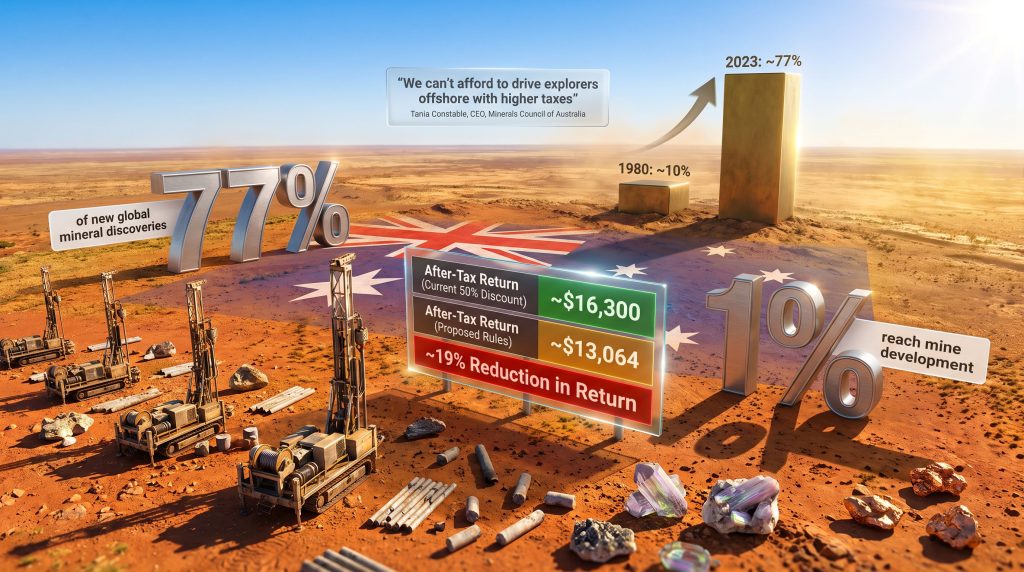
- Their probability of project success is exceptionally low, with only approximately 1 in every 100 exploration projects ever reaching a Final Investment Decision to become an operating mine
- Institutional investors, bound by mandate requirements around liquidity, return visibility, and fiduciary standards, are structurally excluded from backing most of these companies
This 1% success rate places junior mineral exploration among the highest-risk investment categories in the Australian economy, comparable in failure probability to early-stage venture capital but with far longer holding periods and considerably less liquidity.
The consequence of this structural financing gap is that retail investors, individuals prepared to commit capital across a five-to-fifteen year horizon with no income in the interim, form the primary funding base for Australian mineral exploration. The junior mining investment landscape makes clear that without a meaningful financial incentive to compensate for that asymmetric risk profile, exploration investment dries up at the source.
How the 50% CGT Discount Functions as a Risk-Compensation Tool
Under Australia's current tax framework, individual investors who hold shares in qualifying companies for at least 12 months are eligible to pay capital gains tax on only 50% of their realised profit. For investors backing junior mineral explorers, who receive no dividends and face elevated rates of project failure, this discount functions as the primary financial mechanism for making long-duration, high-risk capital exposure commercially rational.
The 12-month minimum holding period is, in practice, almost irrelevant to exploration investors. These are people committing capital across multi-year horizons. A discovery cycle for a greenfields project, from initial licence acquisition through geophysical surveying, drilling, resource definition, scoping, feasibility, and eventually a development decision, can span anywhere from five to fifteen years. The discount's real purpose is not to reward short-term holders but to compensate investors for the near-complete absence of liquidity, dividends, or interim financial return that characterises the asset class.
Critically, the CGT discount is not a subsidy in the conventional sense. It does not involve a government transfer of funds. It reduces the tax liability on a gain that only materialises if the investment actually succeeds. Given the 1% project success rate, the overwhelming majority of investors in junior explorers will never claim this discount at all, because most exploration programmes never generate a taxable capital gain.
What the Proposed CGT Reform Would Actually Change
The proposed reform currently before the Senate Economics Legislation Committee would replace the flat 50% CGT discount with a cost base indexation model for eligible assets held beyond 12 months. While indexation adjusts the investor's original purchase price upward in line with inflation, thereby reducing the nominal gain subject to tax, the practical effect for high-growth assets held over long periods is substantially less favourable than the current discount.
The Minerals Council of Australia modelled the financial impact with a representative scenario:
| Scenario | Initial Investment | Capital Gain | Tax Rate | After-Tax Return (Current 50% Discount) | After-Tax Return (Proposed Indexation) | Reduction in Return |
|---|---|---|---|---|---|---|
| Representative Case | $10,000 | $20,000 | 37% | ~$16,300 | ~$13,064 | ~19% |
A 19% reduction in after-tax return is not a marginal policy adjustment. For an investor who has committed capital for five or more years, accepted no dividends, carried significant risk of total loss, and foregone alternative investment opportunities, a near-one-fifth reduction in their eventual return fundamentally alters the risk-reward calculation.
The proposed effective date is 1 July 2027, meaning investment decisions being made today, across exploration programmes that will not reach any resolution for years, are already being shaped by uncertainty about which tax rules will apply at the point of eventual return. As highlighted by The Australian, the proposed changes risk undermining Australia's position in the global critical minerals race at precisely the wrong moment.
Four Decades of Discovery: How Junior Explorers Took Over
Perhaps the most striking statistical transformation in global mining over the past generation is not about commodity prices or processing technology. It concerns who finds mineral deposits.
In 1980, junior exploration companies accounted for approximately 10% of new mineral discoveries worldwide. Major mining companies, with their substantial geological teams, airborne survey fleets, and exploration divisions, dominated the discovery landscape.
By 2023, junior companies were responsible for approximately 77% of new global mineral discoveries, a structural transformation driven by several converging forces:
- Major mining companies progressively rationalised their exploration divisions through the 1990s and 2000s, focusing capital on mine development, operations, and shareholder returns rather than early-stage discovery
- Junior explorers proved more agile and cost-efficient at greenfields work, where geological creativity and local knowledge often outperform scale
- The ASX and TSX (Toronto Stock Exchange) developed into sophisticated capital markets for funding pre-revenue exploration, enabling thousands of small companies to access public equity
- Risk appetite among specialist retail investors in resource markets created a functional, if imperfect, funding ecosystem for high-probability-of-failure exploration programmes
The practical implication of this shift is rarely discussed in mainstream policy circles: if junior explorer funding dries up, global mineral discovery rates decline. There is no alternative institutional infrastructure standing ready to absorb the exploration function that junior companies now dominate.
Furthermore, the importance of mineral exploration to Australia's long-term economic position cannot be overstated, particularly as the global energy transition accelerates demand for battery and strategic metals.
The MCA's Two-Part Policy Position
The Minerals Council of Australia's formal submission to the Senate Economics Legislation Committee contains two distinct but complementary demands:
1. Retain the 50% CGT discount for individual investors in early-stage exploration companies beyond the current 30 June 2027 sunset date, preserving the primary financial incentive that makes retail investment in junior explorers commercially viable.
2. Permanently reinstate the Junior Minerals Exploration Incentive (JMEI) as a structural feature of Australia's exploration investment framework, rather than allowing it to remain subject to periodic renewal uncertainty.
Understanding the JMEI
The Junior Minerals Exploration Incentive is a flow-through tax credit mechanism that allows eligible exploration companies to convert a portion of their tax losses, a natural consequence of being pre-revenue and heavily spending, into refundable tax offsets that are then distributed to investors.
In practice, the JMEI functions as follows:
- A junior explorer spends capital on qualified exploration activities and generates a tax loss
- The company elects to convert a portion of that loss into exploration credits
- Those credits flow through to qualifying investors, who can apply them against their own tax liability
- The result is a partial reduction in the after-tax cost of the investor's exploration investment
The JMEI and the CGT discount are complementary instruments targeting different points in the investment lifecycle. The JMEI reduces the effective entry cost of exploration investment, while the CGT discount improves the after-tax return at exit. Consequently, weakening either mechanism creates a gap that the other cannot fully compensate.
The MCA's argument for permanence is straightforward: multi-year exploration programmes require multi-year funding commitments, and funding commitments require policy certainty. A scheme subject to periodic renewal creates planning uncertainty that discourages exactly the kind of long-duration capital commitment that exploration investment demands. In addition, junior explorers funding considerations at the federal budget level will play a significant role in shaping the sector's trajectory.
The next major ASX story will hit our subscribers first
Critical Minerals, China, and the Long Supply Chain
The CGT policy debate does not exist in geopolitical isolation. China currently holds a dominant position in the refining and processing of many of the minerals classified as critical by Western governments, including lithium, cobalt, rare earth elements, manganese, and others central to battery technology, defence manufacturing, and clean energy infrastructure.
Australia's role as a potential upstream alternative supplier is well established in terms of geology. The continent hosts world-class deposits of many of these materials. However, the question is whether the investment required to discover, define, and develop those deposits will materialise in sufficient volume.
The Minerals Council of Australia has framed this connection explicitly, noting that tax policies which reduce after-tax returns for exploration investors create downstream consequences for supply chain diversification. The logic is linear:
- Reduced investor returns lower exploration investment flows
- Lower exploration investment reduces the rate of new discovery
- Fewer discoveries mean fewer projects entering the development pipeline
- A thinner development pipeline constrains Australia's ability to deliver critical mineral supply to global markets in the 2030s and beyond
The timelines involved are important context. A mineral discovery made today, if successful, typically requires eight to fifteen years of additional investment before becoming an operating mine. Exploration investment decisions made in 2026 and 2027 are therefore determining critical minerals demand availability in the mid-2030s, precisely when demand for battery metals and strategic materials is forecast to be at its most intense.
The Offshore Capital Risk: Global Competition for Exploration Investment
Australia does not compete for exploration capital in isolation. The global landscape for junior mining finance is anchored by two primary exchanges: the ASX in Australia and the TSX and TSX Venture Exchange in Canada. Both jurisdictions compete actively for exploration listings, investor attention, and the geological talent that follows capital.
Canada operates a materially different incentive structure through its flow-through share scheme, a mechanism that allows exploration companies to pass their eligible exploration expenditure deductions directly to shareholders. This means investors can effectively reduce their taxable income in the year of investment, rather than waiting for a capital gain that may never materialise. The after-tax cost of entering a Canadian junior explorer can be substantially lower than an equivalent Australian investment, particularly for higher-income investors.
A Comparison of Incentive Mechanisms
| Incentive Mechanism | How It Works | Who Benefits | Current Status in Australia |
|---|---|---|---|
| 50% CGT Discount | Halves taxable capital gain on qualifying assets held 12+ months | Individual investors | Active, scheduled to sunset 30 June 2027 |
| Junior Minerals Exploration Incentive (JMEI) | Flow-through tax credit for exploration expenditure | Investors via company pass-through | Active but non-permanent |
| Flow-Through Share Scheme (Canadian model) | Companies pass exploration deductions directly to shareholders | Investors in eligible companies | Not available in Australia |
The absence of a flow-through share equivalent in Australia is a structural gap relative to Canada. If the CGT discount is also weakened or removed, Australia's relative attractiveness as an exploration investment destination deteriorates further, at precisely the moment that global demand for the minerals Australia hosts is accelerating.
The Minerals Council of Australia has raised the risk of capital migration, noting that higher effective tax burdens on exploration returns could accelerate the movement of both investment capital and the geological and engineering expertise that follows it to competing jurisdictions. Furthermore, the MCA's submission outlines in detail how the proposed changes represent a significant hit to minerals exploration and the long-term future of Australian mining. Australia's world-class geological workforce is internationally mobile and internationally sought.
Balancing the Argument: Fiscal Equity and Policy Design
The policy case for retaining the CGT discount is compelling from a sectoral perspective, but the debate is not entirely one-sided. The government's rationale for CGT reform centres on tax equity objectives, with some analysis suggesting the 50% discount disproportionately benefits investors in higher income brackets who are more likely to realise large capital gains.
Policymakers face a genuine challenge in designing exploration incentives that are simultaneously effective at channelling capital toward high-risk discovery activities and fiscally defensible in the context of broader distributional goals.
Several considerations complicate this balance:
- The CGT discount is a broad-based mechanism, not targeted exclusively at exploration investment, meaning its reform affects all qualifying assets, not just junior mining shares
- Well-targeted alternatives, such as the JMEI and hypothetical flow-through share arrangements, can direct incentives more precisely toward exploration spending
- The economic multiplier effects of mineral discovery, including employment in geology, drilling, surveying, environmental assessment, and downstream processing, generate tax revenues that can partially offset the cost of exploration incentives
- The long lead times of exploration investment mean that the fiscal cost of the discount is deferred and contingent on success, making it more efficient than upfront subsidies
Disclaimer: This article contains forward-looking statements and references to economic modelling scenarios. These represent illustrative projections based on stated assumptions and should not be construed as financial advice. Readers considering investment in junior exploration companies should seek independent financial counsel and conduct their own due diligence.
Frequently Asked Questions
What is the 50% CGT discount for junior mining explorers?
Individual Australian investors who hold shares for more than 12 months are currently eligible to pay capital gains tax on only 50% of their taxable gain. For junior explorer investors who receive no dividends and accept high failure risk, this discount is typically the primary financial incentive for committing long-duration capital to the sector.
When is the proposed CGT change scheduled to take effect?
The proposed shift from the 50% discount to a cost base indexation model is currently proposed to apply from 1 July 2027, affecting capital gains realised on qualifying assets after that date.
What is the Junior Minerals Exploration Incentive (JMEI)?
The JMEI is a federal scheme allowing eligible exploration companies to convert a portion of their tax losses into refundable tax offsets distributed to investors. The MCA is advocating for this scheme to receive permanent status rather than being subject to periodic renewal decisions.
Why do junior explorers rely on retail rather than institutional investors?
Because junior exploration companies are pre-revenue, pay no dividends, and carry extremely high probability of project failure, they do not satisfy the return profile, liquidity requirements, or mandate constraints of most institutional investors. Specialist retail investors, however, form the structural capital base for the sector.
How does Australia's exploration tax treatment compare internationally?
Australia's 50% CGT discount is a competitive mechanism at the exit stage of investment, but it lacks the direct-entry deductibility available through Canada's flow-through share scheme. Any weakening of the CGT discount would widen Australia's competitive gap relative to Canada as a destination for global exploration capital.
What the CGT Discount Debate Signals About Australia's Exploration Future
The broader lesson embedded in this policy debate extends beyond the mechanics of any single tax concession. It concerns the relationship between fiscal design and national resource endowment.
Australia is one of the most geologically prospective countries on Earth, with established world-class deposits and substantial under-explored frontier territory across Western Australia, Queensland, South Australia, and the Northern Territory. The continent holds genuine potential to contribute meaningfully to global critical mineral supply chains across lithium, nickel, cobalt, rare earths, copper, and manganese.
However, geological potential does not translate into mine production without the sustained investment of exploration capital across long, uncertain timelines. The MCA capital gains tax discount for junior mining explorers debate is ultimately a question about whether Australia's tax architecture is calibrated to support the risk-taking that converts geological potential into economic reality.
The numbers are stark: 77% of global mineral discoveries now come from junior explorers, yet those explorers depend almost entirely on retail investor capital that is directly sensitive to after-tax return expectations. A 19% reduction in after-tax returns is not a rounding error. It is a structural shift in the calculus of a funding ecosystem that has no institutional backstop.
What Australia decides about the MCA capital gains tax discount for junior mining explorers, and the permanence of the JMEI, will not determine this year's exploration budgets. It will shape the discovery pipeline of the 2030s, and by extension, the availability of the minerals that global clean energy and technology supply chains will require most urgently.
Want to Know Which ASX Junior Explorers Are Making Significant Mineral Discoveries Right Now?
Discovery Alert's proprietary Discovery IQ model delivers real-time alerts the moment significant ASX mineral discoveries are announced, turning complex geological data into actionable investment insights for both short-term traders and long-term investors — precisely the kind of edge that matters in a sector where 77% of global discoveries now originate from junior explorers. Explore historic discovery returns to understand the scale of opportunity, then begin your 14-day free trial at Discovery Alert to position yourself ahead of the broader market.