
August 11, 2026
The Hidden Cost of Going Green Too Fast: Lessons From Colombia's Energy Experiment
Every decade or so, an emerging economy attempts to leapfrog the conventional energy development curve and transition directly to renewables before its hydrocarbon foundation has been adequately monetised. The outcomes of these experiments offer some of the most instructive case studies in energy policy design. Colombia's recent experience under President Gustavo Petro, and the sharp correction now underway under his successor, provides a rare real-time look at what happens when ideological ambition outpaces economic architecture.
The phrase Colombia revives oil and gas after renewable energy push captures a geopolitical moment, but the deeper story is about structural economic fragility, the limits of accelerated decarbonisation in hydrocarbon-dependent states, and the conditions under which energy transition strategies collapse under their own weight.
When big ASX news breaks, our subscribers know first
When Ambition Becomes a Liability: The Economics of Colombia's Transition Period
Colombia entered the Petro administration with a formidable hydrocarbon base. As South America's second-largest petroleum and liquid fuels producer behind Brazil, and the continent's largest coal exporter, it was a nation whose fiscal architecture was built on extraction. Ecopetrol, the state-owned national oil company, contributed nearly two-thirds of total fossil fuel production and channelled an estimated 35 trillion Colombian Pesos (approximately USD $11.1 billion) annually to the government through taxes, royalties, and dividends.
What followed under the "Just Energy Transition" agenda was a rapid unravelling of that foundation. Key metrics from the 2023 to 2025 period tell a stark story:
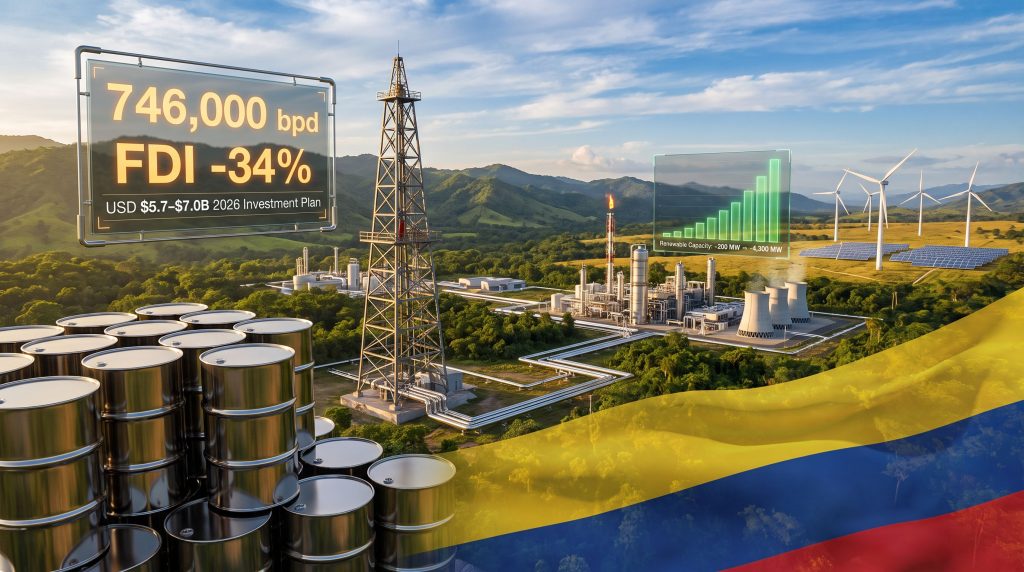
- Average domestic oil output declined roughly 4%, settling at approximately 746,000 barrels per day
- Natural gas import dependency surged from 3% of domestic consumption in 2023 to 31% by 2025, a near-tenfold increase in just two years
- Foreign direct investment in the combined mining and oil sectors contracted by 34%, falling to approximately USD $6.9 billion across the period
- Colombia's total crude oil reserves shrank by 54 million barrels, raising long-term supply security concerns
- Ecopetrol's full-year net income dropped nearly 40% in 2025 to approximately COP 9 trillion (roughly USD $2.85 billion), the lowest profit level recorded since 2017
- Annual revenues at Ecopetrol declined 10.2% year-over-year to COP 119.7 trillion (approximately USD $38.0 billion)
The gas import surge is arguably the most underappreciated data point in this entire episode. Understanding natural gas price trends helps contextualise why a country with Colombia's hydrocarbon endowment becoming structurally dependent on imported natural gas within 24 months is not a transition story — it is an energy security failure.
The Institutional Damage Done to Ecopetrol
Beyond the headline financial metrics, the Petro administration inflicted significant institutional damage on Ecopetrol that does not appear in quarterly earnings reports. Hundreds of experienced technical staff were replaced with political appointees, hollowing out operational expertise that takes years to rebuild. High-profile board members resigned in protest, citing inconsistent strategic messaging and government resistance to international capital deployment.
Two particularly consequential decisions defined this period. First, a USD $3.6 billion acquisition of a 30% stake in shale producer CrownRock was blocked before completion. Second, a joint venture with Occidental Petroleum in the U.S. Permian Basin was terminated on environmental grounds. Both decisions severed Ecopetrol's pathway to growing its international reserve base through upstream partnerships at a time when domestic exploration was simultaneously frozen.
The combined effect was a company stripped of its commercial independence, burdened by higher income-tax surcharges on hydrocarbons and new corporate wealth levies, and prevented from pursuing the upstream growth strategies that fund long-term reserve replacement.
What the Renewable Energy Boom Actually Delivered
It would be analytically incomplete to dismiss the Petro era's energy achievements. The renewable buildout was, by conventional metrics, impressive. Furthermore, Colombia's installed renewable energy capacity expanded from approximately 200 megawatts in 2022 to over 4,300 megawatts by 2026, a more than twentyfold increase in four years. Solar generation surpassed coal-fired electricity output for the first time in Colombia's history in 2025.
| Metric | 2022 Baseline | 2025/2026 Outcome |
|---|---|---|
| Renewable capacity | ~200 MW | ~4,300 MW |
| Natural gas import share | ~3% of consumption | ~31% of consumption |
| Average oil output | ~776,000 bpd | ~746,000 bpd |
| Crude oil reserve change | Baseline | -54 million barrels |
| FDI in mining and oil | Higher baseline | -34% decline |
| Ecopetrol net income | Record highs (2022) | ~40% decline by 2025 |
The table above encapsulates the central paradox of Colombia's transition period. Renewable energy solutions grew at an extraordinary pace while virtually every conventional energy security indicator deteriorated simultaneously. This outcome forces a critical question that energy planners in developing economies rarely ask explicitly: at what pace can a fossil fuel-dependent fiscal state afford to constrain its own hydrocarbon revenues before the transition becomes self-defeating?
Colombia's experience suggests the answer involves a sequence problem. Transition financing requires revenue. Revenue requires production. Production requires investment. And investment requires regulatory stability. When an administration breaks the investment link in that chain, the entire sequence reverses.
President de la Espriella's Reset: What Has Been Pledged
Inaugurated in Cali, President Abelardo de la Espriella represents not merely a change of government but a fundamental reorientation of Colombia's energy philosophy. His administration has committed to a framework that explicitly positions hydrocarbon revenues as the financing engine for longer-term clean energy development, rather than treating oil and gas extraction as incompatible with transition goals. However, as Americas Quarterly has noted, Colombia has previously struggled to fully capitalise on its clean energy potential, making this balancing act particularly consequential.
The core policy commitments include:
- Reopening oil and gas exploration licensing, reversing the moratorium on new upstream contracts
- Authorising hydraulic fracturing under tightly regulated conditions, unlocking unconventional resource plays that had been entirely inaccessible
- Restoring Ecopetrol's commercial and operational independence, including the ability to pursue international upstream partnerships and acquisitions
- Maintaining the renewable energy infrastructure built under the previous administration rather than dismantling it
De la Espriella's stated philosophy centres on building the energy transition from a position of economic self-sufficiency rather than import dependency and fiscal constraint. This framing represents a meaningful conceptual departure from the previous administration's approach: rather than treating the transition and hydrocarbon production as mutually exclusive, his government positions them as sequentially dependent.
Ecopetrol's 2026 Investment Plan: Reading the Capital Allocation
The most concrete expression of the incoming administration's priorities is Ecopetrol's 2026 Annual Investment Plan, which is being actively adjusted to align with the new policy direction. The plan targets total capital deployment of between COP 22 and 27 trillion (approximately USD $5.7 billion to $7.0 billion), with a clear weighting toward upstream hydrocarbon recovery.
| Investment Category | Share of Budget | Estimated Value |
|---|---|---|
| Total investment plan range | 100% | COP 22-27 trillion (~USD $5.7-$7.0B) |
| Upstream hydrocarbons | ~70% | ~COP 17.2 trillion |
| Power, infrastructure, cleaner energy | ~30% | ~COP 7.1 trillion |
| Direct renewable projects (subset of 30%) | ~3% of total | Minimal share |
The plan targets the drilling of up to 430 development wells, predominantly within Colombia. This is not an exploration-stage strategy. Development wells target known reservoirs, meaning the near-term mandate is production recovery from existing assets rather than frontier exploration.
The 70/30 split between upstream hydrocarbons and infrastructure signals that Ecopetrol's institutional priority has shifted decisively toward reversing the production decline of recent years. The 3% allocation to direct renewable projects within the broader 30% infrastructure envelope is a notable recalibration from the clean energy emphasis of the prior period.
Ecopetrol's international asset base, including recently expanded holdings in Brazilian independent operators, is positioned to generate cash flows that can be recycled into domestic hydrocarbon development. This capital recycling model is a structurally important mechanism: international returns subsidising domestic upstream reinvestment without requiring sovereign fiscal transfers.
Fracking in Colombia: A Game-Changer or a Long Road Ahead?
The authorisation of hydraulic fracturing represents the most geopolitically significant element of the policy reversal. Colombia possesses unconventional resource plays in the Middle Magdalena Valley and other sedimentary basins that have never been commercially developed. The previous administration's fracking ban meant these resources remained entirely inaccessible, even as the terminated Occidental Petroleum Permian Basin joint venture would have provided exactly the technical expertise needed to evaluate their potential. This debate around Colombia revives oil and gas after renewable energy push continues to draw significant international attention.
What is less commonly understood is that fracking authorisation is not equivalent to fracking production. The pathway from policy permission to commercial output involves multiple layers of complexity:
- Regulatory framework development: Colombia will need to establish environmental monitoring standards, water management protocols, and community consultation requirements before commercial pilot programmes can commence
- Technical capacity rebuilding: The departure of experienced technical staff and the termination of international partnerships have reduced the institutional knowledge base within Ecopetrol
- Legal challenges: Environmental organisations and indigenous community groups have historically challenged upstream expansion through Colombia's court system, and unconventional resource development is likely to attract heightened scrutiny
- Infrastructure requirements: Many prospective unconventional plays lack the pipeline, water handling, and road infrastructure necessary for large-scale development
Analysts watching the sector closely have noted that while fracking authorisation sends a powerful investment signal, commercial-scale unconventional production in Colombia is unlikely to materialise within a two to three year horizon even under the most optimistic regulatory scenarios.
The next major ASX story will hit our subscribers first
Colombia in Regional Context: A Pattern Across Latin America
Colombia's policy oscillation is not an isolated phenomenon. Across Latin America and beyond, the tension between clean energy commitments and near-term energy security imperatives has produced a recurring pattern of policy reversal. Consequently, investors and policymakers alike should treat this as a structural feature of the current transition period rather than an anomaly.
| Country | Transition Policy | Reversal Driver | Current Direction |
|---|---|---|---|
| Colombia | Exploration ban, NOC restructuring | Fiscal pressure, import dependency | Reopening exploration, fracking authorisation |
| Argentina | Selective restrictions | Economic crisis, Vaca Muerta potential | Aggressive upstream expansion |
| Mexico | NOC prioritisation over private sector | Energy sovereignty framing | State-led production recovery |
| United Kingdom | North Sea windfall taxes | Energy security post-Ukraine crisis | Licensing review, selective rollbacks |
What distinguishes Colombia's case is the speed and completeness of the reversal. Moving from a near-total exploration halt to a USD $7 billion upstream-weighted capital plan within a single electoral cycle is extraordinary. It reflects the severity of the economic consequences accumulated during the Petro years, and the degree to which those consequences translated directly into political outcomes at the 2026 election.
How Does the Energy Transition in Mining Relate?
The broader energy transition in mining sector mirrors Colombia's experience at a national level. Resource-dependent industries globally are grappling with the same fundamental tension: how to honour decarbonisation commitments without destabilising the revenue foundations that fund them. Colombia's case offers a cautionary illustration of what happens when this balance is misjudged. Similarly, the energy transition challenges faced by Canada highlight that this dilemma extends well beyond emerging markets.
Investment Implications: What Recovery Could Look Like
For investors tracking Colombia's upstream sector, the Association of Colombian Petroleum Companies projected approximately USD $4.68 billion in exploration and production spending for 2025, with output estimates stabilising around 760,000 to 770,000 barrels of oil equivalent per day. These figures represent a floor from which the new administration is targeting upward recovery. In addition, foreign investment fuelling green energy development in the broader region demonstrates that capital is available for credible energy frameworks.
The structural conditions for FDI recovery are improving, but several critical risk factors remain:
- Global oil price sensitivity: Colombia's fiscal calculus is highly exposed to benchmark crude price movements. A sustained period of lower oil prices would compress the hydrocarbon revenue thesis underpinning the entire dual-track strategy
- Regulatory implementation lag: Policy pledges require operational follow-through, and the gap between inaugural commitments and licensing activity can extend investor uncertainty
- Security conditions: Certain producing regions continue to face operational security challenges that create cost overruns and schedule delays for both domestic and international operators
- Political durability: Perhaps the most fundamental investor concern is whether the regulatory reset will survive the next electoral cycle
The 34% decline in FDI during the Petro period represents a significant base from which recovery is mathematically possible. However, rebuilding investor confidence in a jurisdiction that has demonstrated willingness to cancel international acquisitions, terminate joint ventures, and replace technical management with political appointees typically requires demonstrated regulatory consistency over multiple years, not a single inaugural speech.
The Dual-Track Model: Three Scenarios for Colombia's Energy Future
The central strategic question facing Colombia under its new administration is whether simultaneous expansion of hydrocarbons and renewables is financially and politically sustainable over a multi-year horizon.
Scenario 1: Managed Dual-Track Success
Ecopetrol restores production toward pre-2022 levels, foreign investment recovers progressively, natural gas import dependency falls as domestic supply expands, and hydrocarbon revenues provide the fiscal headroom to continue renewable infrastructure investment. Colombia achieves energy security while maintaining transition momentum. This scenario requires oil price stability, rapid regulatory implementation, and sustained political commitment.
Scenario 2: Hydrocarbon Lock-In
Strong upstream investment and production recovery generate fiscal flows that entrench political support for hydrocarbon development. Clean energy investment stagnates as the fiscal incentive to maintain transition spending weakens. The renewable energy infrastructure built between 2022 and 2026 represents a ceiling rather than a foundation. Colombia's decarbonisation timeline extends by a decade or more.
Scenario 3: Policy Instability Persists
A future electoral cycle reverses the de la Espriella framework, reinstating exploration restrictions and creating a third consecutive policy discontinuity. International capital permanently discounts Colombia as a jurisdiction with unacceptable political risk, suppressing both hydrocarbon and renewable investment below potential.
The probability distribution across these three scenarios is genuinely uncertain, and investors should resist treating the current policy reset as a resolved question. Furthermore, the growth in critical minerals demand globally adds another layer of strategic complexity for Colombia as it seeks to position its resource base within evolving supply chains.
Frequently Asked Questions: Colombia Oil and Gas Revival
Why Did Colombia Stop Issuing New Oil and Gas Exploration Contracts?
The previous administration implemented a comprehensive ban on new upstream contracts as part of a broader fossil fuel phase-out agenda that prioritised wind and solar development over hydrocarbon production.
What Is Ecopetrol's Role in Colombia's Economy?
Ecopetrol is Colombia's state-owned national oil company, responsible for approximately two-thirds of total domestic fossil fuel production. It is a critical fiscal contributor through taxes, royalties, and dividend transfers to the government.
What Happened to Colombia's Oil and Gas Sector During the Transition Period?
Domestic oil output fell roughly 4%, reserves shrank by 54 million barrels, natural gas imports surged from 3% to 31% of domestic consumption, and Ecopetrol's net income declined by nearly 40% to its lowest level since 2017. This period encapsulates why Colombia revives oil and gas after renewable energy push has become such a defining policy narrative for the new administration.
Is Hydraulic Fracturing Now Permitted in Colombia?
The new administration has pledged to authorise fracking under strict regulatory conditions, reversing the previous ban. However, a comprehensive regulatory framework must still be developed before commercial activity can begin, meaning production timelines extend well beyond the near term.
How Much Is Ecopetrol Planning to Invest in 2026?
The 2026 Annual Investment Plan targets between COP 22 and 27 trillion (approximately USD $5.7 billion to $7.0 billion), with roughly 70% directed toward upstream oil and gas development and up to 430 development wells planned primarily within Colombia.
Will Colombia Abandon Its Renewable Energy Progress?
The incoming administration has indicated it will preserve the renewable energy infrastructure developed under the previous government whilst pursuing expanded hydrocarbon production in parallel. The strategy is one of simultaneous development rather than outright reversal.
Disclaimer: This article is intended for informational purposes only and does not constitute financial, investment, or legal advice. All forward-looking statements, projections, and scenario analyses involve material uncertainty and should not be relied upon as predictions of future outcomes. Investors should conduct their own due diligence before making any investment decisions related to the Colombian energy sector or any companies referenced herein.
Want to Track the Next Major Resource Discovery Before the Market Does?
Colombia's energy policy reversal underscores how swiftly commodity dynamics can shift — and how quickly capital follows credible resource plays. Discovery Alert's proprietary Discovery IQ model delivers real-time ASX mineral discovery alerts, turning complex resource data into actionable opportunities the moment they are announced, with a track record of identifying discoveries that have generated extraordinary returns — start your 14-day free trial today and position yourself ahead of the broader market.