August 11, 2026
The Analytical Revolution Quietly Reshaping How Mining Companies Value Their Ore
For decades, the gold mining industry has relied on a centuries-old process to determine the metal content of ore samples. Fire assay, which involves dissolving ore in high-temperature fluxes and extracting precious metals through a series of chemical reactions, has remained the default method across commercial laboratories and mine sites worldwide. It is accurate enough for most purposes, but it is also slow, chemically hazardous, and fundamentally incompatible with the throughput demands of modern, high-volume mining operations. The emergence of physics-based alternatives is beginning to challenge that dominance, and the financial results flowing through to early movers in this space — including Chrysos PhotonAssay earnings — are becoming difficult to ignore.
When big ASX news breaks, our subscribers know first
Why the Mining Industry Is Rethinking Its Assay Workflows
The global mining sector processes hundreds of millions of ore samples annually. Each sample represents a decision point: how much metal is present, whether a deposit is worth developing, and how processing circuits should be calibrated. Errors or delays at the assay stage create cascading inefficiencies across the entire value chain.
Traditional fire assay, despite its precision, carries meaningful operational liabilities. It requires toxic fluxes including lead oxide, generates hazardous waste streams that must be managed under increasingly stringent environmental regulations, and typically delivers results over timescales measured in hours or days rather than minutes. As mining companies face tighter ESG reporting requirements and growing pressure to reduce their environmental footprints, the cost-benefit calculus of sticking with legacy methods is shifting.
Furthermore, current gold exploration trends point toward increasing sample volumes and tighter decision-making timelines, making legacy assay methods a growing operational bottleneck. Into this context, high-energy X-ray fluorescence-based analysis technologies have arrived with a compelling value proposition: faster throughput, no chemical reagents, no toxic waste, and results that are comparable or superior in accuracy for gold and a growing range of other elements.
How PhotonAssay Works and Why It Is Winning Commercial Adoption
PhotonAssay, the proprietary technology developed by Chrysos Corporation Ltd (ASX: C79), directs high-energy X-rays at bulk ore samples, inducing specific nuclear reactions in the target elements. The resulting gamma-ray signatures are measured and converted into elemental concentration data. Because the process is non-destructive and requires no sample preparation with chemical reagents, a single unit can process samples at a throughput rate that would require multiple fire assay furnaces and associated support infrastructure to match.
The practical implications for mining laboratories are significant:
- Faster turnaround times allow exploration teams and mine geologists to make decisions based on near-real-time assay data rather than waiting for batch results.
- Elimination of hazardous chemicals reduces both the regulatory compliance burden and the risk of workplace incidents associated with handling lead-based compounds.
- Higher sample volumes per unit translate directly into improved laboratory economics, particularly as labour costs across mining jurisdictions continue to rise.
- Consistent measurement across large sample masses reduces the nugget effect, a well-known challenge in gold assay where coarse gold particles create statistical variability in small-sample fire assay results.
The nugget effect is particularly relevant for high-grade, coarse-gold deposits, where conventional fire assay on small sub-samples can produce results with significant variance. PhotonAssay's ability to analyse larger sample masses in their entirety reduces this source of error, which has been a meaningful technical selling point with mine-site customers. For investors interested in interpreting drill results, understanding how assay accuracy affects resource estimation is an equally important consideration.
Chrysos PhotonAssay Earnings: A Record-Breaking FY26 in Numbers
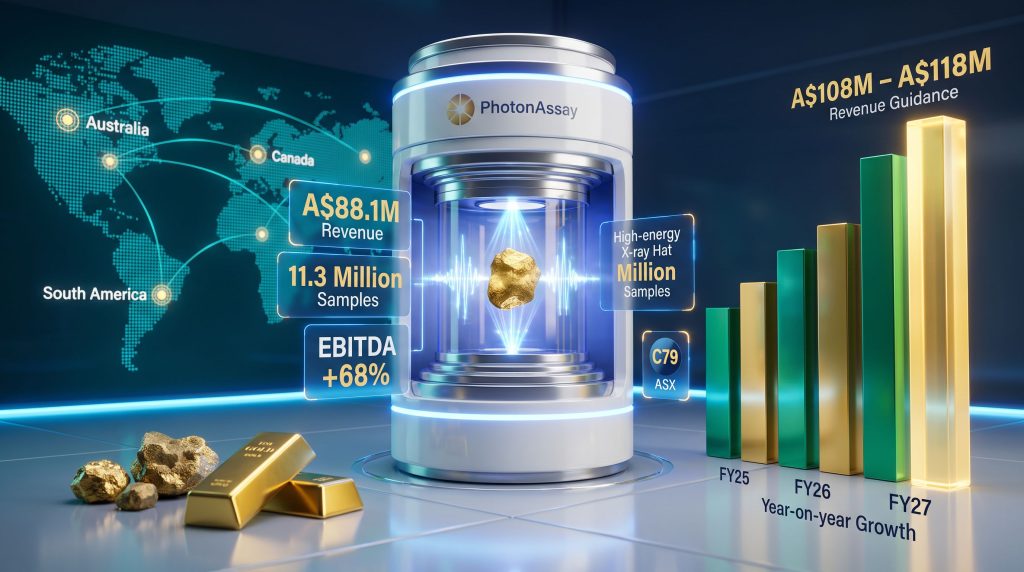
The Chrysos PhotonAssay earnings result for the full year ending June 2026 reflects what operational maturity looks like for a technology business that has successfully crossed the threshold from early adoption into mainstream commercial deployment. Both headline metrics reached record levels and arrived at the upper end of the guidance range the company had previously communicated to the market.
| Financial Metric | FY25 Actual | FY26 Actual | Year-on-Year Change |
|---|---|---|---|
| Total Revenue | A$66.1 million | A$88.1 million | +33% |
| EBITDA | A$16.1 million | A$27.2 million | +68% |
| EBITDA Margin | ~24% | ~31% | +7 percentage points |
| Samples Processed | ~6.8 million (est.) | 11.3 million | +67% |
| Net Operating Cash Inflow | ~$8.8 million (est.) | $17.9 million | +103% |
| Contracted Units (Total) | ~63 (est.) | 87 | +24 new in FY26 |
The EBITDA margin expansion from approximately 24% to 31% in a single year is the figure that deserves particular attention from investors evaluating the underlying business model. It indicates that revenue growth is outpacing cost growth, a characteristic of technology platforms that have achieved meaningful scale. The doubling of net operating cash inflow to $17.9 million further reinforces that this is not an accounting artefact but genuine cash conversion improvement.
The Half-Year Setup and What It Reveals About Business Rhythm
Breaking the result into halves provides additional texture about how Chrysos's revenue model behaves as the unit fleet expands.
| Metric | 1H FY26 | FY26 Full Year |
|---|---|---|
| Revenue | A$43.3 million | A$88.1 million |
| EBITDA | A$14.3 million | A$27.2 million |
| EBITDA Margin | 33% | 31% |
The first-half EBITDA margin of 33% briefly exceeded the full-year average of 31%. This reflects a pattern common to capital deployment businesses: as new units are commissioned during the second half, they incur setup and ramp-up costs before they reach full utilisation. Investors should expect this rhythm to repeat in FY27 as additional contracted units are deployed, which means second-half margins may again temporarily compress before recovering as those units mature.
The Revenue Architecture: Understanding What Drives Chrysos's Financial Engine
Chrysos operates through a recurring lease model rather than a traditional equipment-sale model. This distinction is commercially significant and often misunderstood by investors who are more familiar with capital goods businesses.
Under the lease structure, Chrysos retains ownership of every PhotonAssay unit it deploys. Customers pay periodic lease fees and, critically, volume-linked charges that scale with the number of samples processed. This second revenue component, referred to as the Additional Assay Charge (AAC), functions as an embedded operational leverage mechanism.
As sample volumes grow beyond base thresholds, AAC revenue expands disproportionately relative to the costs of running the deployed fleet. This means the incremental margin on AAC revenue is structurally higher than on base lease income, creating a natural profitability accelerator as utilisation increases.
The commercial logic is compelling for several reasons:
- Customer retention is high because switching away from an integrated, on-site PhotonAssay unit requires significant workflow restructuring.
- Revenue predictability is strong because base lease fees are contractual and not dependent on commodity price fluctuations.
- Growth in processed volumes drives margin expansion without proportional cost increases, creating compounding returns on the installed fleet as it matures.
Five consecutive months of processing over one million samples during FY26 represents an operational milestone that validates the scalability of this model in practice rather than in theory.
Geographic Expansion and Key Customer Relationships
Chrysos expanded its deployed footprint across three continents during FY26, with units placed in Canada, Australia, and South America. The geographic diversification is strategically important because it reduces concentration risk and exposes the business to multiple gold production cycles simultaneously.
The distinction between the two primary deployment channels is worth understanding clearly:
| Deployment Model | Description | Strategic Significance |
|---|---|---|
| Commercial Laboratory Leasing | Units placed within third-party assay labs | Broad market reach, shorter sales cycles |
| Direct-to-Mine Leasing | Units deployed at individual mine sites | Higher utilisation rates, deeper integration, stronger retention |
The direct-to-mine channel is where the most strategically significant FY26 developments occurred. Lease agreements were executed with Newmont Corporation (ASX: NEM), one of the largest gold producers in the world by output, as well as with Allied Gold. The inclusion of Newmont as a direct-to-mine customer is particularly notable because it signals that major producers with highly developed internal technical standards are satisfied that PhotonAssay meets or exceeds the accuracy and reliability benchmarks required for mine-site grade control.
It is worth noting that Chrysos management has indicated the initial Newmont deployments will represent an opportunity to demonstrate PhotonAssay's capabilities beyond simply replacing fire assay on a one-for-one basis. This implies potential for the technology to enable new workflows, including faster resource model updating and real-time ore sorting decisions, that create value above and beyond simple assay cost reduction. Kirkland Lake Gold's early adoption of PhotonAssay at its Fosterville operation provides a well-documented precedent for how mine-site integration can unlock these broader workflow benefits.
All major laboratory partners also expanded their PhotonAssay capacity during FY26, suggesting that commercial laboratories are not treating PhotonAssay as a niche supplement to fire assay but as a core capacity investment.
Next-Generation Hardware: The XN Unit
The rollout of the XN unit in Perth during FY26 marks the beginning of a hardware refresh cycle that investors should track carefully. The XN represents the latest generation of PhotonAssay equipment and is expected to deliver higher throughput and improved operational efficiency relative to earlier-generation units. As existing contracts come up for renewal or expansion, the XN's performance characteristics could accelerate migration toward higher-volume, higher-margin deployments.
The next major ASX story will hit our subscribers first
Balance Sheet Strength and the Capacity to Scale
A technology deployment business of this type requires ongoing capital to manufacture and commission new units. The financial architecture Chrysos has assembled to fund that deployment pipeline is structurally sound.
| Balance Sheet Item | FY26 Position |
|---|---|
| Cash on Hand | A$25.9 million |
| Undrawn Debt Facility | A$140 million |
| New Syndicated Debt Facility | A$200 million |
The refinancing completed during FY26, which replaced prior arrangements with a new A$200 million syndicated debt facility on improved covenant terms, materially expands the runway available to fund unit manufacturing and global deployment without near-term equity dilution. The combination of $25.9 million in cash, significant undrawn debt capacity, and a recurring cash-generating lease portfolio provides a layered capital structure that is well-suited to a business with long-duration, predictable revenue streams.
The net operating cash inflow of $17.9 million in FY26, more than double the prior year's figure, is also relevant here. As the fleet matures and utilisation rates rise on units already deployed, cash generation should continue to strengthen, reducing the business's dependence on debt drawdowns to fund growth.
FY27 Guidance: What the Numbers Imply
Management has set the following targets for the financial year ending June 2027:
| Metric | FY27 Guidance Range | Implied Growth vs. FY26 |
|---|---|---|
| Revenue | A$108 million – A$118 million | +23% to +34% |
| EBITDA | A$35 million – A$42 million | +29% to +54% |
The width of the EBITDA guidance range (+29% to +54%) reflects genuine uncertainty around deployment timing and utilisation ramp-up rates. If newly contracted units commission on schedule and reach target utilisation quickly, EBITDA could approach the top of the range. If deployment timelines extend, results will be skewed toward the lower end.
The key operational assumptions underpinning this guidance include:
- Continued deployment of contracted units from the 87-unit backlog, plus four additional agreements signed after the period closed.
- Rising utilisation on the installed base as recently commissioned units reach maturity.
- Growth in direct-to-mine deployments, including the anticipated initial Newmont sites.
- Sustained expansion in processed sample volumes beyond the 11.3 million FY26 baseline.
The Non-Gold Frontier: How Commodity Diversification Could Reshape the TAM
One of the most speculative but potentially consequential long-term developments is Chrysos's active effort to extend PhotonAssay to non-gold commodities. The physics of high-energy X-ray analysis are not inherently limited to gold; the technique can theoretically be calibrated for copper, silver, and polymetallic ores.
If commercially viable multi-element applications are demonstrated at scale, the addressable market expands dramatically beyond the gold assay sector. Gold assay is itself a large and durable market, but copper in particular represents a substantially larger global mining volume. In this context, the surging critical minerals demand driven by the energy transition could further amplify the case for high-throughput, reagent-free assay technology across a broader range of commodities.
Successful penetration of copper assay markets would not simply add incremental revenue; it would structurally reposition Chrysos as a broad-based analytical technology platform rather than a gold-sector specialist. This development is at an early stage, and investors should treat it as a long-duration optionality position rather than a near-term revenue driver. However, it is the kind of strategic optionality that quality technology businesses frequently monetise as their core technology platform matures.
Comparing the Models: Why Chrysos's Structure Differs From Traditional Mining Services
| Dimension | Traditional Fire Assay Labs | Chrysos PhotonAssay Model |
|---|---|---|
| Revenue Type | Transactional fee-for-service | Recurring lease plus volume-linked AAC |
| Asset Ownership | Customer or lab-owned | Chrysos retains ownership |
| Scalability | Linear with lab capacity additions | Grows with fleet deployment and utilisation |
| Environmental Profile | Chemical-intensive, hazardous waste | Reagent-free, lower footprint |
| Customer Switching Cost | Low | High due to workflow integration |
The customer switching cost dynamic is particularly important for assessing the durability of Chrysos's revenue streams. Once a mine site or commercial laboratory has integrated PhotonAssay into its sample submission workflow, grade control protocols, and resource modelling pipelines, the practical cost and disruption of reverting to fire assay becomes substantial. This creates a degree of revenue defensibility that is unusual in the broader mining services sector, where contract renewal is frequently contested on price alone.
ASX Performance and What It Signals About Market Sentiment
Over the 12 months to the date of the FY26 result announcement, Chrysos shares delivered a return of approximately +18%, compared with approximately +3% for the All Ordinaries Index over the same period. This meaningful outperformance reflects growing market recognition of the recurring revenue model's quality and the accelerating adoption metrics that are now visible in the operational data.
However, investors should note that sustained outperformance from this point will be more dependent on execution than on narrative. The market has priced in a degree of continued growth; whether Chrysos meets or exceeds FY27 guidance will likely be a more significant share price catalyst than the FY26 result itself. Deployment timing, utilisation ramp-up rates, and margin trajectory in the first half of FY27 are the metrics most worth monitoring. Understanding the broader gold market outlook is equally relevant here, given how closely Chrysos's sample volumes correlate with gold sector activity levels.
Key Risks That Warrant Careful Consideration
Despite the compelling financial trajectory, several risk factors deserve honest assessment:
Deployment timing risk is the most immediate concern. A material portion of FY27 revenue growth depends on contracted units being manufactured, shipped, commissioned, and reaching productive utilisation within the financial year. Any disruption to this sequence, whether from logistics, site preparation delays, or manufacturing constraints, could push revenue recognition into FY28.
Additional risks include:
- Gold price dependency: The bulk of Chrysos's current revenue base is linked to gold mining activity. A sustained deterioration in the gold price that triggers exploration and production cutbacks would reduce sample volumes and potentially delay new contract signings.
- Competitive technology risk: While no commercially deployed alternative currently matches PhotonAssay's combination of throughput, accuracy, and environmental profile for gold, the broader analytical technology sector is active. Laser ablation techniques and portable X-ray fluorescence devices are improving and could narrow the competitive gap over time, particularly for lower-grade or bulk-sampling applications.
- Multi-jurisdiction execution risk: Scaling direct-to-mine deployments across Canada, Australia, South America, and potentially other regions simultaneously introduces logistical and regulatory complexity that could affect deployment velocity.
- Concentration risk at the customer level: A small number of major laboratory partners and mining companies currently account for a disproportionate share of sample volumes. Loss or significant reduction of any one of these relationships would have an outsized impact on revenue.
Three Structural Tailwinds That Support the Long-Term Investment Thesis
Looking beyond the next 12 months, three macro-level forces appear likely to sustain demand for high-throughput, environmentally responsible assay technology:
- Global gold mining capital expenditure: Despite short-term price volatility, the structural case for gold investment remains intact given persistent currency debasement concerns and central bank buying trends. Sustained exploration and production activity creates durable demand for accurate, scalable assay solutions.
- ESG and regulatory pressure on mining operations: Environmental standards across major mining jurisdictions are tightening, particularly around chemical waste management. The elimination of lead-based fluxes and toxic byproducts positions PhotonAssay as a compliance-aligned solution rather than simply a faster alternative to existing methods.
- Fleet maturation compounding: As the deployed unit base ages and individual units reach higher utilisation rates, the AAC contribution per unit grows without requiring additional capital investment. This creates a natural margin expansion dynamic that strengthens as the fleet matures.
Furthermore, understanding how to evaluate gold drilling results from exploration programmes that feed into assay demand remains a valuable skill for investors tracking the upstream drivers of Chrysos PhotonAssay earnings over time.
Frequently Asked Questions: Chrysos PhotonAssay Earnings
What revenue did Chrysos report for FY26?
Total revenue reached A$88.1 million, representing a 33% increase from A$66.1 million in the prior year.
What was the EBITDA result for FY26?
Chrysos recorded EBITDA of A$27.2 million, up 68% year on year, with the margin expanding from approximately 24% to 31%.
How many samples did PhotonAssay process during FY26?
The company processed a record 11.3 million samples, up 67% compared to the prior financial year. Five consecutive months saw volumes exceed one million samples, a new operational milestone.
What is Chrysos's FY27 guidance?
Revenue guidance for FY27 sits between A$108 million and A$118 million, with EBITDA expected in the range of A$35 million to A$42 million, implying further meaningful growth across both metrics.
How many PhotonAssay units are under contract?
As of the FY26 reporting date, 87 units were under contract, including 24 new agreements executed during the year and a further four signed after the period ended.
What is the Additional Assay Charge?
The AAC is a volume-linked component of Chrysos's lease agreements that generates incremental revenue as sample processing volumes exceed base contractual thresholds. It amplifies profitability as utilisation rises, acting as an embedded leverage mechanism within the business model.
Is Chrysos expanding beyond gold?
Yes. The company is actively developing PhotonAssay capabilities for non-gold commodities, including copper and silver. Management views multi-element expansion as a long-term avenue to broaden the total addressable market, though commercial-scale applications beyond gold remain in development.
This article contains general information only and does not constitute financial advice. Chrysos Corporation (ASX: C79) financial data referenced in this article is sourced from the company's FY26 results announcement, published on the ASX market announcements platform on 11 August 2026. Past performance is not indicative of future returns. Investors should conduct their own due diligence and consider seeking professional financial advice before making investment decisions. Forward-looking statements, including FY27 guidance figures, are subject to risks and uncertainties that may cause actual results to differ materially from those anticipated.
Want to Spot the Next Major ASX Mineral Discovery Before the Market Does?
Discovery Alert's proprietary Discovery IQ model scans ASX announcements in real time, instantly converting complex mineral data into actionable insights across more than 30 commodities — giving both short-term traders and long-term investors a meaningful edge the moment a significant discovery is announced. Explore historic discoveries and the exceptional returns they've generated, then start your 14-day free trial at Discovery Alert to position yourself ahead of the broader market.