August 11, 2026
The Hidden Complexity Behind Tungsten's Journey from Ore to Industry
Most metals tell a straightforward story: dig it up, process it, sell it. Tungsten refuses to cooperate with that narrative. It melts at 3,422 degrees Celsius, the highest melting point of any pure metal, which makes it indispensable for applications where other materials simply cease to exist. The Tungsten Mining Watershed Project drilling program sits at the intersection of this industrial indispensability and a global supply chain under increasing geopolitical strain. Cemented carbide cutting tools, aerospace alloys, armour-piercing munitions, and semiconductor manufacturing all depend on tungsten's extraordinary physical properties.
China controls approximately 80% of global tungsten production, a dominance that has persisted for decades and now sits uncomfortably within a geopolitical environment increasingly focused on supply chain resilience. Western governments, including Australia, the United States, and members of the European Union, have formally classified tungsten as a critical mineral. Understanding tungsten's strategic importance helps explain why this policy recognition has sharpened the commercial logic for advanced-stage development projects sitting outside Chinese jurisdiction.
It is within this context that the Tungsten Mining Watershed Project drilling program carries significance that extends well beyond a routine exploration update.
When big ASX news breaks, our subscribers know first
Australia's Geological Position in a Supply-Constrained Mineral
Australia's tungsten endowment is not a recent discovery. The country hosts several known tungsten occurrences, but what distinguishes the more advanced projects is the combination of deposit scale, mineralisation style, and proximity to established logistics infrastructure. The Watershed Project, located approximately 130 kilometres north of Cairns in Queensland, benefits from all three attributes.
The deposit's mineralisation style is predominantly scheelite, the calcium tungstate mineral that serves as the primary economic source of tungsten globally. Scheelite deposits are generally more amenable to standard flotation-based processing than wolframite-bearing systems, which require more complex gravity and magnetic separation circuits. This metallurgical characteristic directly influences capital intensity, recovery rates, and the reliability of process design assumptions in feasibility-level engineering.
Watershed's history adds further technical credibility. A Definitive Feasibility Study was completed in 2014, establishing a detailed technical foundation that subsequent owners have been able to build upon rather than reconstruct from scratch. When the project was acquired in 2018, that foundational work remained a meaningful asset, reducing the informational deficit that typically accompanies early-stage resource projects.
What a 250-Hole Drilling Program Actually Means for Resource Confidence
The distinction between exploration drilling and resource definition drilling is not merely semantic. It reflects a fundamentally different purpose, methodology, and risk profile. Exploration drilling tests geological hypotheses about where mineralisation might exist. Resource definition drilling, by contrast, operates within known mineralised zones and seeks to reduce statistical uncertainty in grade and tonnage estimates to a standard acceptable for engineering decisions.
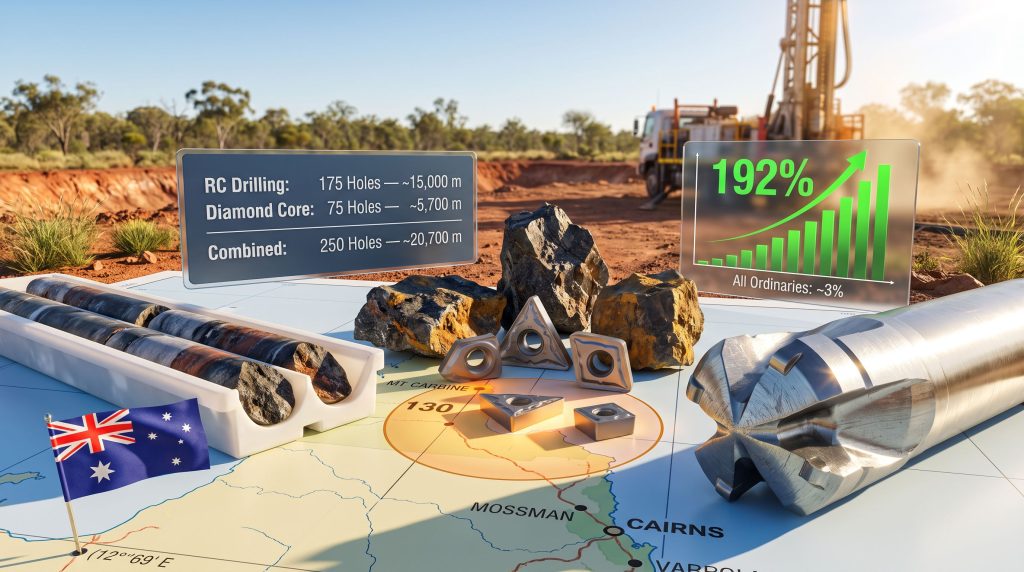
The Watershed drilling program sits firmly in the second category. The combined program encompasses 250 drill holes across approximately 20,700 metres, structured around two complementary methodologies:
| Drilling Method | Holes Planned | Total Metres | Primary Purpose |
|---|---|---|---|
| Reverse Circulation (RC) | 175 | ~15,000 m | Grade definition, resource confidence, infill sampling |
| Diamond Core (DD) | 75 | ~5,700 m | Metallurgical samples, geotechnical data, structural geology |
| Combined Program | 250 | ~20,700 m | Full project de-risking and mine plan refinement |
Why RC Drilling Dominates the Program by Volume
Reverse circulation drilling achieves its efficiency through a dual-tube system that returns drill chips to the surface inside the drill string, minimising contamination and sample dilution. In near-surface, unconsolidated, or moderately fractured rock environments, RC drilling delivers high sample volumes at lower cost per metre than diamond drilling, making it the logical tool for systematic infill programs across broad mineralised zones.
The 175 RC holes targeting 15,000 metres at Watershed are concentrated within the five highest-grade near-surface zones identified from prior drilling campaigns. This geographic concentration is a deliberate strategic choice. By tightening drill spacing to approximately 20 metres within these zones, the program generates the data density required under JORC 2012 to reclassify resources from Inferred to Indicated or Measured status.
Furthermore, interpreting drill results correctly is essential for investors seeking to understand what each progressive assay release actually means for the project's economic foundations.
Technical Note: Under the JORC Code 2012, the transition from Inferred to Indicated resource classification requires sufficient sampling to establish geological continuity with reasonable confidence. Drill spacing of 20 metres in a tungsten scheelite deposit with consistent structural controls is generally sufficient to meet this threshold, though the final determination depends on variogram analysis and the geological modelling approach adopted by the competent person.
The Role of Diamond Drilling in Engineering Confidence
Diamond drilling's value at this project stage lies not in its volume but in the quality of information it produces. Oriented diamond core provides three categories of data that RC chips fundamentally cannot:
-
Metallurgical composites: Bulk samples of representative ore types that can be subjected to bench-scale and pilot-scale processing tests, confirming tungsten trioxide (WO₃) recovery rates and concentrate grades under controlled conditions.
-
Geotechnical parameters: Measurements of rock quality designation (RQD), joint orientation, intact rock strength, and structural discontinuities that directly determine safe pit wall angles. A steeper allowable pit wall angle reduces the strip ratio, with significant implications for capital and operating costs.
-
Structural geology interpretation: Oriented core reveals the three-dimensional geometry of ore bodies and controlling fault structures. In addition, geological logging codes underpin the standardised classification systems used to record these observations consistently across all drill holes.
The 75 diamond holes targeting approximately 5,700 metres are therefore not a complement to RC drilling so much as a prerequisite for transitioning from resource estimation to mine engineering.
The Data Pipeline: From Drill Hole to Updated Mineral Resource Estimate
Understanding how raw drilling data becomes a JORC-compliant Mineral Resource Estimate illuminates why the October 2026 timeline for first assay results is meaningful, and why the subsequent compilation phase is equally important.
The process follows a structured sequence:
-
Sample collection and preparation at an accredited laboratory, with RC chips split using a riffle splitter and diamond core cut with a diamond saw to retain half for reference.
-
Assay analysis for WO₃ grade, typically using X-ray fluorescence (XRF) screening followed by acid digest and ICP-OES or ICP-MS for verification of high-grade intercepts.
-
Quality assurance and quality control (QAQC) protocols, including certified reference materials (standards), blanks inserted to detect contamination, and field duplicates to assess sampling precision.
-
Data validation and geological interpretation, integrating assay results with lithological logs and structural measurements.
-
Grade interpolation using geostatistical methods, most commonly ordinary kriging or multiple indicator kriging, to estimate grades in unsampled blocks within the resource model.
-
Classification of the resulting model under JORC 2012, with blocks assigned to Inferred, Indicated, or Measured categories based on data density and geological continuity.
-
Reporting of an updated Mineral Resource Estimate with confidence-classified tonnage and grade tables, reviewed and signed off by a qualified competent person.
Each stage introduces its own quality requirements and potential sources of uncertainty, which is precisely why the program's emphasis on QAQC protocols and dual drilling methodologies reflects industry best practice rather than procedural excess.
What the June 2026 Preliminary Economic Evaluation Established and Where It Falls Short
The PEE completed in June 2026 delivered what management described as strong outcomes, a characterisation that carries specific technical meaning within the project development hierarchy. A PEE sits between a Scoping Study and a Pre-Feasibility Study in the standard development framework, and its primary function is to test whether a project's economics are sufficiently robust to justify the substantially higher expenditure required for more detailed engineering.
Context for Investors: A PEE is not a bankable study. Capital cost estimates carry an accuracy range of approximately plus or minus 35 to 40 percent, and the study relies heavily on inferred resources and conceptual engineering assumptions. Its value lies in confirming economic viability at the concept level, not in providing the technical rigour required for project financing or a final investment decision.
The drilling program directly addresses the PEE's inherent limitations by:
-
Upgrading inferred resources to indicated and measured classification, satisfying the resource confidence threshold required for a Pre-Feasibility Study.
-
Replacing conceptual geotechnical assumptions with measured rock strength and structural data, enabling defensible pit slope designs.
-
Generating actual metallurgical test work results rather than relying on analogues from prior studies or comparable deposits.
-
Reducing capital cost estimate uncertainty from the PEE's characteristic plus or minus 35 to 40 percent band toward the plus or minus 15 to 25 percent range achievable at PFS level.
Project Development Timeline: Key Milestones Investors Should Track
| Development Milestone | Indicative Timing | Significance |
|---|---|---|
| Major drilling program commences | August 2026 | Initiates resource definition and geotechnical data collection |
| First assay results released | From October 2026 | Initial geological confidence signal |
| Assay results released periodically | October 2026 onward | Progressive resource model refinement |
| Updated Mineral Resource Estimate | Post-assay compilation | Upgraded JORC classification supporting PFS |
| Pit design and mine plan refinement | Concurrent with MRE update | Optimised mine sequence and capital cost inputs |
| Pre-Feasibility or DFS advancement | Subject to board approval | Bankable study required for project financing |
| Potential production commencement | Conditional on all approvals | Dependent on funding, approvals, and FID |
The Regulatory Head Start That Compresses the Development Timeline
One of the least discussed but most commercially significant characteristics of the Watershed Project is its existing regulatory tenure. Granted Mining Leases and an existing Environmental Authority for open-pit development represent milestones that typically consume three to seven years in the Australian regulatory environment, depending on jurisdiction complexity and community consultation requirements.
Consequently, Australian tungsten mining projects that have already cleared these regulatory hurdles possess a structural advantage that meaningfully compresses the risk-adjusted development timeline relative to greenfield alternatives. For Watershed, once a positive Final Investment Decision is reached, the pathway to construction commencement is not gated by regulatory uncertainty.
The next major ASX story will hit our subscribers first
How Watershed Compares Within the Non-Chinese Tungsten Pipeline
| Project | Country | Stage | Key Characteristics |
|---|---|---|---|
| Watershed | Australia (QLD) | Resource definition drilling | Granted leases, existing EA, post-PEE |
| Barruecopardo | Spain | Producing | Europe's only significant operating tungsten mine |
| Sangdong | South Korea | Commissioning/early production | Historic large-scale mine, significant reserves |
| Cantung | Canada | Care and maintenance | High-grade but remote, cost-challenged |
| Panasqueira | Portugal | Producing | Long-operating underground mine, constrained scale |
The non-Chinese tungsten development pipeline is notably thin. Barruecopardo and Panasqueira serve European demand but face the scale limitations inherent to older underground operations. Sangdong represents a credible large-scale alternative but is geographically and geopolitically positioned to serve Northeast Asian markets. Furthermore, Cantung's economics have historically struggled against the combined headwinds of remote logistics and moderate tungsten prices.
Watershed's combination of open-pit amenability, proximity to port infrastructure at Cairns, existing regulatory tenure, and advanced technical definition positions it as one of the more credible development-stage tungsten assets in the Western supply chain. For further context, industry commentary on the project's 2027 production target outlines the commercial conditions under which that timeline could be achieved.
Reading Drilling Results: What Investors Should Actually Monitor
A 250-hole drilling program will generate substantial volumes of data over several months. The challenge for investors is distinguishing signal from noise in a progressive disclosure environment. The following framework identifies the metrics most likely to determine whether the program confirms, upgrades, or disappoints relative to expectations embedded in the June 2026 PEE.
Investor Checklist: Evaluating Watershed Drilling Results
WO₃ grade consistency: Are reported intercepts confirming or exceeding the grade distribution assumed in the existing resource model?
Geological continuity: Do drill results demonstrate uninterrupted mineralisation between previously drilled sections, or are there unexpected gaps?
JORC reclassification progress: Is the proportion of Indicated and Measured resources increasing materially with each resource update?
Metallurgical recovery rates: Do diamond core test results confirm tungsten recovery rates consistent with or superior to prior bench-scale work?
Geotechnical outcomes: Do pit slope recommendations from oriented core support the strip ratio assumptions embedded in the PEE?
Understanding the Share Price Risk at This Project Stage
Tungsten Mining shares appreciated approximately 192% over the twelve months preceding the drilling announcement, a performance that stands in stark contrast to the All Ordinaries Index's roughly 3% gain over the same period. This magnitude of re-rating in advance of drilling results carries an asymmetric risk profile that deserves careful consideration.
When a company's share price has already incorporated significant optimism about project outcomes, the probability distribution of price responses to drilling results shifts. Results that confirm existing expectations may produce limited further upside, while results that disappoint carry substantially higher downside risk. This dynamic is particularly pronounced in small-cap resource stocks where the entire investment thesis is concentrated in a single asset.
However, a recent assessment of the Watershed Project's development potential provides broader market context for investors seeking to benchmark management's claims against independent industry commentary. Investors approaching Watershed at current valuations should consider what grade and continuity outcomes would need to be reported to justify current market pricing, and whether the project's economic sensitivity to tungsten price movements creates additional volatility risk independent of drilling outcomes.
Disclaimer: This article contains general information only and does not constitute financial advice. Investing in resource exploration companies involves significant risk, including the possibility of total loss of capital. Past share price performance is not indicative of future returns. Readers should seek independent financial advice tailored to their personal circumstances before making any investment decisions.
Frequently Asked Questions: Tungsten Mining Watershed Project Drilling Program
What is the total scale of the Watershed drilling program?
The current program encompasses 250 drill holes across two methodologies: 175 reverse circulation holes targeting approximately 15,000 metres, and 75 diamond drill holes targeting approximately 5,700 metres, combining for roughly 20,700 metres of total drilling.
When will the first drilling results be available?
Initial assay results from the RC component of the program are expected to be released from October 2026, with further results disclosed progressively as the program advances and assays are returned from the laboratory.
What distinguishes diamond drilling from RC drilling at this project stage?
RC drilling delivers high-volume, cost-efficient grade sampling across broad mineralised zones and is the primary tool for resource confidence building. Diamond drilling, however, serves a complementary but distinct function: producing oriented core for metallurgical test work, geotechnical pit slope analysis, and structural geological interpretation.
What regulatory approvals does Watershed already hold?
The project holds granted Mining Leases and an existing Environmental Authority for open-pit development, two of the most material regulatory milestones in Australian mining project development.
Why is tungsten supply diversification strategically important?
With China controlling approximately 80% of global tungsten output, Western governments and industrial consumers have recognised that single-source concentration in a mineral critical to defence, advanced manufacturing, and electronics creates unacceptable supply chain vulnerability. Development projects in geopolitically aligned jurisdictions therefore carry inherent strategic interest from potential offtake partners and financiers seeking to diversify procurement.
What is WO₃ and why does it matter for assay results?
Tungsten trioxide, or WO₃, is the standard reporting unit for tungsten grades in drill hole assays and resource estimates. It represents the oxidised form of tungsten and allows direct comparison between deposits and against benchmark economic thresholds. Higher WO₃ grades generally translate to lower processing costs per tonne of tungsten produced, making grade consistency across a deposit a primary determinant of economic viability.
Want to Stay Ahead of the Next Major ASX Mineral Discovery?
Discovery Alert's proprietary Discovery IQ model delivers real-time alerts the moment significant ASX mineral discoveries are announced — transforming complex data across 30+ commodities into clear, actionable investment insights for both short-term traders and long-term investors. Explore how historic discoveries have generated extraordinary returns on Discovery Alert's dedicated discoveries page, and begin your 14-day free trial today to position yourself ahead of the broader market.