
August 11, 2026
The Hidden Architecture of US Critical Minerals Containment
When governments decide that a commodity is too strategically important to leave to market forces alone, they rarely announce it with fanfare. Instead, they reach for existing legal instruments, apply them quietly, and let markets absorb the consequences. This pattern, visible across rare earths in the early 2010s and antimony more recently, is now playing out with US tungsten scrap export curbs. The metal sits at an unusual intersection of industrial ubiquity and military necessity, making it a natural target for supply chain intervention once policymakers decide the risk calculus has shifted.
Understanding what the US Bureau of Industry and Security has actually done with tungsten scrap requires separating the regulatory architecture from the market reaction, because the two are telling very different stories right now.
When big ASX news breaks, our subscribers know first
What the US Tungsten Scrap Export Curbs Actually Require
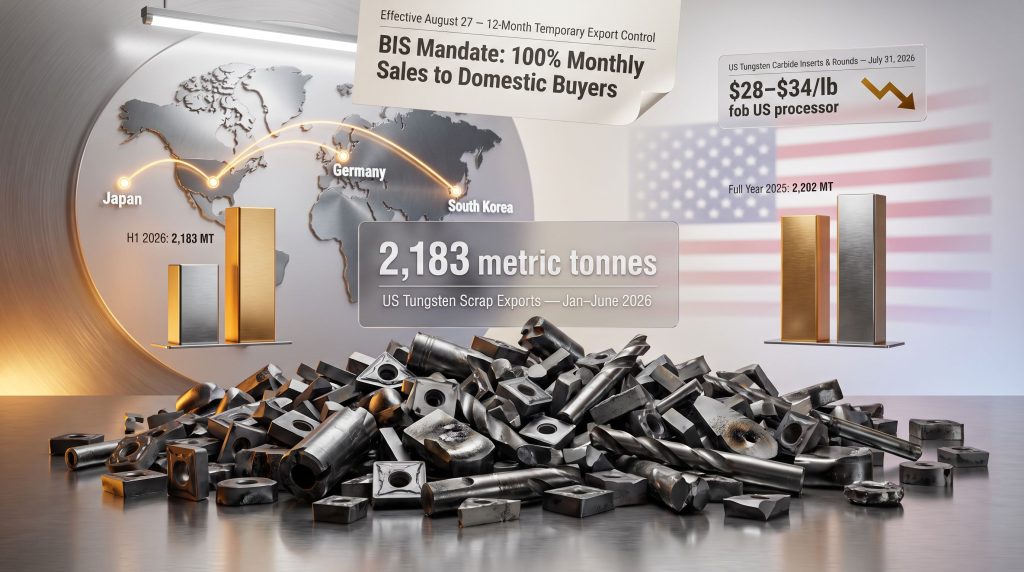
The BIS order, which takes effect on 27 August 2026, mandates that every domestic seller of tungsten waste and scrap direct 100 percent of their monthly sales volume to US-based buyers for a period of 12 months. The order also extends to battery black mass containing tungsten-bearing material, broadening its reach beyond conventional carbide scrap streams.
Critically, the restriction is not a permanent export ban. It functions as a temporary export control mechanism administered under Defense Production Act authority, with a case-by-case waiver pathway built into the framework from the outset.
| Feature | Detail |
|---|---|
| Restriction Type | Temporary export control |
| Duration | 12 months from 27 August 2026 |
| Governing Authority | US Bureau of Industry and Security / Defense Production Act |
| Domestic Allocation Requirement | 100% of monthly sales directed to US buyers |
| Waiver Availability | Yes, rolling case-by-case basis |
| Black Mass Coverage | Included in the order |
Policy Distinction: Multiple market participants and analysts have drawn attention to a critical nuance that some media coverage has missed. The legal mechanism is a temporary export restriction with an exemption pathway, not an absolute prohibition. The waiver structure is not an afterthought; it is a core design feature intended to manage transition-period disruption while the domestic processing base adapts.
The Scale of What Is Being Redirected
The trade volumes involved explain why the market reaction has been so sharp. US exports of tungsten waste and scrap reached 2,183 metric tonnes in just the first six months of 2026, according to Argus Media price assessments, a figure that nearly matched the 2,202 metric tonnes exported across the entirety of 2025. This trajectory suggests that pre-restriction export activity was accelerating, possibly as dealers front-ran the anticipated controls.
The three largest destinations for US tungsten scrap exports over this period were Japan, Germany, and South Korea, all of which operate significant tungsten carbide manufacturing and processing industries. Each of these countries now faces a material reduction in feedstock availability from a source they had come to rely on with increasing intensity. Furthermore, US critical minerals policy signals that this kind of supply-side intervention is likely to extend well beyond tungsten alone.
Why Scrap Exporters Became So Dependent on Asian Markets
The commercial logic that built this dependency is straightforward. Tungsten scrap, particularly spent carbide inserts and rounds, requires substantial processing infrastructure to convert into usable intermediate products such as ammonium paratungstate (APT) or tungsten oxide. The US has historically lacked the refining depth to absorb its own scrap generation, making export to well-capitalised Asian processing hubs the rational commercial choice.
- Asian processors, particularly in Japan and South Korea, operate at industrial scale with established chemical processing routes for carbide scrap recovery
- The economics of domestic processing versus export have consistently favoured export given the capital intensity of hydrometallurgical tungsten refining
- Long-term commercial relationships between US scrap dealers and overseas processors have reinforced this structural dependency over many years
- Domestic processors have, in many cases, focused on narrower product categories rather than building out full-cycle scrap-to-intermediate conversion capability
This is the infrastructure gap that the BIS order is now trying to close by force, rather than by incentive alone. According to reporting from Nikkei Asia, US tungsten scrap exports to Japan had already been soaring on the back of Chinese curbs, further illustrating how entrenched these trade flows had become.
The Domestic Processing Bottleneck: Policy Intent Versus Industrial Reality
Perhaps the most consequential dimension of the US tungsten scrap export curbs is the mismatch between what the regulation is designed to achieve and what the domestic processing sector is currently capable of delivering. Market participants have been direct about this tension.
Existing US tungsten processors are reported to be operating at or near maximum capacity, meaning they have limited ability to absorb additional scrap volumes even if those volumes are now legally required to remain onshore. This creates an immediate oversupply dynamic in the domestic market, with material that previously flowed to export channels having few viable domestic outlets in the near term.
Key Structural Insight: The restriction is specifically designed to stimulate domestic capacity development. However, the refining infrastructure needed to make that policy fully effective does not yet exist at sufficient scale. This creates a transitional window, potentially spanning multiple years, where the regulation's long-term intent and its near-term market consequences diverge significantly.
Joseph Miller, director at mining company Mission Critical Metals, has framed this as a question of capital deployment. He has noted that the US administration is working to encourage domestic processing capacity growth through measures of this kind. The critical question centres on whether funding from agencies such as the Department of Defense or the Department of Energy will be directed toward plant expansions or capability upgrades within existing US industry, drawing on the precedent established in the rare earths, antimony, and tin sectors. He has also cautioned that any meaningful new capacity is likely to take years to develop, with incremental expansion by established processors being the most probable near-term pathway.
This is a pattern well-documented in critical mineral policy literature. The rare earths sector provides the clearest precedent: regulatory and commercial pressure to reshore processing capability existed for years before sufficient capital was mobilised to make it a reality, and even then, government co-investment was required to make the economics viable.
Tungsten Carbide Scrap Prices: What the Market Is Already Pricing In
The pricing data tells the story of a market that began absorbing the policy shock well before the effective date. Argus assessed US tungsten carbide inserts at $28-34/lb fob US processor as of 31 July 2026, representing the lowest price levels recorded in 2026. Month-over-month declines were steep: inserts fell 13 percent and rounds fell 12 percent over the same period.
The mechanics driving this are not complicated. Large processors, operating near capacity, had adequate near-term inventory and were not actively seeking new purchases. Exporters, facing the imminent loss of their primary market outlets, found few willing domestic buyers at the volumes and prices they had previously commanded. The result was a buyers' market in a commodity that had previously enjoyed relatively stable demand.
Pre-Implementation Market Behaviour
The trading patterns in the weeks immediately preceding the 27 August effective date reveal the psychology of a market in transition:
- Buyers and sellers broadly adopted a wait-and-see posture while implementation details of the controls remained unclear
- Spot purchases were limited to small volumes under 10,000 lbs, predominantly to fulfil existing contractual orders before controls activated
- Most exporters avoided placing new orders pending regulatory clarity on waiver processes
- The lack of clarity around exemption criteria created a chilling effect on commercial activity well beyond what the regulation itself technically required
Price Scenario Framework
| Time Horizon | Expected Price Direction | Primary Driver |
|---|---|---|
| Near-term (0-3 months) | Downward pressure | Domestic oversupply, limited processing absorption capacity |
| Medium-term (3-12 months) | Possible stabilisation | Waiver grants, processor capacity adjustments, demand normalisation |
| Long-term (12+ months) | Potential recovery | New domestic processing capacity, tighter domestic supply balance |
Disclaimer: Price forecasts involve inherent uncertainty and should not be treated as investment advice. Market outcomes will depend on regulatory implementation details, waiver grant rates, and macroeconomic conditions that cannot be predicted with precision.
Understanding the Waiver Framework and Defense Demand Anchor
The exemption mechanism is where the practical operation of the US tungsten scrap export curbs will ultimately be determined. Industry participants broadly expect that waivers will be granted primarily for material shipped overseas for processing and refining, provided that refined tungsten units are returned to the US market after conversion. This creates a processed-return loop that serves the policy's underlying objective of retaining tungsten value within the domestic supply chain without completely severing existing processing relationships.
Additional exemptions are anticipated in circumstances where US defense supply requirements have been demonstrably satisfied first, establishing defense demand as the effective priority threshold for the entire framework.
The scale of that defense demand anchor was illustrated on 27 July 2026, when the US Defense Logistics Agency published a Request for Information seeking data on the potential future acquisition of up to 200 metric tonnes of tungsten hard scrap. It is important to note that an RFI is an information-gathering exercise only and does not commit the DLA to issuing a formal tender. However, its timing relative to the BIS order signals a coordinated effort to establish domestic military supply assurance before export restrictions took effect.
According to Argus Tungsten Analytics estimates for 2025, the defense sector accounts for approximately 10 percent of global tungsten consumption, with the automotive sector remaining the largest demand source globally. Consequently, while defense is the policy's north star, the commercial ecosystem surrounding the controls is overwhelmingly civilian in character.
The next major ASX story will hit our subscribers first
Global Trade Flow Realignment: Who Loses and Who Benefits
The immediate geographic impact of the US tungsten scrap export curbs falls most heavily on the three countries that built significant import dependency on US scrap flows.
Countries facing the most significant supply disruption:
- Japan has historically been the largest single recipient of US tungsten scrap exports and operates a substantial carbide tooling and hard metals manufacturing sector that relies on secondary feedstock
- Germany maintains a significant tungsten processing and carbide manufacturing base, particularly for precision cutting tools and industrial machinery components
- South Korea is an active consumer of tungsten intermediates for industrial tooling, with integrated manufacturing operations that blend primary and secondary feedstock
Potential beneficiaries of constrained US scrap availability:
- Alternative scrap-producing nations capable of filling gaps in Asian supply chains, including European scrap aggregators
- Domestic US processors with existing capacity and established customer relationships, who gain preferential access to a constrained feedstock supply
- Companies pursuing new US-based tungsten processing or refining projects, particularly those with strategic tungsten supply arrangements already in place
The China Variable
The policy's explicit strategic logic includes reducing US exposure to Chinese tungsten supply chains. China has consistently accounted for the dominant share of global primary tungsten mine output, with USGS Mineral Commodity Summaries data placing Chinese production at well above 80 percent of global supply in the early-to-mid 2020s.
This concentration means that the secondary, or recycled, tungsten loop represents one of the few near-term levers available to Western economies seeking to reduce structural dependence on Chinese primary supply without waiting the decade or more that new mine development typically requires. By retaining tungsten scrap domestically, the US is essentially treating its recycling stream as a strategic reserve — a concept borrowed from the rare earths and battery materials playbooks but applied here to a metal whose defense applications include kinetic energy penetrators, radiation shielding, and high-performance cutting tools for aerospace manufacturing.
Is This a Template for Other Critical Materials?
The tungsten restriction did not emerge in isolation. It follows a recognisable sequence of policy interventions applied progressively to critical minerals where China's market dominance creates a supply security concern. In addition, antimony shortage risks have followed a remarkably similar trajectory, and the military antimony demand picture closely mirrors what is now unfolding in tungsten. Furthermore, as reported by the Wall Street Journal, the US ban on exports of recycled battery metals and tungsten reflects a broader containment strategy that is accelerating across multiple commodity classes.
The sectors most likely to see analogous interventions in coming years are those where:
- Primary production is geographically concentrated in a single country or small group of countries perceived as strategically adversarial
- Domestic scrap and recycling streams exist at meaningful scale but are currently exported rather than processed domestically
- Defense applications are well-established, providing the legal and political justification for Defense Production Act deployment
- Processing infrastructure gaps are significant enough that a mandatory domestic allocation requirement would generate both oversupply dislocation and investment incentive simultaneously
Tungsten carbide tooling, tungsten wire for lighting and electronics, and high-density tungsten alloys used in defense munitions all fit this profile, suggesting that the current export restriction may be the opening move in a longer sequence of market interventions rather than a one-off measure.
Frequently Asked Questions: US Tungsten Scrap Export Controls
What exactly do the US tungsten scrap export curbs require?
Effective 27 August 2026, all domestic sellers of tungsten waste, tungsten scrap, and battery black mass must direct 100 percent of their monthly sales to US-based buyers. The restriction runs for 12 months and is administered by the Bureau of Industry and Security under Defense Production Act authority.
Is this an outright export ban?
No. The mechanism is a temporary export control with a built-in waiver pathway. Companies can apply for case-by-case exemptions, particularly where material is being sent overseas for processing with the intention of returning refined tungsten units to the US.
Why are tungsten carbide scrap prices falling when supply is being retained domestically?
Domestic processors are operating near maximum capacity and cannot absorb the additional material that previously flowed to export markets. The result is near-term oversupply in a market without sufficient domestic processing depth to clear it at existing prices.
Which countries are most exposed to the supply disruption?
Japan, Germany, and South Korea — the three largest recipients of US tungsten scrap in the first half of 2026 — face the greatest feedstock disruption. Combined, these three markets absorbed the bulk of the 2,183 metric tonnes exported between January and June 2026.
How long before the domestic processing capacity gap closes?
Industry analysis suggests meaningful new refining capacity could take several years to develop. Near-term relief is most likely to come from incremental expansion by existing processors, potentially supported by Department of Defense or Department of Energy funding mechanisms, following precedents established in the rare earths and antimony sectors.
Key Takeaways for Industry Participants and Investors
- The BIS restriction is a strategic supply chain intervention with a defined 12-month horizon, not a permanent trade barrier, though its effects on commercial relationships may prove more durable
- Near-term market dislocation is already underway, with prices at 2026 lows and commercial activity suppressed by regulatory uncertainty ahead of the effective date
- The waiver mechanism will be the decisive variable in determining how severely export-dependent businesses are affected during the transition period
- Defense demand is the policy's calibration instrument: the DLA's interest in securing up to 200 metric tonnes of tungsten hard scrap signals that military supply assurance will govern how exemptions are prioritised
- Long-term commercial opportunity exists for domestic processors, recyclers, and investors prepared to commit capital to US tungsten refining infrastructure, particularly if government co-investment follows the pattern established in adjacent critical mineral sectors
- Investors should treat current price weakness as a transition-period phenomenon rather than a structural repricing, while recognising that the timeline to capacity rebalancing carries genuine uncertainty
This article is intended for informational purposes only and does not constitute financial or investment advice. Forecasts and scenario analyses involve inherent uncertainty, and readers should conduct independent due diligence before making any commercial or investment decisions. For independent price assessments and market intelligence on tungsten and related critical minerals, Argus Media publishes regularly updated analysis at argusmedia.com.
Want to Stay Ahead of the Next Major Critical Minerals Discovery on the ASX?
Discovery Alert's proprietary Discovery IQ model scans ASX announcements in real time, instantly identifying actionable opportunities across tungsten, rare earths, and more than 30 other commodities — turning complex mineral data into clear, timely insights for investors at every level. Explore how historic mineral discoveries have generated substantial returns on Discovery Alert's dedicated discoveries page, and begin your 14-day free trial today to position yourself ahead of the broader market.