
August 11, 2026
The Hidden Architecture of US Critical Minerals Policy — And Why Mexico Keeps Missing Out
When industrial policy shifts from optimising trade efficiency to securing supply chain sovereignty, the rules governing capital allocation change fundamentally. The United States is now deep inside that transition. Federal agencies are no longer evaluating mineral investment opportunities purely on economic merit — they are building a strategic industrial architecture designed to function independently of Chinese processing infrastructure. Understanding that shift explains not only where Washington's latest wave of capital landed, but why US critical minerals funding excludes Mexico despite the country sitting atop one of the hemisphere's most impressive mineral endowments.
When big ASX news breaks, our subscribers know first
China's Processing Chokehold and Why Washington Is Building Around It
The strategic logic driving Washington's current spending spree is not primarily about mine output. It is about processing capacity. China controls roughly 70% of global mineral refining capacity and an estimated 91% of rare earth processing infrastructure worldwide. This gives Beijing leverage at the point in the supply chain where raw ore becomes usable industrial material — the conversion step that determines whether a battery cell, a permanent magnet, or an aerospace alloy can actually be manufactured.
China rare earth restrictions have temporarily eased through a trade truce on exports of rare earths and magnets, but the underlying dynamic remains unresolved. Washington's response has been to finance what policymakers describe as a mine-to-magnet supply chain: an end-to-end domestic and allied-nation pathway that processes materials without touching Chinese facilities at any stage. That framing reorients the entire funding logic from trade partnership toward defence readiness, and it explains why eligibility criteria for federal programmes lean heavily toward US-domiciled entities and formal treaty allies.
The deeper strategic point is that China's dominance sits in refining, not extraction. Nations like Mexico can possess world-class ore bodies and still be peripheral to Washington's supply chain calculus if the processing infrastructure connecting mine output to finished components remains absent.
Furthermore, it is worth noting that rare earth supply chains have become a central focus of US industrial policy, reflecting how profoundly the geopolitical stakes have shifted since 2020.
Breaking Down the US$3 Billion: Where the Capital Actually Went
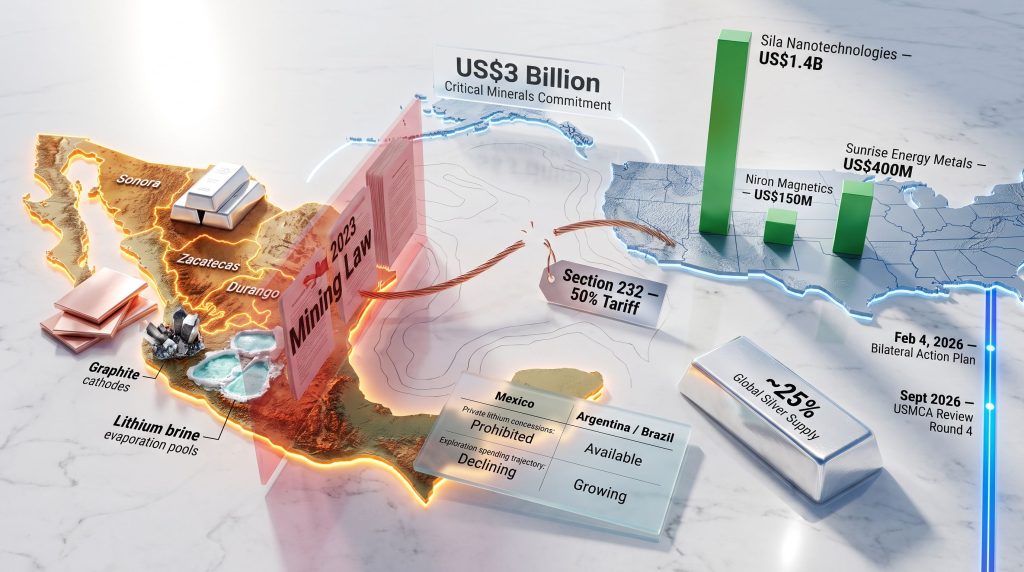
On August 7, 2026, a package totalling close to US$3 billion in federal loans, equity positions, and grants was announced, targeting domestic and allied-nation critical minerals projects across the battery, magnet, and mining workforce sectors. President Trump framed the announcement explicitly around domestic industrial production, with senior cabinet officials including the Secretary of Interior, Secretary of State, and Secretary of Commerce present alongside executives from major mining and materials companies.
The allocation breakdown reveals the strategic priorities embedded within the package:
| Recipient / Project | Funding Type | Amount | Mineral Focus | Location |
|---|---|---|---|---|
| Sila Nanotechnologies | DoD Conditional Loan | US$1.4 billion | Silicon anode / graphite substitute | USA |
| Sunrise Energy Metals | DoD Conditional Loan | US$400 million | Scandium | Australia |
| Niron Magnetics | DoD Conditional Loan | US$150 million | Rare-earth-free permanent magnets | Minnesota, USA |
| Ivanhoe Electric (Santa Cruz) | EXIM Bank | US$1 billion+ | Copper | Arizona, USA |
| Alabama Graphite Project | EXIM Bank | US$25 million | Graphite | Alabama, USA |
| Westwater / Global Advanced Metals / 5E Advanced Materials | EXIM Bank | US$58 million (combined) | Mixed critical minerals | USA |
| Mining Workforce & Education Programs | Federal Grants | US$180 million | Sector-wide | USA |
Why Silicon Anodes Captured the Largest Single Allocation
The US$1.4 billion directed to Sila Nanotechnologies is the package's most technically revealing line item. Silicon-based anode material addresses one of the most persistent constraints in lithium-ion battery performance: graphite dependency. Conventional anodes rely on graphite, of which China controls dominant processing capacity. Silicon anodes offer higher energy density and reduce that specific dependency simultaneously.
This investment reflects a layered strategic calculus: funding a material that improves battery performance while also reducing reliance on a Chinese-controlled input is more valuable than addressing either objective independently. It is, consequently, a structural hedge embedded within a single capital commitment.
The Pentagon as a Critical Minerals Capital Allocator
The Defence Department's Office of Strategic Capital is now functioning as an industrial bank for supply chain security. Federal agencies have collectively committed upward of US$10 billion toward domestic rare earth and permanent magnet capacity since the Pentagon's initial US$400 million preferred equity stake in MP Materials. The August 2026 package extends that campaign rather than initiating it, confirming a multi-year structural programme with compounding momentum.
The inclusion of Sunrise Energy Metals in Australia demonstrates that the programme is not strictly restricted to US soil — it extends to formal allies operating within trusted supply frameworks. This distinction matters for understanding Mexico's position, which sits in a separate and more ambiguous category. In addition, Trump's critical minerals order has provided the broader executive mandate underpinning these successive funding commitments.
US Critical Minerals Funding Excludes Mexico — But Not for the Reasons Commonly Assumed
Program Eligibility vs. Geopolitical Exclusion
A critical and frequently misunderstood distinction separates two different questions. The first is whether US domestic funding programmes are available to Mexico-based projects. The second is whether the US-Mexico bilateral relationship on critical minerals is active or dormant.
On the first question, the answer is largely structural. Programmes administered by the Department of Defence's Office of Strategic Capital and the Export-Import Bank are generally structured around US-domiciled entities, with foreign applicants requiring specific waivers or allied-nation designations. Mexico does not currently hold the formal security and supply chain partnership classifications that would routinely unlock these mechanisms.
This is a programme eligibility constraint, not a deliberate geopolitical punishment. The distinction matters because it changes the policy prescription: Mexico cannot solve this problem by lobbying for inclusion on a single funding list. It needs to build the regulatory and treaty architecture that would change its classification.
The February 2026 Action Plan: Promising Framework, No Capital
The Mexico-US Action Plan on Critical Minerals, signed on February 4, 2026, identified five priority minerals for joint development:
- Copper
- Silver
- Lithium
- Graphite
- Zinc
The framework outlined cooperation mechanisms including geological data sharing between the US Geological Survey and its Mexican counterpart, coordinated stockpiling strategies, and border-adjusted price floors on mineral imports from third countries. A 60-day implementation window was set, closing on April 5, 2026.
That window closed without binding capital commitments materialising. The action plan is a policy framework, not a treaty, and it carries no legal obligation on either signatory to deploy funds or advance specific projects. Mexico attended the 2026 Critical Minerals Ministerial but was not among the eleven nations that signed the memoranda concluded at the event.
What the August 2026 package demonstrates, in contrast, is what binding commitment actually looks like: conditional loans with drawdown schedules, equity positions with named offtakers, and capital that moves to specific projects on defined timelines. The gap between a non-binding action plan and that structure is the gap Mexico currently occupies.
Washington is simultaneously advancing coordinated supply arrangements with the European Union, including minimum pricing mechanisms and joint investment vehicles. If those frameworks consolidate around partners other than Mexico, the bilateral window narrows further.
Mexico's Mineral Endowment: World-Class Geology, Self-Imposed Capital Constraints
The Numbers Behind the Missed Opportunity
Mexico's geological position is objectively strong. The country ranks in the global top 15 for 19 minerals, with 12 of those appearing on the US critical minerals list. It supplies approximately one-quarter of global silver production and hosts significant copper, zinc, and graphite resources across its northern and central states.
The CAMIMEX industry association has projected that a coherent critical minerals policy framework could attract US$43 billion in investment by 2030 and generate 500,000 jobs across the sector. Pedro Rivero, President of CAMIMEX, has stated that fully integrating mining within the USMCA framework represents a matter of economic security for the entire North American region. However, the gap between that potential and the current trajectory is captured in a single set of numbers:
| Indicator | Current Status |
|---|---|
| Minerals in global top 15 | 19 |
| Minerals on US critical list | 12 |
| Share of global silver supply | ~25% |
| Exploration spending (2023) | Above US$500 million |
| Exploration spending (current trajectory) | Approaching US$400 million |
| LitioMx 2026 operating budget | MX$13.9 million (~US$805,000) |
| Concessions cancelled by government | ~1,200 |
| Land area of recovered concessions | 889,512 hectares |
| Stalled projects inherited by Ministry of Economy | 176 |
| Projects resolved by Ministry of Economy | 110 |
| Pipeline value unlocked through permitting | US$11 billion |
| CAMIMEX projected investment potential by 2030 | US$43 billion |
| Projected job creation under coherent policy | 500,000 |
Lithium: Mexico's Most Constrained Critical Mineral
Lithium presents the starkest case of policy-created constraint. Following its constitutional designation as a state monopoly, private concessions in lithium are closed entirely to market participants. LitioMx, the state entity responsible for development, has operated for three consecutive years without project-level capital. Its 2026 budget of approximately US$805,000 covers operating expenses only, leaving no funding pathway for exploration, delineation, or production development.
No new concession titles have been issued under this framework. For a mineral that sits at the centre of both the US critical minerals list and the bilateral action plan's stated priorities, this represents a foundational contradiction: Mexico cannot credibly offer lithium as a joint development opportunity while simultaneously prohibiting the investment structures that would make development viable.
The Regulatory Vacuum Compounding Investment Risk
Beyond lithium, the broader regulatory environment creates compounding uncertainty. The implementing regulations for the 2023 Mining Law reform remain unpublished, leaving operators to function under the prior legal framework. Foreign investors attempting to model project risk face an unusual challenge: they must assess compliance against a law whose enforcement mechanisms have not been formally defined.
Approximately 1,200 concessions have been cancelled, and 889,512 hectares of previously titled land has been recovered by the federal government. Exploration spending has declined from above US$500 million in 2023 toward US$400 million as capital has rotated toward more predictable jurisdictions.
How Regulatory Ambiguity Is Redirecting Capital to Argentina and Brazil
The capital migration away from Mexico is not hypothetical. Argentina and Brazil both offer structured investment incentive regimes with published regulatory frameworks and active concession issuance. The competitive differential is significant:
| Factor | Mexico | Argentina | Brazil |
|---|---|---|---|
| Private lithium concessions | Prohibited (state monopoly) | Available | Available |
| Investment incentive framework | Non-binding action plan | Structured regime | Structured regime |
| 2023 mining reform regulations published | No | N/A | N/A |
| New concession issuance | Suspended | Active | Active |
| Exploration spending trajectory | Declining | Growing | Growing |
Capital that might otherwise have priced Mexican projects is being absorbed by jurisdictions that offer greater regulatory legibility. For exploration-stage companies weighing portfolio allocation decisions, the choice between a clearly defined incentive regime and an unpublished regulatory framework is not a difficult one — particularly when the downside scenario involves concession cancellation without clear legal recourse.
The permitting progress the Ministry of Economy has achieved — resolving 110 of 176 inherited stalled projects and unlocking an estimated US$11 billion pipeline concentrated in Zacatecas, Sonora, and Durango — demonstrates genuine administrative capacity. However, procedural normalisation and a competitive investment framework are different instruments. The former clears existing backlogs; the latter creates conditions for new capital entry at scale.
The next major ASX story will hit our subscribers first
The Section 232 Paradox: Taxing the Minerals Washington Wants Most
One of the less-discussed structural contradictions in the US-Mexico minerals relationship is the simultaneous pursuit of supply chain integration and the maintenance of Section 232 tariffs of 50% on copper, steel, and aluminium products crossing the border. The broader US-Australia tariff dispute offers a useful parallel — demonstrating that even close allies are not immune to Washington's blunt tariff instruments.
Mexican exports to the United States reached US$298.2 billion in the first half of 2026, a 13% year-on-year increase, demonstrating the depth of trade integration across the two economies. Yet the specific minerals Washington is most urgently seeking to secure within a regional supply chain are precisely the ones subject to the steepest border costs when sourced from Mexico.
This creates a structural contradiction that bilateral action plans cannot resolve on their own: the minerals framework signals partnership intent while the tariff structure imposes cost penalties that undermine the economic case for sourcing those same minerals from Mexico rather than domestic US production. Furthermore, the critical minerals demand surge globally only intensifies these contradictions, as Washington's urgency grows while its policy levers remain internally inconsistent.
September 2026: A Converging Policy Inflection Point
Two separate policy calendars are converging in September 2026, and their interaction will significantly shape the trajectory of North American critical minerals supply chains.
-
USMCA Review Round 4 opens in the first week of September, under the annual review cycle triggered when the United States declined a 16-year extension on July 1, 2026. Whether critical minerals receive formal trade framework recognition within USMCA — a position CAMIMEX has explicitly advocated — will depend partly on the regulatory signals Mexico sends before those talks close.
-
US-China diplomatic engagement is expected to intensify in September, with Chinese President Xi Jinping anticipated in Washington. The durability of the current trade truce on rare earth export controls, and the potential for those controls to be reimposed, will affect how urgently Washington pursues alternative supply arrangements — and how much leverage that urgency gives Mexico.
The intersection of these two calendars creates a narrow window. If Mexico's regulatory environment sends credible signals of framework stability before USMCA talks advance, the minerals agenda could be formally embedded within the trade agreement's structure. If it does not, the consolidation of US supply arrangements around formal treaty allies and structured bilateral agreements risks leaving Mexico in a permanent observer role — resource-rich, but capital-constrained.
What a Credible Mexican Critical Minerals Framework Would Require
Five regulatory and policy conditions would materially change Mexico's position in the eyes of foreign capital. According to analysis from the Energy Policy Institute at Columbia University, the US is actively internationalising its critical minerals industrial policy — meaning the window for Mexico to establish itself as a credible partner is narrowing as other nations move faster.
-
Publication of the 2023 Mining Law implementing regulations, providing a stable and finalised legal operating environment that investors can model against.
-
Restructuring of the lithium state monopoly to allow structured private participation under defined sovereign oversight conditions — without requiring full privatisation.
-
Capitalisation of LitioMx beyond annual operating budgets, with project-level funding tied to defined exploration and development milestones.
-
Resumption of concession issuance under a transparent, time-bound permitting framework with clear eligibility criteria and appeal mechanisms.
-
Conversion of the bilateral action plan into a binding investment instrument with drawdown schedules and named offtakers, mirroring the structural commitments Washington has made to domestic and Australian projects.
None of these conditions require abandoning the constitutional framework around lithium or the core principles of the 2023 mining law reform. They require operational specificity — the translation of policy intent into investable structure. Consequently, the Carnegie Endowment's research on securing America's critical minerals supply underscores that Washington will gravitate toward partners who can demonstrate exactly that kind of regulatory credibility.
FAQ: US Critical Minerals Funding and Mexico's Position
Does the US have a binding critical minerals agreement with Mexico?
No. The February 2026 action plan is a non-binding cooperation framework identifying five priority minerals and outlining data-sharing and coordination mechanisms. It carries no attached capital and imposes no binding obligations on either government.
Why does US critical minerals funding exclude Mexico in practice?
Most US federal critical minerals programmes restrict eligibility to US-domiciled entities, with allied-nation access requiring specific classifications that Mexico does not currently hold. The August 2026 package reflects these eligibility structures, not a deliberate geopolitical exclusion.
What minerals does Mexico supply that are on the US critical list?
Mexico ranks in the global top 15 for 19 minerals, 12 of which appear on the US critical minerals list. Priority minerals in the bilateral action plan include copper, silver, lithium, graphite, and zinc. Mexico contributes approximately 25% of global silver supply.
What is the current status of LitioMx?
LitioMx is Mexico's state-owned lithium entity. Its 2026 operating budget is approximately US$805,000, covering administrative costs only. This is the third consecutive year without project-level capital allocation, meaning no funded development activities are currently underway.
How do Section 232 tariffs affect regional supply chain logic?
Section 232 duties of 50% apply to copper, steel, and aluminium products exported from Mexico to the United States. This imposes a direct cost barrier on the minerals most central to Washington's supply chain security objectives, creating a tension between tariff policy and the stated goal of regional minerals integration.
What happens at USMCA negotiations in September 2026?
The fourth review round opens in early September under the annual cycle triggered when the US declined a 16-year extension on July 1, 2026. Whether critical minerals receive formal recognition within the USMCA framework depends significantly on the regulatory and policy signals Mexico sends before those talks close.
Readers seeking ongoing coverage of Mexican mining sector developments and bilateral trade dynamics can access related reporting through Mexico Business News at mexicobusiness.news/mining.
This article contains forward-looking projections, including investment potential estimates and job creation forecasts, which are subject to change based on regulatory, political, and market conditions. Nothing in this article constitutes investment advice.
Want to Track the Next Major ASX Mineral Discovery Before the Broader Market Does?
As Washington races to secure critical mineral supply chains and capital floods into strategic commodities, Discovery Alert's proprietary Discovery IQ model delivers real-time notifications on significant ASX mineral discoveries — instantly turning complex geological and market data into actionable investment insights. Explore historic discoveries and their extraordinary returns, then begin your 14-day free trial at Discovery Alert to position yourself ahead of the market.