
August 10, 2026
Africa's Refining Paradox: Why the Continent That Exports Crude Imports Fuel
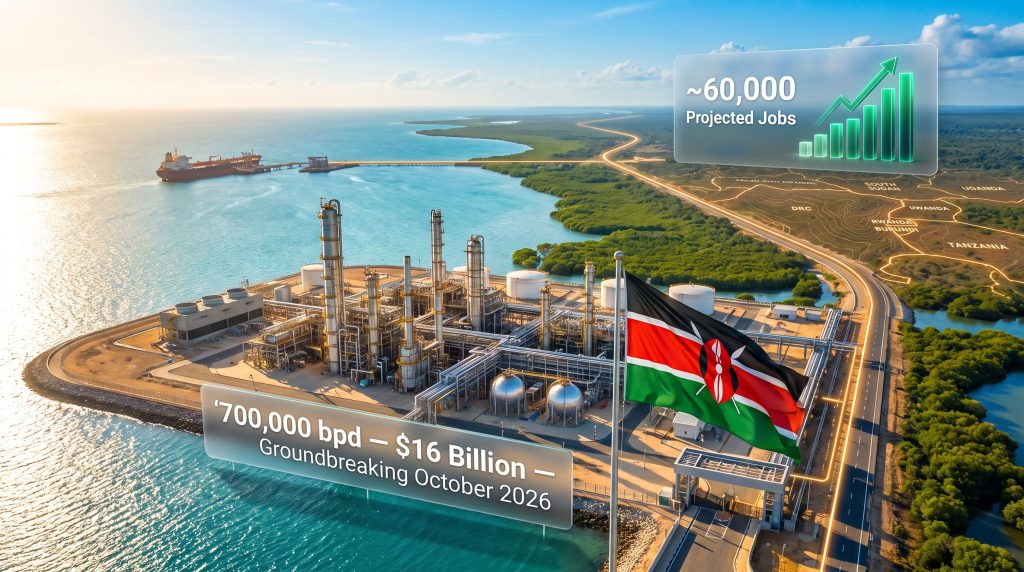
Africa sits atop some of the world's most significant crude oil reserves, yet for decades the continent has exported raw barrels to overseas refineries only to buy back refined petroleum products at a substantial premium. This structural imbalance has cost African economies hundreds of billions of dollars in lost value-add, inflated fuel prices for consumers, and created chronic supply vulnerabilities that ripple through transport, agriculture, and manufacturing alike. The planned Dangote Kenya refinery in Lamu represents one of the most ambitious attempts yet to reverse this dynamic on the continent's eastern flank.
Understanding what this project could mean requires looking beyond a single investment announcement. It demands an examination of East Africa's energy infrastructure deficit, the economic logic of locating a mega-refinery at Lamu, the financing architecture required to make it viable, and the very real environmental and social risks that could determine whether October 2026's groundbreaking becomes a turning point or another delay.
When big ASX news breaks, our subscribers know first
The Strategic Logic Behind Choosing Lamu as East Africa's Next Refining Hub
Why Lamu's Geography Makes It Uniquely Suited for a Mega-Refinery
Coastal geography is not the only reason Lamu was selected as the site for what would become East Africa's largest refinery. The town's deep-water port infrastructure already handles significant cargo volumes and is physically capable of accommodating very large crude carriers, the class of vessels required to supply a facility processing 700,000 barrels of crude oil per day. Few ports along the East African coastline offer both the depth and the surrounding land availability that a refinery of this scale demands.
What makes Lamu particularly compelling from an industrial planning perspective is the combination of port access, available land for construction, and its position at the southern anchor of an overland infrastructure corridor stretching northward through Kenya toward South Sudan and Ethiopia.
The LAPSSET Corridor: How Infrastructure Connectivity Amplifies the Refinery's Regional Reach
The Lamu Port-South Sudan-Ethiopia Transport (LAPSSET) Corridor is the infrastructural backbone that transforms the Lamu refinery from a national project into a continental one. Designed to connect Kenya's coast with landlocked markets via road, rail, and pipeline, LAPSSET gives refined products a delivery pathway into Uganda, South Sudan, Rwanda, Burundi, and the eastern Democratic Republic of Congo.
For deeply landlocked markets like Rwanda and Burundi, where supply chain distances from coastal ports already inflate fuel prices significantly, access to a domestic refinery through pipeline and road logistics could meaningfully compress end-consumer costs. The same applies to South Sudan, whose conflict-affected energy infrastructure leaves it highly dependent on external fuel supply with limited negotiating leverage over pricing.
It is worth noting, however, that LAPSSET has faced its own delays and community consultation shortcomings historically, factors that have periodically slowed the corridor's development and remain relevant to the refinery's timeline assumptions.
Comparing Lamu to Mombasa: Why Kenya's Refining Capacity Gap Created This Opportunity
Kenya has had no domestic crude refining capacity since the closure of the Mombasa refinery, leaving the entire country reliant on imported refined petroleum products. This structural gap is not merely a logistical inconvenience. It means Kenya's fuel supply is entirely subject to international refining margins, shipping costs, and the pricing power of overseas suppliers.
Furthermore, every price shock in global refined product markets passes directly through to Kenyan consumers and businesses with no domestic buffer. The Lamu refinery, if completed, directly addresses this vulnerability. Kenya is also exploring domestic oil production in the Turkana basin, which creates the longer-term possibility of a vertically integrated domestic energy chain from extraction to refining to distribution, though Turkana production development remains at an early stage.
What Are the Core Project Specifications of the Dangote Lamu Refinery?
Capacity, Cost, and Scale: Breaking Down the $16 Billion Project
| Project Parameter | Detail |
|---|---|
| Planned Processing Capacity | 700,000 barrels of crude oil per day |
| Revised Project Cost Estimate | ~$16 billion (reduced from ~$17 billion) |
| Anticipated Construction Timeline | Less than 4 years from groundbreaking |
| Planned Groundbreaking | October 2026 |
| Financing Structure | ~30% equity / ~70% debt |
| Projected Direct and Indirect Jobs | ~60,000 (Kenyan government estimate) |
| Target Markets | Kenya, Uganda, Tanzania, South Sudan, Rwanda, Burundi, DRC |
The scale of this investment is difficult to contextualise without reference points. At $16 billion, the Lamu refinery represents one of the largest single private infrastructure investments ever proposed for East Africa. The projected employment figure of 60,000 direct and indirect jobs, as estimated by the Kenyan government, would span construction, engineering, logistics, and downstream service industries, making the social and economic footprint of the project potentially transformative for the region.
How Does the Lamu Refinery Compare to Dangote's Lagos Facility?
| Metric | Lagos Refinery | Lamu Refinery (Planned) |
|---|---|---|
| Current Capacity | 650,000 bpd | 700,000 bpd (at completion) |
| Projected Expanded Capacity | 1.4 million bpd (within 3 years) | TBD |
| Geographic Role | West African supply anchor | East and Central African supply anchor |
| Operational Status | Operational | Pre-construction (groundbreaking Oct 2026) |
| Continental Ranking | Largest on continent (current) | Second-largest (upon completion) |
The Lagos refinery, which currently processes 650,000 barrels per day and is slated to expand to 1.4 million barrels per day within three years, serves as both a benchmark and a blueprint. Its operational experience has provided the engineering, procurement, and project management learnings that directly informed the design and cost architecture of the Lamu project.
How Did Dangote Reduce the Refinery's Cost by $1 Billion?
Lessons Transferred From the Lagos Refinery Construction Experience
The reduction from approximately $17 billion to $16 billion before ground has even been broken is significant and worth examining carefully. Large-scale refinery projects rarely get cheaper as they progress. Cost reductions at the pre-construction stage typically reflect improvements in engineering design, procurement efficiency, or supply chain organisation.
In this case, the Lagos refinery, despite its well-documented construction delays and cost overruns during development, functioned as a real-world proving ground for exactly the kind of complex procurement and logistics challenges that define a project of this magnitude. According to reporting by Business Insider Africa, the project has already encountered early land and logistics challenges, making these cost-reduction efforts all the more consequential.
The learnings extracted from Lagos include optimised modular construction sequencing, improved vendor relationships that compress procurement timelines, and better management of the interface between marine logistics and onshore construction activities.
The Role of Accelerated Execution Timelines in Compressing Capital Expenditure
One of the less obvious levers for reducing total project cost at this scale is timeline compression. A refinery project carries substantial financing costs during construction, the period before any revenue is generated to service debt. Every month shaved from the construction schedule directly reduces the interest cost burden during the build phase.
With 70% of $16 billion expected to come from debt financing, the interest cost exposure during construction is measured in hundreds of millions of dollars annually. An accelerated four-year build target is therefore as much a financial discipline as an engineering ambition. In addition, the geopolitical landscape for metals and energy projects globally continues to shift, making swift execution increasingly important for long-term project viability.
Financing Cost Reductions: Why Lower Debt Costs Matter at This Scale
The financing structure for the Lamu refinery carries a critical implication: with roughly $11.2 billion expected to be sourced from debt markets, the difference between securing favourable versus unfavourable lending terms could translate into billions of dollars of variance in total project cost over the loan's life. Debt syndication quality is therefore not a back-office consideration but a core determinant of the project's financial viability.
Furthermore, import tax structures across East Africa's key target markets will also influence the refinery's commercial returns, as the landed cost of refined products in each country shapes the pricing competitiveness of domestically produced fuel.
What Markets Will the Lamu Refinery Serve and What Does It Mean for Regional Fuel Supply?
East Africa's Refined Fuel Import Dependency: The Problem the Refinery Solves
East Africa's dependence on imported refined fuel creates a compounding disadvantage across the regional economy. Countries pay for crude to be shipped out, refined elsewhere, and then shipped back as product. They absorb the full margin of international refining capacity, ocean freight on refined products, and port handling costs at every link in that chain. For inland countries, additional road or rail transport costs are layered on top.
This structural cost burden is particularly acute during global supply disruptions, when shipping capacity tightens and refined product premiums spike. A regional refinery does not eliminate exposure to crude price volatility, but it removes the compounding disadvantage of paying for refining capacity that currently sits on another continent.
Country-by-Country Breakdown: Which Markets Stand to Benefit Most
- Kenya: Primary host market; currently imports all refined petroleum products following the closure of the Mombasa refinery, making it the most direct beneficiary of domestic refining capacity.
- Uganda: A landlocked nation where road transport distance from the Kenyan coast already adds meaningfully to fuel costs; pipeline connectivity via LAPSSET could substantially reduce landed fuel costs.
- South Sudan: Conflict-affected energy infrastructure and limited domestic refining make this market highly dependent on external supply; proximity to LAPSSET routing creates potential supply pathway.
- Tanzania: Possesses limited existing refining capacity; the Lamu refinery introduces both competitive dynamics and potential cooperation opportunities in the regional supply market.
- Rwanda, Burundi and DRC: Deep-inland markets where layered logistics costs make fuel among the most expensive on the continent per litre; a pipeline-connected regional refinery represents a structural cost reduction opportunity.
How the LAPSSET Corridor Extends the Refinery's Market Penetration Beyond Kenya's Borders
The LAPSSET infrastructure corridor was conceived as a multi-modal transport system integrating a deep-water port at Lamu, a standard-gauge railway extending to South Sudan and Ethiopia, oil pipelines, and a highway network. For the refinery, this corridor functions as a ready-made distribution backbone, provided its components are developed on a compatible timeline.
The risk, as historical LAPSSET delays have demonstrated, is that infrastructure promises and delivery timelines do not always align, a variable that refinery planners and financiers will need to price carefully. Australia's experience with resource and energy exports highlights precisely this challenge, where infrastructure bottlenecks have repeatedly constrained the ability to translate resource wealth into export revenue at scale.
Where Does the Financing Stand and What Must Be Secured Before October 2026?
Understanding the 70/30 Debt-to-Equity Capital Structure
The financing architecture of the Lamu refinery follows a structure common to large-scale infrastructure projects: a minority equity contribution paired with a dominant debt component. In this case, approximately 30% equity and 70% debt are anticipated. At the revised project cost of $16 billion, this implies roughly $4.8 billion in equity and approximately $11.2 billion in debt financing that must be arranged, typically through a combination of commercial banks, development finance institutions, export credit agencies, and potentially sovereign wealth funds.
Each of these lender categories has distinct due diligence requirements. Development finance institutions, for example, typically require comprehensive environmental and social impact assessments before committing capital. This creates a direct linkage between the environmental review process and debt syndication readiness.
Kenya's Government Role: Seed Capital, Minority Stake Considerations, and Dedicated Infrastructure Committees
The Kenyan government has established a dedicated committee to oversee the project and has allocated seed funding under its national infrastructure framework. The nature and scale of any government equity stake or formal co-investment position has not been publicly confirmed beyond these preparatory measures. Investors and analysts should be cautious about assuming any formalised government financial commitment beyond what has been publicly stated.
The IPO Pathway: How a Planned Public Offering Could Broaden the Project's Capital Base
A potential initial public offering pathway has been discussed as a mechanism to broaden the equity capital base of the project, potentially drawing in institutional investors across East Africa and internationally. An IPO structure would also serve to distribute project risk across a wider shareholder base while potentially improving the project's governance profile in the eyes of development finance lenders.
Key Financial Milestones That Must Be Achieved Before Construction Can Effectively Begin
With 70% of the project's $16 billion cost expected to come from debt financing, securing lender commitments represents the single most consequential pre-construction variable. Any delays in debt syndication, particularly if triggered by outstanding environmental approvals, could push the October 2026 groundbreaking target beyond its current schedule.
The sequencing challenge here is notable. Environmental clearances influence lender readiness. Lender readiness influences groundbreaking feasibility. And groundbreaking timing determines whether the less-than-four-year construction commitment produces an operational refinery before the end of the decade.
The next major ASX story will hit our subscribers first
What Pre-Construction Work Has Already Been Completed?
Soil Studies, Site Surveys, and Early Engineering: What's Already Underway
Preparatory activities already underway at and around the Lamu site include soil investigations, topographic surveys, and early-stage design and engineering work. These activities represent standard pre-construction due diligence for a project of this complexity, providing the geotechnical data necessary to finalise foundation designs for what will be an extraordinarily large industrial facility.
How Site Selection Was Finalised and What Criteria Were Applied
Site selection for a refinery of this scale involves a multi-variable assessment balancing port depth and accessibility, land availability and topography, proximity to pipeline and road networks, distance from sensitive ecological areas, and community and regulatory considerations. Lamu's selection reflects the convergence of port infrastructure, LAPSSET connectivity, and available coastal land, though its position adjacent to ecologically sensitive coastal habitats introduces environmental assessment obligations that are non-trivial.
What Are the Environmental and Social Risks Surrounding the Lamu Refinery Project?
Lamu's Ecological Sensitivity: Mangroves, Coral Reefs, Seagrass Beds, and Coastal Fisheries at Risk
The Lamu archipelago is one of East Africa's most ecologically significant coastal environments. Its mangrove forests serve as nursery habitat for marine species, coastal protection against erosion and storm surge, and carbon sequestration systems. The surrounding waters contain coral reef systems and seagrass beds that support local fishing communities whose livelihoods are entirely dependent on the health of these ecosystems.
Industrial development at the scale contemplated for the Dangote Kenya refinery in Lamu introduces risks across multiple ecological pathways, including dredging impacts on marine habitat, air quality effects on mangrove systems, potential hydrocarbon spill exposure for reef and seagrass ecosystems, and increased vessel traffic through sensitive coastal waters. The natural capital impacts of such development on these irreplaceable coastal ecosystems deserve serious, independent assessment before construction commences.
Greenpeace Africa's Position: The Case for an Independent Environmental and Social Impact Assessment
Environmental advocacy organisations, including Greenpeace Africa, have raised formal concerns about the project's progression without a comprehensive, independently conducted environmental and social impact assessment. Their position reflects a widely held principle within development finance that projects of this scale and ecological proximity require rigorous, externally verified assessment processes rather than developer-commissioned reviews alone.
The intersection of environmental advocacy, lender requirements, and regulatory obligation means that the ESIA process is not simply a procedural box to check. It is a substantive determinant of whether international capital, particularly from development finance institutions with formal environmental and social performance standards, can be committed to the project.
The 2018 Legal Precedent: What a Kenyan Court's Ruling on LAPSSET Community Consultations Means for This Project
In 2018, a Kenyan court identified material shortcomings in the community consultation processes associated with earlier LAPSSET corridor development activities. This legal precedent is directly relevant to the Lamu refinery because it established that affected communities in the region have successfully challenged infrastructure development on procedural consultation grounds, and that Kenyan courts are willing to scrutinise the quality of engagement processes rather than simply their existence.
For the refinery project, this means that community consultation must be substantive, documented, and demonstrably inclusive to withstand potential legal challenge, adding both time and process requirements to the pre-construction phase.
Balancing Industrial Development Against Ecological Preservation: A Framework for Assessment
The tension between large-scale industrial investment and ecological preservation is not unique to Lamu, but the specific characteristics of this location make the balancing exercise particularly complex. A robust framework for assessment should consider:
- Baseline ecological surveys conducted independently before construction commences
- Quantified impact modelling for marine habitat, air quality, and hydrological systems
- Community livelihood impact assessments covering fishing, tourism, and coastal agriculture
- Clearly defined mitigation and compensation mechanisms
- Ongoing independent environmental monitoring throughout construction and operations
How Does the Lamu Refinery Fit Into Africa's Broader Refining Capacity Gap?
Africa's Structural Refining Deficit: Why the Continent Exports Crude and Imports Refined Products
Africa's refining paradox is one of the continent's most persistent economic inefficiencies. Despite being a significant crude oil producer, Africa's total refining capacity has historically been insufficient to meet domestic demand, concentrated in ageing facilities, and poorly distributed relative to population centres. The result is that African nations collectively spend enormous sums importing refined products, effectively subsidising refining industries in Europe, Asia, and the Middle East.
The Dangote Lagos refinery was the first major private-sector attempt to break this pattern at scale in West Africa. The proposed Lamu facility would extend the same ambition to East and Central Africa, representing a geographic diversification of Africa's emerging domestic refining capability. However, the geopolitical landscape for energy infrastructure investment continues to evolve rapidly, and the project's long-term commercial success will be shaped as much by regional political dynamics as by its engineering specifications.
The Continental Significance of a Second Dangote Refining Hub
The establishment of a second Dangote refinery would give the group effective control over two of the largest refining facilities on the continent, creating a private refining network with the capacity to influence regional fuel pricing and supply dynamics from Senegal to the DRC. From a continental energy architecture perspective, this concentration of private refining capacity raises questions about market structure and competitive dynamics that regulators in multiple jurisdictions may eventually need to address.
What Are the Key Risks and Uncertainties That Could Delay or Derail the Project?
Risk Matrix: From Financing to Environmental Approvals
| Risk Category | Specific Risk Factor | Severity Assessment |
|---|---|---|
| Financial | Failure to secure 70% debt component | High |
| Regulatory and Environmental | ESIA requirements delaying permits | Medium to High |
| Infrastructure | LAPSSET corridor development delays | Medium |
| Community Relations | Inadequate stakeholder consultation | Medium to High |
| Geopolitical | Regional instability in target markets | Low to Medium |
| Execution | Construction timeline overruns | Medium |
What the Lagos Refinery's Delay History Tells Us About Lamu's Risk Profile
The Lagos refinery's journey from announcement to operation involved years of delays, cost escalations, and financing complications that became cautionary benchmarks for African mega-infrastructure. The project ultimately succeeded, but the gap between initial projections and delivery reality was substantial. For Lamu, the honest investor and policy assessment must account for the probability that similar friction points will emerge, even as the Lagos experience has genuinely improved the group's execution capabilities.
Construction timeline overruns on refinery projects globally are more common than on-time delivery. The less-than-four-year construction target for a 700,000 bpd facility is ambitious by any international standard and will require sustained execution discipline across procurement, logistics, and on-site management.
How Kenyan Regulatory Frameworks Could Accelerate or Constrain the Timeline
Kenya's regulatory environment for large industrial and environmental projects involves multiple agency interactions spanning the National Environment Management Authority, county governments, the Kenya Ports Authority, and sector-specific energy regulators. Navigating this landscape efficiently requires early and proactive engagement, and delays in any single regulatory pathway can cascade across interdependent approval processes.
Furthermore, the broader energy transition is reshaping how development finance institutions evaluate fossil fuel infrastructure. The growing emphasis on renewable energy solutions across African industrial sectors means that refinery projects must increasingly demonstrate long-term commercial resilience in a world moving toward lower-carbon energy systems.
What Would Completion of the Lamu Refinery Mean for East Africa's Economic Architecture?
Job Creation at Scale: Unpacking the 60,000 Employment Projection
The Kenyan government's estimate of 60,000 direct and indirect jobs deserves both respect and scrutiny. At the direct level, a refinery of this scale typically employs several thousand skilled operators, engineers, and maintenance personnel on a permanent basis. The indirect employment multiplier across logistics, construction supply chains, catering, security, maintenance contracting, and downstream fuel distribution is where the bulk of the 60,000 figure likely resides. The actual employment outcome will depend heavily on local content requirements embedded in the project's contractual and regulatory framework.
Fuel Price Dynamics: Could Domestic Refining Reduce Pump Prices Across the Region?
The relationship between domestic refining capacity and consumer fuel prices is not automatic. Prices at the pump reflect crude costs, refining margins, taxes, distribution costs, and retailer margins. A domestic refinery removes the international refining margin and some shipping costs from the equation but introduces its own cost structure. The net effect on consumer prices depends on how efficiently the refinery operates, what regulatory pricing framework governs product sales, and whether competitive pressure exists to pass cost savings through to consumers.
Geopolitical Implications: How a Private African Refinery Could Shift Energy Sovereignty Narratives
Beyond economics, the Lamu refinery carries a geopolitical dimension worth examining. East African nations that currently depend on refined fuel imports from the Middle East, India, or Europe have limited energy security leverage. A regionally owned and operated refinery, even if privately held, introduces a new variable into the region's energy sovereignty equation and reduces the strategic vulnerability that comes with total import dependence.
Frequently Asked Questions About the Dangote Kenya Refinery in Lamu
What is the planned capacity of the Dangote Lamu refinery?
The facility is planned to process 700,000 barrels of crude oil per day, which would make it the largest refinery in East Africa and the second-largest on the African continent upon completion.
Why was Lamu chosen as the refinery site?
Lamu was selected for its deep-water port infrastructure capable of handling large crude carriers, its connectivity to the LAPSSET corridor providing overland distribution access to landlocked East African markets, and the availability of land suitable for a large industrial facility.
How much will the Dangote Kenya refinery cost to build?
The revised project cost estimate is approximately $16 billion, reduced from an earlier estimate of approximately $17 billion, with the reduction attributed to lessons from the Lagos refinery, faster execution planning, and lower financing costs.
When is construction expected to begin and how long will it take?
Groundbreaking is targeted for October 2026, with construction expected to be completed in less than four years from that date.
Which countries will the Lamu refinery supply with refined fuel?
The primary target markets are Kenya, Uganda, Tanzania, South Sudan, Rwanda, Burundi, and the Democratic Republic of Congo.
What environmental concerns have been raised about the project?
Environmental advocacy groups have called for a comprehensive, independent environmental and social impact assessment, citing the ecological sensitivity of Lamu's coastal habitats including mangrove forests, coral reef systems, and seagrass beds that support local fishing communities.
How is the Lamu refinery being financed?
The project is expected to be financed through a structure of approximately 30% equity and 70% debt, with the debt component requiring syndication from commercial banks, development finance institutions, and potentially export credit agencies.
How does the Lamu refinery compare to the Lagos refinery?
The Lagos refinery currently operates at 650,000 barrels per day and is slated to expand to 1.4 million barrels per day. The Lamu facility is planned at 700,000 barrels per day at completion, giving the two refineries complementary geographic coverage anchoring West Africa and East Africa respectively.
Conclusion: October 2026 as a Defining Moment for East African Energy Infrastructure
What a Successful Groundbreaking Would Confirm About Private Capital's Role in African Energy
If October 2026 arrives with a functioning groundbreaking ceremony at Lamu, it will confirm something significant: that private capital, informed by prior continental experience, can mobilise at sovereign-infrastructure scale without waiting for public-sector leadership. That signal, demonstrated first at Lagos and potentially repeated at Lamu, would materially alter the risk perception of large African energy infrastructure among international institutional investors.
The Conditions That Must Hold for the Lamu Refinery to Deliver on Its Regional Promise
For the Dangote Kenya refinery in Lamu to deliver on its stated regional promise, a convergence of conditions must hold simultaneously:
- Debt syndication of approximately $11.2 billion must be secured on viable terms before construction commences.
- Environmental and social impact assessment processes must satisfy both regulatory requirements and the standards of development finance lenders.
- Community consultation must meet the substantive quality threshold implied by the 2018 Kenyan court precedent.
- LAPSSET corridor development must progress on a timeline compatible with the refinery's distribution requirements.
- Construction execution must maintain the discipline necessary to achieve the less-than-four-year completion target.
Monitoring the Milestones: What to Watch Between Now and Construction Commencement
The period between now and October 2026 will be defined by a series of observable milestones. Progress on debt facility arrangements, publication of environmental assessment outcomes, updates on LAPSSET corridor development, and any announcements regarding government equity participation or IPO planning will collectively determine whether the groundbreaking proceeds on schedule and whether the project maintains the momentum necessary to reach completion within the current decade.
This article is intended for informational purposes only and does not constitute financial or investment advice. Project timelines, cost estimates, employment projections, and financing structures are subject to change. Readers should conduct independent due diligence before drawing conclusions about project viability or investment implications.
For ongoing coverage of East Africa's energy infrastructure landscape and broader African industrial development, Ecofin Agency at ecofinagency.com provides detailed sector reporting across the continent's key economic sectors.
Want to Stay Ahead of the Next Major Resource Discovery Before the Market Moves?
While Africa's refining transformation reshapes regional energy supply chains, significant mineral discoveries continue to emerge across the ASX — and Discovery Alert's proprietary Discovery IQ model delivers real-time alerts the moment they are announced, turning complex geological data into actionable opportunities for investors at every level. Explore why major mineral discoveries have historically generated substantial returns and begin your 14-day free trial today to ensure you are positioned ahead of the broader market.