August 10, 2026
The Workforce Gap Nobody Talks About in the Critical Minerals Debate
Before the conversation turns to lithium grades, cobalt processing routes, or rare earth separation chemistry, there is a more fundamental constraint sitting at the base of the entire US critical minerals agenda: the people problem. The United States cannot mine, process, or refine materials it does not have trained professionals to extract. For more than a decade, enrolment in mining engineering programs at American universities has been declining, quietly eroding the human capital foundation that any serious domestic supply chain strategy ultimately depends on.
This workforce deficit is now receiving federal attention at a scale that would have been unimaginable five years ago. The combination of large-scale financial commitments, institutional education investment, and a shift toward more interventionist industrial financing tools signals that US critical minerals investment and mining school funding has entered a genuinely new phase — one defined less by policy aspiration and more by capital deployment.
When big ASX news breaks, our subscribers know first
The Scale of Federal Financial Commitment: What the Numbers Actually Mean
To understand the magnitude of what is now being mobilised, it helps to view the financial architecture as a whole rather than as a series of disconnected announcements. The figures that have emerged from US government channels in 2025 and 2026 are substantial by any historical measure.
| Funding Mechanism | Reported Value | Timeframe |
|---|---|---|
| State Department total mobilisation | $30+ billion | Prior 6 months |
| EXIM Bank letters of interest | $14.8 billion | Prior 12 months |
| Critical minerals and battery projects | $3 billion | August 2026 announcement |
| Federal equity investments in minerals firms | $8.6 billion | January 2025 to mid-2026 |
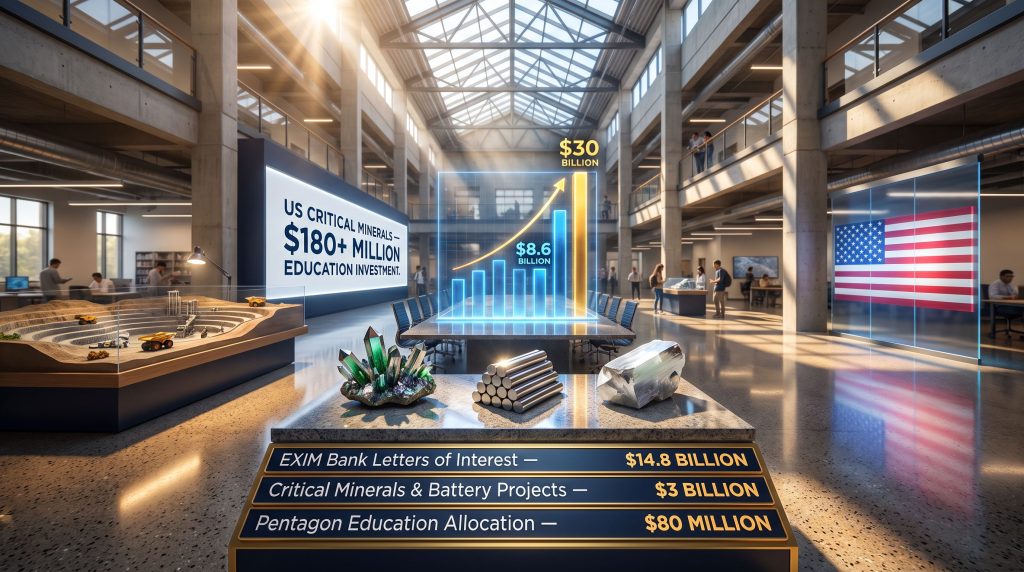
| Mining school education package (total) | $180+ million | August 2026 announcement |
Within a six-month window, the US State Department reported mobilising more than $30 billion across letters of interest, investments, loans, and related financial instruments directed at critical minerals projects. The Export-Import Bank alone has issued $14.8 billion in letters of interest over the prior twelve months. A further $3 billion commitment was announced in August 2026 specifically targeting critical minerals and battery-related projects.
Perhaps the most structurally significant figure is the $8.6 billion in federal equity investments made directly in minerals companies since January 2025. This is not grant funding or loan guarantees in the conventional sense. The federal government is now taking ownership stakes, acquiring warrants, and in some cases entering offtake agreements that effectively guarantee demand for domestic production before a single tonne of ore has been processed.
This shift toward equity participation and offtake commitments represents a meaningful departure from the grant-making model that characterised earlier industrial policy in the United States. The federal government is now acting less like a funder and more like a strategic co-investor, absorbing early-stage risk to attract private capital that might otherwise flow to more permissive jurisdictions.
Furthermore, the broader policy context matters here. The critical minerals executive order has provided the overarching legislative framework within which these financial commitments are being deployed, signalling to markets that this is a sustained strategic direction rather than a short-term political gesture.
Beyond Grants: The Multi-Instrument Financing Toolkit
Understanding why the government has moved toward equity stakes, warrants, and offtake agreements rather than simply writing cheques requires some background in how mining project financing actually works.
Mining projects are capital-intensive, long-duration, and subject to commodity price volatility that makes conventional debt financing difficult to secure in early stages. A greenfield critical minerals project might require hundreds of millions of dollars before a single dollar of revenue is generated, and that revenue may not arrive for a decade or more. Private capital is understandably cautious.
The federal response has been to construct a financing architecture that addresses the specific failure points in private capital allocation:
- Letters of interest provide early signals of government intent, allowing project developers to leverage those signals in conversations with private lenders
- Loan facilities offer below-market-rate capital for capital expenditure that commercial banks are reluctant to finance at competitive rates
- Equity stakes and warrants allow the government to participate in upside while reducing the dilutive cost to project developers in critical early funding rounds
- Offtake commitments solve the demand-side uncertainty that often prevents projects from reaching financial close, by effectively pre-purchasing future production
This toolkit is more sophisticated than previous US industrial policy frameworks and reflects lessons absorbed from observing how competitor nations, particularly China, have structured their own critical minerals investment vehicles over decades. The US mineral production order has further reinforced the national security dimensions of this approach, providing legal authority for the more interventionist financing mechanisms now being deployed.
The Education Investment: Which Institutions, How Much, and Why It Matters
Alongside the project-level financial commitments, a $180+ million education package has been directed at strengthening the pipeline of qualified mining professionals in the United States. This investment is split between two major federal departments.
| Funding Source | Allocation | Primary Focus |
|---|---|---|
| Pentagon | $80 million | Three mining schools, innovation hubs and workforce programs |
| Department of Energy | $100 million | Educational grants across accredited institutions |
| Combined package | $180+ million | Scholarships, innovation hubs, workforce development |
| Graduate output target | 2x current levels | To be achieved within two years |
The Pentagon's $80 million is distributed across three institutions: Colorado School of Mines, South Dakota School of Mines, and Johns Hopkins University. Each of these institutions is being positioned to develop innovation hubs alongside workforce training programs, with a particular emphasis on the technical disciplines most directly connected to critical minerals extraction and processing. The SME's federal support briefing provides additional detail on how these funds are being structured across accredited institutions.
The Department of Energy's complementary $100 million in educational grants reaches across a broader pool of fourteen accredited mining schools, funding scholarships and building institutional capacity at a wider range of programs.
The stated ambition is to double the number of mining-related graduates within two years. That is an ambitious target. Mining engineering enrolment in the United States has been under pressure for years, partly because the sector competes poorly for talent against technology, finance, and software careers that offer higher starting salaries, more urban work locations, and stronger cultural cachet among younger professionals.
Reversing a decade of declining enrolment within a two-year window through scholarship incentives and hub development is achievable in principle, but the structural barriers are significant. Changing career perception requires sustained cultural messaging as much as financial incentives, and universities cannot scale faculty capacity overnight.
Innovation hubs, if well designed, could serve a dual function: attracting research-oriented students who might otherwise be drawn to academic science careers, while simultaneously accelerating the technology development that makes domestic mining operations more competitive. The integration of automation, machine learning applications for ore body modelling, and advanced processing chemistry into mining school curricula is increasingly essential given where the sector is heading.
The Workforce Crisis: What the Skills Gap Actually Looks Like
The workforce shortage in US mining is not evenly distributed. The most acute deficits are concentrated in several specific technical disciplines:
- Hydrometallurgical engineers with expertise in solvent extraction and electrowinning, the processes used to separate and purify critical minerals from ore
- Geometallurgists capable of integrating geological data with processing parameters to optimise recovery rates across variable ore body conditions
- Geotechnical engineers specialising in underground stability and tailings management
- Rare earth separation chemists, a highly specialised field where US expertise has been particularly thin given the near-total historical dominance of Chinese processing infrastructure
- Environmental permitting specialists who understand both the regulatory framework and the technical requirements needed to navigate approval processes
Each of these disciplines requires years of specialised training and, critically, practical experience that cannot be replicated in a classroom. The two-year doubling target for graduate output is a reasonable starting point, but converting graduates into experienced practitioners is a ten-year process at minimum.
How the US Approach Compares Globally
US critical minerals investment and mining school funding does not exist in a vacuum. It is explicitly a response to the competitive landscape shaped by decades of strategic investment by other nations.
| Country/Bloc | Strategic Framework | Key Focus | Workforce Investment |
|---|---|---|---|
| China | Centralised state enterprise model | Rare earth dominance, processing capacity | Integrated vocational and university pipeline |
| Australia | Critical Minerals Strategy aligned with allied nations | Upstream extraction, export partnership | Growing investment, smaller domestic market |
| European Union | Critical Raw Materials Act | Domestic processing, import diversification | Emerging, uneven across member states |
| United States | Multi-instrument federal financing | Full value chain, from extraction to processing | $180M+ education package, doubling target |
China's position in rare earth processing is the most frequently cited benchmark problem. It controls an estimated 85 to 90 percent of global rare earth separation and processing capacity, meaning that even minerals mined outside China often return there for processing before being sold on global markets. This creates a structural dependency that persists even when upstream mining occurs in allied nations. Understanding the rare earth supply chain is consequently essential for evaluating the realistic scope of what US investment can achieve.
Australia's critical minerals strategy is notably complementary to US objectives, with significant alignment on export partnerships and joint investment frameworks. The US-Australia framework for securing critical minerals supply offers a detailed view of how bilateral co-investment mechanisms are being structured between the two allied nations. The EU's Critical Raw Materials Act, passed in 2024, established domestic production benchmarks and strategic stockpiling requirements that echo the direction of US policy, though the implementation mechanisms differ considerably.
Where the US approach diverges most clearly from its allies is in the scale of equity investment and the directness of federal participation in private company ownership structures. This is closer to the Chinese model of state-backed co-investment than to the grant-and-incentive frameworks traditionally preferred in Western market economies.
The next major ASX story will hit our subscribers first
The Production Timeline Problem: Why Today's Funding Shapes 2035 Supply
Mining is an industry defined by long lead times. From initial discovery through feasibility study, permitting, construction, and ramp-up to full production, the typical timeline for a greenfield critical minerals project ranges from 10 to 17 years. That figure is not an outlier estimate; it is a well-documented industry reality supported by decades of project development data.
This has a direct implication for how the current wave of investment commitments should be interpreted. The funding decisions being made in 2025 and 2026 will determine mineral supply availability in the late 2030s and into the 2040s, not in the near term. Understanding mining permitting realities is therefore essential context for anyone evaluating whether these financial commitments will translate into actual domestic production.
Scenario Analysis: Three Trajectories for US Critical Minerals Self-Sufficiency
| Scenario | Key Conditions | Likely Outcome by 2035 |
|---|---|---|
| Accelerated Build-Out | Permitting reform sustained, funding maintained, workforce grows | Meaningful reduction in import dependency for key minerals |
| Partial Progress | Funding sustained but permitting delays persist, workforce grows slowly | Incremental supply gains, continued strategic gaps in processing |
| Strategic Stagnation | Policy reversal, underfunding, or workforce shortfalls persist | Continued structural reliance on foreign critical mineral supply chains |
The permitting dimension is arguably the most significant variable in this analysis. Even with abundant capital and a growing workforce, projects that cannot obtain environmental and operational permits within a reasonable timeframe will not reach production. Permitting reform has been discussed extensively in US policy circles but has proven difficult to implement at the scale required without generating significant political and legal friction.
Export Controls as a Complementary Policy Layer
Running alongside the investment and education commitments is a parallel set of export restriction measures. The proposed US ban on exports of tungsten and battery scrap represents a demand-side complement to the supply-side investment agenda.
The logic is straightforward: if the US restricts outbound flows of materials that could otherwise be refined and recirculated domestically, it creates a larger feedstock base for domestic processing industries. Battery scrap in particular represents a significant secondary resource stream for lithium, cobalt, nickel, and manganese — materials that sit at the centre of the EV supply chain. In addition, the critical minerals demand surge underway across clean energy and defence sectors makes securing these secondary feedstocks an increasingly urgent priority.
Tungsten restrictions carry a different strategic rationale. Tungsten is a critical material for defence applications, particularly in armour-piercing munitions and high-temperature aerospace components. The United States imports the vast majority of its tungsten from China, making it one of the most acutely exposed mineral dependencies from a national security standpoint.
Frequently Asked Questions
How much has the US committed to critical minerals investment in 2026?
The total mobilisation reported by the US State Department across a six-month window exceeded $30 billion, encompassing loans, equity investments, letters of interest, and offtake commitments. A further $3 billion was specifically directed at critical minerals and battery projects in August 2026.
Which mining schools are receiving federal funding from the Pentagon?
The Pentagon's $80 million allocation is distributed across Colorado School of Mines, South Dakota School of Mines, and Johns Hopkins University, targeting innovation hubs and workforce development programs.
What is the US government's target for mining graduate output?
The stated objective is to double the number of mining-related graduates within two years, supported by scholarships and innovation hub development across fourteen accredited institutions receiving Department of Energy funding.
How does US critical minerals investment and mining school funding address rare earth dependency on China?
The strategy addresses this through a combination of upstream project financing, processing infrastructure investment, and workforce development in rare earth chemistry and metallurgy. However, rebuilding domestic separation capacity is a multi-decade challenge given China's entrenched processing dominance.
What financial instruments is the federal government using beyond direct grants?
The toolkit includes equity stakes, warrants, offtake agreements, loan facilities, and letters of interest — a more interventionist and commercially structured approach than conventional grant programmes.
When will federally funded mining projects begin producing domestic supply?
Given standard development timelines of 10 to 17 years from discovery to full production, projects funded in 2025 and 2026 would realistically begin contributing meaningful supply in the mid to late 2030s under favourable conditions.
Key Takeaways
- The US has mobilised more than $30 billion in total critical minerals support through loans, equity, letters of interest, and offtake commitments across a six-month period
- Federal equity investment in minerals companies has reached $8.6 billion since January 2025, marking a structural shift toward government co-investment in private sector projects
- A $180+ million education package split between the Pentagon ($80 million) and Department of Energy ($100 million) targets workforce expansion with a stated goal of doubling mining graduates within two years
- The most acute workforce deficits are concentrated in hydrometallurgy, geometallurgy, rare earth separation chemistry, and environmental permitting specialisations
- Project-level commitments must be assessed against 10 to 17 year development timelines, meaning today's funding shapes supply availability in the late 2030s, not the near term
- Export restrictions on tungsten and battery scrap form a complementary policy layer alongside domestic investment, aiming to strengthen the feedstock base for US processing industries
- The shift toward equity participation and offtake agreements represents the most interventionist US industrial policy posture in the critical minerals sector in the modern era
Readers seeking further context on US critical minerals policy and domestic mining investment trends can find related reporting and analysis through Mining Magazine's Americas coverage at miningmagazine.com.
Want to Track the Next Major Mineral Discovery Before the Market Does?
Discovery Alert's proprietary Discovery IQ model delivers real-time alerts on significant ASX mineral discoveries, turning complex mineral data into actionable insights for both short-term traders and long-term investors — explore historic discoveries and their returns to understand what early positioning can mean, then begin your 14-day free trial to secure your market-leading edge.