
August 10, 2026
Mexico Water Law Reforms and Mining Water Concessions: Understanding the New Regulatory Reality
Water scarcity and governance have quietly become among the most consequential risk factors in global mining investment, and nowhere is this dynamic playing out with more structural complexity than in Mexico. Across mining jurisdictions worldwide, water access has historically been treated as a secondary permitting consideration, something resolved after the geology was proven and the economics were modelled. That assumption is now fundamentally obsolete in Mexico, where a sweeping legislative transformation spanning 2023 to 2025 has repositioned water from a manageable operational input into a first-order feasibility determinant with constitutional-level implications.
For mining operators, investors, and project developers with exposure to Mexican assets, understanding the depth and architecture of these Mexico water law reforms and mining water concessions is no longer optional. It is the difference between a viable project and one that cannot proceed at all.
When big ASX news breaks, our subscribers know first
What the 2023 Mining Law Amendments Actually Changed
The 2023 reforms introduced several targeted interventions into both the Mining Law and the National Waters Law, each with direct operational consequences for extraction-focused businesses.
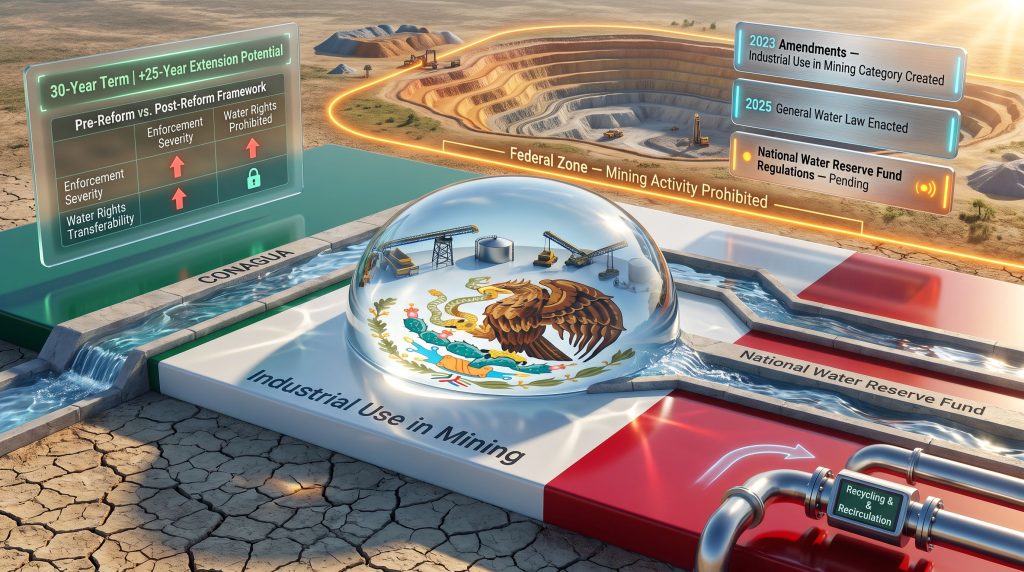
The most structurally significant innovation was the creation of a distinct water-use classification called "Industrial Use in Mining." This category applies specifically to water consumed across the full operational spectrum of mining, covering exploration, extraction, and mineral processing activities. Before this amendment, mining operations could and did hold water concessions originally granted for agricultural or general industrial purposes, then apply that water to mining activities without triggering additional obligations. That flexibility is gone.
Furthermore, the broader mining claims framework has similarly evolved in other jurisdictions, reflecting a global trend toward tighter regulatory oversight of resource access and Indigenous consultation requirements.
Key Restrictions Introduced Under the 2023 Reforms
- The new Industrial Use in Mining category carries compliance requirements that exceed those of standard industrial-use concessions.
- The conversion of water concessions from any other use category into Industrial Use in Mining was explicitly prohibited. This means existing agricultural or urban water rights cannot be repurposed for mining extraction.
- Mining activity, infrastructure placement, and waste disposal are now prohibited in federal zones adjacent to rivers, streams, and other federally governed water bodies. This restriction directly affects tailings dam siting and process infrastructure planning.
- Water concessions for mining are structured around a 30-year term, with a possible extension of up to 25 additional years, generally aligned with the underlying mining concession term. CONAGUA, the National Water Commission, remains the governing authority for all concession approvals and renewals.
| Parameter | Detail |
|---|---|
| Standard concession term | 30 years |
| Possible extension | Up to 25 additional years |
| Alignment mechanism | Tied to underlying mining concession |
| Governing authority | CONAGUA (National Water Commission) |
| Conversion of other use categories | Prohibited |
The prohibition on federal watercourse zone usage is particularly consequential for legacy operations. Projects that were designed and built prior to 2023 with infrastructure near water bodies now face reassessment requirements. For new development, this constraint must be embedded at the earliest stages of site selection and engineering.
The 2025 General Water Law: A Constitutional-Level Reset
While the 2023 reforms were sector-specific in their targeting, the December 2025 enactment of the General Water Law represented something categorically different in scope. This legislation elevated water governance from a sectoral administrative framework into a mechanism for implementing constitutionally recognised human rights. Its primary objective is codifying the human right to access, use, and sanitation of water for personal and domestic consumption as the supreme allocation priority across all sectors of the economy.
The implications extend far beyond mining, touching every productive sector in Mexico. However, the extractive industries face a particularly acute exposure because their water consumption volumes and operational water dependencies are among the highest of any industrial activity. According to Norton Rose Fulbright's analysis of Mexico's mining regulation overhaul, these reforms represent one of the most substantial reshapings of the country's extractive sector legal architecture in decades.
The End of Private Water Concession Transfers
One of the most disruptive provisions of the 2025 reform concerns the transferability of water rights. Prior to this law, water concessions were informally traded between private parties in a practice that, while technically inconsistent with water's legal status as a national asset, had become a standard deal-structuring tool in mining mergers, acquisitions, and project financings.
Legal practitioners in the sector confirm that buying and selling water concessions had never been formally legal given water's national asset classification, but the practice was widespread and largely tolerated. The 2025 General Water Law brought that era to a definitive close. All reassignment of water volumes must now flow through CONAGUA via a formal administrative mechanism called the Reallocation of Water Volumes, which will be administered through a newly established National Water Reserve Fund.
Critical Regulatory Gap: As of mid-2026, the operational regulations governing the National Water Reserve Fund have not yet been published. This creates a transitional compliance uncertainty period that mining operators must navigate carefully, as the Fund will become the primary pathway for new water access once regulations are finalised.
Structural Changes to the Water Rights Registry
The legacy Public Registry of Water Rights is being superseded by a new national water registry with centralised oversight and enhanced transparency requirements. For due diligence purposes in mining transactions, this transition changes the evidentiary standard for proving valid water rights and requires practitioners to adapt their title verification methodologies accordingly.
Enforcement Escalation
The 2025 reforms also introduced a significantly strengthened penalty framework, with new water-related offences and elevated financial penalties for unauthorised use, discharge violations, and misuse of concession terms. Mining operators with any legacy compliance gaps face materially increased regulatory exposure.
How the Cancellation Risk Mechanism Works
Perhaps the most consequential risk architecture introduced by these combined reforms is the direct interdependency between water concession status and mining concession validity. Under the current framework, if a water concession is found to be invalid, non-existent, or lapsed, the underlying mining concession becomes eligible for cancellation proceedings.
The pathway from water compliance failure to mining concession cancellation follows a structured sequence:
- Water concession lapses or is found non-compliant triggering a CONAGUA review process.
- CONAGUA notifies the Ministry of Economy placing the mining concession status under formal scrutiny.
- A grace period or remediation window is opened during which the operator must demonstrate corrective action.
- Failure to remedy initiates formal mining concession cancellation proceedings.
- Operations may be suspended pending resolution or legal challenge.
This is a materially different risk profile than existed under previous frameworks, where water and mining concession statuses were more administratively independent. Today, water compliance failure can cascade directly into operational shutdown.
Comparative Risk Profile: Pre-Reform vs. Post-Reform Framework
| Dimension | Pre-2023/2025 Framework | Post-Reform Framework |
|---|---|---|
| Water rights transferability | Informally traded between private parties | Prohibited; CONAGUA-administered reallocation only |
| Use category flexibility | Concessions convertible between use types | Fixed at time of grant; no conversion permitted |
| Tailings infrastructure placement | Permitted near federal watercourse zones | Prohibited in federal zones |
| Concession cancellation risk | Limited linkage to mining concession status | Direct interdependency; invalid water = cancellation risk |
| New water access pathway | Open market acquisition | National Water Reserve Fund (regulations pending) |
| Enforcement severity | Moderate | Significantly elevated |
Water Due Diligence as a First-Order Feasibility Requirement
One of the deeper structural shifts these reforms have produced is the repositioning of environmental and water due diligence within the project development lifecycle. Legal practitioners specialising in Mexican environmental and mining compliance have noted that water availability and feasibility assessments are no longer supplementary analyses appended to a definitive feasibility study. They are now prerequisite inputs that must be resolved before project planning can proceed meaningfully.
A compliant water feasibility analysis now requires:
- Identification and confirmation of the applicable water-use classification for all proposed operations.
- Mapping of federal watercourse zones relative to all proposed infrastructure, including tailings storage and processing facilities.
- Verification of concession validity, term status, and compliance history across all existing water rights associated with the project.
- Assessment of water availability within CONAGUA's basin-level allocation framework, including any restrictions applicable to the specific hydrological basin.
For M&A transactions specifically, the prohibition on private water concession transfers has fundamentally altered deal architecture. An acquirer in a mining asset transaction can no longer assume that water rights bundled with the asset will be transferable. Any acquisition must now account for the possibility that new water concessions will need to be independently sourced through CONAGUA or the National Water Reserve Fund post-closing.
The next major ASX story will hit our subscribers first
Operational Strategies and Technology Priorities
Immediate Compliance Actions
Mining operators with Mexican assets should treat the following as urgent priorities:
- Conduct a comprehensive audit of all existing water concessions to confirm validity, term status, and alignment with the Industrial Use in Mining classification.
- Identify any infrastructure located within newly restricted federal watercourse zones and assess remediation or relocation requirements.
- Verify that current concession volumes are sufficient for planned production levels without reliance on conversion from other use categories.
Water Stewardship as a Concession Extension Criterion
A particularly significant and underappreciated element of the 2025 reforms is the incorporation of water stewardship as an evaluation criterion for granting concession term extensions. This means that operators who invest in water efficiency and responsible management practices are building a regulatory track record that directly supports their ability to extend concession terms beyond the initial 30-year period.
Consequently, the growing emphasis on natural capital in mining operations aligns closely with these stewardship requirements, as regulators increasingly value quantifiable environmental performance metrics alongside operational outputs.
Water stewardship in this regulatory context encompasses:
- Investment in water recycling and recirculation infrastructure within processing circuits.
- Implementation of stormwater harvesting systems to reduce dependence on freshwater sources.
- Demonstrated reduction in net freshwater withdrawal intensity relative to production volumes.
- Third-party verification of water efficiency performance metrics.
Technology Investment Priorities
The technological response to water-constrained operations in Mexico should focus on:
- Closed-loop water recycling systems for mineral processing.
- Dry-stack tailings technology as an alternative to conventional water-intensive impoundments, which also addresses the federal zone prohibition on tailings placement.
- Real-time volumetric monitoring systems to satisfy CONAGUA's measurement and metering obligations.
- Advanced tailings management to minimise process water loss and reduce regulatory exposure.
In addition, mining waste management strategies are increasingly being integrated into water compliance planning, as tailings disposal and water quality obligations now overlap significantly under Mexico's reformed regulatory framework. Similarly, mine reclamation importance has grown as regulators link end-of-life site obligations more directly to water stewardship performance records established during operations.
The Regulatory Timeline: How 2023 and 2025 Reforms Interact
| Reform Event | Year | Primary Impact on Mining |
|---|---|---|
| Amendments to Mining Law and National Water Law | 2023 | Created Industrial Use in Mining category; restricted use transfers; prohibited mining in federal zones |
| General Water Law enacted | Late 2025 | Prohibited private transfers; established National Water Reserve Fund; elevated human right to water as priority |
| National Water Reserve Fund regulations | Pending post-2025 | Will define reallocation procedures and priority hierarchy |
The gap between the 2025 law's enactment and the publication of Fund operating regulations represents a critical transitional period. During this window, mining operators should maintain all existing concessions in good standing, avoid any administrative actions that could trigger cancellation proceedings, and prepare pre-application documentation packages in anticipation of Fund activation.
Systemic Challenges for Both Regulators and Industry
The reforms impose substantial implementation burdens on both sides of the regulatory relationship.
For government agencies, the principal challenges include publishing secondary regulations that operationalise the General Water Law and the National Water Reserve Fund before sector planning cycles are materially disrupted, clearing the existing administrative backlog within CONAGUA's concession pipeline, and maintaining functional digital filing systems capable of handling the increased procedural volume. Balancing the constitutional human-right-to-water priority against the economic contribution of mining to regional employment and export revenues will require careful calibration.
For the private sector, the challenges centre on restructuring project development timelines to accommodate extended water feasibility phases, redesigning M&A transaction frameworks to account for non-transferable water rights, and financing water technology investments against a backdrop of broader capital cost pressures. White & Case's analysis of new water legislation risks for investments in Mexico further underscores that managing investor relations around water-related regulatory uncertainty in the country's critical minerals pipeline adds a significant layer of complexity for publicly listed operators.
Frequently Asked Questions
Can a Mining Company in Mexico Still Purchase Water Rights from Another Party?
No. The 2025 reforms explicitly prohibit private transfers of water concessions. All volume reassignments must be processed through CONAGUA via the Reallocation of Water Volumes procedure.
What Happens If a Mining Concession's Associated Water Concession Expires or Becomes Invalid?
An invalid or lapsed water concession creates direct cancellation risk for the underlying mining concession, potentially suspending operations until the water rights issue is formally resolved. The Mexico water law reforms and mining water concessions framework has made this linkage explicit and enforceable in ways that did not previously exist.
How Long Can a Mining Water Concession Last in Mexico?
Up to 30 years, with a possible extension of 25 additional years, generally aligned with the term of the underlying mining concession.
What Is the National Water Reserve Fund?
A new centralised mechanism through which CONAGUA will manage the reallocation of water volumes across sectors. Its operational regulations had not been published as of mid-2026.
Why Does Water Stewardship Matter for Concession Renewals?
Under the 2025 reforms, demonstrated water stewardship practices — including recycling, reuse, recirculation, and stormwater harvesting — are incorporated as evaluation criteria when CONAGUA considers granting extensions to concession terms. This directly links operational water management investment to long-term asset security and reinforces why Mexico water law reforms and mining water concessions have become central to project viability assessments.
This article is intended for informational purposes only and does not constitute legal, financial, or investment advice. Readers should seek independent legal counsel qualified in Mexican environmental and mining law before making decisions based on the regulatory frameworks described above. The status of pending regulations referenced in this article may change following publication.
Want To Stay Ahead of Regulatory Shifts Reshaping ASX Mining Opportunities?
Discovery Alert's proprietary Discovery IQ model scans ASX announcements in real time, delivering instant alerts on significant mineral discoveries so investors can act before the broader market catches on — explore historic examples of major discovery returns or begin a 14-day free trial to gain an immediate market edge.