August 10, 2026
The Strategic Logic of Frontier Energy: Why Venezuela's Oil Sector Is Drawing Early-Mover Capital
When global energy supply chains fracture along geopolitical fault lines, capital tends to migrate toward alternatives that were previously considered too risky to engage. That dynamic is playing out in real time across the Western Hemisphere, where the disruption of Strait of Hormuz traffic following the US-Iran conflict has forced energy-importing nations to reassess their supply geography with fresh urgency. Japan, for instance, has established a working group exploring cost-sharing mechanisms to support crude imports that bypass the Hormuz chokepoint entirely.
This reflects how deeply the instability has penetrated long-term supply planning among major import-dependent economies. Furthermore, the broader shifts in oil geopolitics and supply are reshaping which producing nations attract serious capital attention in this environment.
Within this shifting landscape, the Venezuela oil investment outlook occupies an unusual position: the country holds the world's largest proven crude oil reserves, yet currently produces at a fraction of its geological capacity. That disconnect is the defining feature of the investment case and the central reason risk-tolerant capital is beginning to probe the country's upstream potential with renewed seriousness.
When big ASX news breaks, our subscribers know first
The Geological Foundation: What Venezuela Actually Has Underground
Venezuela's reserve base is anchored in the Orinoco Heavy Oil Belt, one of the largest contiguous hydrocarbon accumulations on the planet. The country's proven reserves are officially the largest in the world, surpassing Saudi Arabia, yet the characteristics of those reserves introduce complexity that differentiates Venezuela from lighter-crude producers.
The Orinoco Belt predominantly contains extra-heavy crude, typically with API gravity in the range of 8 to 12 degrees. This grade of crude is too viscous and sulfur-rich to be refined in standard configurations without significant upgrading. The upgrading process transforms extra-heavy Orinoco crude into synthetic crude oil (SCO) suitable for conventional refinery processing, and requires large, capital-intensive upgrader facilities.
These installations blend extra-heavy crude with lighter diluents or apply thermal cracking processes to produce exportable grades. This technical reality carries two important implications for investors. First, the resource base itself is not in question: the oil exists in commercially extractable volumes. Second, the capital required to monetise those barrels is substantially higher than for conventional plays, and the infrastructure needed to do so has largely deteriorated or been abandoned.
The barrier to entry created by upgrader complexity is, paradoxically, also a competitive moat for operators who can navigate it.
Infrastructure rehabilitation, not exploration risk, is the primary technical barrier separating Venezuela's geological potential from its commercial reality.
Current Production Reality: The Scale of the Gap
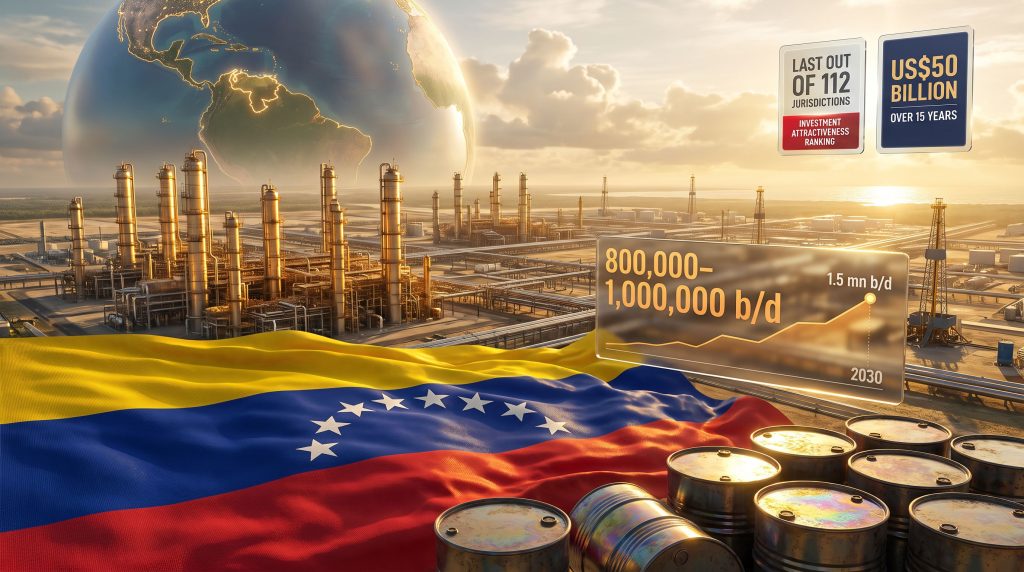
Venezuela's crude output is estimated at approximately 800,000 to 1,000,000 barrels per day as of 2025. This figure represents a dramatic contraction from peak production levels exceeding 3 million barrels per day achieved in the late 1990s. Few major oil-producing nations in modern history have experienced a decline of this magnitude over a comparable timeframe.
The causes are structural rather than geological. State oil company PdVSA has suffered chronic underinvestment, loss of technical staff, and severe operational degradation. Wellbores have aged beyond productive capacity without workover or replacement. Upgrader facilities that once processed Orinoco crude into exportable synthetic grades have fallen into disrepair. According to Wood Mackenzie's energy analysis, pipeline systems are corroded and export terminal infrastructure requires substantial reinvestment before incremental production gains can reach global buyers.
Production Scenario Comparison
| Scenario | Timeframe | Projected Output | Key Conditions Required |
|---|---|---|---|
| Base Case (Constrained) | 2025-2030 | ~1.5 mn b/d | Incremental licensing, limited foreign capital |
| Moderate Recovery | 2030-2035 | 2.5-3.5 mn b/d | Legal reform, debt restructuring, sustained FDI |
| Optimistic Upside | 10-12 years | 6-7 mn b/d | Full normalisation, large-scale redevelopment capital |
| Bear Case | 2025-2028 | Flat or declining | Sanctions tightening, political reversal, infrastructure failure |
Alex Cranberg, chairman of Aspect Holdings and one of the earliest Western independent operators to engage with Venezuela's reopening investment cycle, has indicated publicly that Venezuela could realistically reach 6 to 7 million barrels per day within 10 to 12 years, provided the investment environment becomes genuinely accommodative. This assessment, shared with Argus Media, reflects the view of a practitioner with direct in-country exposure rather than a theoretical desk estimate. It is, however, an optimistic ceiling contingent on conditions that do not yet exist at scale.
How Much Capital Does a Full Recovery Actually Require?
The capital requirements for Venezuela's oil sector rehabilitation rank among the most demanding of any upstream recovery project globally. Independent industry assessments suggest the country requires approximately US$50 billion over 15 years simply to sustain its existing, already-diminished production base without further decline. That figure does not encompass the investment needed to grow output toward historic or peak levels.
Achieving meaningful production growth would require an estimated US$10 billion or more per year in sustained foreign direct investment. Across a full recovery cycle, total capital deployment could reach hundreds of billions of dollars, distributed across the following cost categories:
- Well rehabilitation and new drilling: Thousands of wells across the Orinoco Belt and conventional fields require workover operations or full replacement. New drilling programmes would need to be sustained over years to rebuild reservoir drainage networks.
- Upgrader reconstruction: Extra-heavy Orinoco crude cannot be exported in its raw state without blending or upgrading. Most upgrader facilities are non-functional or severely degraded, meaning reconstruction is a prerequisite for large-scale production growth rather than an optional enhancement.
- Pipeline and export terminal investment: Even if upstream production is restored, the logistics chain to move crude from field to tanker requires parallel reinvestment. Bottlenecks in midstream infrastructure have historically constrained production gains in analogous recovery environments, including post-invasion Iraq.
- Refinery and processing systems: Venezuela's domestic refining capacity has collapsed, limiting the country's ability to supply its own fuel market. This creates a dual constraint: the country cannot efficiently supply internal demand while simultaneously maximising export revenue.
Multiple independent assessments place Venezuela's total sector rebuild cost in the range of tens to hundreds of billions of dollars, depending on the production target chosen and the pace of capital deployment. This is categorically a long-duration commitment, not a short-cycle trade.
The Risk Architecture: What Deters Institutional Capital
Understanding the Venezuela oil investment outlook requires a clear-eyed assessment of the risk stack confronting prospective investors. Venezuela ranked last out of 112 jurisdictions assessed for oil-and-gas investment attractiveness in S&P Global's framework, a ranking that reflects the cumulative weight of multiple overlapping risk categories.
Investment Risk Summary
| Risk Category | Severity | Time Horizon | Mitigation Pathway |
|---|---|---|---|
| Political and Legal Instability | Very High | Near to Medium Term | Legal reform, dispute resolution frameworks |
| Sanctions Exposure | High | Near Term | US policy clarity, licensing certainty |
| Infrastructure Failure | High | Near to Long Term | Capital injection, technical partnerships |
| Fiscal Terms Uncertainty | High | Medium Term | Transparent contract structures |
| Force Majeure and Natural Events | Moderate | Unpredictable | Operational contingency planning |
| Debt Restructuring Stall | Moderate-High | Medium Term | Sovereign debt negotiation progress |
Political and Legal Risk: The Dominant Deterrent
Contract enforceability remains the most frequently cited concern among institutional investors evaluating Venezuela exposure. The absence of functioning arbitration mechanisms that provide genuine recourse against unilateral government action creates an environment where long-duration capital commitments carry binary downside risk. Operators can deploy capital but may lack legal avenues to protect returns if fiscal terms are modified retroactively or assets are expropriated.
Major integrated oil companies have publicly confirmed they require greater certainty around dispute resolution access and security conditions before committing capital at scale. The gap between their stated conditions and the current operating environment is one of the defining structural features of Venezuela's investment landscape in 2025.
Sanctions Architecture and Its Asymmetric Effects
The broader impact of sanctions on oil trade provides a useful reference point for understanding how selective licensing frameworks can both enable and constrain market participation. In Venezuela's case, US policy on PdVSA has historically constrained both direct investment flows and Venezuelan entities' access to international financial markets, subject to policy reversal that creates a binary risk dynamic.
One particularly nuanced observation from practitioners with direct country exposure relates to the potential role of US government political risk insurance. Because the US government maintains effective control over certain Venezuelan revenue streams, it is uniquely positioned to offer political risk coverage at reasonable cost with minimal net exposure to itself. A government-backed or multilateral political risk insurance facility could materially de-risk early-stage capital deployment, an outcome that private insurance markets cannot replicate at comparable cost or scale.
Seismic and Force Majeure Risk: An Underappreciated Factor
A less frequently discussed dimension of Venezuela's operational risk profile is seismic vulnerability. A significant earthquake affecting Venezuela's producing regions can simultaneously disrupt active operations, complicate contract negotiation timelines, and divert organisational bandwidth from investment planning to emergency response. The compounding effect of natural disaster risk on an already-fragile infrastructure base represents a genuine tail risk for field-level operators that is often underweighted in high-level investment analyses.
Who Is Entering the Market First, and How?
The Wildcatter Advantage in Greenfield Exploration
Independent operators specialising in early-stage, greenfield exploration roles have emerged as the first active participants in Venezuela's reopening investment cycle. This category of investor accepts higher early-stage risk in exchange for preferential contract positioning, structuring entry strategies that mirror historical patterns observed in other post-sanction or post-conflict hydrocarbon provinces.
The strategic rationale is straightforward: in frontier market reopening cycles, the first movers who establish contractual footholds, acquire technical data, and demonstrate operational credibility tend to negotiate terms unavailable to later entrants. Major integrated companies typically follow only after independent operators have demonstrated proof of concept and the operating environment has stabilised sufficiently to meet institutional investment criteria.
Aspect Holdings, led by Alex Cranberg, has publicly described its strategy as pursuing precisely this greenfield exploration positioning, with contract discussions advancing and investment expected to move forward in coming months, according to reporting by Argus Media. The firm's approach illustrates how wildcatter-style operators can function as market-opening agents rather than simply as financial participants.
The Role of Chinese and Non-Western Capital
Chinese state-linked entities have maintained a presence in Venezuela's oil sector through existing debt-for-oil arrangements with PdVSA, providing a channel for capital deployment outside Western sanctions frameworks. These arrangements have historically allowed Venezuela to service portions of its Chinese debt through crude deliveries rather than cash payments. Venezuela's oil exports have consequently reached a seven-year high as non-Western buyers return to the market in greater numbers.
The evolution of this dynamic will depend on the trajectory of US-China relations, Venezuela's own foreign policy positioning, and whether the expansion of Western operator access creates competitive tension or complementary investment alongside Chinese capital.
The next major ASX story will hit our subscribers first
What Iraq's Recovery Teaches Us About Venezuela
The Technical Service Contract Model
Iraq's post-2003 upstream recovery offers the most instructive historical parallel for assessing what is achievable in Venezuela and what structural conditions are required to achieve it. Iraq demonstrated that large-scale production increases are possible in politically complex environments when contract terms are sufficiently attractive and technically specific.
Iraq's Technical Service Contract (TSC) model offered international oil companies fixed fees per barrel of incremental production rather than equity stakes in reserves. This structure attracted international capital while preserving nominal state ownership of resources, a political compromise that allowed the Iraqi government to maintain sovereignty optics while delivering the commercial certainty operators required. Venezuela could adapt analogous structures to attract capital without requiring full privatisation of PdVSA assets.
The Infrastructure Bottleneck Lesson
Iraq's recovery trajectory also illustrates a risk directly applicable to Venezuela: production gains repeatedly stalled due to pipeline and export terminal constraints rather than upstream drilling limitations. The lesson is that upstream investment without parallel midstream and logistics investment creates a production ceiling that limits realised revenue regardless of reservoir capacity. For Venezuela, this reinforces the argument that infrastructure rehabilitation should be treated as investment-grade opportunity in its own right, not merely as a support function for upstream activity.
Venezuela Versus Other Frontier Hydrocarbon Provinces
| Dimension | Venezuela | Iraq (Post-2003) | Libya (Post-2011) | Iran (Hypothetical) |
|---|---|---|---|---|
| Reserve Scale | Largest globally (proven) | Top 5 globally | Significant | Top 5 globally |
| Current Output vs. Peak | ~25-30% of peak | ~80% of peak | ~60-70% of peak | ~60-70% of peak |
| Capital Required for Recovery | US$50B+ (maintenance alone) | Moderate-High | Moderate | Very High |
| Legal and Contract Certainty | Very Low | Low-Moderate | Low | Very Low |
| Infrastructure Condition | Severely Degraded | Partially Degraded | Moderately Degraded | Aging but Functional |
| Western Investment Access | Restricted | Open | Partially Open | Blocked |
| Investment Attractiveness Ranking | Last (112/112) | Low-Mid tier | Low tier | N/A (sanctioned) |
Venezuela's position in this comparison is notable for combining the largest reserve base with the deepest infrastructure degradation and the lowest investment attractiveness ranking. That combination defines both the scale of the challenge and the magnitude of the potential reward if conditions improve. These geopolitical trade disruptions are consequently accelerating the urgency with which energy-importing nations are reassessing frontier supply options.
The Realistic Production Trajectory: Near, Medium, and Long Term
Near-Term (2025-2028): Incremental Recovery
The most credible near-term scenario involves production rising modestly from approximately 800,000 to 1,000,000 b/d toward 1.5 million b/d by 2030, contingent on improving legal certainty and selective foreign investment inflows. This trajectory requires operational continuity, contract execution by early-mover operators, and the absence of major political disruptions or sanctions escalation.
Medium-Term (2028-2033): The Reform Dividend
If legal reforms deepen, debt restructuring advances, and foreign capital flows at meaningful scale, output could reach 2.5 to 3.5 million b/d within a decade. However, this scenario is highly sensitive to political risk: a single major policy reversal could reset years of investment momentum and deter the institutional capital that the medium-term recovery thesis requires. The geopolitical crude price trends of 2025 further complicate medium-term planning for operators and investors alike.
Long-Term (10-12 Years): Full Normalisation Case
The ceiling scenario of 6 to 7 million b/d requires Venezuela to rank among the world's most attractive upstream investment destinations. This transformation demands sustained capital deployment exceeding US$10 billion annually, durable legal frameworks spanning multiple political cycles, and successful reconstruction of upgrading and export infrastructure at scale. Achieving this outcome would represent one of the most significant upstream sector turnarounds in modern energy history.
Frequently Asked Questions: Venezuela Oil Investment
What is Venezuela's current oil production level?
Venezuela's crude oil production is estimated at approximately 800,000 to 1,000,000 barrels per day as of 2025, representing roughly 25 to 30 percent of the country's historical peak output of over 3 million b/d achieved in the late 1990s. Decades of underinvestment, sanctions, and institutional deterioration within PdVSA are the primary drivers of this decline.
How much investment does Venezuela's oil sector need?
Independent industry analysis estimates Venezuela requires approximately US$50 billion over 15 years simply to maintain its current production levels. Achieving meaningful production growth would require an additional US$10 billion or more per year in sustained foreign investment.
What are the biggest risks for investors in Venezuela's oil sector?
The dominant risks include political and legal instability, sanctions exposure, infrastructure deterioration, fiscal terms uncertainty, and sovereign debt overhang. Venezuela ranked last out of 112 jurisdictions assessed for oil-and-gas investment attractiveness, reflecting the cumulative weight of these overlapping risk factors.
What would most accelerate foreign investment into Venezuela's oil sector?
Key catalysts include credible contract protection with enforceable arbitration pathways, progress on sovereign debt restructuring, transparent licensing processes, regulatory consistency, and the establishment of political risk insurance mechanisms. Practitioners with direct country exposure have identified a US government or multilateral political risk insurance facility as potentially the single most transformative near-term catalyst.
Is Venezuela a short-term or long-term investment opportunity?
The Venezuela oil investment outlook is broadly characterised as a high-optionality, long-duration turnaround with near-term opportunities concentrated in selective licensed operations, infrastructure services, and trading. The large-scale production recovery thesis plays out over years to decades and remains contingent on sustained reform progress across multiple political and policy cycles.
Disclaimer: This article is for informational purposes only and does not constitute financial or investment advice. Production forecasts, capital requirement estimates, and risk assessments are drawn from industry analysis and practitioner commentary and involve significant uncertainty. Investors should conduct their own due diligence before making any investment decisions related to Venezuelan oil sector assets or associated securities.
Want to Stay Ahead of the Next Major Resource Discovery?
While Venezuela's oil sector represents a long-duration, high-complexity opportunity, Discovery Alert's proprietary Discovery IQ model delivers real-time alerts on significant ASX mineral discoveries — instantly translating complex resource data into actionable investment insights for both short-term traders and long-term investors. Explore historic examples of extraordinary discovery returns and begin your 14-day free trial at Discovery Alert to position yourself ahead of the market.