August 10, 2026
Blended Finance and the Green Molecule Economy: Why Africa's Hydrogen Moment Is Now
The global energy transition has produced a peculiar investment paradox. Technologies with the greatest long-term decarbonisation potential, particularly green hydrogen and its derivative molecules, are frequently the hardest to finance at scale. This is not because the underlying resources are scarce or the technology is unproven in principle. It is because the capital structures required to bridge early-stage development risk and utility-scale project delivery have historically been absent in emerging markets. South Africa is now attempting to resolve that paradox with a purpose-built blended finance vehicle, and the results of its first financial close are drawing attention far beyond the continent.
The South Africa green hydrogen fund raises $185 million milestone, achieved through the SA-H2 Fund's first financial close announced in early August 2026, represents more than a fundraising headline. It signals a structural shift in how frontier clean energy markets can aggregate institutional capital around nascent green hydrogen sectors, and it positions South Africa as the continent's most credible near-term green hydrogen export candidate.
When big ASX news breaks, our subscribers know first
What the SA-H2 Fund Is and Why Its Structure Matters
The SA-H2 Fund is a dedicated blended-finance investment vehicle managed by Climate Fund Managers, a specialist asset manager with a track record in structuring climate-focused capital pools across emerging markets. The fund's mandate spans the full lifecycle of green molecule production, encompassing green hydrogen, green ammonia, and green methanol projects from early feasibility through to construction-stage financing.
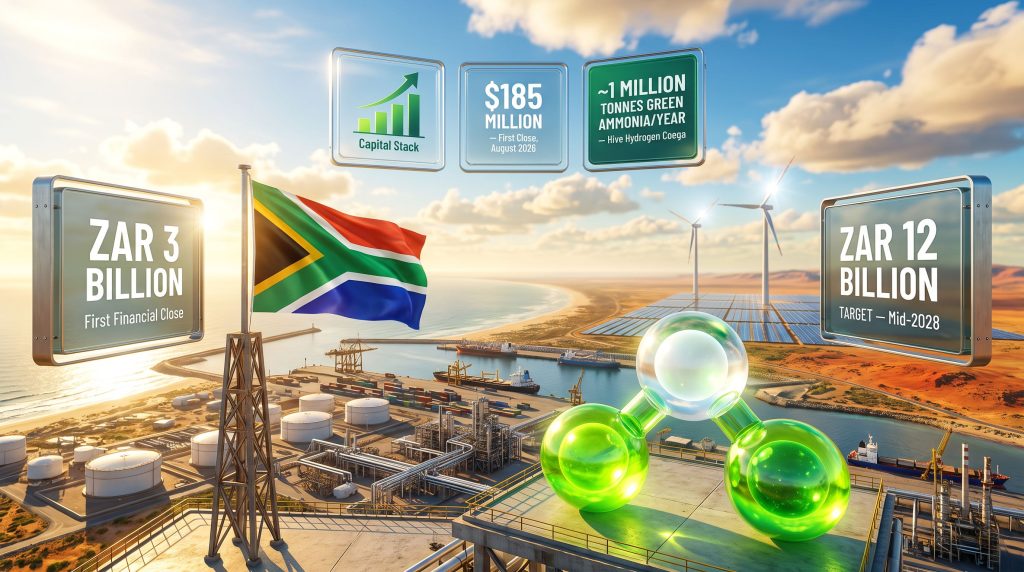
Launched in June 2023 with co-founding participation from the South African, Dutch, and Danish governments, the fund was initially conceived with an aspirational facility target of $1 billion. The current fundraising architecture has since been formalised around a ZAR 12 billion (approximately USD $740 million) final close target, with the fundraising window extending to mid-2028.
| Milestone | Amount (ZAR) | Amount (USD approx.) | Timeline |
|---|---|---|---|
| First Financial Close | ZAR 3 billion | ~$185 million | August 2026 |
| Remaining Capital Required | ZAR 9 billion | ~$555 million | By mid-2028 |
| Final Target | ZAR 12 billion | ~$740 million | Mid-2028 |
| Original Facility Target | N/A | $1 billion | Announced June 2023 |
Understanding the distinction between a first financial close and a final close is important for assessing what this milestone actually means in practice. A first close confirms that a minimum threshold of committed capital has been secured, enabling the fund to begin making investments and generating a track record. It does not represent completion of the fundraising process. The fund still needs to mobilise approximately ZAR 9 billion in additional commitments before reaching its full operational scale.
Who Is Backing the Fund: A Capital Stack Breakdown
The investor coalition behind the first close reflects a deliberate construction of complementary capital types, each serving a specific function within the blended finance architecture.
- European Commission: Provides multilateral anchor capital, signalling EU strategic interest in diversifying green hydrogen supply chains beyond North Africa and the Gulf states. This aligns closely with EU support for green hydrogen initiatives across the continent.
- Invest International: The Dutch development finance arm, whose participation reflects the Netherlands' foundational role as a co-sponsor of the broader SA-H2 initiative.
- Industrial Development Corporation (IDC): South Africa's state development finance institution, lending domestic institutional credibility to the fund's governance and investment thesis.
- Public Investment Corporation (PIC): Acting on behalf of the Government Employees Pension Fund, the PIC's involvement represents one of Africa's largest institutional investors making an explicit allocation to the green hydrogen asset class for the first time. According to reporting on the PIC's backing of the R3 billion fund, this signals a significant shift in domestic institutional strategy.
- Sanlam Life: The participation of a private sector life insurer is arguably the most commercially significant signal from the first close. It indicates that commercial capital is beginning to view green hydrogen projects as an investable asset class rather than a developmental experiment.
The inclusion of Sanlam Life alongside development finance institutions demonstrates a critical inflection point: when insurance capital follows public development money into a new asset class, it typically signals the beginning of genuine market formation rather than continued grant dependency.
Beyond the equity fund structure, the European Union committed approximately R628 million (EUR 32 million) in direct grant funding in September 2024 to support South African green hydrogen infrastructure more broadly. Grant capital of this type complements fund structures by absorbing the earliest and most technically uncertain expenditures, such as feasibility studies and environmental impact assessments, without diluting equity returns within the fund itself.
Why Blended Finance Is Not Just a Preference, But a Necessity
Green hydrogen projects face what practitioners in development finance describe as a financing valley of death. The gap between conceptual feasibility and bankable construction-stage finance is particularly acute for green hydrogen because the sector combines several compounding risk factors simultaneously:
- Technology cost uncertainty: Electrolyser manufacturing costs have been declining but remain volatile, and project economics are highly sensitive to both capital and operating expenditure assumptions.
- Offtake market immaturity: Long-term purchase agreements for green ammonia and green methanol at prices sufficient to support project economics are still being established, particularly for export-oriented supply chains.
- Infrastructure dependencies: Green hydrogen projects require abundant renewable electricity, access to purified water, and port facilities capable of handling specialised cargoes, none of which can be assumed to exist at project locations.
- Currency and political risk premiums: Institutional investors in global capital markets typically apply elevated discount rates to African infrastructure assets, reflecting genuine and perceived governance risks.
Blended finance addresses this by deploying concessional capital from development finance institutions and multilateral agencies at below-market returns, absorbing first-loss positions that commercial investors are unwilling to take. This de-risking function allows private institutional capital, such as that provided by Sanlam Life, to participate at risk-adjusted returns that would otherwise be unachievable without public sector participation.
Project Pipeline: Where the Capital Is Being Deployed
With its first financial close secured, the SA-H2 Fund has already committed capital to two projects representing distinct segments of the green molecule opportunity. Furthermore, the renewable energy solutions underpinning these projects reflect a broader transformation in how South Africa sources and deploys clean power.
Hive Hydrogen Coega: South Africa's Flagship Green Ammonia Project
Located within the Coega Special Economic Zone in the Eastern Cape, Hive Hydrogen Coega is currently the most advanced large-scale green ammonia project on the African continent by planned output capacity. The SA-H2 Fund has committed up to $20 million in development-stage capital, with an option to provide a further $200 million toward construction financing once the project reaches its final investment decision.
The project entered its execution phase in July 2025, targeting production of approximately 1 million tonnes of green ammonia per annum. At that scale, Hive Hydrogen Coega would represent a globally significant supply source for green ammonia, a molecule increasingly targeted by European fertiliser producers and shipping companies seeking to decarbonise their fuel consumption.
Green ammonia's commercial logic is more immediately compelling than pure compressed or liquefied hydrogen for several reasons:
- Ammonia is already a globally traded commodity with established port handling infrastructure.
- It can be transported at relatively moderate pressures without cryogenic temperatures, reducing logistics costs compared to liquid hydrogen.
- It can be cracked back into hydrogen at the point of use, or consumed directly as a fuel in marine applications and power generation.
Green eFuels Producers: The Green Methanol Play in Gauteng
In May 2026, the SA-H2 Fund committed up to $4 million in development capital to Green eFuels Producers, a green methanol project based in Gauteng Province. While smaller in initial commitment than Hive Hydrogen Coega, the project reflects an important dimension of the fund's mandate. Moreover, methanol is gaining rapid commercial traction as a shipping decarbonisation fuel, with major ocean carriers already retrofitting vessels and placing orders for methanol-capable newbuilds.
| Development Stage | Fund Role | Example Projects |
|---|---|---|
| Early Development | Feasibility and pre-FEED capital | Green eFuels Producers (Gauteng) |
| Advanced Development | Detailed engineering, offtake structuring | Hive Hydrogen Coega |
| Construction | Debt and equity co-investment | Hive Hydrogen Coega (option, $200M) |
South Africa's Structural Advantages as a Green Hydrogen Producer
The broader investment thesis resting on the South Africa green hydrogen fund raises $185 million narrative is grounded in a set of genuine competitive advantages that distinguish the country from most other emerging market green hydrogen candidates.
Renewable resource quality is the starting point. The Northern Cape and Western Cape corridors rank among the highest solar irradiance zones globally, with capacity factors for photovoltaic installations consistently exceeding those of most European project locations. Wind resources along the southern and western coastlines further improve the economics of hybrid renewable electricity systems required for continuous electrolyser operation.
Platinum group metals represent a less obvious but strategically critical advantage. South Africa produces over 70% of global platinum supply, and platinum is a primary catalytic material in PEM electrolyser technology, currently the dominant technology pathway for green hydrogen production at scale. As electrolyser demand scales globally, South Africa's position in the platinum supply chain creates potential for vertically integrated industrial development, connecting mining, refining, and clean energy manufacturing within a single national economy.
Port infrastructure at Coega, Richards Bay, and Saldanha Bay provides existing foundation assets for green ammonia and methanol export operations, reducing the greenfield infrastructure investment required compared to countries building export capability from scratch.
Geographic proximity to Europe matters enormously in the hydrogen economy. Transport costs for ammonia are non-trivial, and shorter shipping distances to European import terminals in Germany, the Netherlands, and Belgium give South African producers a structural cost advantage over Gulf state or Australian competitors targeting the same markets.
The parallel opening of South Africa's private power market is also worth noting as a contextual development. Seriti Green's 155 MW wind farm in Mpumalanga commenced commercial operations recently, with the company indicating a further ZAR 10 billion (approximately $620 million) in planned private energy investments. Consequently, this reflects a broader directional shift in South Africa's energy market structure that is relevant to the long-term renewable electricity supply assumptions underpinning green hydrogen project economics. In addition, critical minerals demand trends are accelerating the urgency of developing local green production capacity.
Risks That Cannot Be Overlooked
An honest assessment of the SA-H2 Fund and South Africa's green hydrogen ambitions requires confronting several material risks alongside the opportunity.
Cost competitiveness remains the central challenge. The levelised cost of green hydrogen production in South Africa is currently estimated in the range of $3 to $6 per kilogram, depending on renewable electricity input costs and electrolyser scale. This compares unfavourably to grey hydrogen produced from natural gas in most markets, and cost convergence timelines remain uncertain. Electrolyser manufacturing capacity globally is constrained, creating supply chain bottlenecks that affect project delivery schedules and capital cost certainty.
Grid and infrastructure readiness present near-term operational challenges. South Africa's transmission network requires substantial capital investment and capacity expansion to support large-scale renewable energy generation for electrolysis at multiple project sites simultaneously. Water availability in high-solar regions of the Northern Cape is also a legitimate concern, given that green hydrogen production is a water-intensive process requiring significant volumes of purified feedstock.
Fundraising execution risk is perhaps the most pressing near-term challenge. The fund must close the remaining ZAR 9 billion gap before mid-2028, a significant task in a global capital environment characterised by elevated interest rates, compressed risk appetite for emerging market infrastructure, and competing claims on institutional clean energy investment budgets. The success of the first close investor coalition in attracting subsequent institutional participants through demonstrated project progress will be a critical variable.
The ZAR 9 billion still to be raised is not merely a fundraising challenge. It is a test of whether the blended finance model deployed at first close can be replicated and scaled within a constrained timeframe, in a market where African infrastructure assets still carry elevated perception risk relative to their actual risk profiles.
The next major ASX story will hit our subscribers first
How the SA-H2 Fund Compares Globally
| Fund / Vehicle | Country | Capital Target | Stage Focus | Structure |
|---|---|---|---|---|
| SA-H2 Fund | South Africa | ~$740M (ZAR 12B) | Development to Construction | Blended Finance |
| H2Global Foundation | Germany / Global | EUR 900M+ | Demand-side offtake | Auction-based |
| ACWA Power H2 Ventures | Saudi Arabia | Multi-billion | Construction | Private Equity |
| European Hydrogen Bank | EU | EUR 3 billion (initial) | Production subsidies | Grant/Auction |
The IEA's coverage of the SA-H2 Fund's investment policy provides additional context on how this vehicle fits within the global hydrogen policy landscape, further illustrating why international bodies regard the fund as a model worth monitoring closely.
Strategic Outlook and Scenario Analysis Through 2030
Three credible scenarios define the range of outcomes for the SA-H2 Fund and South Africa's green hydrogen sector through the end of the decade.
Base case: The fund reaches its ZAR 12 billion final close by mid-2028, enabling construction financing for two to three utility-scale green ammonia or methanol projects. First commercial exports arrive in the 2030 to 2031 timeframe, establishing South Africa's position as a credible African hydrogen supply source.
Upside case: Accelerating European demand for green ammonia under the Renewable Energy Directive framework and tightening shipping emissions regulations pull forward offtake agreement timelines, improving project economics and attracting additional private capital into subsequent fund closes ahead of schedule.
Downside case: Electrolyser cost reduction trajectories stall, grid infrastructure delays extend project development timelines beyond fund mandates, and the ZAR 9 billion fundraising gap proves difficult to close in a risk-averse global capital environment characterised by sustained high interest rates.
| Indicator | Current Status | Target / Milestone |
|---|---|---|
| Capital Raised | ZAR 3 billion (~$185M) | ZAR 12 billion (~$740M) by mid-2028 |
| Projects Committed | 2 (Hive Hydrogen Coega, Green eFuels) | Pipeline expansion expected post-close |
| Hive Hydrogen Coega Output | Development stage | ~1 million tonnes green ammonia/year |
| Construction Finance Deployed | Option only ($200M for Hive) | Full deployment post-FID |
What the first close ultimately demonstrates to the broader African green economy is that blended finance structures can successfully aggregate public development capital and private institutional investment around frontier clean energy mandates. South Africa's green metals leadership trajectory aligns with this ambition, reinforcing why analysts across the continent are watching the fund's next phase so closely. Whether the South Africa green hydrogen fund raises $185 million milestone proves to be the launchpad for a fully subscribed vehicle, or a cautionary tale about frontier market fundraising, its architecture and investor coalition will serve as a template studied closely by similar vehicles being explored across Namibia, Kenya, and Morocco.
This article contains forward-looking statements, scenario projections, and financial estimates that are subject to material uncertainty. Readers should conduct independent research and seek professional financial advice before making investment decisions. Cost estimates and project timelines referenced herein are based on publicly available information and may change as market conditions and project development progress evolve.
Want to Stay Ahead of the Next Major Resource Discovery Powering the Green Energy Transition?
Discovery Alert's proprietary Discovery IQ model delivers real-time alerts on significant ASX mineral discoveries — including the platinum group metals and critical minerals central to green hydrogen and clean energy supply chains — instantly converting complex data into actionable investment insights. Explore historic discoveries and their exceptional market returns, then begin your 14-day free trial at Discovery Alert to position yourself ahead of the market.