August 10, 2026
The Anode Materials Race and Why It Has Become a National Security Equation
For most of the past decade, battery chemistry debates were largely confined to academic journals and venture capital boardrooms. Graphite dominated anode manufacturing, costs fell steadily, and the assumption was that incremental improvement would define progress. That assumption is now being systematically dismantled. A convergence of military electrification priorities, geopolitical supply chain anxiety, and genuine materials science breakthroughs has elevated anode technology from a component-level conversation to a strategic national concern, and federal capital is following that shift at unprecedented scale.
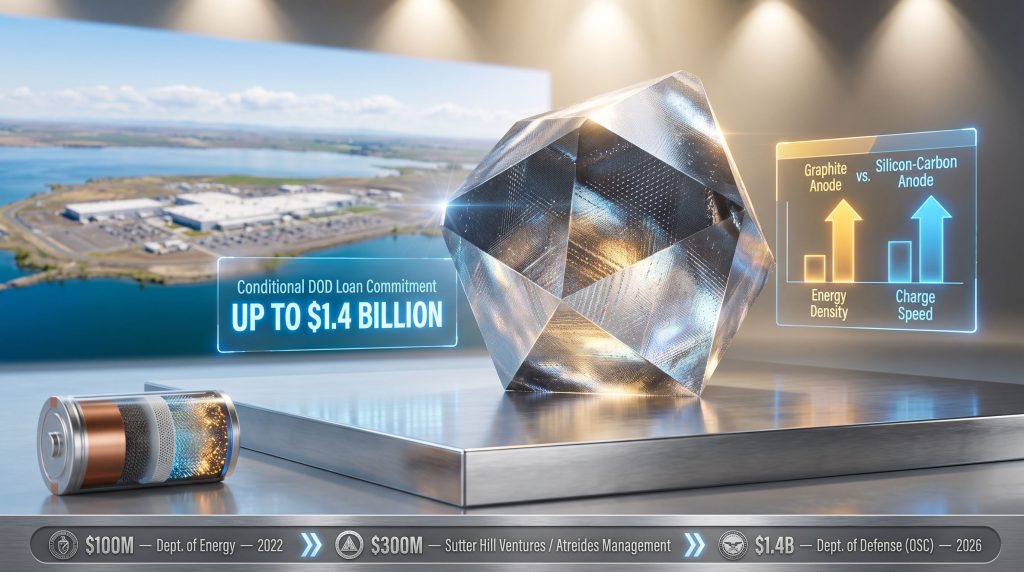
The Sila battery technology loan from US government channels, specifically a conditional commitment of up to $1.4 billion from the Department of Defense's Office of Strategic Capital, is the clearest expression yet of how fundamentally Washington's thinking about energy storage has changed. This is not a clean energy subsidy. It is an industrial capability investment rooted in defence readiness logic, and it reflects the growing urgency around defence critical materials strategies across allied nations.
When big ASX news breaks, our subscribers know first
Why Silicon-Carbon Anodes Matter More Than Most People Realise
The Structural Weakness in America's Battery Supply Chain
The United States currently imports the overwhelming majority of its battery-grade graphite, the material used in virtually every conventional lithium-ion anode. China controls an estimated 80 to 90 percent of the global graphite processing and anode material supply chain, according to data tracked by the U.S. Geological Survey and repeated in multiple congressional briefings. For consumer electronics, this dependency is inconvenient. For defence procurement, it is a strategic liability.
Silicon-carbon composite anodes represent a fundamentally different supply chain geometry. Silicon is one of the most abundant elements in the Earth's crust, and domestic sourcing pathways are far more viable than for processed graphite. However, the material science challenge has always been the same: pure silicon expands by roughly 300 percent during charging as it absorbs lithium ions, causing the anode to crack and degrade rapidly. Composite designs that embed silicon within a carbon matrix buffer this expansion, dramatically extending cycle life while preserving the energy density advantage that makes silicon so attractive in the first place.
Performance Comparison: Silicon-Carbon vs. Conventional Graphite Anodes
The technical case for silicon-carbon technology is not subtle. When measured across the metrics that matter most to both commercial EV manufacturers and defence procurement officers, the performance gap is meaningful.
| Performance Metric | Graphite Anode | Silicon-Carbon Anode |
|---|---|---|
| Gravimetric Energy Density | Baseline (~372 mAh/g theoretical) | Significantly higher (~3,579 mAh/g for pure Si) |
| Charge Speed | Moderate | Faster due to higher lithium uptake rates |
| Cycle Stability | Well-established, mature | Improving rapidly with composite architecture |
| Domestic Sourcing Potential | Severely constrained | Expanding through U.S. facilities |
| Weight Implications for Drones/UAS | Heavier per unit energy | Lighter, critical for flight time and payload |
The weight reduction dimension is particularly important for unmanned aerial systems. Military drones and autonomous agricultural platforms face strict payload constraints, meaning that every gram saved in battery weight translates directly into additional flight time, operational range, or sensor capacity. This is why the DOD's interest in Sila's technology extends well beyond clean energy policy. Furthermore, the broader critical minerals demand dynamics underpinning this shift are reshaping procurement strategies across multiple allied governments.
How the $1.4 Billion Conditional Loan Structure Works
The Office of Strategic Capital and Its Mandate
The Department of Defense's Office of Strategic Capital, established in 2022, operates with a mandate distinct from the Department of Energy's Loan Programs Office. Where the DOE targets clean energy infrastructure broadly, the OSC was specifically designed to mobilise private and public capital toward technologies with direct or dual-use defence applications. Its involvement with Sila signals that silicon-carbon anode manufacturing has cleared an internal assessment threshold linking battery cell performance to military platform readiness.
The term conditional commitment carries specific technical and legal meaning in federal lending. It is not a disbursed loan. It is a binding expression of intent, contingent on the borrower satisfying a defined set of pre-closing conditions across financial, legal, technical, and operational domains. Only once all conditions are verified does the formal loan agreement execute and funds become available. For further context on Sila's official press announcements, their communications detail the company's broader commercialisation roadmap.
Federal and Private Capital Flowing Into Sila: A Timeline
The scale of the 2026 commitment becomes more legible when viewed alongside Sila's prior capital milestones.
| Funding Event | Year | Amount | Source | Purpose |
|---|---|---|---|---|
| ATVM Loan Program | 2022 | $100 million | U.S. Department of Energy | Initial Moses Lake facility scale-up |
| Private Equity Round | Recent | $300 million | Sutter Hill Ventures / Atreides Management | Commercialisation and expansion capital |
| OSC Conditional Loan | 2026 | Up to $1.4 billion | U.S. Department of Defense | Anode manufacturing expansion + battery cell facility |
The progression from a $100 million DOE technology loan in 2022 to a $1.4 billion DOD conditional commitment in 2026 reflects not only Sila's maturation as a company, but also a broader institutional shift in how Washington categorises battery materials: no longer as energy infrastructure alone, but as defence-critical industrial capacity.
This layered capital structure, private equity stacked beneath federal loan facilities, is increasingly being described within battery investment circles as the optimal financing model for capital-intensive advanced materials companies. It preserves equity while enabling manufacturing at a scale that private markets alone cannot efficiently fund. In addition, the evolving battery raw materials market is creating further urgency for exactly this kind of vertically integrated domestic manufacturing strategy.
Where the Money Goes: Two Manufacturing Priorities
Expanding Anode Material Production at Moses Lake, Washington
Moses Lake was not selected arbitrarily. The site offers access to some of the lowest-cost hydroelectric power in the continental United States, a critical input for energy-intensive anode material processing. Washington State's Columbia Basin also provides established industrial infrastructure and proximity to Pacific logistics corridors, which matter for both inbound raw material flows and outbound product distribution.
The expansion funded through the conditional loan is designed to substantially increase silicon-carbon anode output capacity beyond Sila's initial operational baseline. Domestically produced anode materials reduce the exposure that has made U.S. battery manufacturers dependent on foreign processing facilities, particularly for graphite, and they provide supply chain traceability that defence contractors increasingly require under procurement specifications.
Building a Specialty Battery Cell Manufacturing Facility
The second track of Sila's expansion plan involves constructing a dedicated lithium-ion battery cell facility oriented toward specialty-use applications. This is a strategically distinct undertaking from consumer EV cell production.
Target markets for the new facility include:
- Military unmanned aerial systems (UAS): Long-range, high-endurance drone platforms requiring maximum energy density per kilogram
- Industrial and agricultural drones: Autonomous spraying, surveying, and logistics platforms where battery weight directly affects payload capacity and flight efficiency
- Defence platform electrification: Broader applications in electrified ground and maritime systems where weight-optimised energy storage improves operational parameters
Specialty battery cell manufacturing operates under different design requirements than mass-market EV production. Cycle life profiles, operating temperature ranges, discharge rate tolerances, and safety certification pathways all differ. The ability to manufacture cells tailored to these specifications domestically, rather than sourcing from allied or foreign suppliers, has direct procurement implications for U.S. defence programs.
The Broader Federal Strategy Behind Battery Manufacturing Investment
How the Sila Loan Fits Within a Larger Industrial Policy Architecture
The OSC commitment to Sila sits within a wider federal effort to repatriate critical battery manufacturing capacity. Parallel mechanisms include the Department of Energy's Loan Programs Office, which has deployed tens of billions across battery, solar, and grid storage projects, and the Advanced Manufacturing Production Credit under Section 45X of the Inflation Reduction Act, which provides per-unit tax credits for domestically produced battery components including anode materials.
What makes the Sila case instructive is the DOD channel rather than a DOE channel. It suggests that federal battery manufacturing strategy is bifurcating: general energy transition investments flowing through energy-focused agencies, while performance-critical, defence-adjacent technologies are being channelled through defence financing mechanisms with different risk tolerances and strategic mandates. Consequently, this approach mirrors the logic being developed through a broader critical minerals coalition framework among allied nations seeking to reduce dependence on adversarial supply chains.
The Competitive Landscape for Domestic Anode Manufacturing
Sila is not operating in a vacuum. The domestic anode materials space includes producers pursuing synthetic graphite pathways, companies developing lithium-metal anodes, and a small but growing cohort of silicon-composite innovators at various stages of commercial readiness. What distinguishes the silicon-carbon composite approach, and implicitly what the OSC appears to have evaluated favourably, is the combination of energy density improvement and improving cycle stability that composite architectures deliver over pure silicon designs.
Speculative but increasingly discussed within advanced materials investment circles is the possibility that DOD procurement preferences, once formalised around silicon-carbon anode specifications, could effectively set a performance floor for military battery supply contracts that excludes lower-density graphite-based alternatives entirely. If that preference hardens into formal procurement standards, the commercial addressable market for silicon-carbon anode producers would expand substantially beyond defence into any civilian application where military-grade battery specifications become an industry benchmark.
Furthermore, the ongoing battery recycling push across the industry adds another dimension to this competitive landscape, as closed-loop material recovery increasingly influences how domestic manufacturing economics are modelled at scale.
Risk Factors and the Conditions Sila Must Meet
What a Conditional Commitment Actually Requires
Federal conditional loan commitments are not formalities. They reflect a point in due diligence where the agency has sufficient confidence to announce intent, but retains structured protection for public capital through defined conditions. For a manufacturing-scale loan of this magnitude, those conditions typically span several domains:
- Technical milestones including production yield targets, material quality certifications, and facility construction progress benchmarks
- Financial covenants covering revenue trajectories, debt-to-equity ratios, working capital adequacy, and capital structure requirements
- Legal and regulatory compliance encompassing environmental permitting for the Moses Lake site, ITAR compliance for defence-adjacent manufacturing, and corporate governance requirements
- Operational readiness verification including equipment commissioning timelines and workforce capacity planning
Should Sila encounter delays in any of these categories, whether a permitting complication at Moses Lake, a quality certification gap, or a shift in its capital structure, the OSC retains the authority to modify, reduce, or withdraw the conditional commitment. This conditionality is standard practice in federal advanced technology lending and serves as the primary risk management mechanism protecting taxpayer exposure. Investors and observers should interpret the announcement as a significant milestone of confidence, not as an unconditional guarantee of disbursement.
The next major ASX story will hit our subscribers first
Frequently Asked Questions: Sila Battery Technology Loan from US Government
What is Sila Nanotechnologies?
Sila Nanotechnologies is a U.S.-based advanced materials company focused on silicon-carbon anode technology designed to replace conventional graphite in lithium-ion batteries. Its primary manufacturing operations are based at Moses Lake, Washington.
How much is the US government committing to Sila?
The Department of Defense's Office of Strategic Capital has issued a conditional loan commitment of up to $1.4 billion to support Sila's domestic battery manufacturing expansion across two facilities.
What will the loan fund specifically?
The financing targets two parallel priorities: scaling silicon-carbon anode production capacity at Moses Lake, and constructing a new lithium-ion battery cell manufacturing facility focused on specialty applications including military drones, agricultural autonomous systems, and industrial platforms.
Is the loan finalised and funded?
No. The commitment remains conditional, meaning Sila must satisfy a defined set of financial, technical, legal, and operational requirements before the loan agreement is formally executed and capital is disbursed. Detailed reporting on the announcement is available via Yahoo Finance's coverage of the conditional loan commitment.
Has Sila received federal funding previously?
Yes. In 2022 the Department of Energy provided Sila with a $100 million loan through its Advanced Technology Vehicles Manufacturing Loan Program to support the initial scaling of its Moses Lake anode materials facility.
Who are Sila's private institutional investors?
Sila's most recent private capital round totalling $300 million was led by Sutter Hill Ventures and Atreides Management, providing the commercial capital foundation on which the federal financing structure is layered.
Why is the Department of Defense, not the Department of Energy, providing this loan?
The DOD's involvement through the Office of Strategic Capital reflects the dual-use nature of Sila's battery technology. The Sila battery technology loan from US government defence channels positions silicon-carbon anode cells as a national security asset alongside their clean energy credentials, given their direct applications in military unmanned systems and defence platforms.
The Geopolitical and Industrial Stakes of Getting This Right
Batteries as Strategic Infrastructure, Not Just Energy Products
The framing of battery manufacturing as defence infrastructure rather than clean energy infrastructure carries implications that extend well beyond Sila's balance sheet. It signals that Washington has concluded, at an institutional level, that the electrification of military platforms, from drones and autonomous ground vehicles to electrified logistics systems, creates a category of supply chain dependency that cannot be managed through energy policy alone.
The geographic concentration of battery material processing in China, a strategic competitor, means that disruption scenarios once considered theoretical are now incorporated into DOD planning. A domestic silicon-carbon anode manufacturing base, even at the scale Sila is targeting, does not resolve that dependency entirely. However, it creates a meaningful onshore capability anchor that reduces the most acute single-point vulnerabilities in the military battery supply chain.
For the broader U.S. battery manufacturing landscape, the template being established through the Sila battery technology loan from US government defence mechanisms could prove as significant as the specific dollar figure. A capital stack combining institutional private equity with DOD loan facilities, structured around a technology company with demonstrated commercial deployments and a clear defence applications pathway, may become the standard model for how the next generation of advanced battery materials companies approach scale-up financing.
Readers seeking further coverage of U.S. battery manufacturing policy, energy storage financing developments, and the global clean energy investment landscape can explore reporting available at Renewables Now, which tracks major deals, project financing, and sector trends across the renewable energy industry.
This article contains forward-looking analysis and scenario projections. The conditional nature of the loan commitment means outcomes described are contingent on conditions being met. Nothing in this article constitutes financial or investment advice.
Want to Track the Next Major Resource Discovery Before the Market Does?
Discovery Alert's proprietary Discovery IQ model scans ASX announcements in real time, instantly identifying high-potential mineral discoveries across more than 30 commodities — transforming complex data into actionable opportunities for investors at every experience level. Explore historic discoveries and their exceptional returns, then begin your 14-day free trial to position yourself ahead of the market.