August 10, 2026
The Structural Paradox at the Heart of East Africa's Petroleum Economy
Few economic contradictions in sub-Saharan Africa are as striking as that of a nation preparing to export crude oil while simultaneously spending approximately $2 billion annually importing refined fuel. This is the reality Uganda has navigated for years, and it reveals something important about how petroleum wealth actually functions in landlocked, infrastructure-constrained economies: upstream production capability and downstream energy security are entirely separate problems requiring entirely separate solutions.
The Uganda Tanzania Tanga energy hub is the most ambitious attempt yet to bridge that gap. However, understanding what the hub actually represents, what it may realistically deliver, and where its structural risks lie requires looking beyond the headline figures.
When big ASX news breaks, our subscribers know first
Why Landlocked Energy Systems Break Down Differently
The Geography Problem That Money Cannot Simply Fix
Uganda's petroleum challenge is fundamentally geographic before it is financial. The country sits at the centre of the East African plateau with no coastline, no domestic refining capacity of meaningful scale, and a fuel import network that has historically funnelled through a single foreign transit corridor.
For decades, more than 90% of Uganda's refined fuel imports arrived via Kenya's Mombasa port and the Kenya Pipeline Company's distribution network. This arrangement was commercially convenient during stable periods but carried a systemic vulnerability that most energy planners acknowledged privately while few addressed structurally.
That vulnerability became visible in 2023 when a commercial dispute with Nairobi temporarily disrupted the supply corridor. The episode did not cause a prolonged crisis, but it functioned as a stress test that Uganda's policymakers could not ignore. A single point of failure in a national fuel supply chain is not a minor logistical inconvenience; it is a sovereignty risk with direct economic consequences.
"The 2023 Mombasa corridor disruption was not just a trade dispute. It was a demonstration that Uganda's energy security was being held in trust by a foreign partner with its own commercial interests. The Tanga hub is, in structural terms, an insurance policy as much as an infrastructure project."
The Crude Export Paradox
Uganda's Hoima oil fields are the upstream anchor of the country's petroleum ambitions. The East African Crude Oil Pipeline (EACOP), a 1,443-kilometre heated pipeline running from Hoima in western Uganda to the Chongoleani terminal at Tanga on Tanzania's Indian Ocean coast, was designed to solve the export problem. It does that with considerable technical sophistication.
Because Uganda's crude is waxy and would solidify at ambient temperatures, the pipeline must be heated along its entire length, making it one of the longest electrically heated pipelines in the world. Furthermore, the broader resource export challenges facing landlocked economies like Uganda make infrastructure decisions of this kind particularly consequential.
However, EACOP solves only one side of the equation. It moves crude out; it does nothing to bring refined products in. The planned Kabaale refinery near Hoima is intended to address domestic processing needs, but it is not expected to come online before oil production formally begins. The Tanga hub is consequently designed to reduce the cost and vulnerability of that transition.
What the Tanga Hub Actually Proposes to Build
From Export Node to Integrated Energy Complex
Tanga's existing infrastructure centres on the Chongoleani oil terminal, which serves as EACOP's Indian Ocean terminus. The proposed hub would transform this single-function export node into a multi-purpose energy complex serving both upstream and downstream needs across the region.
The core infrastructure components under consideration include:
| Infrastructure Element | Current Status | Target Function |
|---|---|---|
| Crude export terminal (Chongoleani) | Operational | Anchor asset for hub expansion |
| Petroleum product refinery | Proposed | Process regional and international crude for distribution |
| Bi-directional refined products pipeline | Feasibility and FEED studies underway | Move fuel between Uganda and Tanzania in either direction |
| Expanded storage and distribution facilities | Expansion planned | Regional supply buffer and trading hub |
| Natural gas pipeline (Uganda to Tanzania) | Feasibility studies due October 2026 | Diversify energy mix across both nations |
The Bi-Directional Pipeline: Why It Matters More Than It Sounds
Among the hub's components, the proposed bi-directional refined products pipeline represents perhaps the most strategically significant innovation. Unlike EACOP, which moves crude in one direction only, this pipeline is designed to operate in either direction depending on market conditions and supply availability.
In practical terms, this means Uganda could draw refined fuel from Tanga when domestic supply is short, or push surplus refinery output back through the system when its own processing capacity exceeds local demand. This operational flexibility transforms the pipeline from a static logistics asset into a dynamic supply-management tool — something East Africa's landlocked energy markets have never had access to before.
Feasibility and front-end engineering design (FEED) studies for both the pipeline and the associated storage terminal are expected to conclude during 2026.
The $20 Billion Investment Thesis
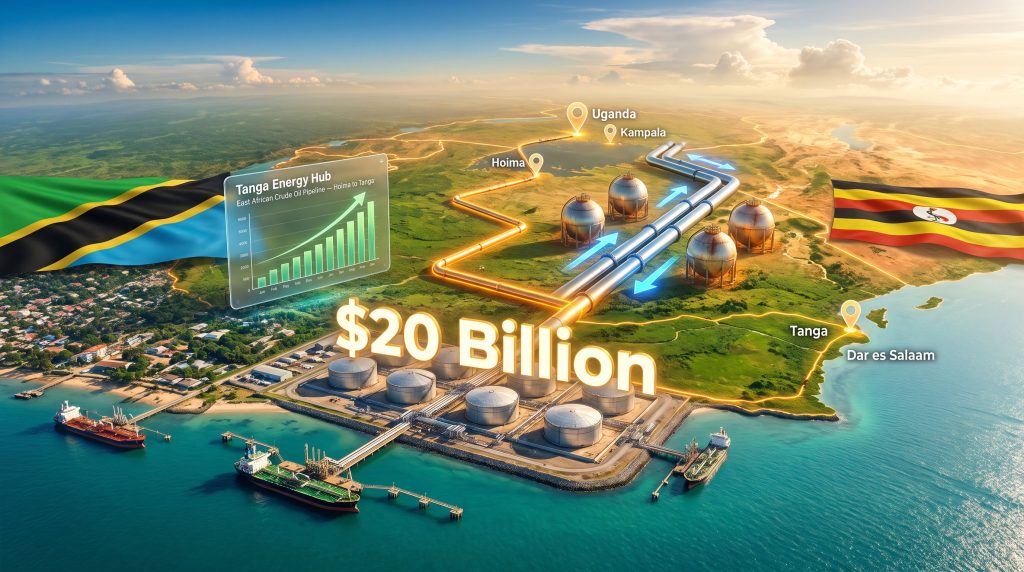
The total projected investment potential across the integrated Tanga hub exceeds $20 billion, a figure that contextualises the ambition in concrete terms. For comparison, EACOP itself required approximately $5 billion in capital to develop, making the Tanga hub a downstream commitment roughly four times larger than the pipeline that feeds it.
Tanzania's Energy Minister Deo Ndejembi has framed the project as a mechanism for converting crude oil movement into broader downstream economic value for both nations — not simply a logistics upgrade. In addition, the African infrastructure finance landscape increasingly views integrated energy corridors as the most bankable class of regional development assets.
The August 2026 MOU: What Was Actually Agreed
The Parties and the Ceremony
On August 6, 2026, in Dar es Salaam, three entities signed a memorandum of understanding in the presence of Tanzanian President Samia Suluhu Hassan and Ugandan President Yoweri Museveni:
- Tanzania Petroleum Development Corporation (TPDC): Tanzania's state energy entity and the host-country institutional anchor
- Uganda National Oil Company (UNOC): Uganda's state petroleum company managing upstream and strategic interests
- Vitol Bahrain: The international trading and logistics arm of Swiss-headquartered commodity trader Vitol
The public presence of both heads of state signals political commitment at the highest level, but it is important to distinguish between political endorsement and binding legal obligation.
What the MOU Does and Does Not Lock In
Memoranda of understanding in African energy infrastructure carry a specific and often misunderstood legal character. This agreement is non-binding in nature. It covers planning intent, feasibility scope, and cooperation frameworks — not final capital commitments, environmental approvals, or construction timelines.
What remains unresolved after the signing includes:
- The financing structure and which parties bear capital risk at each development stage
- Environmental and social impact permitting across both jurisdictions
- Competitive tendering processes for construction and operations contracts
- The precise timeline from FEED completion to financial close to groundbreaking
"In African energy infrastructure development, the distance between a signed MOU and an operational facility has historically been measured in years rather than months. The Tanga hub's trajectory will be determined by factors that no signing ceremony can predetermine."
Vitol's Expanding Role: Strategic Partner or Systemic Risk?
A Footprint Built Across Three Vectors
No analysis of the Uganda Tanzania Tanga energy hub is complete without examining Vitol's position across Uganda's entire petroleum system. The commodity trading giants in this sector increasingly position themselves across multiple nodes of a single national energy system, and Vitol's influence now spans three distinct vectors:
| Role | Agreement or Transaction | Year |
|---|---|---|
| Exclusive petroleum products supplier to Uganda | $2 billion supply agreement with UNOC | 2025 |
| Equity investor in transit infrastructure | 20.15% stake in Kenya Pipeline Company IPO | March 2026 |
| Co-developer of Tanga hub infrastructure | MOU with TPDC and UNOC | August 2026 |
This is an unusual concentration of influence for a single private trading company. Vitol now holds positions in Uganda's supply relationships, its primary existing transit corridor through Kenya, and its proposed alternative logistics hub in Tanzania — simultaneously.
The Governance Gap
The governance questions this raises are not merely theoretical. According to reporting by Uganda Standard, a significant portion of Vitol's Ugandan contracts were awarded outside competitive tendering processes. This procurement pattern, combined with the company's expanding infrastructure role, has yet to attract sustained scrutiny from Uganda's parliamentary or regulatory oversight bodies.
The structural argument in Vitol's favour is straightforward: state-owned entities like UNOC and TPDC typically lack the balance sheet, supply-chain infrastructure, and global commodity market access that a company like Vitol brings to multi-billion-dollar downstream projects. Private capital is not optional in this context; it is structurally necessary.
The structural argument against over-dependence is equally direct: when a single private counterparty controls supply, financing, distribution, and infrastructure planning within a national petroleum system, it accumulates leverage that can constrain sovereign decision-making. Robust risk management frameworks will therefore be essential to protecting national interests as the hub evolves.
"The question Uganda's policymakers and civil society will eventually need to answer is whether the efficiency gains of a single strategic private partner outweigh the governance costs of concentrated control in a critical national asset class."
Rwanda as an Early Signal: The Hub's Regional Function Is Already Live
One of the most underappreciated aspects of the Tanga hub story is that the port's function as a multi-country fuel import corridor has already begun operating — before the hub itself is built.
In early July 2026, Rwanda signed an agreement with Gulf Bulk Petroleum Tanzania Limited to import fuel through Tanga. The first shipment of 40,000 tonnes arrived in late July 2026, according to The New Times, with monthly deliveries expected from August onward.
This matters strategically because it demonstrates market validation of the Tanga route's viability for landlocked countries. Rwanda's adoption of the corridor before Uganda's hub infrastructure is even in FEED studies suggests that the commercial logic of the Tanga alternative is already persuasive to regional buyers, independent of the larger development timeline.
The next major ASX story will hit our subscribers first
Energy Interconnection Beyond Oil: The Broader Architecture
Electricity, Gas, and the Grid Ambition
The Uganda Tanzania Tanga energy hub sits within a broader bilateral energy cooperation framework that extends well beyond petroleum. Two additional dimensions deserve attention:
Natural gas pipeline: Uganda and Tanzania are advancing feasibility studies for a cross-border natural gas pipeline, with study completion targeted for October 2026. If viable, this would add a second energy commodity to the Tanga corridor's function, diversifying the hub's revenue base and strategic relevance.
High-voltage electricity transmission: Uganda has secured $250 million in World Bank financing for its section of a high-voltage transmission line linking Uganda and Tanzania. According to ChimpReports, the longer-term objective is to enable electricity trading between East Africa and Southern Africa through an integrated grid corridor, positioning the Uganda-Tanzania axis as a potential bridge between two of the continent's major power pools.
What the Kenya-Tanzania Competition Means for Regional Energy Politics
The Tanga hub implicitly creates a competitive dynamic between Tanzania and Kenya for the role of dominant transit and logistics partner to East Africa's landlocked economies. Kenya has held that position for decades, with the Mombasa port and Kenya Pipeline Company network serving as the default infrastructure for Uganda, Rwanda, Burundi, and parts of the Democratic Republic of Congo.
If Tanga develops as planned, Tanzania gains substantial leverage as an alternative corridor nation. Furthermore, the broader geopolitical risk landscape across East Africa means that route diversification is no longer merely a commercial preference — it is a strategic imperative for energy-importing landlocked states.
Scenario Analysis: Three Realistic Pathways for the Tanga Hub
| Scenario | Conditions Required | Realistic Assessment |
|---|---|---|
| Full Hub Realisation | Financing close achieved, all permits secured, bilateral cooperation sustained, EACOP operational | Moderate probability; dependent on EACOP completion and refinery project bankability |
| Partial Development | Storage and distribution infrastructure built; refinery delayed or restructured | Higher probability in the medium term; consistent with regional infrastructure norms |
| Stalled Development | Financing failure, political disruption between Kampala and Dar es Salaam, or environmental opposition | Lower but non-negligible given MOU's non-binding character |
Disclaimer: The scenario assessments above are analytical projections based on regional infrastructure development patterns and publicly available information. They do not constitute investment advice or predictions of specific outcomes.
Frequently Asked Questions: Uganda Tanzania Tanga Energy Hub
What is the Tanga energy hub and where is it located?
The Tanga energy hub is a proposed integrated petroleum infrastructure complex centred on the Chongoleani oil terminal in Tanga, a port city on Tanzania's Indian Ocean coast. The facility is the terminus of the East African Crude Oil Pipeline (EACOP) and is planned to expand into a full-service refining, storage, distribution, and logistics complex serving Uganda, Tanzania, and potentially other landlocked regional economies.
Why does Uganda urgently need an alternative fuel corridor?
Uganda has historically channelled over 90% of its fuel imports through Kenya's Mombasa port and the Kenya Pipeline Company network. A 2023 commercial dispute temporarily disrupted this corridor, demonstrating that single-corridor dependency represents a genuine national security risk. The Tanga hub offers a direct Indian Ocean supply route that does not transit Kenyan territory.
How much investment is expected for the Tanga hub development?
The broader integrated hub is projected to attract more than $20 billion in investment across refining, storage, pipeline, and logistics infrastructure, representing a downstream commitment approximately four times larger than the $5 billion EACOP pipeline that feeds into it.
Who signed the August 2026 MOU and is it legally binding?
The MOU was signed by Tanzania's TPDC, Uganda's UNOC, and Vitol Bahrain on August 6, 2026, in the presence of Presidents Samia Suluhu Hassan and Yoweri Museveni. The agreement is non-binding and covers planning intent and feasibility cooperation rather than final capital commitments.
Is Rwanda already using Tanga as a fuel import route?
Yes. Rwanda signed an agreement with Gulf Bulk Petroleum Tanzania Limited in early July 2026 to import fuel through Tanga. A first shipment of 40,000 tonnes arrived in late July 2026, with monthly deliveries expected from August onward, establishing Tanga's regional corridor function ahead of the hub's formal development.
When will feasibility studies for the hub's key components be completed?
FEED and feasibility studies for the refined-products pipeline and storage terminal are expected to conclude during 2026. Studies for the proposed natural gas pipeline connecting Uganda and Tanzania are specifically targeted for completion by October 2026.
Want to Stay Ahead of the Next Major Resource Discovery?
While East Africa's energy infrastructure signals the growing strategic value of resource corridors, investors seeking exposure to significant mineral discoveries closer to home can rely on Discovery Alert, powered by its proprietary Discovery IQ model, to deliver real-time ASX alerts that turn complex commodity data into actionable opportunities — explore the historic returns major discoveries have generated and begin your 14-day free trial to position yourself ahead of the broader market.