July 31, 2026
When Operating Leverage Meets a Commodity Supercycle: The Copper Producer Playbook in Action
There is a specific moment in the life cycle of a commodity producer when everything converges: the price environment, the operational infrastructure, the balance sheet trajectory, and the growth pipeline all align simultaneously. For investors tracking the copper sector, understanding when that alignment is genuine versus temporary is the difference between a well-timed position and a costly mistake. The Capstone Copper record Q2 earnings result for the quarter ended June 30, 2026, offers a compelling case study in what structural earnings power actually looks like when tested against real-world conditions.
This is not simply a story about a higher copper price lifting all boats. It is about a mid-tier producer that has spent years building the operational architecture to convert commodity price tailwinds into margin expansion at a rate that outpaces revenue growth, and then sustaining that performance across seven consecutive quarters.
When big ASX news breaks, our subscribers know first
Seven Consecutive Record Quarters: Understanding What That Streak Actually Signals
In commodity mining, one record quarter is noise. Two or three could reflect a price cycle. Seven consecutive quarters of record adjusted EBITDA is something categorically different. It suggests a company has crossed a structural threshold where its cost base, throughput capacity, and asset mix have been fundamentally repositioned.
For Capstone, this streak reflects a multi-year integration and optimisation effort across its Chilean and Mexican operations following the 2022 merger of Capstone Mining and Mantos Copper. That merger created a multi-asset platform spanning Mantoverde and Mantos Blancos in Chile, Cozamin in Mexico, and Pinto Valley in Arizona. The complexity of integrating these assets, harmonising labour frameworks, and optimising processing circuits took time. The earnings results of the past seven quarters suggest that integration work is now delivering compounding returns.
Furthermore, the Chile copper outlook has remained broadly supportive, reinforcing the strategic value of Capstone's Chilean asset base throughout this streak.
The key distinction here is between cyclical leverage and operational leverage. A cyclical lift means revenue rises with the commodity price. Operational leverage means EBITDA rises faster than revenue because fixed costs are absorbed more efficiently at higher throughput, and because process improvements reduce the cost per pound of copper produced.
Q2 2026 Financial Performance: The Numbers in Full Context
The Capstone Copper record Q2 earnings figures for the quarter ended June 30, 2026, represent the strongest quarterly result in the company's history across virtually every meaningful financial metric.
Headline Financial Results at a Glance
| Financial Metric | Q2 2026 | Q2 2025 | Year-on-Year Change |
|---|---|---|---|
| Revenue | $739.7 million | $543.2 million | +36.2% |
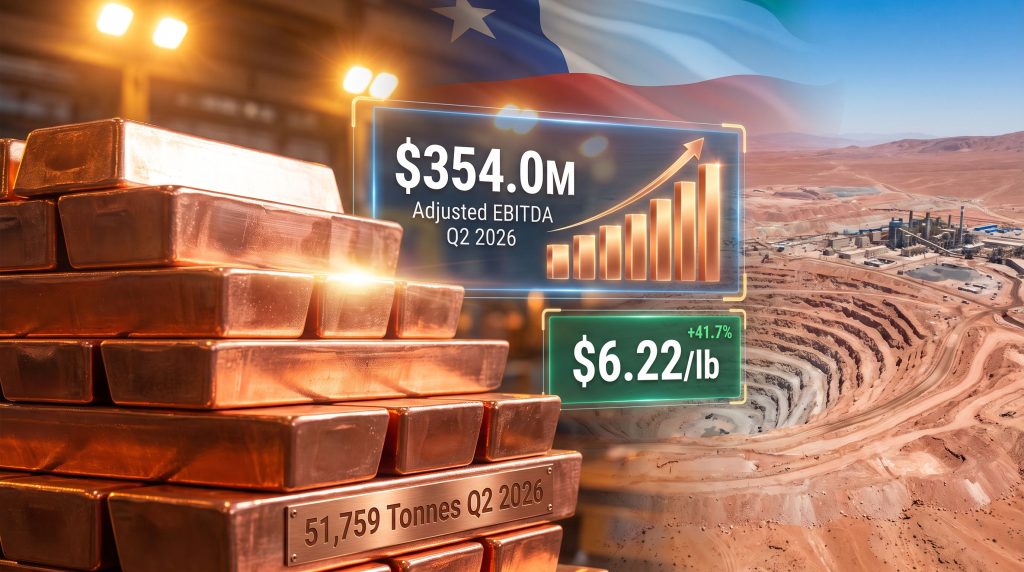
| Adjusted EBITDA | $354.0 million | $215.6 million | +64.2% |
| Net Income (Attributable) | $74.3 million ($0.10/share) | $24.0 million ($0.03/share) | +209.6% |
| Adjusted Net Income (Attributable) | $97.6 million ($0.13/share) | $27.5 million ($0.04/share) | +254.9% |
| Realised Copper Price | $6.22/lb | $4.39/lb | +41.7% |
| Consolidated Copper Production | 51,759 tonnes | N/A | N/A |
| Net Debt | $674 million | $780 million (Dec 2025) | -$106 million |
| Total Available Liquidity | $1.08 billion | N/A | N/A |
The arithmetic embedded in these figures tells a particularly important story about operating leverage. Revenue grew by 36.2% year-on-year, yet adjusted EBITDA expanded by 64.2%. This gap is not accidental. It reflects the mechanics of high fixed-cost businesses: once a mine is producing at or above its design capacity, each additional dollar of revenue generated at a higher commodity price falls disproportionately to the EBITDA line.
Applying this logic to the copper price movement, the $1.83 per pound improvement in the realised copper price between Q2 2025 and Q2 2026 generated approximately $138.4 million of incremental EBITDA, implying roughly $75.6 million of additional EBITDA for every $1.00 per pound improvement in the copper price across Capstone's production base. This sensitivity figure is critical for investors constructing scenario analyses around the company's future earnings profile.
Why Adjusted EBITDA and Adjusted Net Income Diverge From Reported Figures
The reported net income of $74.3 million sits meaningfully below the adjusted net income figure of $97.6 million. The primary driver of this gap is union bonus payments at the Mantos Blancos operation in Chile, which were treated as non-recurring items for the purpose of the adjusted earnings calculation.
This distinction matters for several reasons:
- Union bonus payments, while legitimate operating costs in the period they occur, do not reflect the ongoing cost structure of the operation under a stable labour agreement
- The new three-year labour agreement signed at Mantos Blancos during Q2 2026 provides cost predictability going forward, meaning the earnings drag from this item is unlikely to repeat
- Adjusted earnings figures give institutional investors a cleaner signal of the underlying earnings power of the asset base, which is the more relevant input for forward valuation modelling
Asset-by-Asset Performance: Where the Earnings Were Made and Lost
Mantoverde: Operating at 13% Above Design Capacity
The standout operational performer in Q2 2026 was the Mantoverde sulphide operation in Chile's Atacama Region, which delivered record sulphide copper production of 18,190 tonnes for the quarter. What makes this figure particularly notable is the context in which it was achieved.
Plant throughput at Mantoverde averaged 36,264 tonnes per day, a rate that is approximately 13% above the operation's original design capacity. Operating above nameplate capacity in a sulphide processing circuit is not simply a matter of running equipment harder. It typically reflects a combination of:
- Ongoing process optimisation at the concentrator, including adjustments to grinding circuits, flotation cell configuration, and reagent dosing
- Improved ore blending strategies that maintain consistent feed grade while maximising mill utilisation
- Operational stability supported by the multi-year labour agreement signed earlier in 2026, which eliminated the production disruption risk associated with labour negotiations
The significance of sustained above-nameplate performance is that it effectively reduces the capital intensity of production. The same infrastructure generates more copper with no additional capital expenditure, which compresses the cost per pound and amplifies margin.
A further catalyst is approaching. The Mantoverde Optimised project, which represents an expansion of the existing sulphide processing circuit, remains on schedule to begin ramping up in late Q3 2026. When commissioned, this will add incremental sulphide production tonnes on top of an already record-performing base.
Cozamin: Underground Leverage to Copper Prices
The Cozamin underground copper-silver mine in Zacatecas, Mexico, delivered a strong operational performance during Q2 2026, reinforcing its role as a consistent cash-generating asset within Capstone's portfolio. Cozamin's underground mining profile, characterised by higher grades relative to typical open-pit operations, means its margins benefit disproportionately from higher copper prices. The operation's silver byproduct credits also served as an additional source of margin support in a quarter where precious metal prices remained elevated.
Mantos Blancos: Labour Resolution Unlocks the Path Forward
The Mantos Blancos operation in Chile's Antofagasta Region had a more complex quarter from a reported earnings perspective, primarily due to the union bonus payments discussed above. However, the resolution of labour negotiations represents a strategically important milestone. The new three-year agreement removes uncertainty from the operational horizon and establishes a predictable cost framework for the medium term.
Beyond the labour resolution, Capstone submitted an environmental impact assessment (EIA) for an expansion project at Mantos Blancos during the quarter. In Chile's regulatory environment, the EIA submission initiates a formal review process that typically involves public consultation periods, technical assessments by the Servicio de Evaluación Ambiental (SEA), and ultimately a resolution that either approves or requires modifications to the proposed expansion. The timeline from EIA submission to construction approval in Chile can vary considerably depending on project complexity and consultation outcomes, making it difficult to assign a precise schedule to this expansion path at this stage.
Pinto Valley: A Planned Reset, Not a Structural Problem
The Pinto Valley operation in Arizona was the operational outlier of the quarter, with unplanned maintenance events weighing on production metrics. However, management has signalled that a planned maintenance shutdown in Q3 2026 is designed to address these issues and establish a more reliable production base for subsequent periods. Pinto Valley's performance trajectory will be an important variable to monitor in H2 2026, particularly as it affects whether the company can achieve the upper end of its full-year production guidance range.
Copper Price Mechanics: How $6.22 Per Pound Becomes a Strategic Advantage
The Supply-Demand Architecture Underpinning Elevated Prices
The $6.22 per pound realised copper price achieved in Q2 2026 represents a 41.7% premium to the $4.39 per pound realised in the same period of the prior year. Understanding whether this price level reflects a temporary speculative peak or a more durable structural shift is central to assessing Capstone's forward earnings profile. Indeed, the copper price drivers underpinning this elevation extend well beyond short-term speculation.
The structural case for elevated copper prices rests on several reinforcing dynamics:
- Demand acceleration: The energy transition continues to drive copper intensity across electricity grids, utility-scale battery storage installations, solar generation systems, and electric vehicle drivetrains. Each electric vehicle contains approximately three to four times the copper content of an internal combustion engine vehicle, according to industry estimates from the Copper Development Association
- Supply-side deterioration: Average ore grades at established copper mines globally have declined over decades. The International Copper Study Group (ICSG) has documented this trend across major producing regions including Chile and Peru, where declining head grades at mature operations increase the cost and energy requirements per pound of copper produced
- Permitting timelines: New greenfield copper mine development now routinely takes 15 to 20 years from discovery to first production in many jurisdictions, a structural supply constraint that limits the market's ability to respond quickly to price signals
- Geopolitical concentration: Approximately 40% of global mined copper supply originates from Chile and Peru, creating concentration risk that can be amplified by labour disputes, political uncertainty, or water availability constraints
The copper supply crunch continues to underpin this pricing environment, with long-lead-time project development making a rapid supply response structurally unlikely across the near to medium term.
Byproduct Credits: The Hidden Margin Contributor
One dimension of Capstone's Q2 2026 performance that deserves specific attention is the contribution of gold and silver byproduct credits to the company's effective cost position. When a copper mine produces meaningful quantities of gold or silver as co-products, the revenue from those metals can be credited against the reported cash cost per pound of copper, lowering the C1 cost metric that analysts use to assess competitiveness.
Capstone's net debt reduction of $106 million in the first half of 2026, from $780 million at the end of December 2025 to $674 million at June 30, 2026, was explicitly driven by strong cashflow from higher realised copper, gold, and silver prices. This confirms that precious metal price appreciation played a meaningful role in supporting the company's deleveraging trajectory, not merely the copper price alone.
Balance Sheet Transformation: From Leverage Overhang to Financial Flexibility
Net Debt Trajectory and Liquidity Position
The pace of net debt reduction achieved in H1 2026 is notable for a company that carried significant legacy debt from its 2022 merger. The $106 million reduction in six months, driven entirely by operating cashflow rather than asset sales or equity raises, signals that Capstone has achieved a level of free cashflow generation that meaningfully exceeds its capital expenditure requirements at current copper prices.
The total available liquidity position of $1.08 billion at June 30, 2026, comprising $367 million in cash and $715 million in undrawn credit facilities, provides the company with substantial financial flexibility. This liquidity buffer serves multiple strategic functions:
- Funding growth capital across the organic project pipeline without requiring equity market access
- Providing a buffer against copper price volatility, ensuring operational continuity if prices retrace materially
- Supporting future capital allocation decisions including potential shareholder returns once debt metrics reach target levels
Capital Allocation Priorities in a High-Price Environment
The discipline with which management allocates capital allocation in copper projects at current price levels will be a key determinant of long-term value creation. The competing priorities include accelerating debt repayment to improve the credit profile, funding growth capital across the project pipeline, and potentially initiating shareholder returns. The reaffirmation of full-year guidance and the board's approval of the Mantoverde Pyrite Augmentation project suggest that capital efficiency and growth execution remain the primary near-term priorities.
The next major ASX story will hit our subscribers first
Growth Pipeline: Building Toward 375,000 Tonnes Per Year
The Capital Efficiency Argument for Organic Growth
Capstone's growth strategy is fundamentally differentiated by its reliance on organic, permitted projects rather than acquisitions. In a copper market where greenfield project development timelines extend to two decades and M&A competition for producing assets drives acquisition premiums, organic growth from permitted projects offers a significantly lower-risk and capital-efficient pathway to production growth.
The Mantoverde Pyrite Augmentation project, recently approved by Capstone's board, is a technically interesting example of this approach. Pyrite augmentation in a copper flotation circuit involves processing pyrite-bearing material that would otherwise report to tailings, recovering additional copper that was previously lost in the metallurgical process. By leveraging existing infrastructure at Mantoverde, this project adds copper production capacity without requiring a new processing plant, making it highly capital-efficient relative to the production increment it delivers. Those exploring copper investment strategies will recognise this organic growth model as a compelling approach to value creation in the current environment.
Project Pipeline Summary
| Project | Status | Expected Timeline | Key Outcome |
|---|---|---|---|
| Mantoverde Optimised | Ramp-up commencing | Late Q3 2026 | Incremental sulphide production |
| Mantoverde Pyrite Augmentation | Board approved | Post-approval | Enhanced copper recovery rates |
| Mantos Blancos Expansion | EIA submitted | Subject to regulatory review | Capacity uplift at existing operation |
| Santo Domingo | Detailed engineering | Multi-year horizon | Major new production source |
| Full Portfolio Target | Medium-term | TBD | ~375,000 t/year |
Santo Domingo: The Long-Horizon Flagship
The Santo Domingo copper-iron-gold project in Chile's Atacama Region represents the largest potential growth lever in Capstone's portfolio. Currently in the detailed engineering phase, Santo Domingo would, if developed, represent a significant new source of copper production with co-product revenues from iron ore and gold. However, a final construction decision remains conditional on completing detailed engineering, securing project financing, and navigating any additional regulatory requirements. Investors should treat Santo Domingo as a longer-dated option on copper production rather than a near-term catalyst.
Full-Year 2026 Guidance: What Reaffirmation Communicates Beyond the Numbers
Capstone has reaffirmed full-year 2026 production guidance of 200,000 to 230,000 tonnes of copper. On the surface, this is simply a number. But in investor relations terms, guidance reaffirmation after a record quarter carries specific informational content.
It signals that management does not expect the record Q2 performance to be fully replicated in H2, principally because of Pinto Valley's planned Q3 maintenance shutdown. It also implies that the Mantoverde Optimised ramp-up in late Q3 is expected to partially offset the Pinto Valley drag, keeping the full-year outcome within the guided range. For institutional investors, this kind of transparent guidance management builds the credibility that supports valuation premium over time.
Competitive Positioning: EBITDA Margins and Peer Comparison
Capstone's Q2 2026 adjusted EBITDA margin of approximately 47.9% ($354 million on $739.7 million of revenue) places the company among the more efficient operators in the mid-tier copper producer category. This margin level is particularly notable because it was achieved during a period that included one-time labour costs at Mantos Blancos. On a fully adjusted basis, the underlying margin quality of the portfolio is arguably even stronger.
According to Capstone's Q2 2026 earnings release, the company's result reflected the combined effect of higher copper prices, improved operational throughput, and disciplined cost management across the portfolio — a combination that underpins the quality of the margin outcome.
The company's dual listing on the Toronto Stock Exchange (TSX) and the Australian Securities Exchange (ASX) broadens its institutional investor base across North American and Asia-Pacific markets, providing greater liquidity depth and access to a broader pool of capital than a single-listed peer would typically enjoy.
Frequently Asked Questions: Capstone Copper Q2 2026 Earnings
What was Capstone Copper's adjusted EBITDA in Q2 2026?
Capstone reported record adjusted EBITDA of $354.0 million in Q2 2026, a 64.2% increase from $215.6 million in Q2 2025, representing the company's seventh consecutive quarter of record adjusted EBITDA.
What was Capstone Copper's realised copper price in Q2 2026?
The company achieved a realised copper price of $6.22 per pound in Q2 2026, compared to $4.39 per pound in the same quarter of the prior year, a 41.7% year-on-year improvement.
How much copper did Capstone produce in Q2 2026?
Capstone produced 51,759 tonnes of consolidated copper in Q2 2026, including a record 18,190 tonnes from Mantoverde's sulphide operations.
What is Capstone Copper's full-year 2026 production guidance?
The company has reaffirmed full-year 2026 production guidance of between 200,000 and 230,000 tonnes of copper.
What is Capstone Copper's long-term production target?
Through its organic growth pipeline, including Mantoverde Optimised, Mantoverde Pyrite Augmentation, the Mantos Blancos expansion, and the Santo Domingo project, Capstone is targeting approximately 375,000 tonnes per year of copper production.
How has Capstone Copper's debt changed in 2026?
Net debt declined by approximately $106 million in the first half of 2026, falling from $780 million at December 31, 2025, to $674 million at June 30, 2026, driven by strong operating cashflow supported by elevated copper, gold, and silver prices.
What caused the difference between reported and adjusted net income in Q2 2026?
The primary adjustment relates to union bonus payments at the Mantos Blancos operation in Chile, which were treated as non-recurring items. The adjusted net income attributable to shareholders was $97.6 million, compared to the reported figure of $74.3 million.
What the Capstone Copper Record Q2 Earnings Tell Us About the Broader Copper Sector
Three Structural Themes Emerging From the Quarter
- Operating leverage is the real story, not just the copper price — Mantoverde running 13% above design capacity demonstrates that asset quality and process optimisation amplify commodity price tailwinds in ways that a simple revenue analysis would understate
- Labour stability in Chile is a genuine strategic asset — Multi-year agreements across Mantoverde and Mantos Blancos remove a historically significant source of production volatility in a country that accounts for roughly a quarter of global copper mine supply
- Mid-tier copper producers with permitted organic growth pipelines are being structurally re-rated — Seven consecutive record EBITDA quarters, combined with accelerating deleveraging and a visible path to 375,000 tonnes per year, are the conditions under which institutional investors typically revise valuation multiples upward
Key Variables to Monitor in H2 2026
- Mantoverde Optimised ramp-up pace and whether throughput targets are achieved on schedule in late Q3
- Pinto Valley's production recovery following the planned maintenance shutdown and its contribution to the full-year guidance range
- Copper price sustainability above $6.00 per pound and the EBITDA sensitivity implications for any material price movement
- Progress on Santo Domingo detailed engineering and whether any construction decision timeline becomes clearer
- Continued net debt reduction trajectory and any signals from management regarding capital return policy initiation
As Mining Weekly's coverage of the Q2 result highlights, Capstone's revenue record reflects a broader re-rating of well-positioned mid-tier copper producers operating in the current commodity environment — a trend that investors tracking the sector should monitor closely through the remainder of 2026.
Disclaimer: This article is intended for informational purposes only and does not constitute financial advice. All financial projections, production targets, and forward-looking statements involve inherent uncertainty and may differ materially from actual outcomes. Investors should conduct their own due diligence and consult a qualified financial adviser before making investment decisions. References to copper price forecasts and supply-demand dynamics reflect publicly available industry analysis and are subject to change.
Want to Catch the Next Major Copper Discovery Before the Market Does?
Discovery Alert's proprietary Discovery IQ model delivers real-time alerts on significant ASX mineral discoveries, instantly translating complex commodity data into actionable investment insights — so subscribers are positioned ahead of the broader market the moment a major find is announced. Explore Discovery Alert's dedicated discoveries page to understand how historic mineral discoveries have generated substantial returns, and begin your 14-day free trial today to gain a market-leading edge in the copper and broader resources sector.