August 4, 2026
The global mining industry stands at a transformative crossroads where traditional extractive operations must evolve beyond their historical role as net carbon emitters. As regulatory frameworks tighten and investor scrutiny intensifies around environmental performance, mining companies face mounting pressure to reimagine their operational footprint. This sector-wide challenge has catalyzed innovative approaches that leverage the inherent geological properties of mining waste materials to create permanent carbon storage solutions, fundamentally altering the economics and environmental profile of mineral extraction through carbon dioxide sequestration in mining.
Understanding Mining-Based Carbon Capture Fundamentals
Carbon dioxide sequestration in mining represents a fundamental shift in how the industry manages waste materials and environmental impact. Rather than viewing mining byproducts as liabilities requiring costly management, this approach transforms ultramafic rock formations into active carbon absorption systems. The process exploits the natural affinity of magnesium and calcium-rich minerals to form stable carbonate compounds when exposed to atmospheric CO₂.
The scientific foundation rests on well-established geochemical processes where specific mineral phases react directly with carbon dioxide to form thermodynamically stable products. When magnesium hydroxide (brucite) encounters CO₂, it undergoes the reaction: Mg(OH)₂ + CO₂ → MgCO₃ + H₂O, creating magnesium carbonate that remains stable over geological timescales.
Furthermore, this direct reaction pathway eliminates the need for complex pre-processing while achieving rapid carbonation rates. The integration of such processes aligns with broader sustainability transformation initiatives across the mining sector.
Key Process Characteristics:
• Mineral carbonation acceleration rates of 1,000-10,000 times natural weathering speeds
• Chemical transformation of gaseous CO₂ into solid carbonate minerals
• Permanent storage duration measured in millions of years
• Seamless integration with existing mining infrastructure and waste management systems
The Turnagain Project in British Columbia exemplifies this integration, where mining operations will expose approximately 1.3 billion metric tons of brucite-enriched ultramafic material. This massive exposure creates sequestration potential for up to 220 million metric tons of atmospheric CO₂, demonstrating how large-scale mining can become a net carbon sink rather than an emission source.
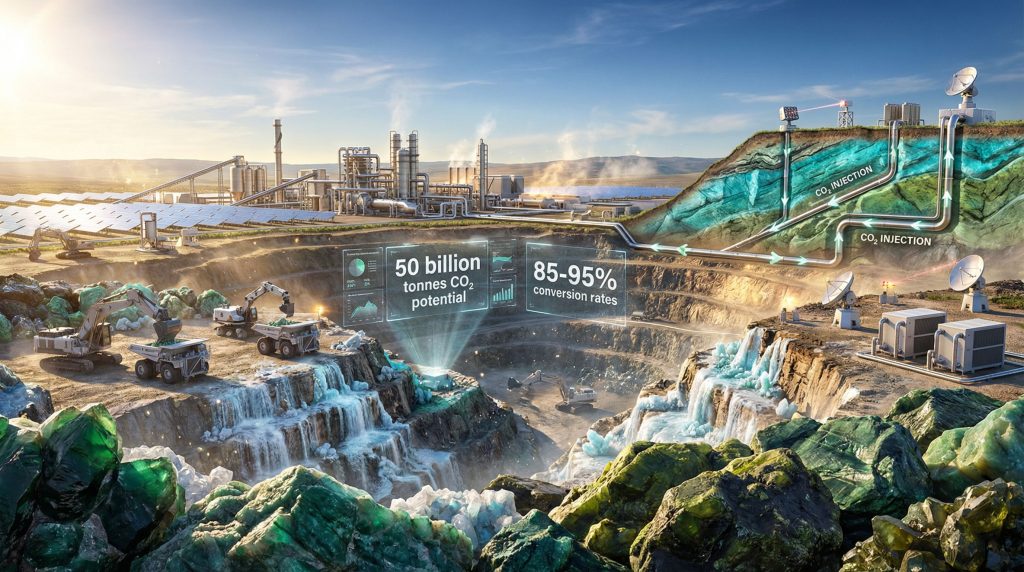
Thermal activation systems enable controlled acceleration of these natural processes by heating mining waste to 500-700°C, converting brucite and other hydroxide minerals into highly reactive oxide phases. When cooled and exposed to CO₂, these activated materials achieve 85-95% conversion efficiency within 2-6 hours, compared to decades required for natural weathering processes.
When big ASX news breaks, our subscribers know first
What Mining Waste Materials Offer the Greatest Carbon Capture Potential?
The effectiveness of carbon dioxide sequestration in mining depends critically on the mineralogical composition of waste materials generated during extraction and processing operations. Ultramafic rock formations containing high concentrations of magnesium-bearing minerals represent the most promising feedstock for large-scale atmospheric carbon removal.
Brucite-Enriched Ultramafic Formations
Brucite-rich ultramafic deposits offer exceptional carbon sequestration potential due to their direct reactivity with atmospheric CO₂. These formations, commonly associated with nickel and chromium mining operations, contain magnesium hydroxide minerals that react spontaneously with carbon dioxide without requiring energy-intensive pre-treatment processes.
The Turnagain deposit demonstrates this potential, where 0.169 tonnes of CO₂ can be sequestered per tonne of exposed ultramafic material under conservative operational estimates. Optimized conditions may achieve theoretical maximums approaching 0.6 tonnes CO₂ per tonne of brucite-rich material, depending on mineral purity and processing methodology.
University of British Columbia research has identified ultramafic rocks as the largest CO₂-storing reservoirs on Earth, with brucite-enriched formations offering superior reactivity compared to silicate-dominated assemblages. The functional advantage stems from brucite's hydroxide structure, which facilitates direct CO₂ absorption without requiring silicate bond breaking.
Serpentine Tailings and Processing Waste
Serpentine minerals (Mg₃Si₂O₅(OH)₄) generated from nickel laterite processing represent another significant carbon sequestration opportunity. While requiring more complex reaction pathways than brucite, serpentine tailings offer sequestration capacity of 0.3-0.5 tonnes CO₂ per tonne of material through enhanced weathering processes.
Serpentine Carbonation Characteristics:
• Lower energy barriers than olivine-based systems
• Abundant availability in global nickel mining regions
• Proven stability of carbonate reaction products
• Integration potential with existing tailings management infrastructure
In addition, the mineralogical advantage of serpentine lies in its hydrated structure, where existing OH⁻ groups facilitate faster carbonation kinetics compared to anhydrous silicate phases. Comminution during mining and processing increases reactive surface area, directly improving CO₂ uptake rates without additional crushing requirements.
Olivine-Rich Mining Waste
Olivine ((Mg,Fe)₂SiO₄) occurs in forsterite (Mg-rich) and fayalite (Fe-rich) compositions, with magnesium-rich varieties offering 0.4-0.7 tonnes CO₂ sequestration potential per tonne of material. These minerals commonly occur in mafic and ultramafic mining operations across major mineral provinces including:
• Kambalda District, Western Australia (serpentine-hosted nickel deposits)
• Sudbury Basin, Ontario (olivine-rich ultramafic intrusions)
• Norilsk Region, Russia (mafic-ultramafic complexes)
Each region's waste materials possess different carbonation potentials based on specific mineralogical compositions, with higher Mg:Fe ratios yielding superior CO₂ absorption characteristics. However, the global distribution of olivine-bearing mining waste creates opportunities for regionally scaled sequestration programs.
Which Technologies Enable Accelerated Carbon Mineralization?
Advanced processing technologies transform the kinetics of natural weathering from geological to industrial timescales, enabling commercial-scale carbon dioxide sequestration in mining operations. These systems optimize temperature, pressure, and chemical conditions to maximize CO₂ absorption rates while minimizing energy requirements. Moreover, these technologies align with broader industry evolution trends towards more sophisticated processing methodologies.
Ex-Situ Thermal Activation Systems
Thermal processing represents the most mature technology for accelerating mineral carbonation, achieving 85-95% conversion efficiency through controlled heating and cooling cycles. The process involves three distinct phases optimized for maximum carbon uptake:
Phase 1: Thermal Activation (500-700°C)
- Dehydration of brucite: Mg(OH)₂ → MgO + H₂O
- Formation of highly reactive magnesium oxide
- Energy input: 1.5-2.5 GJ per tonne CO₂ sequestered
Phase 2: Carbonation Reaction
- Direct CO₂ absorption: MgO + CO₂ → MgCO₃
- Exothermic heat release: ~890 kJ/mol for process optimization
- Reaction completion: 2-6 hours under controlled conditions
Phase 3: Product Recovery
- Stable magnesium carbonate formation
- Aggregate material recovery for construction applications
- Process heat recovery for thermal cycling
Furthermore, solar thermal systems eliminate fossil fuel dependencies by providing renewable heat input, creating truly carbon-negative operations. Northern British Columbia receives 1,200-1,500 hours of annual sunshine, sufficient to power concentrated solar thermal systems capable of processing millions of tonnes of ultramafic waste annually.
In-Situ CO₂ Injection Technologies
Direct injection systems eliminate material transport requirements by delivering CO₂ directly into mining-affected geological formations. Supercritical CO₂ dissolved in formation waters reacts with exposed mineral surfaces to precipitate stable carbonate phases over extended timeframes.
Optimal Injection Parameters:
| Parameter | Range | Technical Rationale |
|---|---|---|
| Pressure | 100-200 bar | Supercritical CO₂ conditions |
| Temperature | 40-80°C | Enhanced reaction kinetics |
| Mineralization Time | 6 months – 5 years | In-situ reaction completion |
| Injection Depth | 500-2,000 meters | Pressure maintenance |
The extended timeframe (6 months to 5 years) reflects slower in-situ reaction kinetics compared to ex-situ processing but eliminates surface processing infrastructure requirements. For instance, formation of carbonic acid (H₂CO₃) facilitates mineral dissolution and reprecipitation cycles that permanently bind CO₂ in carbonate minerals.
Passive Enhanced Weathering Systems
Passive carbonation systems maximize natural weathering rates through optimized exposure conditions without external energy inputs. These approaches achieve lower per-tonne processing costs while requiring larger surface areas and longer residence times. Additionally, the implementation of AI in mining processes can optimise these passive systems for maximum efficiency.
Design Elements:
- Increased surface area through controlled comminution
- Optimized particle size distribution (0.1-10 mm)
- Enhanced atmospheric exposure through stacking geometry
- Moisture management for accelerated reaction rates
The Turnagain partnership structure demonstrates practical technology integration, where Arca Climate Technologies maintains exclusive 10-year rights to evaluate and advance CO₂ storage technologies using ultramafic waste rock and tailings. Consequently, this arrangement enables field-scale testing of multiple approaches while integrating with planned mine infrastructure.
How Do Economic Models Support Mining-Based Carbon Sequestration?
The financial viability of carbon dioxide sequestration in mining operations depends on multiple revenue streams, cost optimization, and regulatory incentives that collectively transform waste management from a cost center into a profit generator. Current market conditions and projected carbon pricing create compelling economic frameworks for large-scale implementation, particularly as energy transition security becomes increasingly important.
Revenue Stream Analysis and Market Dynamics
Mining-based carbon sequestration generates income through carbon credit sales, enhanced environmental compliance, and potential aggregate material sales. Voluntary carbon markets currently value high-quality removal credits at $50-150 per tonne CO₂, with geological sequestration commanding premium prices due to permanence guarantees.
The Turnagain project's 220 million tonnes of sequestration potential represents $11-33 billion in gross carbon credit value at current market prices. Even after accounting for processing costs of $40-80 per tonne CO₂, net margins of $10-70 per tonne create substantial revenue opportunities over project lifespans.
Market Factors Driving Premium Pricing:
- Permanence verification (millions of years storage duration)
- Additionality demonstration (sequestration beyond business-as-usual)
- Third-party monitoring and verification protocols
- Integration with critical mineral supply chains
Capital Investment and Operating Cost Structure
Technology selection significantly impacts both initial capital requirements and ongoing operational expenses, with passive systems requiring lower upfront investment but higher land use. However, thermal systems demand substantial energy infrastructure but achieve higher processing rates.
| Technology Approach | Initial CAPEX | Operating Costs | Payback Period | Annual Capacity |
|---|---|---|---|---|
| Solar Thermal Ex-Situ | $200-400M | $30-50/tonne CO₂ | 8-12 years | 5-15M tonnes CO₂ |
| In-Situ Injection | $100-250M | $25-40/tonne CO₂ | 6-10 years | 2-8M tonnes CO₂ |
| Passive Enhanced Weathering | $50-150M | $15-25/tonne CO₂ | 4-8 years | 1-5M tonnes CO₂ |
| Hybrid Renewable Systems | $300-600M | $35-55/tonne CO₂ | 10-15 years | 10-25M tonnes CO₂ |
Solar thermal systems eliminate ongoing fossil fuel costs while providing long-term price stability, particularly valuable given volatile energy markets. A theoretical 5.6 MW average thermal power requirement for processing 10 million tonnes CO₂ annually becomes economically attractive with concentrated solar power systems achieving 20-30% thermal efficiency.
Risk Assessment and Financial Modeling
Investment decisions require comprehensive risk analysis addressing technology performance, carbon price volatility, regulatory changes, and integration challenges with existing mining operations. Furthermore, successful projects demonstrate risk mitigation through diversified technology portfolios and phased implementation strategies.
Primary Risk Categories:
- Technology Risk: Performance validation, scaling challenges, equipment reliability
- Market Risk: Carbon credit price volatility, demand fluctuations, regulatory changes
- Operational Risk: Integration complexity, workforce training, maintenance requirements
- Financial Risk: Capital cost overruns, operating expense escalation, financing availability
What Scale of Carbon Removal Can Mining Operations Achieve?
The theoretical and practical potential for carbon dioxide sequestration in mining operations spans from individual project impacts to global climate significance. Large-scale deployment could potentially address substantial portions of current atmospheric CO₂ emissions while transforming mining from a carbon source to a carbon sink.
Global Sequestration Capacity Assessment
Mining waste streams worldwide possess theoretical capacity to sequester 10-50 billion tonnes of CO₂ annually, representing 25-125% of current global emissions of approximately 40 billion tonnes per year. This potential stems from the vast quantities of ultramafic and mafic materials exposed through mineral extraction activities.
Regional Capacity Distribution:
| Region | Sequestration Potential | Primary Deposit Types | Development Timeline |
|---|---|---|---|
| North America | 5-15 billion tonnes CO₂ | Ultramafic nickel deposits | 2025-2035 |
| Australia | 8-20 billion tonnes CO₂ | Serpentine formations | 2026-2040 |
| Europe/Asia | 3-10 billion tonnes CO₂ | Mixed mafic complexes | 2027-2045 |
| Africa | 2-8 billion tonnes CO₂ | Chromite/PGM deposits | 2030-2050 |
Ultramafic mining regions in Canada, Australia, and Scandinavia offer the highest immediate potential due to established mining infrastructure, favorable regulatory frameworks, and abundant brucite-enriched formations. The Canadian Shield alone contains sufficient ultramafic resources to support multi-billion tonne annual CO₂ sequestration programs.
Project-Scale Implementation Examples
Individual mining operations can achieve substantial carbon sequestration volumes through integrated waste management strategies that maximize exposure of reactive minerals while optimising processing efficiency. In addition, scale effects become pronounced in large operations where infrastructure costs distribute across massive material volumes.
Turnagain Project Benchmarks:
- Mining Scale: 1.3 billion tonnes ultramafic material exposure
- Sequestration Target: 220 million tonnes CO₂ over project life
- Annual Capacity: 7-11 million tonnes CO₂ (30-year operation)
- Comparative Impact: Equivalent to removing 2.4 million cars annually
A typical large-scale nickel operation processing 50 million tonnes of ultramafic ore annually could sequester 15-30 million tonnes of CO₂, depending on brucite content and processing methodology. These volumes represent meaningful contributions to corporate and national emission reduction targets.
Scaling Challenges and Solutions
Achieving global-scale carbon dioxide sequestration in mining requires coordination across multiple operational, technological, and regulatory dimensions. Success depends on standardising technologies, developing specialised expertise, and creating supportive policy frameworks.
Critical Scaling Factors:
- Technology Standardisation: Proven designs adaptable across deposit types
- Workforce Development: Specialised expertise in carbonation processes
- Supply Chain Integration: Equipment manufacturing, reagent supply, transport logistics
- Regulatory Harmonisation: Consistent standards for carbon credit verification
The mining industry's global reach and established infrastructure provide advantages for rapid scaling once demonstration projects validate technical and economic performance. Consequently, major mining companies possess the capital, operational expertise, and international presence necessary for coordinated deployment.
How Does Pit Lake Alkalisation Enhance Carbon Storage?
Abandoned mine sites and active pit lakes represent significant opportunities for carbon dioxide sequestration through controlled alkalisation processes that simultaneously address environmental liabilities while creating permanent CO₂ storage. This approach transforms acidic mining legacies into alkaline carbon sinks through strategic chemical management.
Abandoned Mine Site Remediation Integration
Converting acidic pit lakes into alkaline carbon reservoirs addresses two environmental challenges simultaneously: acid mine drainage mitigation and atmospheric carbon removal. Alkalising agents neutralise acidic conditions while establishing chemical environments favourable for dissolved inorganic carbon accumulation and carbonate precipitation.
Pit Lake Sequestration Metrics:
- Storage Capacity: 10-50 kg CO₂ per cubic metre of lake volume
- Alkalinity Requirements: 2-5 tonnes limestone per tonne CO₂ stored
- Treatment Timeframes: 1-3 years for complete alkalisation
- Monitoring Duration: 10-20 years for stability verification
Large pit lakes can achieve substantial carbon storage volumes through this approach. A typical 100-metre deep lake covering 1 square kilometre contains approximately 100 million cubic metres of water, potentially storing 1-5 million tonnes of CO₂ through alkalisation and carbonate precipitation processes.
Engineered Carbon Precipitation Systems
Advanced pit lake management systems control pH, temperature, mineral saturation, and mixing patterns to optimise carbonate precipitation rates. These engineered approaches achieve 5-10 times higher carbon storage rates than natural alkaline lakes through precise chemical management.
Process Control Parameters:
- pH Optimisation: Maintenance at 8.5-9.5 for maximum carbonate stability
- Temperature Management: Seasonal thermal cycling to enhance precipitation
- Nucleation Sites: Addition of seed crystals to accelerate carbonate formation
- Mixing Systems: Controlled circulation to maintain supersaturation conditions
For instance, engineered systems integrate with renewable energy infrastructure to power circulation pumps, aeration systems, and chemical dosing equipment. Solar-powered alkalinity control eliminates operational emissions while maintaining optimal conditions for carbon capture.
Long-Term Storage Verification and Monitoring
Permanent carbon storage in pit lake systems requires comprehensive monitoring protocols that verify carbonate precipitation, prevent CO₂ re-release, and document long-term stability. Advanced analytical methods track dissolved carbon species, mineral formation, and system performance over decades.
Monitoring Technologies:
- Real-time pH and alkalinity sensors for continuous water chemistry tracking
- Sediment core analysis to quantify carbonate accumulation rates
- Isotopic analysis to verify atmospheric CO₂ incorporation
- Remote sensing systems for surface area and volume monitoring
The next major ASX story will hit our subscribers first
Which Mining Sectors Offer the Greatest Integration Opportunities?
Different mining sectors present varying opportunities for carbon dioxide sequestration based on their waste mineralogy, operational scales, and market dynamics. Battery metal mining, iron ore operations, and copper extraction offer particularly compelling integration potential due to their ultramafic and mafic host rocks.
Nickel and Cobalt Operations
Battery metal mining operations typically generate large volumes of ultramafic waste ideal for carbon sequestration while serving supply chains increasingly focused on environmental performance. The growing demand for electric vehicle materials creates unique opportunities to integrate climate solutions with critical mineral production.
The Turnagain project exemplifies this integration, where 2.17 billion pounds of nickel and 127.9 million pounds of cobalt production over 30 years coincides with 220 million tonnes of CO₂ sequestration potential. This combination delivers both critical minerals for clean energy transition and permanent atmospheric carbon removal.
Nickel Mining Carbon Integration Advantages:
- Ultramafic host rocks rich in brucite and serpentine minerals
- Large-scale waste rock generation requiring management
- Premium market positioning for low-carbon battery materials
- Extended mine life enabling long-term sequestration programmes
Global nickel production of approximately 3 million tonnes annually generates hundreds of millions of tonnes of ultramafic waste suitable for carbonation. Major producing regions in Indonesia, Philippines, New Caledonia, and Canada possess substantial sequestration potential through enhanced weathering programmes.
Iron Ore and Steel Industry Integration
Iron ore mining produces significant volumes of basaltic and ultramafic waste suitable for carbon mineralisation, with additional opportunities for direct integration with steel production facilities that generate concentrated CO₂ emissions. Furthermore, this sector combination enables closed-loop carbon management where steel plant emissions feed directly into mineralisation systems.
Integration Opportunities:
- Mine Site Sequestration: Enhanced weathering of iron formation waste rock
- Steel Plant Integration: Direct CO₂ capture from blast furnace emissions
- Transport Optimisation: Proximity of iron mines to steel production facilities
- Scale Benefits: Massive material volumes enabling cost-effective processing
Major iron ore provinces including the Pilbara (Australia), Carajás (Brazil), and Labrador Trough (Canada) contain substantial mafic and ultramafic formations capable of large-scale carbon sequestration. The steel industry's 2.6 billion tonnes of annual CO₂ emissions create substantial demand for mineralisation capacity.
Copper Mining and Processing
Copper operations in volcanic regions generate substantial quantities of mafic and ultramafic waste while serving supply chains essential for renewable energy infrastructure. The global copper demand growth for electrification creates scaling opportunities for integrated sequestration technologies. Additionally, implementation of data-driven operations can optimise these integration processes.
Copper Mining Sequestration Characteristics:
- Porphyry deposits often occur in mafic volcanic complexes
- Large-scale open pit operations expose extensive waste rock
- Growing demand from renewable energy sector
- Geographic concentration enabling regional sequestration hubs
Major copper provinces including the Andes (Chile/Peru), southwestern United States, and central Asia contain volcanic-hosted deposits with significant carbon sequestration potential. Copper production expansion to meet electrification demands provides opportunities for parallel sequestration capacity development.
What Regulatory Frameworks Support Mining-Based Carbon Capture?
Supportive regulatory frameworks increasingly recognise geological mineralisation as a credible carbon removal methodology while establishing verification standards, financial incentives, and streamlined approval processes. Government policies create market foundations for large-scale deployment through carbon pricing, research funding, and regulatory certainty.
Carbon Credit Certification Standards
International carbon credit standards evolve to accommodate geological mineralisation methodologies, establishing protocols that ensure additionality, permanence, and measurable CO₂ removal. However, verification requirements balance scientific rigour with operational practicality for mining companies.
Certification Requirements:
• Third-party verification of sequestration volumes using standardised measurement protocols
• Long-term monitoring and reporting systems tracking carbon storage permanence
• Environmental impact assessments ensuring no adverse ecological consequences
• Community engagement and benefit-sharing agreements addressing local stakeholder interests
• Additionality demonstration proving sequestration exceeds business-as-usual scenarios
Verification protocols typically require annual reporting for the first decade, followed by periodic assessments confirming permanent storage. Advanced monitoring technologies including satellite remote sensing, isotopic analysis, and automated sensor networks provide cost-effective verification at scale.
Policy Incentives and Support Mechanisms
Government policies supporting carbon removal technologies include direct financial incentives, research and development funding, and regulatory frameworks that reduce implementation barriers. Mining companies benefit from enhanced environmental compliance records and improved social licence to operate.
Policy Support Categories:
- Tax Credits: Direct financial benefits for verified CO₂ sequestration
- Research Grants: Public funding for technology development and demonstration
- Regulatory Fast-Tracking: Accelerated permitting for carbon capture projects
- Public Procurement: Government purchasing preferences for low-carbon materials
The U.S. 45Q tax credit provides $180 per tonne for verified geological sequestration, while similar programmes in Canada, Australia, and Europe create financial foundations for commercial deployment. These incentives often exceed current voluntary carbon market prices, providing additional revenue security.
International Cooperation and Standards Harmonisation
Global coordination on carbon removal standards facilitates international carbon trading while ensuring consistent measurement and verification approaches across jurisdictions. Mining companies operating internationally benefit from standardised protocols reducing compliance complexity.
Harmonisation Priorities:
- Measurement Methodologies: Standardised approaches for quantifying CO₂ sequestration
- Permanence Definitions: Consistent timeframes for storage duration requirements
- Monitoring Protocols: Compatible systems for long-term verification
- Credit Transferability: Mechanisms enabling international carbon trading
How Can Mining Companies Implement Carbon Sequestration Strategies?
Successful implementation of carbon dioxide sequestration in mining requires systematic approaches that integrate technical feasibility, economic optimisation, and operational compatibility. Phased development strategies minimise risks while demonstrating scalability for full commercial deployment.
Phased Implementation Framework
Phase 1: Assessment and Planning (6-12 months)
Initial evaluation focuses on geological characterisation, technology selection, and regulatory pathway development. Comprehensive assessment establishes baseline conditions and quantifies sequestration potential.
• Geological Characterisation: Detailed mineralogical analysis of waste materials
• Sequestration Quantification: Laboratory testing and theoretical capacity modelling
• Technology Evaluation: Comparison of processing approaches and cost analysis
• Regulatory Planning: Permit applications and stakeholder engagement processes
Phase 2: Pilot Project Development (12-24 months)
Small-scale demonstration systems validate technical performance while refining economic models and operational procedures. Pilot projects typically process 10,000-100,000 tonnes of waste material annually.
• Pilot System Construction: Limited-scale processing equipment installation
• Process Optimisation: Parameter refinement for maximum CO₂ uptake efficiency
• Economic Validation: Cost and revenue verification at demonstration scale
• Partnership Development: Technology provider and carbon credit buyer agreements
Phase 3: Commercial Scale-Up (24-60 months)
Full-scale facility construction integrates sequestration systems with existing mining operations while establishing commercial carbon credit sales programmes. Commercial systems process millions of tonnes of waste material annually.
Technology Partnership Strategies
Mining companies increasingly partner with specialised carbon technology firms to access expertise, reduce implementation risks, and accelerate deployment timelines. These partnerships combine mining industry operational knowledge with cutting-edge sequestration technologies.
The Turnagain partnership model demonstrates effective collaboration structure where Giga Metals focuses on mining operations while Arca Climate Technologies develops sequestration systems. This 10-year exclusive agreement provides sufficient time for technology optimisation and commercial deployment.
Partnership Benefits:
- Risk Sharing: Technology developers assume performance risks
- Expertise Access: Specialised knowledge in carbonation processes
- Capital Efficiency: Reduced upfront investment requirements for mining companies
- Market Access: Established relationships with carbon credit purchasers
Integration with Existing Operations
Successful carbon sequestration programmes integrate seamlessly with established mining workflows, utilising existing infrastructure while minimising operational disruption. Integration strategies address material handling, workforce training, and equipment coordination.
Operational Integration Elements:
- Material Flow Optimisation: Waste rock routing to carbonation facilities
- Equipment Coordination: Shared infrastructure for transport and processing
- Workforce Development: Training programmes for carbonation system operation
- Quality Control: Monitoring systems ensuring both mineral recovery and CO₂ capture
What Future Developments Will Enhance Mining-Based Carbon Capture?
Emerging technologies and research developments promise to improve the efficiency, reduce costs, and expand the applicability of carbon dioxide sequestration in mining operations. Advanced materials, artificial intelligence, and renewable energy integration represent key innovation areas driving next-generation capabilities.
Advanced Materials and Catalysts
Research into novel catalysts and reactive materials focuses on reducing energy requirements while increasing sequestration rates through enhanced reaction kinetics. Nanotechnology applications and bio-enhanced mineralisation show particular promise for revolutionary performance improvements.
Catalyst Development Areas:
- Nano-scale Reactive Surfaces: Engineered materials with enhanced CO₂ binding
- Bio-catalytic Systems: Microbial enhancement of natural carbonation processes
- Selective Membranes: CO₂ concentration systems improving reaction efficiency
- Hybrid Materials: Composite systems combining multiple reaction mechanisms
Bio-enhanced mineralisation utilises naturally occurring bacteria that accelerate carbonate precipitation through metabolic processes. These biological systems potentially reduce energy requirements by 50-70% while maintaining high conversion rates, making passive sequestration economically competitive with thermal processing.
Hybrid Renewable Energy Integration
Integration with solar, wind, and geothermal energy systems eliminates fossil fuel dependencies while creating truly carbon-negative mining operations. Advanced energy storage systems enable continuous operation regardless of renewable resource variability.
Renewable Integration Technologies:
- Concentrated Solar Power: High-temperature thermal energy for mineral activation
- Wind-Powered Processing: Variable load systems matching renewable generation
- Geothermal Heating: Steady thermal input for consistent processing rates
- Battery Storage Systems: Load balancing for continuous carbonation operations
Hybrid systems combine multiple renewable sources to optimise reliability and cost-effectiveness. Solar thermal systems provide daytime heating while geothermal systems maintain baseline temperatures, creating 24/7 processing capability with minimal fossil fuel backup.
Artificial Intelligence and Process Optimisation
AI-driven process control systems optimise reaction conditions, predict maintenance requirements, and maximise carbon capture efficiency through continuous learning algorithms. Machine learning applications analyse vast datasets to identify performance improvement opportunities.
AI Application Areas:
- Real-time Process Control: Automated optimisation of temperature, pressure, and flow rates
- Predictive Maintenance: Equipment failure prediction reducing downtime
- Resource Allocation: Optimal material routing and processing sequencing
- Performance Analytics: Continuous improvement identification through data analysis
Advanced control systems potentially improve CO₂ capture rates by 10-20% while reducing energy consumption through precise parameter optimisation. Integration with existing mine management systems creates comprehensive operational visibility and control.
The convergence of these technological developments with supportive policy frameworks and growing carbon market demand positions carbon dioxide sequestration in mining as a transformative approach to climate change mitigation. As demonstration projects validate performance and economics, widespread deployment could fundamentally alter both the mining industry's environmental impact and global carbon removal capacity.
Readers interested in exploring carbon sequestration technologies in mining can access additional technical resources through specialised mining technology publications and research institutions focused on sustainable extraction practices. Industry developments in this rapidly evolving field continue to expand the potential for mining operations to become net contributors to atmospheric CO₂ removal.
Interested in Carbon-Negative Mining Opportunities?
Discovery Alert's proprietary Discovery IQ model delivers real-time alerts on significant mineral discoveries in the sustainability and critical metals sectors, instantly empowering subscribers to identify actionable opportunities ahead of the broader market. Begin your 30-day free trial today and secure your market-leading advantage with immediate access to carbon sequestration and sustainable mining developments.