
July 28, 2026
When Infrastructure Meets Climate: The Hidden Fragility of High-Altitude Copper Mining
Copper mining at high altitude in some of the world's most geologically privileged but climatologically extreme terrain has always carried an implicit bargain. Operators gain access to some of the richest porphyry copper deposits on the planet, but they do so across terrain that punishes infrastructure weaknesses with remarkable efficiency. In Chile's northern mining corridor, where elevations routinely exceed 4,000 metres and annual rainfall can measure in single-digit millimetres, the engineering assumption has long been that extreme precipitation is someone else's problem. The July 2026 storm season has fundamentally challenged that assumption.
The disruption to the Lundin Caserones mine restart after storm damage in mid-July is one data point in a much larger pattern. However, it is a particularly instructive one, because it illustrates precisely how a single infrastructure node failure can cascade into a production-scale event affecting thousands of tonnes of copper output and triggering measurable equity market reactions. Understanding the broader copper supply crunch context makes this disruption even more significant for investors and analysts alike.
When big ASX news breaks, our subscribers know first
Understanding the Caserones Power Outage: What Actually Happened
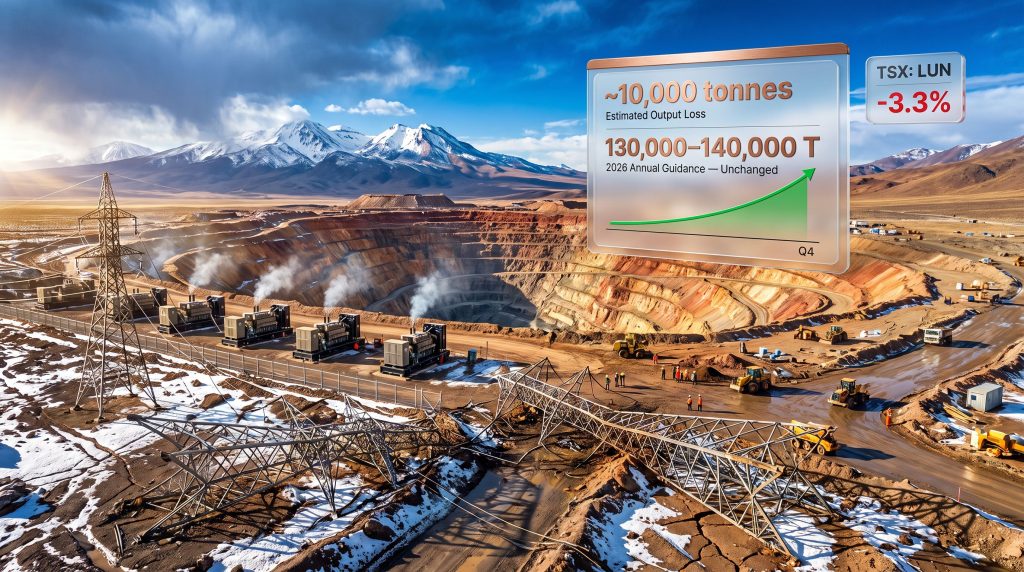
The Caserones copper mine, operated by Lundin Mining (TSX: LUN) and located in Chile's arid north near the Argentine border, lost grid power on July 18, 2026, when a severe winter storm system damaged two high-voltage powerline towers serving the site. The loss of those two towers was sufficient to take the entire operation offline in terms of processing capacity.
Quick-Reference Operational Overview
| Metric | Detail |
|---|---|
| Mine Name | Caserones Copper Mine |
| Operator | Lundin Mining (TSX: LUN) |
| Location | Arid north Chile, near Argentine border |
| Power Outage Date | July 18, 2026 |
| Cause | Severe winter storms destroying two powerline towers |
| Estimated Restart Window | 2 to 3 weeks from July 28 announcement |
| Potential Output Loss | Approximately 10,000 tonnes of copper |
| Full-Year Production Guidance | 130,000 to 140,000 tonnes (unchanged) |
| Backup Systems Active | Yes, generators maintaining critical infrastructure |
| Access Roads Status | Progressively reopening |
Since the outage began, the site has been operating on backup diesel generators. These systems are capable of sustaining critical safety and environmental infrastructure but cannot power the energy-intensive milling and flotation circuits that convert ore into copper concentrate. Repair teams were mobilised promptly, and access roads to the site, which were initially blocked by storm debris, have been progressively cleared to allow personnel and equipment movement.
Lundin announced on July 28 that the restart timeline is estimated at two to three weeks, contingent on successful tower reconstruction and transmission line reinstatement. The company confirmed that employees have been safely managed through crew rotations during the disruption period.
Why Chile's July 2026 Storms Were Unusually Destructive
The Paradox of Precipitation in the Atacama Region
Northern Chile's mining belt sits within or adjacent to the Atacama Desert, the driest non-polar desert on Earth. Annual average precipitation across much of this region measures below 15 millimetres in lower elevations, and while higher-altitude puna grassland zones do receive seasonal precipitation, the intensity of the July 2026 event was well outside historical norms.
The storm system drove heavy rain and snow across north-central Chile simultaneously, producing a compound hazard scenario including:
- River swelling and flash flooding across normally dry watercourses
- Mudslides blocking segments of Chile's primary northern highway corridor
- Structural damage to exposed transmission infrastructure at multiple mining sites
- Fatalities and widespread community-level infrastructure failures
This is the critical engineering gap. Transmission towers and access roads in this region are typically designed for wind loading and seismic activity, not for the kind of saturated-ground, mudslide-generating precipitation that characterised July 2026. When the design envelope is exceeded, the consequences are swift and total.
Multi-Operator Disruption: A Systemic Signal
The Caserones outage did not occur in isolation. The same storm system forced temporary operational disruptions at assets belonging to Teck Resources, Codelco (the world's largest copper producer by output), and Antofagasta Plc. The geographic clustering of these impacts across a single weather event is a defining characteristic of systemic infrastructure vulnerability rather than isolated operational misfortune.
"When Tier-1 copper producers across the same regional corridor experience simultaneous weather-driven shutdowns, the event stops being a company-specific risk and starts being a supply-chain-level signal that markets must incorporate into their pricing models."
Furthermore, Chile's copper supply role in global markets cannot be overstated, as the country contributes roughly 25 to 27% of global mined copper supply, meaning clustered disruptions of this nature carry genuine commodity market significance beyond any single operator's production loss.
Production Guidance: How Significant Is the 10,000-Tonne Loss?
Quantifying the Output Gap
Bloomberg Intelligence analysts noted that the outage could erase approximately 10,000 tonnes of copper production from the Caserones schedule, placing the mine's annual guidance of 130,000 to 140,000 tonnes under pressure unless output accelerates materially in the fourth quarter of 2026.
To contextualise that figure:
- The midpoint of annual guidance is approximately 135,000 tonnes
- A 10,000-tonne loss represents roughly 7.4% of the annual midpoint target
- Recovery of that volume within Q4 would require Caserones to operate at above-normalised throughput for several months
Production Scenario Modelling
| Recovery Scenario | Estimated Annual Output | Guidance Range Achieved? |
|---|---|---|
| Full Q4 Recovery | 130,000 to 140,000 tonnes | Yes |
| Partial Q4 Recovery | 120,000 to 130,000 tonnes | Borderline |
| Extended Delay Beyond 4 Weeks | Below 120,000 tonnes | No |
Lundin's official position, as of the July 28 announcement, is that the interruption is not expected to alter full-year guidance. This is a conditional statement, however, resting entirely on the two-to-three-week restart timeline holding and on processing operations ramping back to sufficient throughput before year-end.
The Role of Q4 Production Catch-Up in Guidance Defence
One nuance often overlooked in these scenarios is that copper concentrate processing is not instantaneously scalable. Increasing throughput at a sulphide porphyry operation like Caserones requires that the milling circuit, flotation cells, and thickening stages all operate at or above nameplate capacity for extended periods.
If ore grades during the catch-up period are below the mine plan average, or if any secondary equipment issues emerge post-restart, the production recovery curve flattens. Consequently, analyst scrutiny of Q3 and Q4 reporting from Lundin will be particularly elevated, especially given the broader copper price drivers that are shaping market expectations heading into the latter half of 2026.
The Infrastructure Failure in Technical Detail
How a Two-Tower Loss Becomes a Full Site Shutdown
A lesser-known aspect of high-altitude mining infrastructure is the extreme vulnerability of single-feed power transmission systems. Unlike urban industrial facilities that frequently have dual-feed or looped grid connections, remote mine sites in Chile's north typically rely on long, exposed radial transmission lines running across rugged terrain. A single structural failure anywhere along that line severs power to the entire site.
The Caserones situation followed exactly this pattern. Two towers were compromised. That was sufficient to take the entire grid supply offline.
The Seven-Stage Recovery Sequence
- Emergency stabilisation — backup diesel generators activated to sustain safety, environmental monitoring, and critical facility systems
- Access road clearance — storm debris removal to allow heavy equipment and personnel access to the site and transmission line route
- Engineering damage assessment — structural evaluation of the two compromised towers and adjacent line segments
- Tower reconstruction — physical rebuilding of damaged tower structures and associated foundation works
- Transmission line reinstatement — stringing, tensioning, and safety-testing of the high-voltage conductor lines
- Grid reconnection and commissioning — controlled restoration of grid power and sequential energisation of site systems
- Processing ramp-up — gradual restart of milling, flotation, and concentrate handling circuits toward full capacity
Each stage has its own weather and logistics dependencies. Road access, in particular, remains a gating factor for equipment delivery and crew movement.
Caserones vs. Candelaria: Two Assets, Two Very Different Storm Outcomes
Lundin Mining's other major Chilean copper asset, Candelaria, was also affected by the July storm system, but the operational outcome diverged significantly from Caserones.
| Factor | Caserones | Candelaria |
|---|---|---|
| Storm Impact Severity | High, full grid power loss | Moderate, temporary disruption |
| Operational Status at Announcement | Processing suspended, restarting | Returned to full mining capacity |
| Processing Continuity | Halted pending power restoration | Mill operated on stockpiled ore |
| Guidance Impact | Under observation pending Q4 | No material guidance change |
The Candelaria outcome illustrates the value of ore stockpile buffer strategy as a resilience mechanism. By maintaining sufficient stockpiles at the mill feed point, Candelaria was able to keep its processing circuit running through the disruption even when upstream mining operations were temporarily affected. This is a practical risk management tool that the Caserones disruption highlights as particularly relevant for infrastructure-exposed operations.
The next major ASX story will hit our subscribers first
Climate Risk and the Evolving Engineering Standard for Chilean Mining
Why the Design Assumption Is Breaking Down
The traditional engineering premise for infrastructure in northern Chile's mining corridor has been that the region's extreme aridity makes precipitation-related design loading largely irrelevant. Seismic resilience, wind loading, and heat management have historically dominated infrastructure design priorities. That calculus is shifting.
The July 2026 event is not the first time abnormal winter precipitation has disrupted Chilean mining. The pattern of increasingly intense winter precipitation events in a region where infrastructure was not designed to withstand them represents a growing operational risk that the industry is only beginning to systematically address. In addition, the Chile copper price outlook for 2025 and beyond is increasingly intertwined with how reliably operators can maintain production continuity through extreme weather.
Emerging Resilience Frameworks for Operators
Mining operators in Chile's northern corridor are increasingly being pushed toward the following infrastructure resilience investments:
- Redundant power supply architecture — dual-feed transmission routes or significantly expanded on-site generation capacity to eliminate single-point-of-failure exposure
- Hardened transmission infrastructure — tower designs engineered for extreme precipitation and saturated-ground loading conditions, not just historical climate norms
- Stockpile buffer management — systematic maintenance of ore stockpiles at processing facilities to decouple mill feed continuity from upstream mining disruptions
- Pre-positioned emergency response assets — repair crews, tower sections, and transmission equipment staged at or near remote sites to compress recovery timelines
- Modular power backup systems — larger-scale distributed generation capable of sustaining partial processing operations, not just critical safety loads
"Climate resilience is no longer an ESG checkbox for mining operators in extreme environments. It is a direct determinant of guidance reliability, which is ultimately what equity investors are paying for when they hold a copper producer."
Moreover, broader copper expansion strategies across the industry are increasingly incorporating climate risk frameworks as a core component of capital investment planning, rather than treating weather resilience as an afterthought.
Market Reaction and Investor Implications
Equity Response and What It Signals
Lundin Mining shares fell by as much as 3.3% in Toronto trading following the July 28 announcement. The magnitude of that decline is instructive. A two-to-three-week operational disruption at a single asset, affecting roughly 7% of annual output at that asset, produced a share price movement that reflects broader investor sensitivity to guidance risk in an environment where copper demand expectations remain elevated.
The market is effectively pricing in a non-trivial probability that the restart takes longer than projected, that Q4 production cannot fully recover the lost volume, and that full-year guidance will require revision. Whether that probability is correctly calibrated will become apparent across Q3 and Q4 reporting periods.
Copper Supply Implications Beyond Lundin
The compound nature of the July 2026 disruption, spanning Lundin, Teck, Codelco, and Antofagasta simultaneously, creates a brief but meaningful supply-side shock across a region that contributes more than a quarter of global copper mine output. Lundin confirmed it would maintain copper guidance despite the storm, however short-term copper price dynamics remain sensitive to these clustering events, particularly when they coincide with periods of already constrained refined copper availability.
Disclaimer: This article contains forward-looking scenarios and financial analysis based on publicly available information. It does not constitute investment advice. Production guidance, restart timelines, and output estimates are subject to change based on operational developments. Investors should conduct independent due diligence before making investment decisions.
FAQ: Lundin Caserones Mine Restart After Storm
When did the Caserones mine lose power?
Grid power was lost on July 18, 2026, after severe winter storms structurally compromised two powerline towers serving the site.
How long will the Lundin Caserones mine restart after storm take?
Lundin estimates approximately two to three weeks from the July 28 announcement date, subject to successful infrastructure repair and road access restoration.
How much copper output could be lost?
Approximately 10,000 tonnes of copper production is estimated to be at risk from the outage period.
Will Lundin's full-year guidance be affected?
The company has stated that full-year guidance of 130,000 to 140,000 tonnes remains unchanged, contingent on a strong Q4 production recovery.
Is the mine completely idle during the repair period?
Processing operations are suspended. Critical infrastructure and safety systems are being maintained on backup diesel generators.
Were other Chilean mines affected by the same storms?
Yes. Operations associated with Teck Resources, Codelco, and Antofagasta also reported temporary disruptions from the same storm system.
What happened at Candelaria during the storms?
Lundin's Candelaria mine experienced a temporary disruption but maintained mill operations using ore stockpiles and returned to full mining capacity ahead of the Lundin Caserones mine restart after storm repairs were completed at the higher-altitude site.
Want to Track the Next Major Copper Discovery Before the Market Moves?
Discovery Alert's proprietary Discovery IQ model scans ASX announcements in real time, instantly identifying significant copper and mineral discoveries and turning complex data into actionable investment insights — explore historic discoveries that have generated substantial returns and begin your 14-day free trial at Discovery Alert to position yourself ahead of the broader market.