July 27, 2026
The Operating Leverage Secret Inside the 2026 Copper Boom
Most commodity cycles reward producers with incremental margin gains. The current copper cycle is doing something far more powerful: it is multiplying profitability at a rate that defies conventional expectations. When a company generating roughly 78% of an entire nation's copper output simultaneously experiences a 30.5% increase in the price it receives and a 56.7% collapse in its unit production costs, the resulting earnings arithmetic becomes extraordinary. This is precisely the dynamic that explains why Grupo México profit jumps on copper strength have captured the attention of mining analysts and commodity investors across 2026.
Understanding why this moment is so significant requires stepping back from the quarterly numbers and examining the structural forces that created them.
When big ASX news breaks, our subscribers know first
Why the 2026 Copper Market Is Unlike Previous Commodity Cycles
Copper has always been sensitive to economic cycles, but the demand architecture underpinning the current price environment is fundamentally different from past bull markets. Three distinct structural forces are converging simultaneously, and each operates on a multi-decade time horizon. Furthermore, reviewing the broader copper market outlook helps contextualise just how exceptional the present environment has become.
Decarbonization infrastructure is the most capital-intensive copper demand driver in history. Wind turbines, offshore cable networks, solar farms, and grid modernisation programmes each require between three and five times more copper per unit of energy capacity than the fossil fuel infrastructure they are replacing. This is not a cyclical trend — it is a structural rewiring of the global energy system.
Artificial intelligence and data centre construction has emerged as a newer but equally powerful demand vector. Server racks, cooling systems, power distribution units, and the high-voltage transmission lines connecting AI campuses to the grid are all copper-intensive. In Mexico specifically, industrial corridors such as Querétaro have become focal points for data centre investment, generating localised demand for both copper and electricity infrastructure.
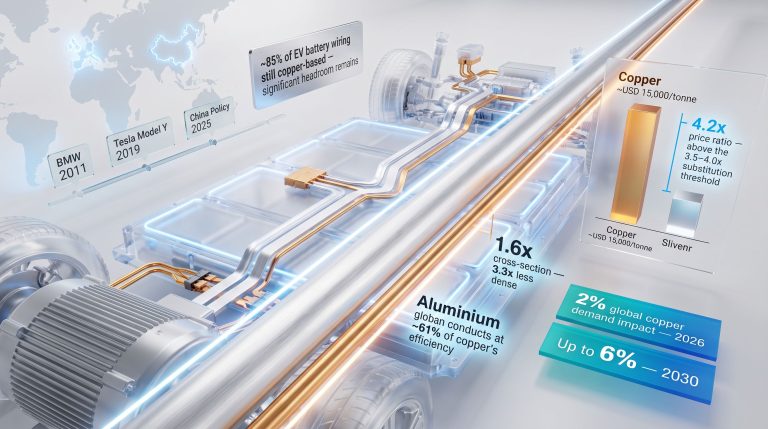
Electric vehicle adoption continues to steepen globally. A battery electric vehicle contains approximately 2.5 to 4 times more copper than a conventional internal combustion engine vehicle, and as EV penetration curves accelerate across major markets, cumulative copper demand compounds accordingly.
Against this demand backdrop, supply has failed to keep pace. Geopolitical disruptions in the Middle East and weather-related production interruptions in Chile tightened available supply further through the first half of 2026. The result was an average realised copper price of approximately US$6.16 per pound in Q2 2026, representing a 30.5% year-on-year increase. Understanding the underlying copper price growth drivers helps explain why industry consensus points toward a market deficit persisting through the remainder of the year.
How Did Grupo México Perform in Q2 2026?
A Financial Snapshot: The 2Q26 Numbers in Full
The scale of Grupo México's second-quarter performance can only be properly appreciated when the individual metrics are placed side by side.
| Metric | Q2 2025 | Q2 2026 | Change |
|---|---|---|---|
| Net Profit | US$1.097B | US$2.093B | +90.9% YoY |
| Total Revenue | US$4.239B | US$5.717B | +34.9% YoY |
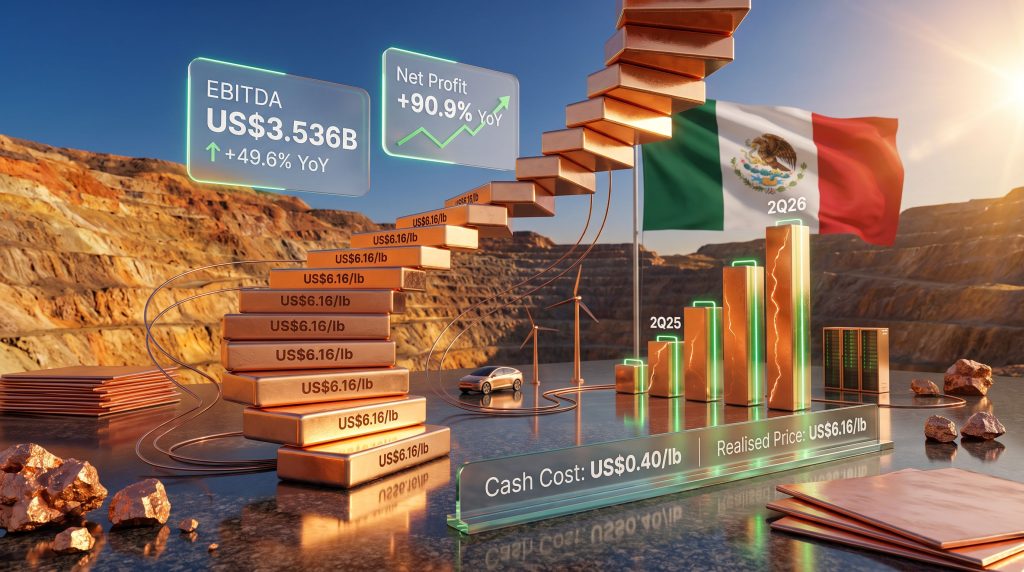
| EBITDA | ~US$2.363B | US$3.536B | +49.6% YoY |
| Cash Cost per Pound (after by-products) | ~US$0.92 | US$0.40 | -56.7% YoY |
| Mining Sales Growth | — | — | +41.3% YoY |
Results submitted to the Mexican Stock Exchange (BMV) confirmed that EBITDA reached US$3.536 billion, representing an incremental gain of US$1.173 billion over the prior corresponding period. Analyst consensus had centred around US$1.66 billion in net profit, meaning the actual result of US$2.093 billion represented a substantial beat.
The critical insight here is not simply that revenue grew by 35%. It is that a 35% revenue increase produced a 90.9% profit increase. This non-linear relationship between top-line growth and bottom-line expansion is the hallmark of extreme operating leverage, and it is entirely explained by the simultaneous movement of copper prices higher and unit costs lower.
The Cash Cost Collapse: What US$0.40 Per Pound Actually Means
The reduction in cash cost per pound from approximately US$0.92 to just US$0.40 is arguably the most significant operational development in Grupo México's 2Q26 results. According to Reuters reporting on the quarterly results, several factors drove this compression:
- By-product revenue credits from silver, zinc, and molybdenum production meaningfully offset the direct cost of extracting each pound of copper
- Operational efficiency improvements across Southern Copper's assets in Mexico and Peru reduced per-unit overhead
- High-throughput operations at scale compress fixed costs on a per-pound basis, particularly when production volumes remain elevated
- Energy cost optimisation at key processing facilities contributed additional unit cost savings
A cash cost of US$0.40 per pound against a realised copper price near US$6.16 per pound implies a gross margin per pound exceeding US$5.70. At meaningful production volumes, this margin differential explains how a company can nearly double its net profit on a 35% revenue increase.
This cost position places Grupo México well within the first quartile of global copper producers by cash cost, meaning it remains profitable even in scenarios where copper prices retrace significantly from current levels.
Grupo México's Position in the Global Copper Hierarchy
Scale, Market Dominance, and Strategic Reach
Context matters when evaluating these results. Grupo México is not a mid-tier miner benefiting incidentally from a commodity cycle. It is the world's fifth-largest copper producer by output volume, and its dominance within Mexico is even more pronounced.
| Global Rank | Producer | Primary Operating Regions |
|---|---|---|
| #1 | Codelco | Chile |
| #2 | Freeport-McMoRan | USA, Indonesia, Peru |
| #3 | Glencore | Globally diversified |
| #4 | BHP | Australia, Chile |
| #5 | Grupo México / Southern Copper | Mexico, Peru |
According to figures from CAMIMEX (Mexico's Mining Chamber), Grupo México accounts for approximately 78% of Mexico's total copper production. Its primary mining subsidiary, Southern Copper Corporation, operates across two of Latin America's most geologically prospective copper jurisdictions, providing geographic diversification and exposure to two distinct regulatory environments.
The company's by-product portfolio is also a frequently underappreciated competitive advantage. Silver, zinc, and molybdenum revenues reduce the effective cost of copper production and provide partial natural hedging when copper prices experience short-term weakness — as occurred during the mid-July 2026 volatility episode triggered by Middle East escalation and the Chilean storm.
Mexico's Emerging Role as a Global Copper Supply Node
The Investment Pipeline Reshaping Mexico's Mining Landscape
The broader significance of Grupo México's 2Q26 results extends well beyond one company's quarterly earnings. They reflect Mexico's accelerating integration into the global copper supply chain at a moment when new mine development is critically needed. In addition, the worsening copper supply crunch underscores precisely why these investment commitments carry such strategic weight.
At least eight copper and polymetallic projects are currently advancing across Mexico, representing a combined investment value of US$5.161 billion. The majority of these projects are targeting production commencement around 2029, contingent on permitting timelines and the outcome of the federal government's mining concession recovery process, which was initiated in February 2026.
Within this ecosystem, Southern Copper is actively negotiating with the Mexican federal administration to advance a US$10.2 billion investment portfolio that includes two flagship projects:
- El Arco project in Baja California, one of the largest undeveloped copper deposits in the Americas
- El Pilar project in Sonora, a state whose mining exports jumped 33.8% to US$988.7 million in Q1 2026 alone
Mexico's nearshoring-driven industrial expansion is providing an additional layer of copper demand that reinforces the domestic supply investment case. As manufacturing capacity relocates to Mexico's industrial corridors, electricity infrastructure, communications networks, and factory fit-outs all generate copper consumption that compounds the broader global demand narrative.
The Permitting Bottleneck: Mining's Critical Path Problem
The three-year timeline between current project commitments and projected 2029 production start-ups reveals an important structural dynamic that investors frequently underweight. Mexico's copper expansion is not primarily constrained by capital or geology — it is constrained by permitting velocity.
The federal concession recovery process launched in early 2026 introduces both opportunity and uncertainty. Companies with existing operational assets and established community relationships hold a structural advantage during this window, since greenfield developers face a more complex regulatory navigation process.
This permitting gap also means that for the next several years, existing producers with operating assets are disproportionately positioned to capture the benefits of elevated copper prices. The supply response that would normally moderate prices is delayed by regulatory process, effectively extending the profitable pricing window for incumbents like Grupo México.
Beyond Mining: The Strategic Diversification Underway
The Saavi Energía Acquisition and Mexico's Energy Transition
In April 2026, Grupo México announced the acquisition of Saavi Energía, a Mexican power generation company. The strategic logic of this transaction is worth examining carefully, because it reveals how the company is deploying copper-driven cash flows to build positions in adjacent infrastructure markets.
The primary demand driver cited for the acquisition is surging electricity consumption from data centres and AI infrastructure in Mexico's industrial corridors. This creates a notable strategic circularity: copper demand from AI data centres generates the profits that fund an acquisition in the power generation sector that serves those same data centres.
The move signals a broader strategic evolution from pure-play mining conglomerate toward an integrated industrial and energy platform. For investors, this diversification trajectory has implications for how the company should be valued — increasingly less like a single-commodity miner and more like a diversified infrastructure holding.
Transportation and Infrastructure: Divisional Performance
The non-mining segments delivered a mixed but informative picture in Q2 2026.
| Business Division | Q2 2026 Revenue | Year-on-Year Change |
|---|---|---|
| Mining (Southern Copper) | Dominant share of US$5.717B total | +41.3% (sales) |
| Transportation (Ferromex / Ferrosur) | US$975M | +14.3% |
| Infrastructure | US$120M | -28.3% |
The Transportation division, comprising railroads Ferromex and Ferrosur, generated US$975 million in Q2 2026, up 14.3% year-on-year. This growth reflects the broader freight volume increases associated with Mexico's nearshoring-driven manufacturing expansion, and positions Ferromex as a structural beneficiary of industrial relocation trends.
The Infrastructure division was the quarter's single underperforming segment, posting net sales of US$120 million — a 28.3% decline from the prior year period. This segment-level weakness was more than offset by mining and transportation strength, but it serves as a reminder that not all divisions of a diversified conglomerate move in the same direction simultaneously.
The next major ASX story will hit our subscribers first
Risk Factors That Could Compress Copper Margins
Price Volatility, Geopolitics, and Demand-Side Uncertainty
The current operating environment, while highly favourable for Grupo México, carries meaningful risks that investors tracking the company should monitor carefully.
Geopolitical and weather-driven volatility remain ever-present. The mid-July 2026 episode — in which simultaneous Middle East escalation and a major Chilean storm triggered sharp intraday copper price swings — demonstrated that even structurally tight markets are vulnerable to short-term dislocations. Grupo México's diversified by-product mix provides a partial natural hedge in these scenarios, but cannot fully insulate earnings from copper-specific price weakness.
Macro and demand-side risks include:
- A US economic slowdown that reduces industrial copper consumption
- Chinese demand variability, given that China accounts for approximately 50 to 55% of global refined copper consumption and remains the single largest swing factor in the global market
- Tariff policy uncertainty affecting Asarco, Grupo México's US subsidiary, which could influence cross-border cost structures and investment planning
Operational and regulatory risks include:
- Permitting delays in Mexico's concession recovery process, which could slow the US$10.2 billion Southern Copper investment programme
- Water availability constraints in the arid mining regions of Sonora and Baja California, where large-scale copper processing requires significant freshwater or desalination infrastructure
- Labour relations and community engagement challenges in Peru, which represent perennial risk factors for Southern Copper's South American operations
The Consecutive Quarter Trend: Building Earnings Momentum
How Q2 2026 Fits Into a Broader Pattern of Outperformance
The 2Q26 result did not emerge in isolation. It represents the continuation of a pattern of consecutive analyst forecast beats that stretches back through 2025. Consequently, those evaluating copper investment strategies are increasingly focused on how this earnings momentum might inform portfolio positioning through the remainder of the decade.
| Quarter | Net Profit | Revenue Growth | Key Driver |
|---|---|---|---|
| Q4 2025 | ~US$1.43B | +34% YoY | Copper +22%, silver and gold gains |
| Q2 2026 | US$2.093B | +34.9% YoY | Copper +30.5%, cash cost -56.7% |
In Q4 2025, Grupo México reported net earnings of approximately US$1.43 billion, driven by a 22% rise in copper prices alongside meaningful gains in silver and gold. Revenue grew approximately 34% year-on-year, establishing the earnings momentum that carried into 2026.
The 2Q26 acceleration is notable because the revenue growth rate remained similar (approximately 35%) while the profit growth rate nearly tripled. This divergence between top-line and bottom-line growth rates is the defining characteristic of an operating leverage inflection — and at Grupo México's production scale, that inflection is generating billions of dollars in incremental earnings.
Each incremental improvement in copper price realisation, applied across Grupo México's production volumes at a cash cost base of just US$0.40 per pound, flows through to net profit at a conversion rate that most industrial companies cannot approach. This is the mathematical core of why Grupo México profit jumps on copper strength is so consequential for the company's valuation.
Frequently Asked Questions: Grupo México and the Copper Market
Why did Grupo México's profit nearly double in Q2 2026?
Net profit surged 90.9% year-on-year because copper prices increased 30.5% to US$6.16 per pound while cash production costs simultaneously fell 56.7% to just US$0.40 per pound after by-product credits. This dual movement of higher realised prices and lower unit costs created extreme margin expansion across the mining division, producing non-linear profit growth relative to revenue growth.
What is a cash cost per pound, and why does it matter?
Cash cost per pound is the industry-standard metric for measuring how much it costs to produce one pound of copper, after deducting revenues received from by-products such as silver, zinc, and molybdenum. A lower cash cost per pound means a producer remains profitable at lower copper prices, and earns disproportionately more when prices are elevated. Grupo México's Q2 2026 cash cost of US$0.40 per pound is among the lowest of any major copper producer globally.
What is Southern Copper's investment plan in Mexico?
Southern Copper, the listed mining subsidiary of Grupo México, is negotiating with the Mexican federal government to advance a US$10.2 billion investment portfolio. This includes the El Arco project in Baja California and the El Pilar project in Sonora, two of the largest undeveloped copper assets in the Americas. Thoughtful copper capital allocation decisions of this scale will be critical to Mexico's long-term supply contribution.
Why did Grupo México acquire Saavi Energía?
The acquisition reflects a strategic diversification move, leveraging strong copper-driven cash flows to enter Mexico's power generation sector. The primary rationale centres on surging electricity demand from data centres and AI infrastructure in Mexico's industrial corridors, particularly in the Querétaro region.
What risks could affect Grupo México's earnings going forward?
Key risks include copper price volatility triggered by geopolitical disruptions or macroeconomic slowdowns, Chinese demand uncertainty given China's approximately 50 to 55% share of global refined copper consumption, Mexican permitting delays affecting new project development, water and environmental constraints in arid operating regions, and labour relations considerations in Peru.
Key Takeaways for Investors and Industry Observers
The story of Grupo México profit jumps on copper strength is ultimately a story about what happens when structural commodity demand meets exceptional operational efficiency. Several conclusions stand out:
- Operating leverage at this scale is rare: A 35% revenue increase producing a 90.9% profit jump confirms that Grupo México's cost structure is positioned to amplify price gains far beyond what most commodity producers can achieve
- The deficit cycle has multi-decade foundations: EVs, AI infrastructure, and decarbonization are not short-term demand events. The structural underpinning of elevated copper prices is measured in decades, not quarters
- Mexico is becoming a more critical copper supply node: The US$5.161 billion project pipeline and Southern Copper's US$10.2 billion investment programme position Mexico to materially expand its share of global copper production by the end of this decade
- Diversification is reshaping the investment thesis: The Saavi Energía acquisition moves Grupo México toward an integrated industrial and energy platform, which has long-term implications for how the company is valued relative to pure-play mining peers
- By-product diversification provides structural downside protection: Silver, zinc, and molybdenum revenues cushion earnings during copper-specific volatility episodes, as demonstrated during the mid-July volatility episode and the mid-2026 price disruptions
Disclaimer: This article contains forward-looking statements and financial analysis based on publicly reported figures. Past performance of commodity prices and corporate earnings is not indicative of future results. Investors should conduct their own due diligence before making any investment decisions. Commodity markets carry significant risks including price volatility, geopolitical uncertainty, and regulatory change.
Want to Capitalise on the Next Major Copper Discovery Before the Market Does?
Discovery Alert's proprietary Discovery IQ model scans ASX announcements in real time, instantly identifying significant mineral discoveries — including copper — and converting complex geological data into clear, actionable investment insights for both short-term traders and long-term investors. Explore how historic discoveries have generated extraordinary returns on Discovery Alert's dedicated discoveries page, and begin your 14-day free trial today to position yourself ahead of the broader market.